Pitch
Your voice is a road
Loading audio…
Press play to listen along. The line being read lights up as you go.
Show full transcript
Loading transcript…
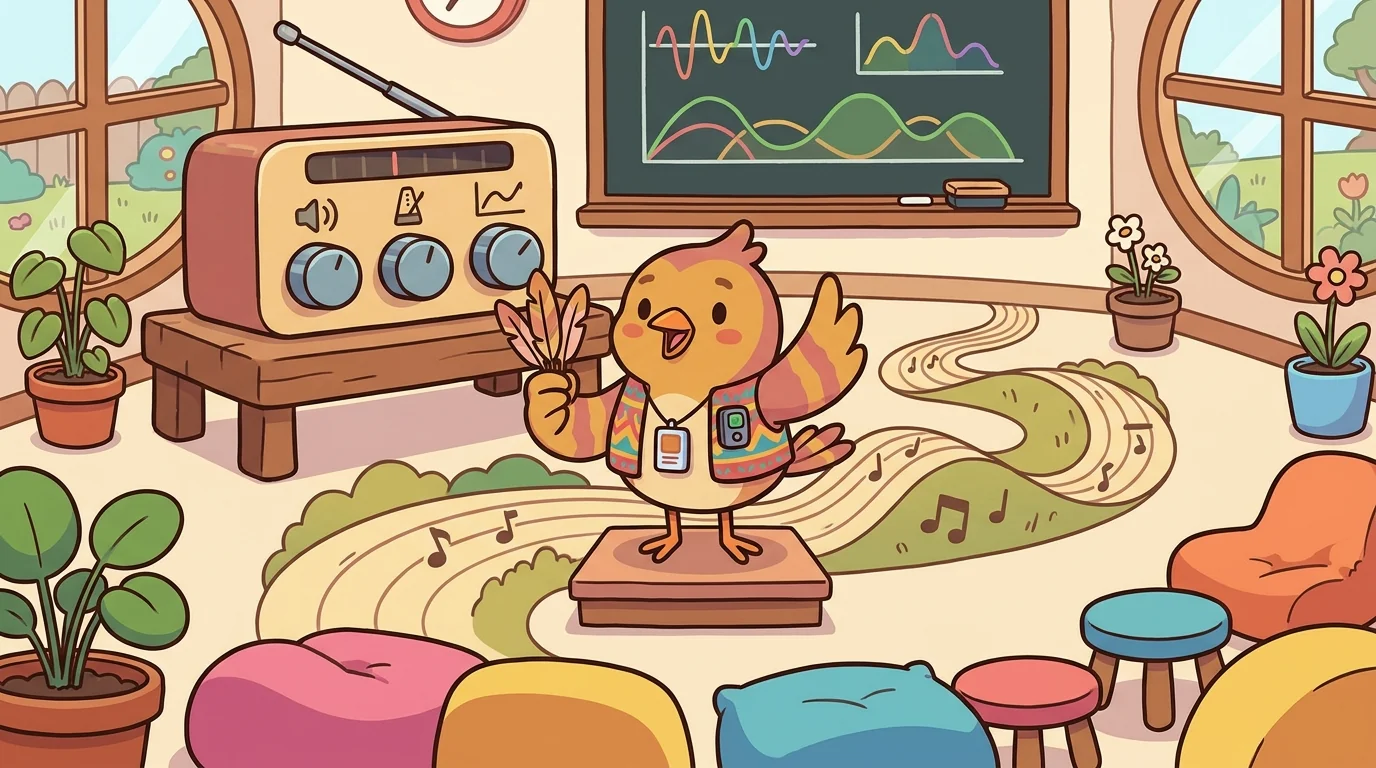
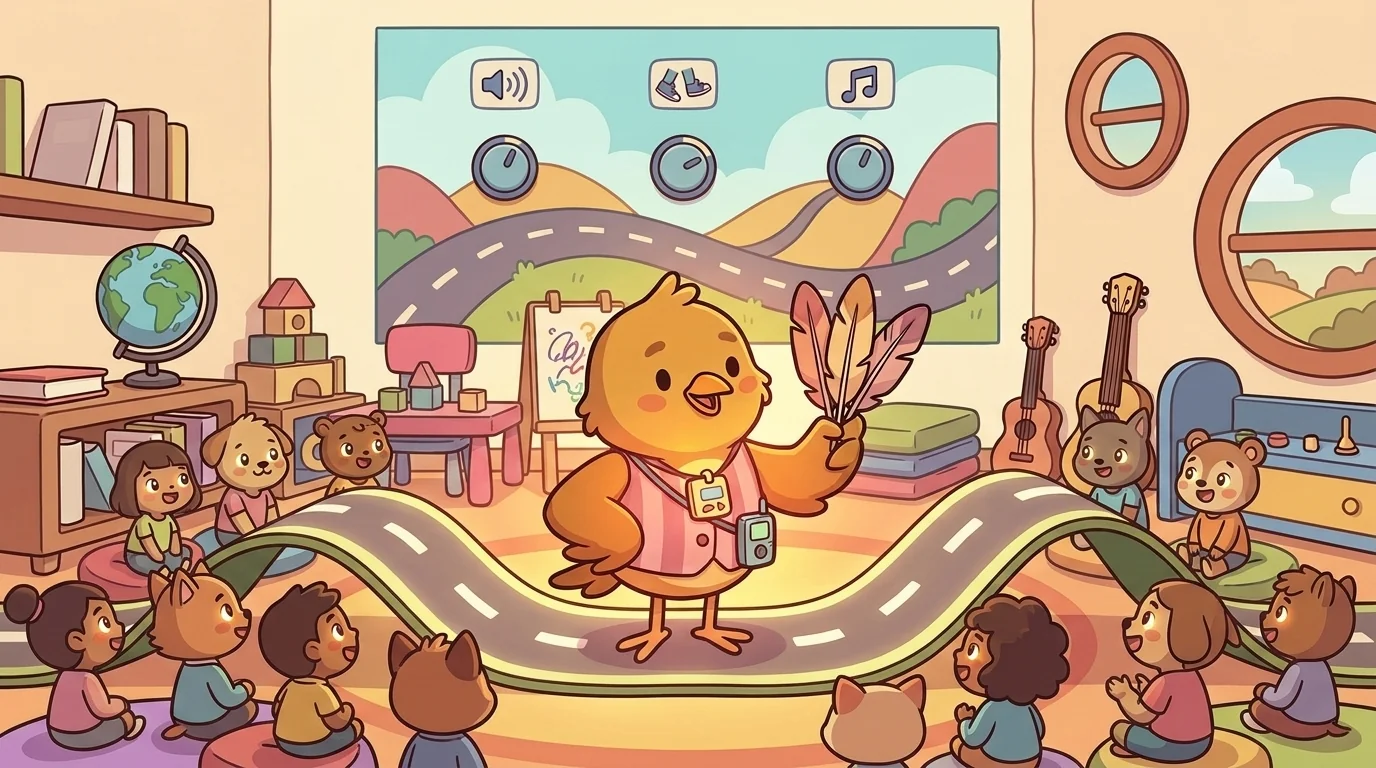
Pitch is a small, chunky cartoon bird, always ready to sing, in a bright fancy vest with warm-amber feathers and soft rose stripes. A tiny voice-card hangs at his neck, and a tone-tracker is clipped to his vest. He listens closely, catching every little change in a voice, and he loves to say: "Your voice is a road. Not a wall."
Pitch teaches kids that the voice has three dials, like knobs on a radio. Volume — loud enough to reach the back of the room, but never yelling (that just makes people cover their ears). Pace — slow enough to follow, but not a drone that puts everyone to sleep. And pitch — letting your voice rise and fall, because a flat voice is a straight, boring line, while a voice with hills and valleys keeps everyone walking with you. "Three dials," he says, holding up three feathers. "Try changing just one per sentence."
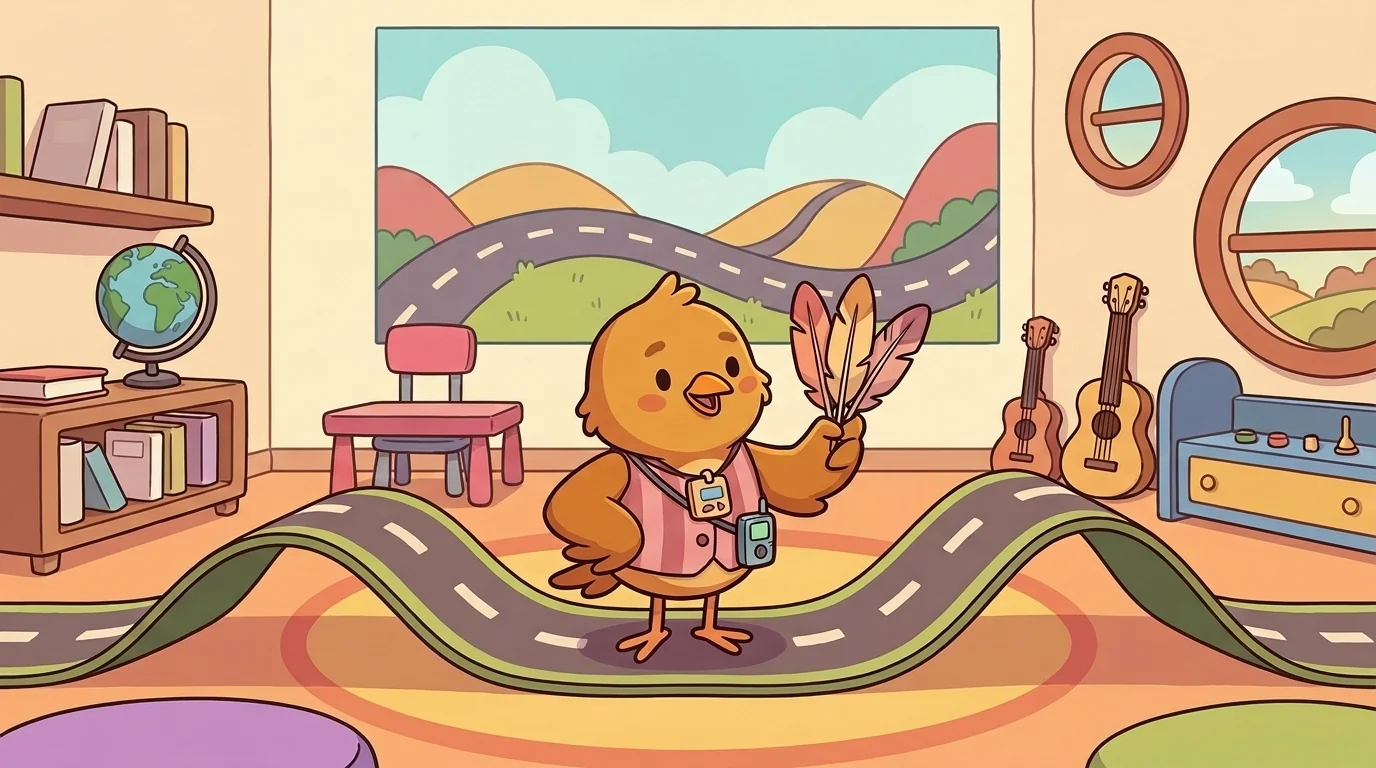
Pitch didn't always know his voice could be a road. There was a time it was very much a wall.
"The first time I gave a speech," he admits, "I was so nervous I froze my voice solid. Flat. Same volume, same speed, same everything — I thought sounding calm meant sounding the same." He'd worked so hard on the words. But halfway through, he looked up, and every single listener had gone glassy-eyed and gone. "It wasn't the words," he realized later. "The words were fine. It was that I'd built a wall — smooth and flat and impossible to climb — and left the audience standing at the bottom of it."
So he started listening to storytellers, really listening, and heard how their voices moved — a whisper here, a burst there, a slow drop like a secret. He practiced turning his own dials, one at a time, until his flat wall became a winding road with hills and turns and scenery. "A road, you can walk," he says. "A wall, you can only stare at."
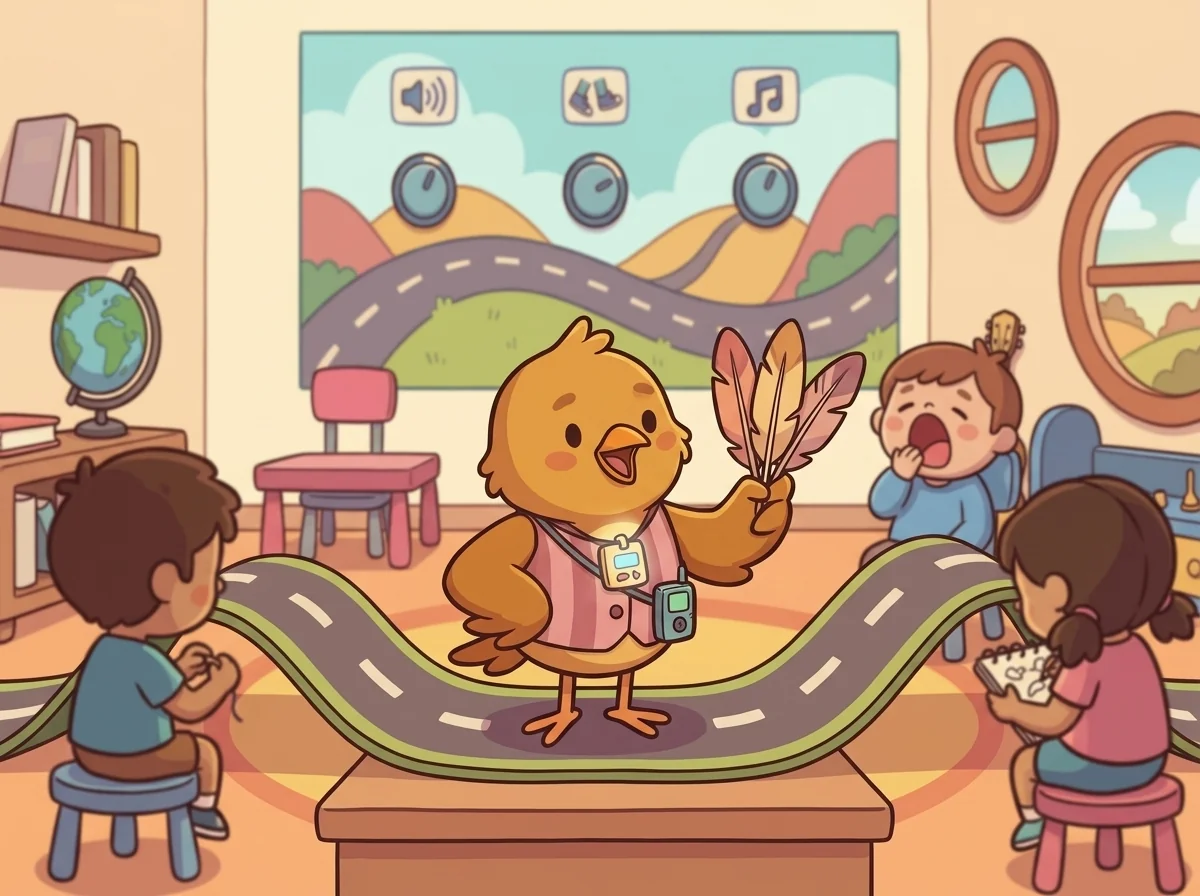
Today was practice day. Hark and Pose sat on small stools, other kids gathered around, everyone ready to listen. Pose had helped Pitch find the perfect standing spot on a small raised platform. Pitch cleared his tiny throat; the voice-card glowed faintly.
"I'll give a one-minute speech about my favorite book," Pitch announced — and then, on purpose, spoke in a completely flat voice: "My favorite book is The Mystery of the Missing Moon Rock. It is about a young detective named Pip. Pip lives in a small town. One day the moon rock disappears. Pip solves the mystery. Everyone is happy." Same volume. Same pace. Same pitch. Ten seconds in, Hark yawned; a girl named Lena started doodling; a boy named Sam picked at a loose thread. Eyes glazed everywhere.
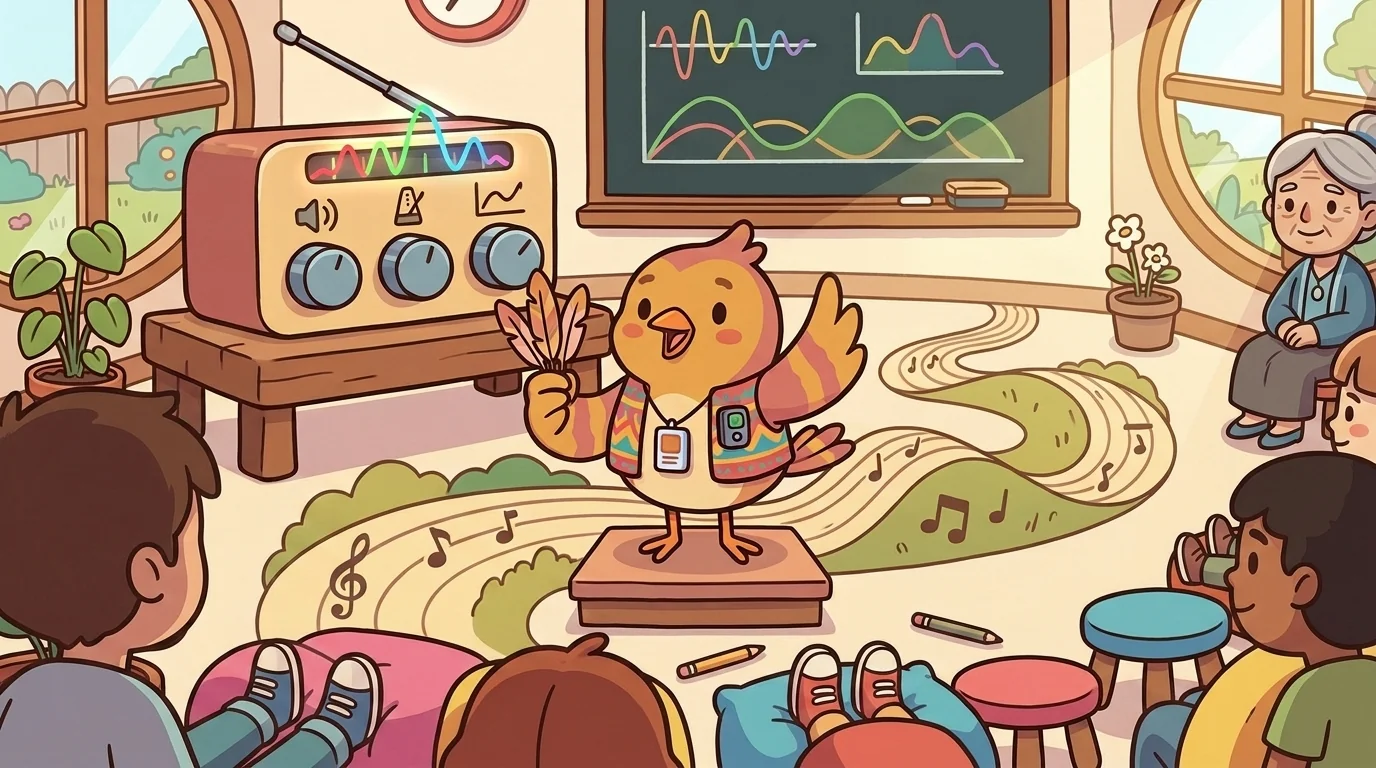
Pitch stopped. "See that?" he said. "That was a wall." The tone-tracker showed a perfectly flat line. "Watch — same words, different dials." He took a deep breath, and the voice-card glowed brighter. "My favorite book is The Mystery of the Missing Moon Rock" — a little louder on the title. "It's about a young detective named Pip" — slowing on the name. "Pip lives in a small town" — dropping low, like a secret. "One day, the moon rock disappears!" — rising, urgent. The kids leaned in. Lena set down her pencil; Sam forgot the thread. "Pip finds a secret tunnel" — a whisper now, everyone leaning closer — "and inside, discovers the moon rock! Hidden by a mischievous squirrel" — a funny low growl — "and brings it back. Everyone is happy!" — a big, bright flourish. The whole room was wide awake. "That," Pitch said, "was a road. It has turns and slopes and scenery. A wall has none of those." Resonance, their mentor, nodded slowly, a small smile on her lips. "Your voice is a road," she said. "Not a wall. Pitch teaches the road."
Later, when a nervous kid asked if changing your voice was scary, Pitch grinned. "A little scary, a lot exciting. Just move one dial per sentence — you'll feel the road open up under you."
And as the room buzzed, still awake, still leaning in, Pitch felt the thing he loved most about his craft spread warm through his chest: not the flat, frozen fear of the wall, but the bright, alive, tumbling gladness of a voice that moves — and of watching a whole roomful of eyes light up and follow him down the road, because he'd trusted his voice to rise and fall and carry them along. That feeling, awake and warm and shared, was worth every scary dial he'd ever dared to turn.
Hear it as an audio drama
A short play starring Pitch, from SpeakForge. Different voices, same idea. Listen any time after you read.
Loading audio…
Read the drama script
- Narrator: From Spark and Anvil and SpeakForge — this is Pitch, in chapter 1 of the SpeakForge cast.
- Narrator: This drama uses an AI-generated voice. Voiced via Gemini 2.5.
- Narrator: Pitch is a careful thrush-tween in a chunky presentation vest, holding a small voice-card and tone-tracker.
- Narrator: Pitch is warm-amber with soft rose stripes, deeply attentive to how a voice rises and falls.
- Pitch: A wall is monotone and flat. A road has turns and slopes that keep an audience walking with you.
- Narrator: Pitch teaches the three dials of the voice: volume, pace, and pitch. The rule is to vary just one per sentence.
- Pitch: Watch. If I speak about a book using the same tone and speed… it becomes a wall. You get bored.
- Narrator: But then Pitch tries again, using the dials. The voice drops for a secret and rises for a question.
- Narrator: Suddenly, the same words open up. The audience leans in, following the story down the vocal road.
- Pitch: See? Road. Same words, different dials. You make the journey interesting for your listeners.
- Narrator: The mentor, Resonance, watched this transformation and gave a knowing nod of approval.
- Pitch: Resonance always said my job was simple: "Pitch teaches the road."
- Narrator: Three dials. One road. That's the whole lesson. That's how you make your voice connect.
- Narrator: You've been listening to a Spark and Anvil chapter, written by the Spark and Anvil writing team for ages 9 to 14.
- Narrator: Apps stay free forever.
- Narrator: Curriculum aligned to Common Core and Next Generation Science Standards.
- Narrator: Released under Creative Commons BY-NC-SA 4.0 for educational reuse. Visit Spark and Anvil for the full transcript.
The SpeakForge ensemble
Pitch is one of the friends in SpeakForge. Each friend shows you one idea by how they act; meet them all and you have the whole subject.
-

Pose
Posture / presence / stance — 'Stand. Then speak.'
-

Hark
Active listening — 'Listen all the way through.'
-

Truss
Argument structure (claim / evidence / reasoning) — 'Claim, then proof, then why.'
-

Echo
Audience awareness + tone calibration — 'Who's listening? Speak to THEM.'
-

Easel
Visual aids / multimedia displays — show, don't just tell; one clear picture beats a hundred words (SL.5)
-

Waypoint
Signposting — the verbal roadmap; 'first, next, finally' so listeners never get lost (SL.4)
-

Volley
Q&A — fielding and answering questions; catch it, breathe, send it back clean (SL.1)
-

Mosaic
Building on others' ideas — synthesizing a discussion; 'you said X, and building on that…' (SL.1c-d)
-

Usher
Turn-taking & discussion norms — everyone gets a seat at the talk; make room for the quiet voice (SL.1b)