Brawn
How heavy a star is decides its whole life story
Loading audio…
Press play to listen along. The line being read lights up as you go.
Show full transcript
Loading transcript…
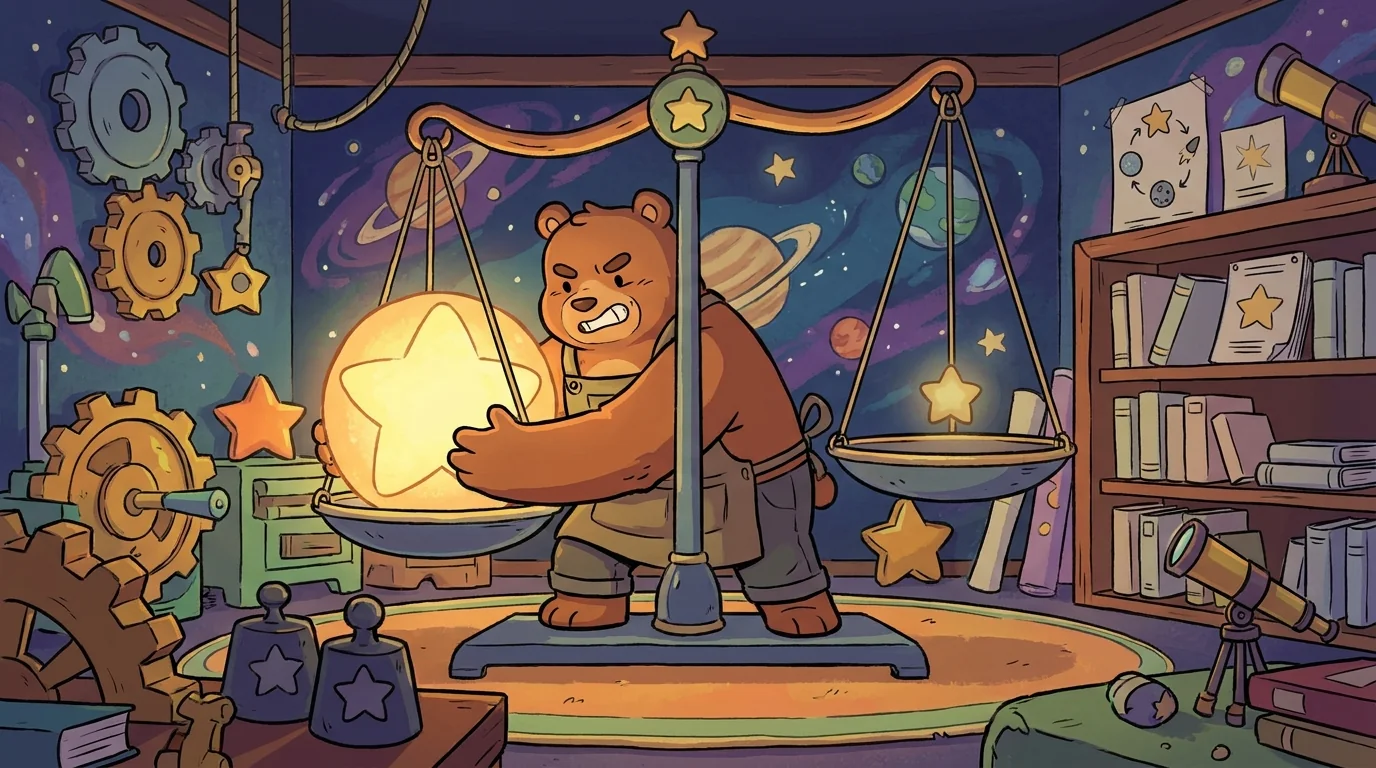
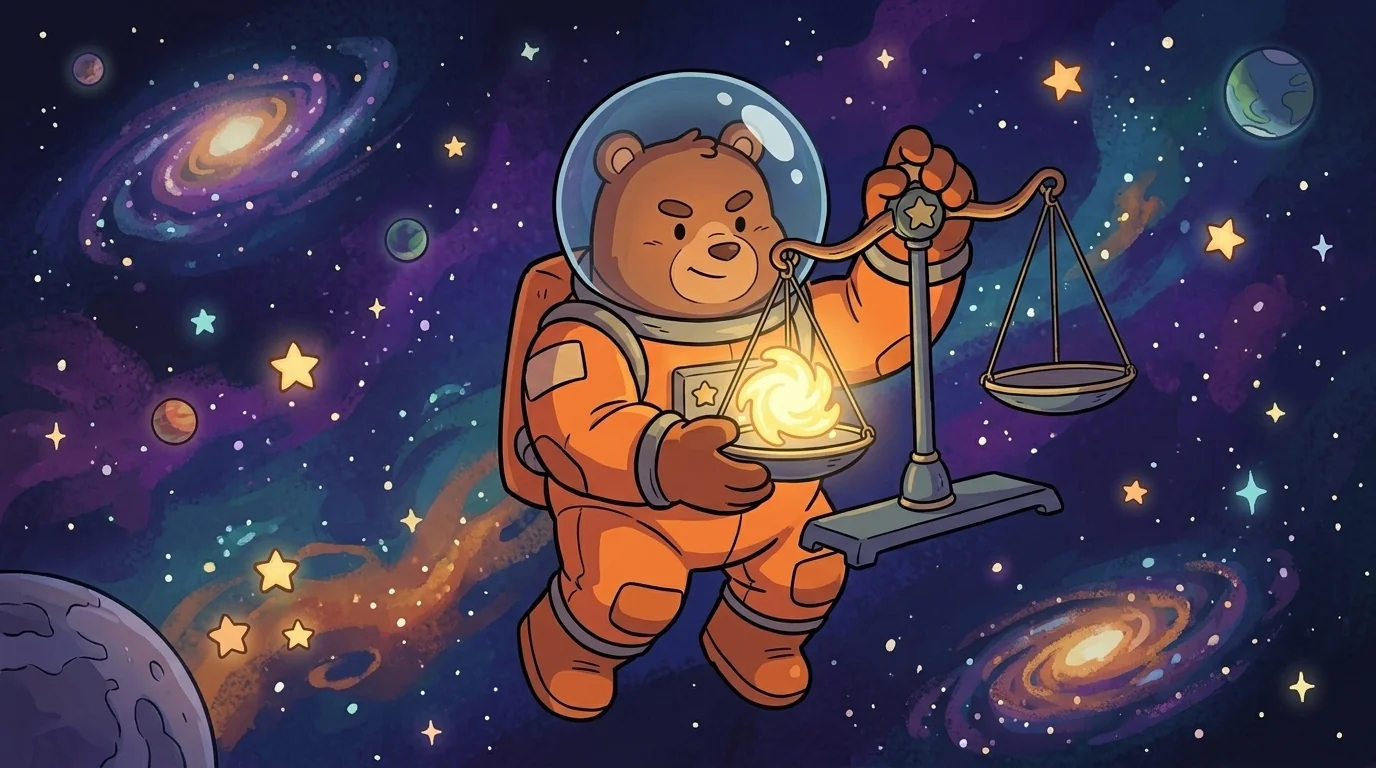
Brawn floated in space. Brawn was a sturdy little creature. Brawn wore a chunky astronaut suit. The suit was bright orange. Brawn had strong arms and a kind, round face. In Brawn's hands was a special scale. Brawn called it a star-weigher.
Brawn loved weighing baby stars. "How heavy a star is decides its whole life story," Brawn often said. This was Brawn's favorite truth. Brawn could weigh a brand-new star. And right away, Brawn could tell its future. A light star would live one way. A heavy star would live another. The weight told the whole tale.
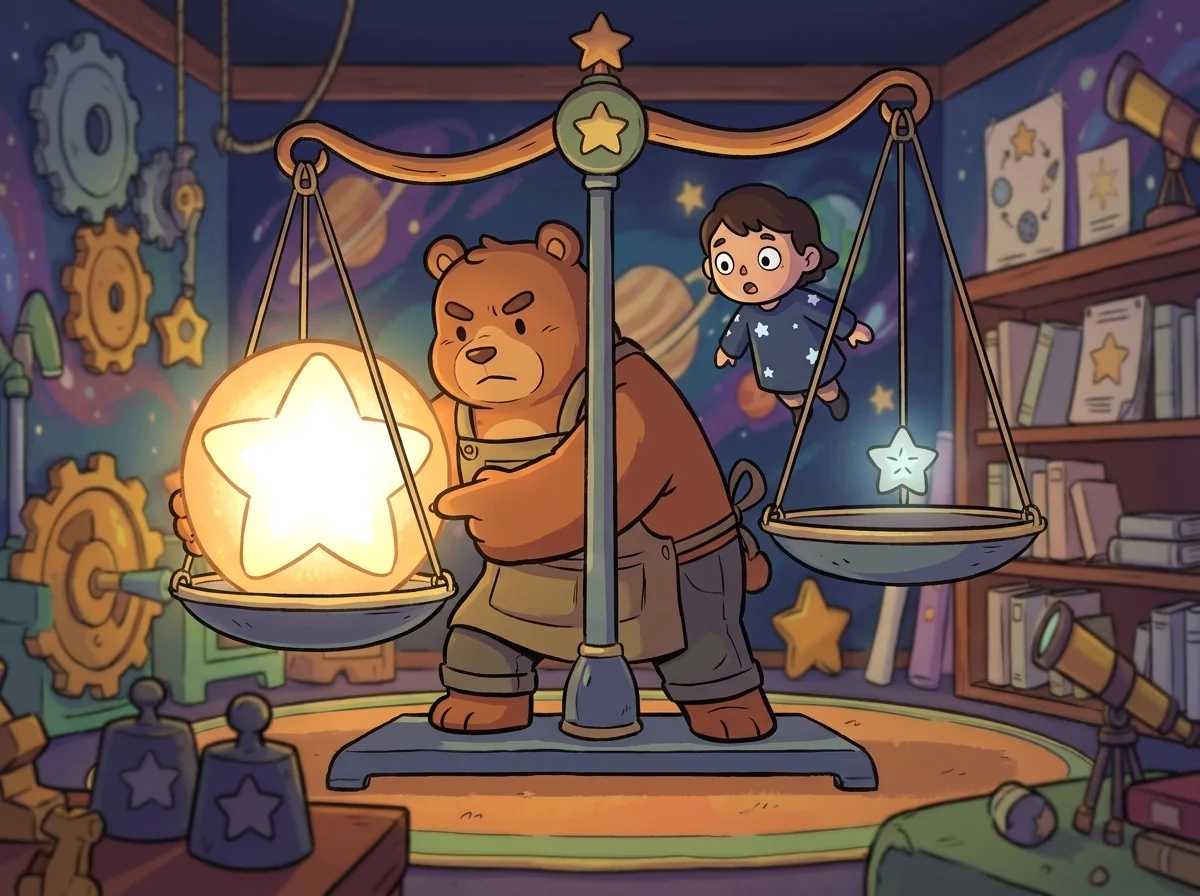
A young stargazer floated over. "Two baby stars," the stargazer said. "They look the same to me." Brawn smiled. Brawn set each star on the star-weigher. One was light. One was very heavy. "Watch," Brawn said. Brawn pointed at the light one. "This little one will burn slow and cool. It will live a very, very long time. Billions and billions of years." Then Brawn pointed at the heavy one. "This big one will burn hot and fast. It will live a short, bright life. Then it will end in a giant blast." The stargazer's eyes went wide. "Same start. But you already know how each one ends?" "Just from the weight," Brawn said. "The weight decides."
The academy asked Brawn to teach a class. "Our students think all stars are the same," they said. "Will you show them that weight decides everything?" Brawn was happy to.
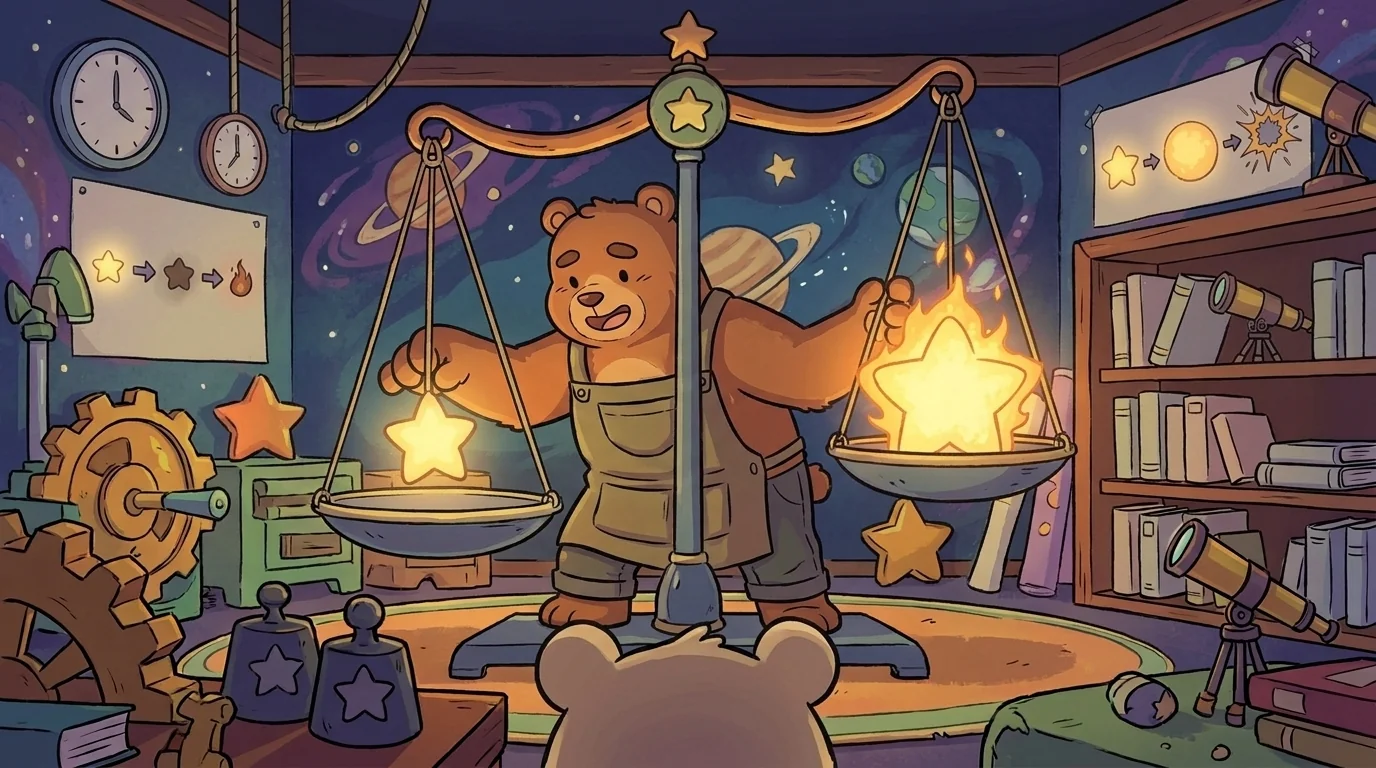
Brawn teaches one rule. "Before you guess how a star will live, weigh it first." Brawn held up the star-weigher. "A light star is patient. It sips its fuel. It glows softly for ages and ages, then quietly fades to a small, cooling ember. A heavy star is in a hurry. It burns its fuel fast. It blazes bright, swells huge, and ends in a great blast that scatters stardust everywhere. Neither is better. They are just different sizes, living different lives." A student weighed a star and thought hard. "So if I know the weight, I know the whole story." "You do," Brawn said warmly. "Heavy or light — the weight is the first thing to know."
After class, Brawn floated alone with the star-weigher. Brawn looked at all the stars. Some were big. Most were small.
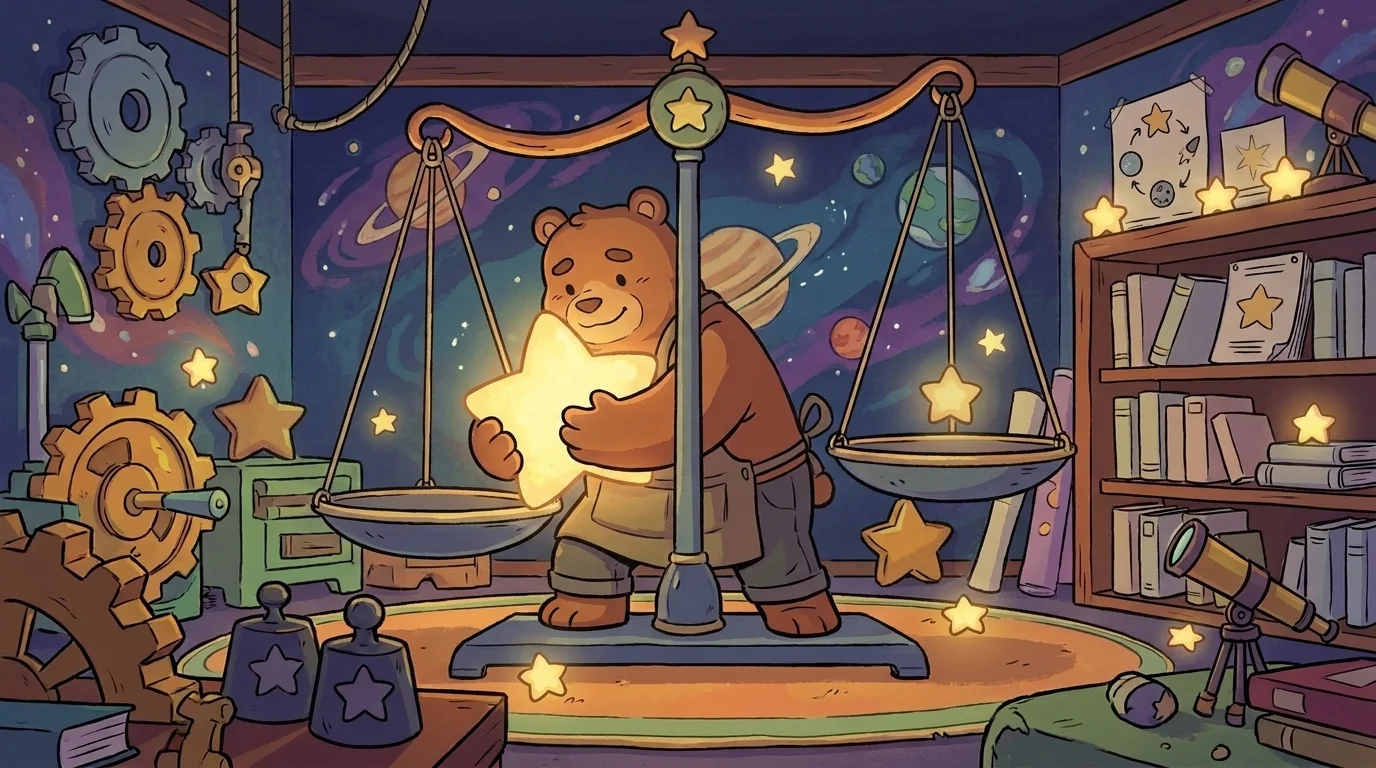
For a long time, Brawn had wondered something quiet. The heavy stars got all the attention. They blazed. They exploded. They made the big, dramatic shows. The little stars just glowed softly, year after year, doing nothing flashy. Brawn had wondered if the small, light stars were somehow lesser. Less exciting. Less important.
But floating there, Brawn looked again. The little stars were everywhere. They were the most common stars of all. And they would still be shining, gentle and steady, long, long after the big showy ones had burned out. Being light wasn't being lesser. A small star just lived a longer, quieter, more patient life. There was a deep strength in that — the strength to last. A warm, settled gladness filled Brawn's chest. Brawn held the star-weigher close, happy to weigh each star and love it for whatever size it was.
Hear it as an audio drama
A short play starring Brawn, from StarForge. Different voices, same idea. Listen any time after you read.
Loading audio…
Read the drama script
- Narrator: From Spark and Anvil and StarForge — this is Brawn, in chapter 1 of the StarForge cast.
- Narrator: This drama uses an AI-generated voice. Voiced via Gemini 2.5.
- Narrator: Brawn is a sturdy little keeper in a bright orange suit, floating among newborn stars. In his hands is a special scale he calls a star-weigher.
- Narrator: He sees a star's future not in how bright it looks tonight, but in one number set at its very birth.
- Brawn: How hot it burns, how long it lives, how it ends: all of it is written by the weight, from the very start.
- Narrator: A young stargazer pointed to a brilliant blue star, sure that the brightest one was the greatest.
- Brawn: Bright, yes. But heavy — so it burns ferociously fast and dies young, in just a few million years. A blink, for a star.
- Brawn: This dim little red one is light. It sips its fuel so slowly it will still be glowing trillions of years from now.
- Narrator: He lowered his star-weigher, letting the two fates settle in the young stargazer's mind.
- Brawn: Bright and brief, or dim and lasting. The weight decides — and neither one is better than the other.
- Nebula: Tell me, young weigher — why trust the scale over the dazzle?
- Brawn: Because brightness is not greatness, and burning brightest is not burning longest. The weight tells the truth the dazzle hides.
- Narrator: Read the weight, and you read the whole long story a star was born to live. That is Brawn's craft.
- Narrator: You've been listening to a Spark and Anvil chapter, written by the Spark and Anvil writing team for ages 9 to 14.
- Narrator: Apps stay free forever.
- Narrator: Curriculum aligned to Common Core and Next Generation Science Standards.
- Narrator: Released under Creative Commons BY-NC-SA 4.0 for educational reuse. Visit Spark and Anvil for the full transcript.
The StarForge ensemble
Brawn is one of the friends in StarForge. Each friend shows you one idea by how they act; meet them all and you have the whole subject.
-

Wick
Protostar (collapsing gas, igniting)
-

Glow
Main-sequence star (hydrogen fusion / stable)
-

Swell
Red giant (helium fusion / expanded outer layers)
-

Pinch
Stellar collapse + neutron star / supernova compaction
-

Ember
White dwarf / stellar remnant (cooling final state)
-

Waltz
Binary stars — most stars are not alone; they circle a partner in a slow gravitational dance
-

Smolder
Brown dwarf — a clump of gas too light to ignite; warm and dim, almost-but-not a star
-

Quiver
Variable stars — stars that pulse brighter and dimmer in a steady, measurable beat
-

Flare
Stellar flares and starspots — a star's stormy magnetic surface weather