Quiver
Some stars beat like a heart, growing brighter and dimmer in a steady rhythm
Loading audio…
Press play to listen along. The line being read lights up as you go.
Show full transcript
Loading transcript…
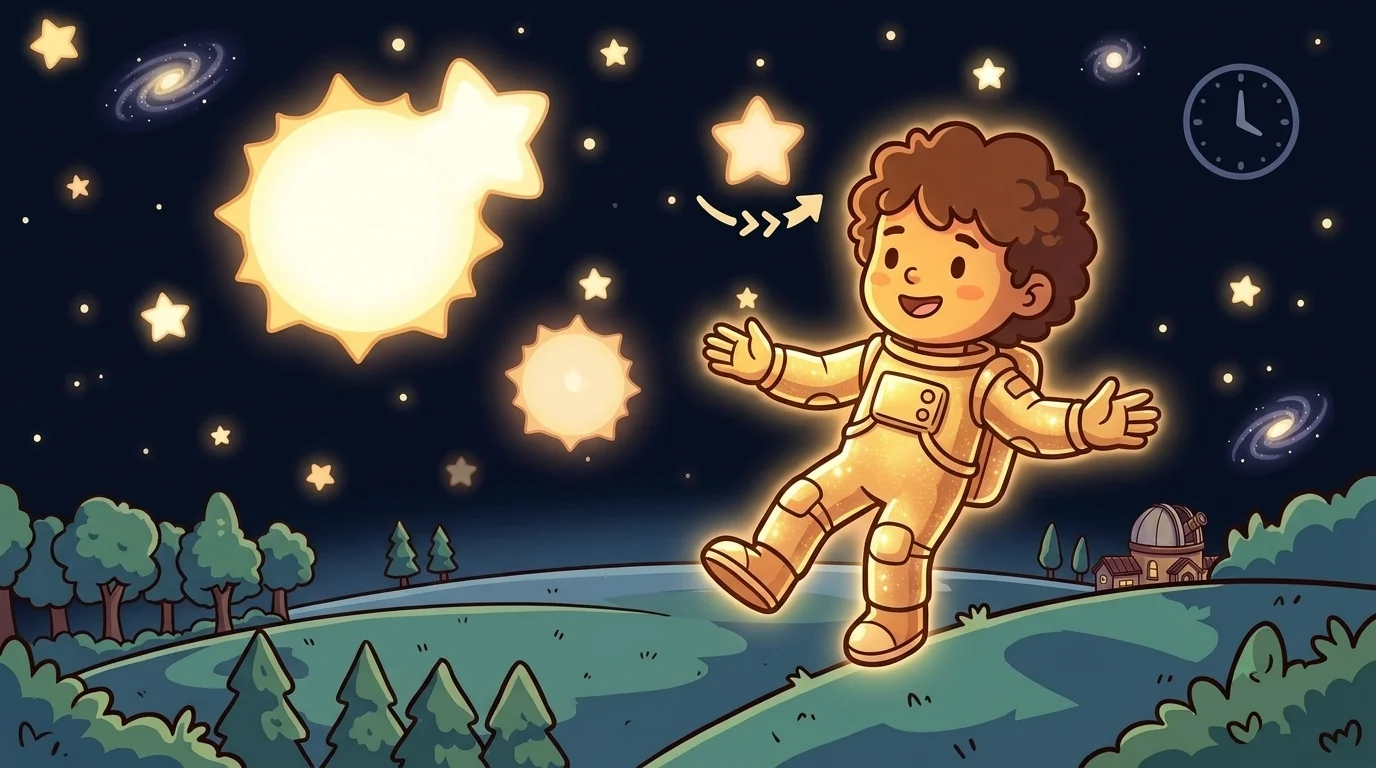
Quiver floated in space. Quiver was a bright little creature. Quiver wore a shimmery astronaut suit. The suit was warm gold. And Quiver's glow did something special. It pulsed. Bright, then dim. Bright, then dim. Like a tiny, glowing heartbeat.
Quiver taught about stars that pulse. "Some stars beat like a heart," Quiver said. Most stars shine steady. But some stars swell and shrink. They puff up bigger, then squeeze back down. And as they do, they grow brighter, then dimmer. Over and over. On a steady beat. "They are called variable stars," Quiver said. "And their beat is so steady, you could set a clock by it."

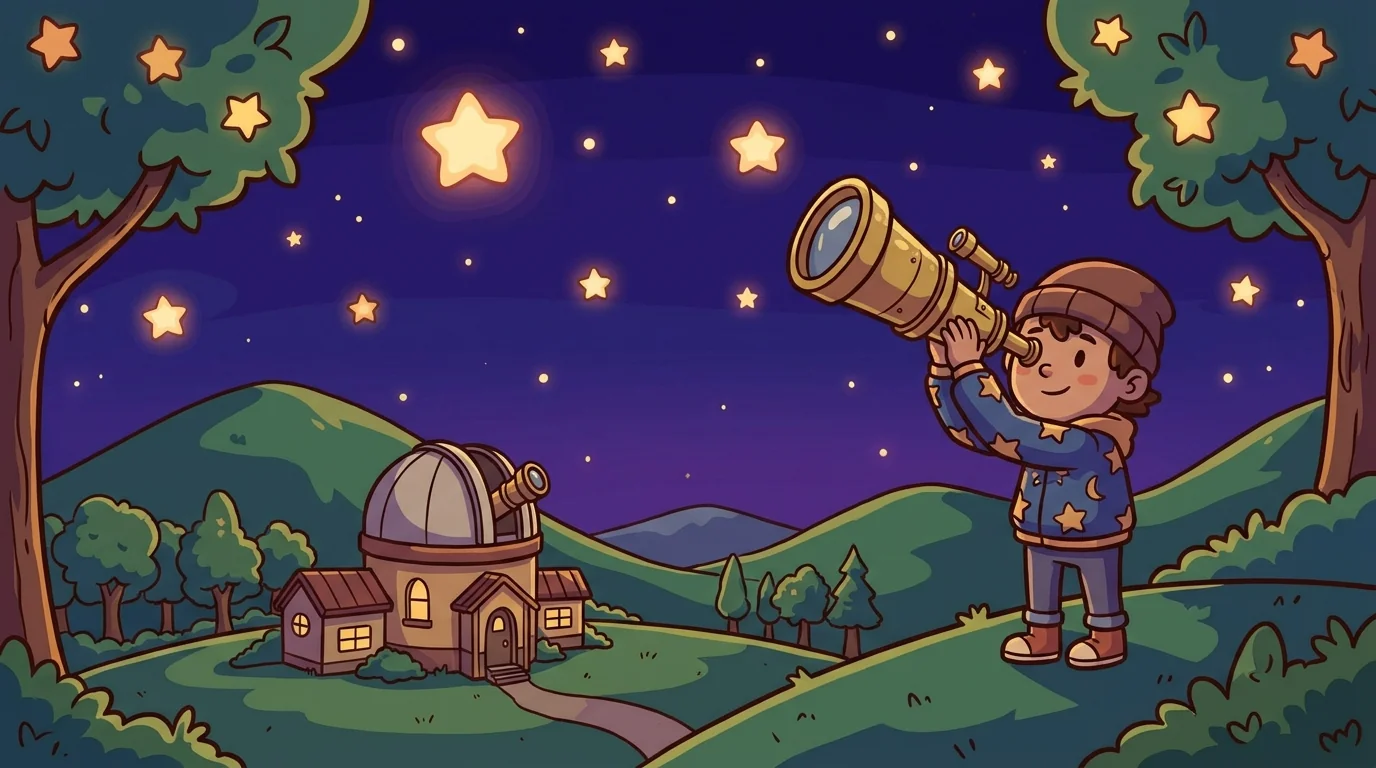
A young stargazer watched Quiver's pulsing glow. "It keeps getting brighter and dimmer." "That is the beat," Quiver said. Quiver pressed a hand to its glowing middle, feeling the pulse. "The star puffs up. It gets bigger and brighter. Then it squeezes back down. It gets smaller and dimmer. Then it puffs up again. Bright, dim, bright, dim. Always the same rhythm." The stargazer counted along. "It's like a heartbeat." "Exactly like a heartbeat," Quiver said, glowing. "Slow ones beat slow. Fast ones beat fast. But each one keeps its own steady time."
The academy asked Quiver to teach a class. "Our students think all stars shine the same way," they said. "Will you teach them the ones that pulse?" Quiver beamed. "Yes!"
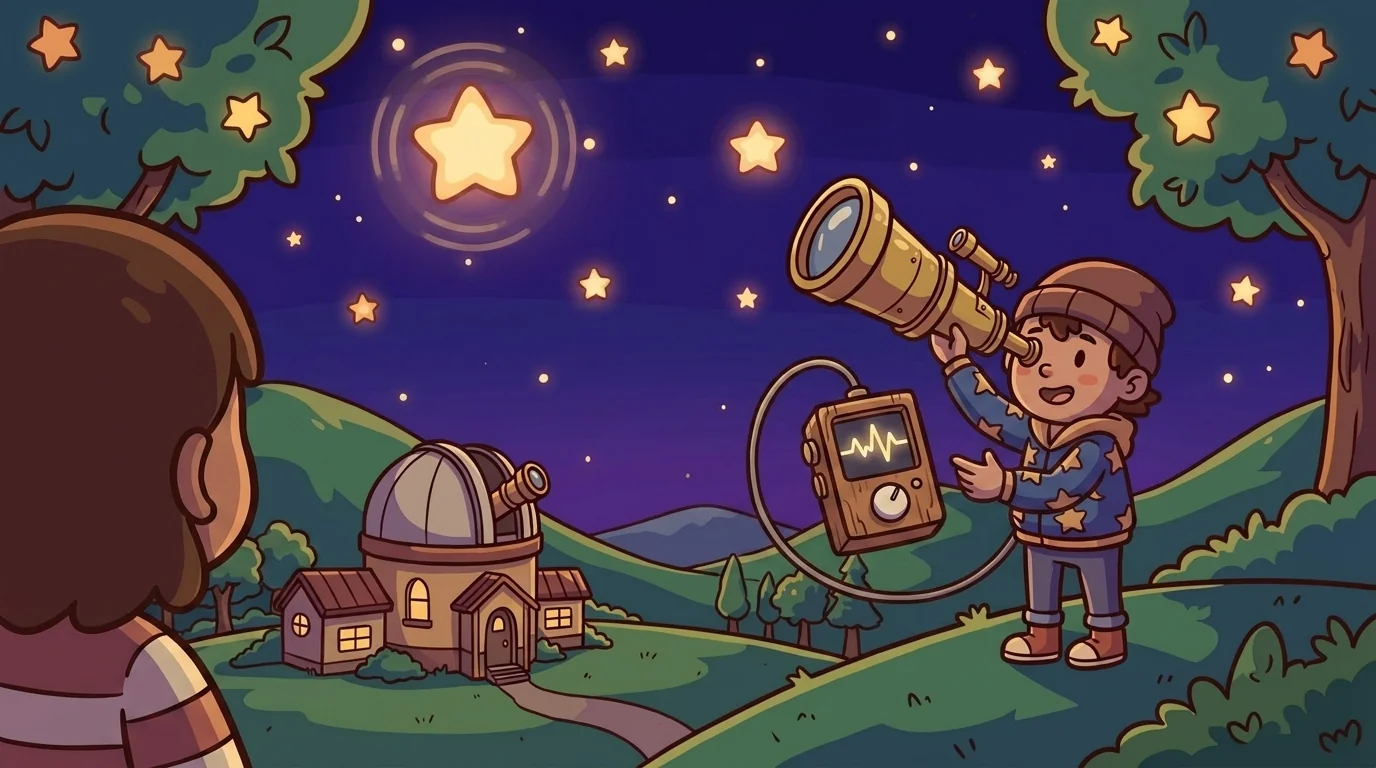
Quiver teaches one rule. "Watch the rhythm, not just the brightness." Quiver pulsed slowly, then explained. "Count how long between one bright moment and the next. That is the star's beat. And here is the wonderful part: for these pulsing stars, the beat tells you how bright the star truly is. Knowing how bright it truly is, and how bright it looks from here, tells you how far away it is. So a pulsing star is like a lighthouse with a clock — it helps us measure the distance across all of space." A student counted a star's beat and gasped. "Its heartbeat helps us measure how far away it is!" "Yes," Quiver said warmly. "The steady beat is a gift."
After class, Quiver floated alone, pulsing softly. Bright, dim, bright, dim.
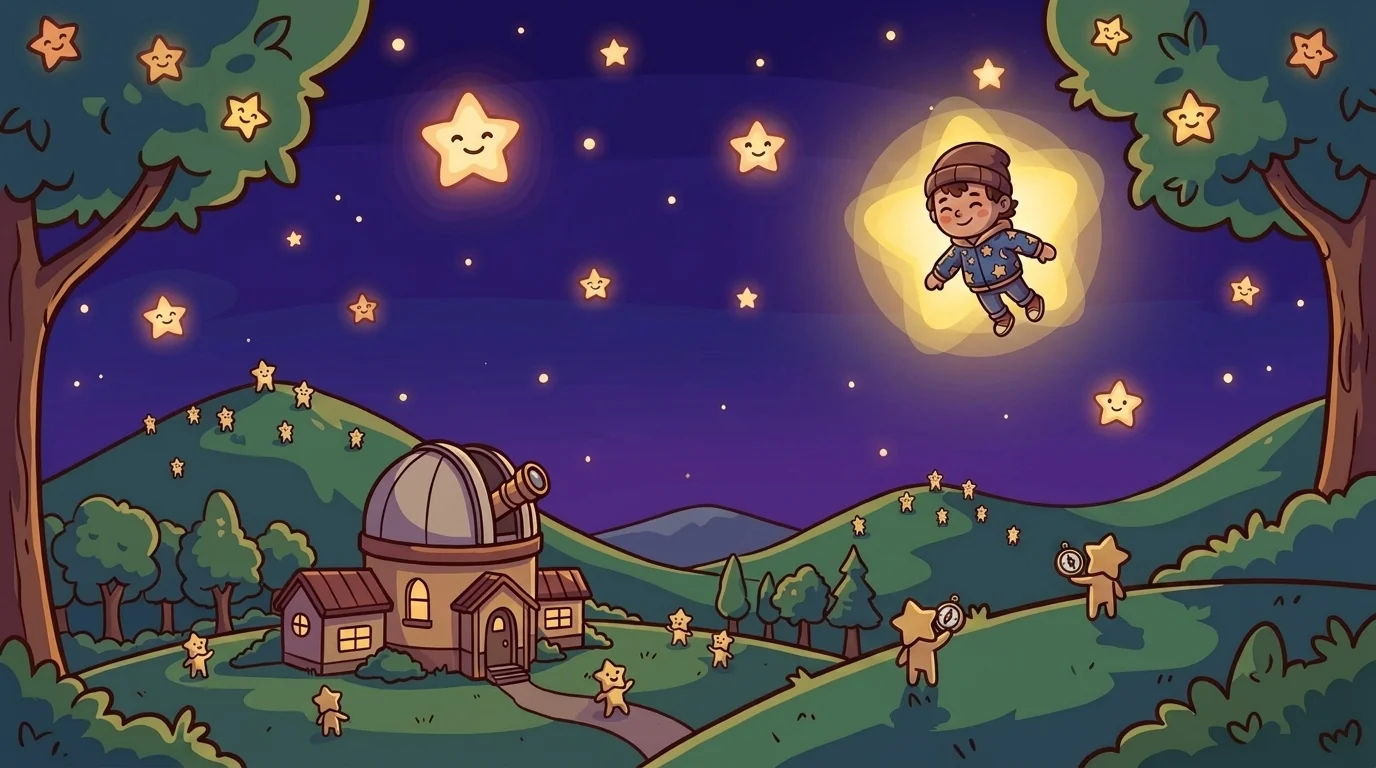
For a long time, Quiver had felt self-conscious. The other stars shone smooth and steady. Quiver could not hold still. Quiver was always swelling and shrinking, brightening and dimming, never quite settled. Quiver had wondered if its restless pulse was a flaw — a wobble, a fidget, a failure to simply shine steady like everyone else.
But floating there, feeling its own steady beat, Quiver remembered the student's gasp. The pulse was not a flaw. It was a rhythm so dependable that others used it to find their way across the whole sky. Quiver's restless beat was a kind of lighthouse. The very thing Quiver had felt shy about was the thing that helped everyone else measure the dark. A warm, glowing pride pulsed through Quiver, in time with its light. Bright, dim, bright, dim. Quiver smiled, glad to beat its own steady, useful, beautiful beat.
Hear it as an audio drama
A short play starring Quiver, from StarForge. Different voices, same idea. Listen any time after you read.
Loading audio…
Read the drama script
- Narrator: From Spark and Anvil and StarForge — this is Quiver, in chapter 1 of the StarForge cast.
- Narrator: This drama uses an AI-generated voice. Voiced via Gemini 2.5.
- Narrator: Quiver is a bright little keeper in a shimmery gold suit, and her own glow pulses — bright, then dim, bright, then dim — like a tiny glowing heartbeat.
- Narrator: She sees her changing not as a flaw, but as a rhythm the whole universe can be measured by.
- Quiver: A pulsing star swells and cools and dims, then shrinks and heats and brightens, over and over, dependable as breathing.
- Narrator: A young keeper worried that a star whose light kept changing must be sick.
- Quiver: Nothing's wrong. I'm not broken. I'm beating. And because my beat is so steady, it can be trusted.
- Quiver: A certain pulsing star beats slower the brighter it truly is. Time the beat, and you know how far away it is.
- Narrator: The young keeper watched her dependable pulse become a ruler for measuring the distant dark.
- Quiver: Being reliable was never about never changing. It's about your changing being something others can count on.
- Nebula: Tell me, young rhythm — why is a beat worth more than a flat, steady line?
- Quiver: Because a rhythm you can trust maps the whole universe. My ups and downs aren't a weakness — they're my gift.
- Narrator: A heart that beats because it's alive, lighting the way for others to find. That is Quiver's craft.
- Narrator: You've been listening to a Spark and Anvil chapter, written by the Spark and Anvil writing team for ages 9 to 14.
- Narrator: Apps stay free forever.
- Narrator: Curriculum aligned to Common Core and Next Generation Science Standards.
- Narrator: Released under Creative Commons BY-NC-SA 4.0 for educational reuse. Visit Spark and Anvil for the full transcript.
The StarForge ensemble
Quiver is one of the friends in StarForge. Each friend shows you one idea by how they act; meet them all and you have the whole subject.
-

Wick
Protostar (collapsing gas, igniting)
-

Glow
Main-sequence star (hydrogen fusion / stable)
-

Swell
Red giant (helium fusion / expanded outer layers)
-

Pinch
Stellar collapse + neutron star / supernova compaction
-

Ember
White dwarf / stellar remnant (cooling final state)
-

Brawn
Stellar mass — how heavy a star is at birth decides its whole life story
-

Waltz
Binary stars — most stars are not alone; they circle a partner in a slow gravitational dance
-

Smolder
Brown dwarf — a clump of gas too light to ignite; warm and dim, almost-but-not a star
-

Flare
Stellar flares and starspots — a star's stormy magnetic surface weather