
Pincer
PINCER — *one move that asks two questions. they can only answer one.*
Loading audio…
Press play to listen along. The line being read lights up as you go.
Show full transcript
Loading transcript…
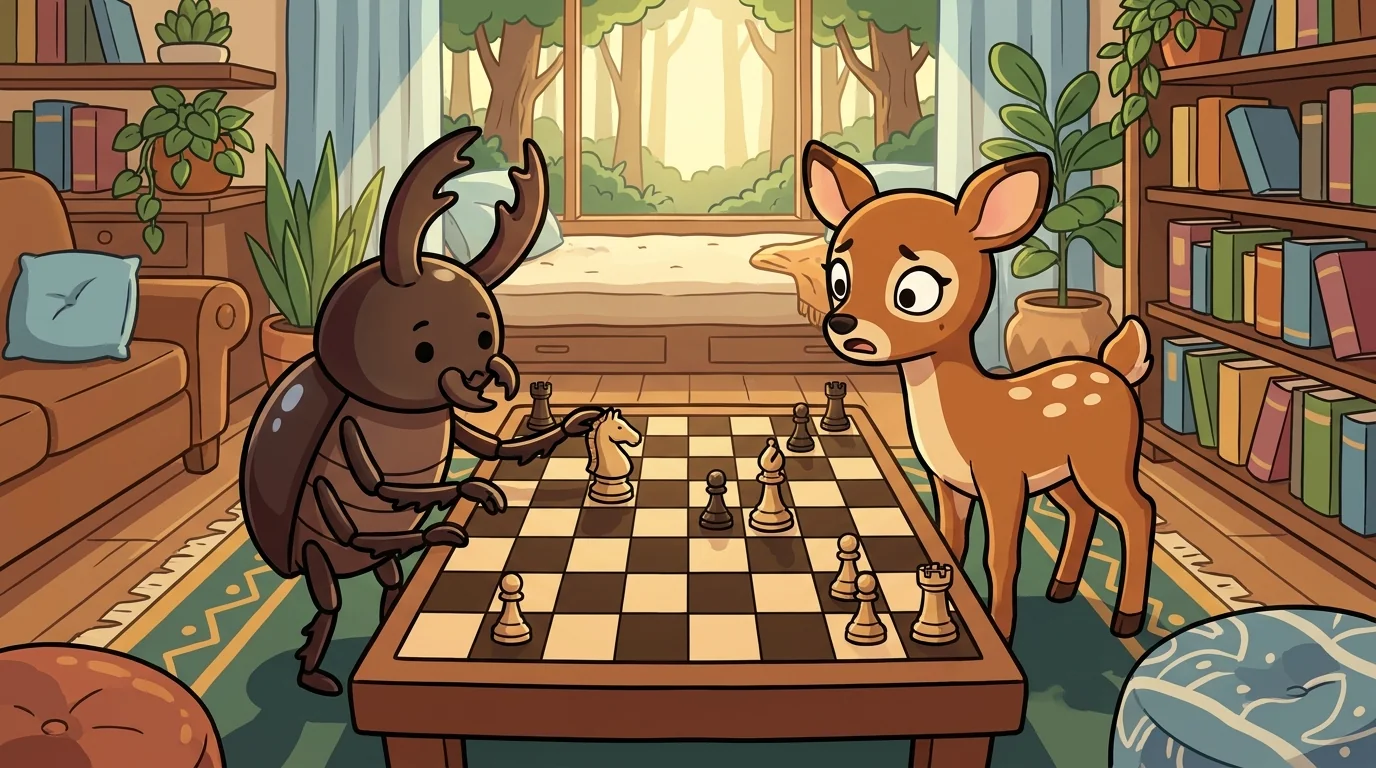
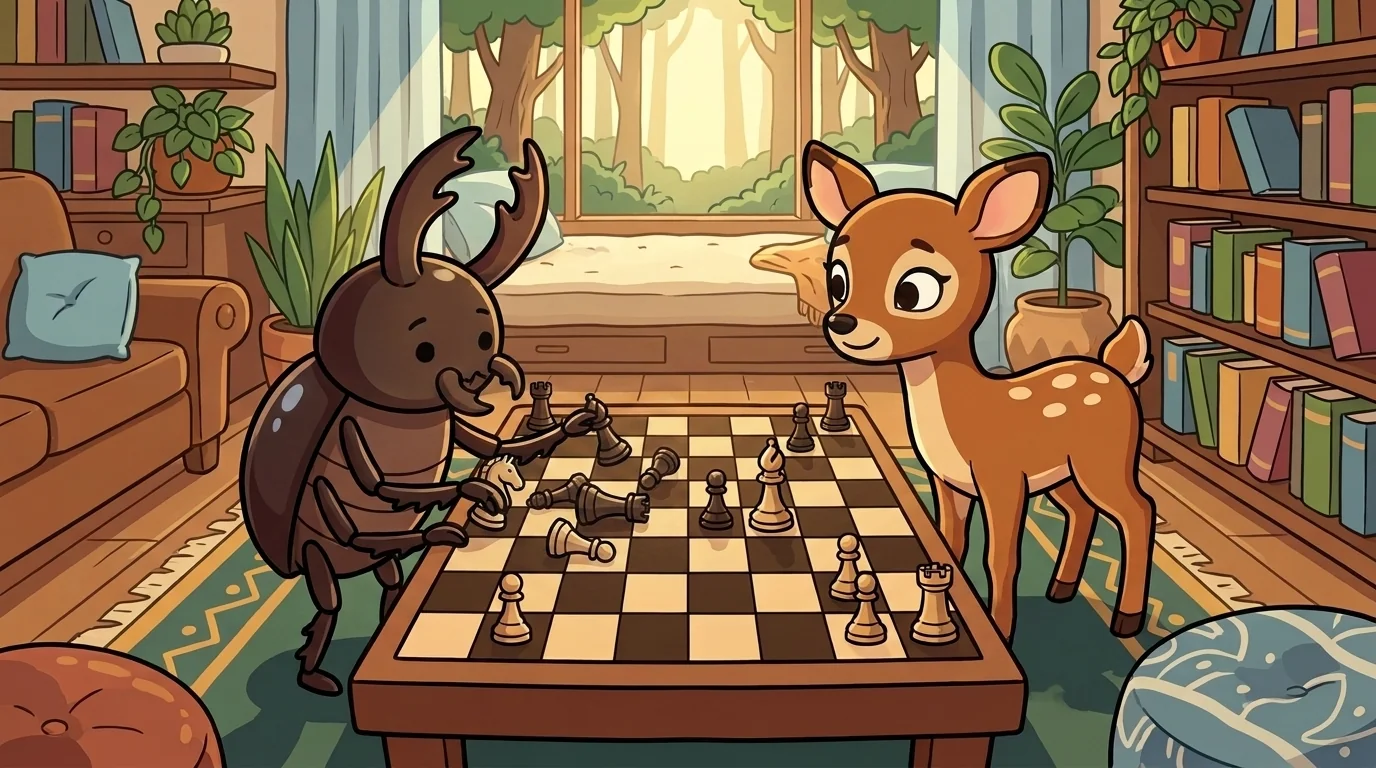
Pincer set his carved birch knight onto a quiet, sunlit square in the center of the board.
Across the workbench, Dapple’s ears flattened against her spotted neck. She stared down at the checkered walnut surface, her small hooves tapping a restless rhythm against the flagstones. That single wooden horse had not simply advanced. It sat squarely between her defenses, aiming one notched shoulder at her rook in the corner and leveling its spear directly at her bishop.
Pincer settled his weight back onto his six sturdy legs. He was an adolescent stag beetle with a shell as glossy as polished river stone. His two great, curved mandibles looked formidable from a distance, but he handled the chess pieces with the gentle precision of a watchmaker.
"One move," Pincer said, his mandibles clicking together with a soft, dry snap. "Two questions. You only get one turn to answer. Which one do you save?"
Dapple reached out a trembling hoof toward the tall, crenellated rook, then hesitated and hovered over the pointed bishop. "I need both of them," she said, her voice tight with frustration. "My rook guards the back rank, and my bishop controls the long diagonal. It isn't fair that one horse attacks two things at once."
"Fairness doesn't enter into geometry," Pincer answered gently. "That is what makes a fork so dangerous. When one piece threatens two targets at the exact same moment, your opponent has to make an impossible choice. They answer one question, and you take whatever they leave behind."
Dapple blew out a long breath that ruffled the wood shavings on the table. Reluctantly, she picked up her rook and slid it to an empty square along the back edge. Pincer’s knight glided forward without any hesitation, snapping up the abandoned bishop with a clean wooden clack.
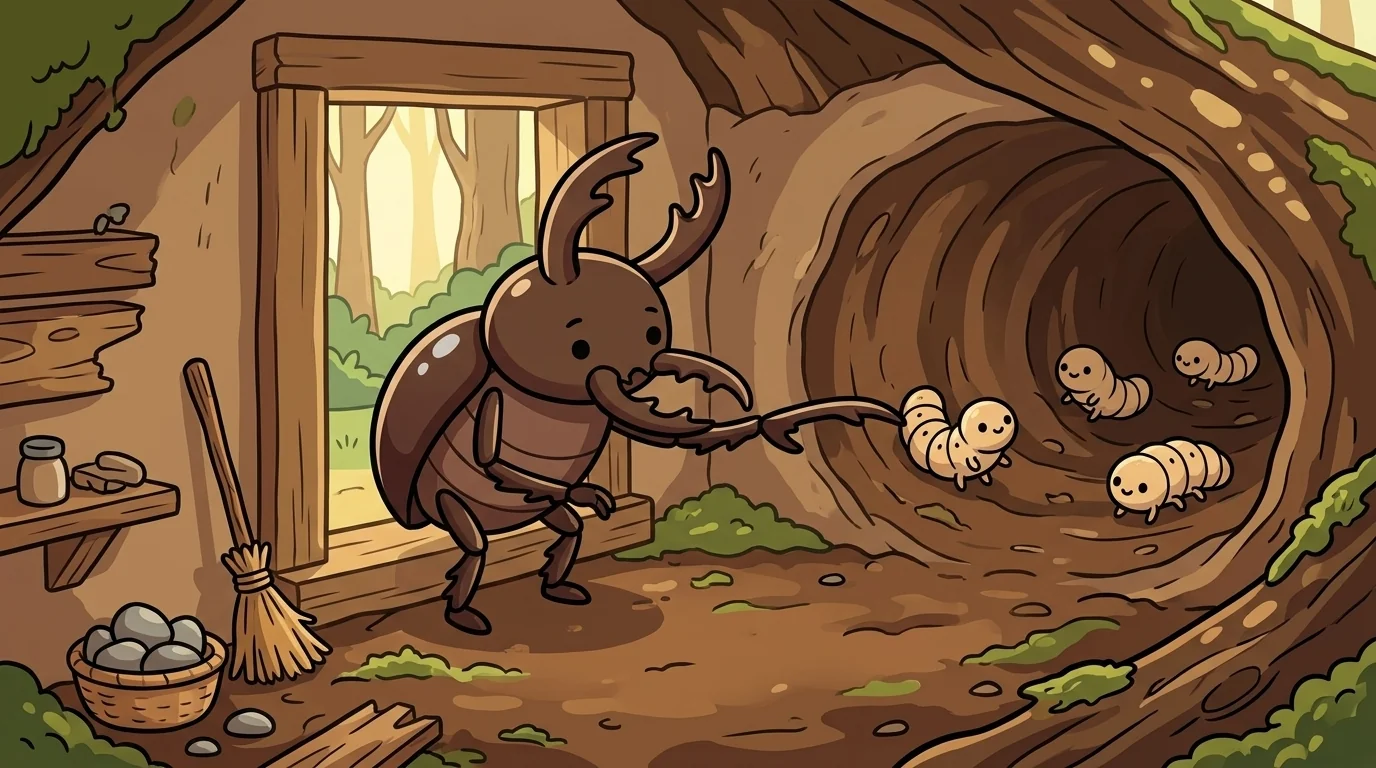
Long before he ever touched a chessboard, Pincer lived beneath a fallen oak log where the work never seemed to stop.
Every autumn, the damp air crept through the bark, bringing rot, cold drafts, and hungry winter molds. As a young grub, Pincer had spent his mornings running frantic laps through the dark tunnels. He would sweep the main entrance clear of crumbling wood, hear a nursery grub crying three corridors away, drop his brush, and sprint into the gloom. By the time he comforted the little ones, rain had washed fresh debris across the doorway. He spent his days exhausted, panting in the sawdust, convinced he simply had too few legs to keep the burrow safe.
An elder beetle lived in the deep knot of the log. Her carapace was scarred gray with age, and she moved with the slow, unbothered rhythm of an old clock. One wet morning, she sat on a root ledge and watched Pincer scramble back and forth until his shell was caked in grime.
"You are wearing your joints down to powder," she said, tapping a claw against the damp wood. "You run to one chore, finish it, and run to the next. Why do you insist on doing your work one piece at a time?"
Pincer leaned against the tunnel wall, his chest heaving. "Because there are ten chores and only one of me," he muttered.
"Then stop running between them," the elder beetle replied. She pointed her antenna toward a wide junction where the nursery passage met the outer entryway. "Find the spot where two needs cross paths. If you stand at that threshold corner, you can brace the nursery gate with your left legs while your right mandibles clear the draft sill. One posture, two tasks within arm's reach. Do not do two things. Find the one place that touches both."
Pincer rubbed the grit from his eyes and looked at the crowded log again. He climbed into the junction, planted his feet, and tested his reach. From that single corner, he kept the small grubs safely in view while scraping away the wet debris that threatened the entrance. The frantic racing in his chest stopped. A calm, solid stillness settled over his work, and for the first time in his life, the burrow stayed clean.
"Speed is just panic in disguise," the old beetle had told him as she ambled past. "Control is knowing where two lines meet."
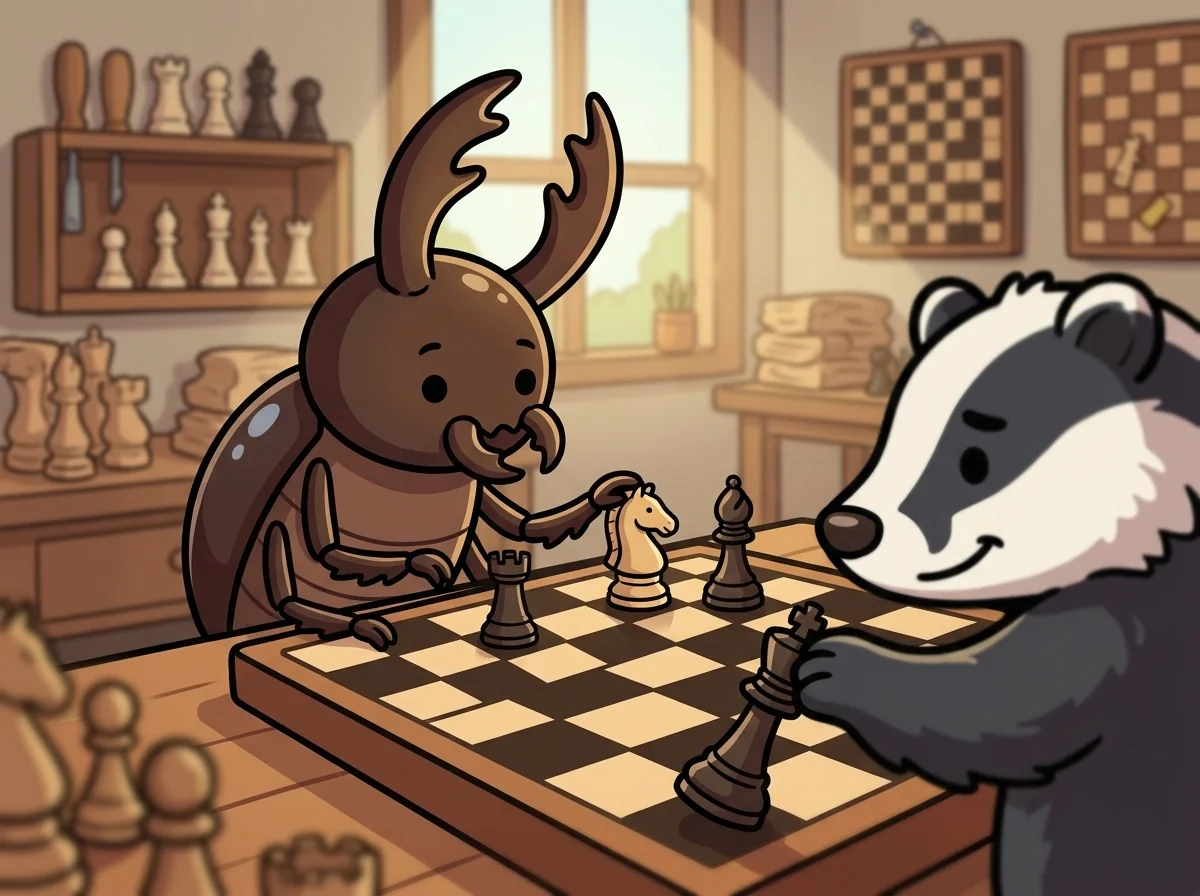
When Pincer reached his twelfth year, he packed his satchel and walked south to StrategyForge. The badger who ran the tactical academy, a grizzled master named Gambit, did not hand out easy welcomes. He simply pointed Pincer to a heavy oak table and sat behind a half-finished midgame.
Gambit played black. He had arranged his pieces aggressively, but his black king lingered on an open file, only two squares away from an unguarded rook. The badger crossed his heavy paws and waited, his dark eyes daring the young beetle to make a mistake.
Pincer did not rush. He rested his mandibles against the edge of the board and studied every intersection. He spotted the square immediately: a small, dark square on the sixth rank where a white knight could check the king and aim directly at the unprotected rook.
His legs twitched to reach out, but the old burrow instinct held him back. Pincer closed his eyes for a three-count and forced himself to look at the board from Gambit's side. If I jump there, can his queen take my knight? No, she is pinned to the back rank. Can his king step to a square that defends the rook at the same time? No, the white bishop covers that escape tile. Does he have a check of his own that ruins my plan? No.
Only when every counter-question came up empty did Pincer pick up the birch horse. He placed it firmly on the target square.
"Check," Pincer murmured.
Gambit leaned forward, his whiskers twitching as he scanned the board for a way out. He grunted under his breath, picked up his black king, and stepped aside into the corner. Pincer neatly tipped over the black rook and removed it from the board.
"A clean double attack," Gambit said, a faint smile creasing his gray muzzle. "Most youngsters see the fork and drop the piece immediately. You sat there for half a minute before moving. What were you looking at?"
"A fork that hangs is just a gift," Pincer replied, setting the captured rook into the wooden tray. "If the opponent can take my piece or solve both threats at once, it is not a tactic. It is just a blunder wearing a costume."
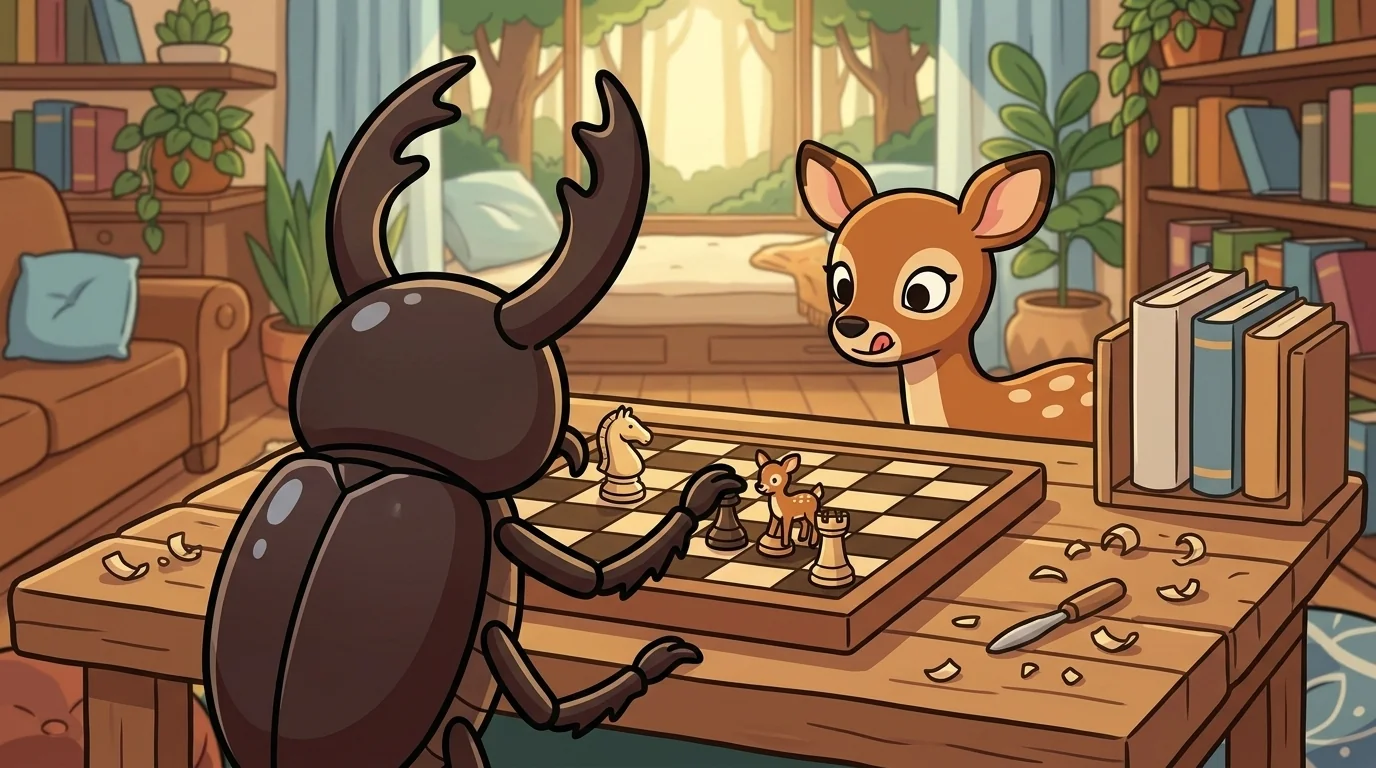
Gambit gave a low chuckle that rattled the dry cedar shavings beneath their stools. "Good. You understand the difference between hoping and calculating. Come sit at the teaching bench. We have plenty of students who still think chess is a game of tag."
Now, Dapple sat at that same workbench, resting her chin on her forelegs. Her eyes lingered on the gap where her proud bishop had stood just moments before.
"I do this every single match," she confessed quietly. "I chase an enemy pawn, and while I run after it, an enemy rook slips behind me. Then I chase the rook, and a knight jumps into my camp. I feel like I am always running three steps behind the board."
Pincer gently swept the captured pieces back into the center of the board. "You are treating your pieces like runners instead of anchors," he said. "Let me show you why the knight is the sharpest tool in the box."
He cleared the board until only three pieces remained: Dapple’s king, Dapple’s rook, and his own birch knight. He placed the fawn’s king on a dark square and her rook on a dark square four tiles away.
"Look at the shape between them," Pincer instructed. "A rook moves in straight lines. A bishop moves along clean diagonals. But a knight jumps in a crooked star. It hops over walls, and every single time it lands, it changes the color of its square."
He held the knight above the board, tracing a distinct L-shape in the air before lowering it onto an empty white tile between the two dark targets.
"From this one white square, the knight reaches in opposite directions," Pincer said. "It asks the king for his life, and it asks the rook for its square. Dapple, where should my knight go if your pieces are here?"
He shifted her king to the left and slid her rook down the column. Dapple leaned forward, her ears twitching as her dark eyes traced the grid. She counted the tiles in her head: two squares up, one square across; two squares across, one square up.
"There," she whispered, pointing a hoof at an open tile near the center. "If my horse lands on that square, it checks your king and points straight at your rook."
"Excellent," Pincer said, but as her hoof darted toward the piece, he raised one broad mandible to block the move. "Now stop. Before you touch the wood, open the gate."
Dapple paused, looking up at him with wide, curious eyes. "Open the gate?"
"The verification gate," Pincer said firmly. "Look at my side of the board. Can any of my pawns capture your knight the moment it lands? Can my king move to a square that protects the rook while stepping out of check?"
Dapple studied the lines carefully, tracing every possible reply in silence. "Your pawns are on the other side," she said after a long moment. "And your king cannot reach the rook from any safe square."
"Then the gate is clear," Pincer said, stepping back. "Play the move."
Dapple gripped the knight and snapped it down onto the board with a sharp, satisfying ring. Her ears stood straight up, and a sudden grin broke across her muzzle. The board no longer felt like a confusing blur of running pieces. It felt clear, geometric, and completely under her command.
"One move," she whispered, her eyes shining with quiet pride. "Two questions."
"And they only get to answer one," Pincer agreed, nodding his glossy head. "Now let them figure out which piece they can afford to lose."
The StrategyForge ensemble
Pincer is part of StrategyForge's distributed-narrative cast. Each character embodies a different curricular primitive; together they teach the full subject.
-

Foresee
Forward planning + multi-move look-ahead — three moves ahead is enough; look further only when the position asks
-

Trade
Piece-value reasoning + exchange evaluation — equal value isn't equal worth; position-value matters more than piece-value
-

Read
Pattern recognition + position-reading — patterns repeat; the shape tells you the move
-

Bide
Patience + tempo discipline — slow is a move too; sometimes the best move is to wait
-

Concede
Graceful loss + post-game analysis — losing is a teacher; winning is too; I write down both
-

Lodge
The outpost — a piece that can't be chased away is worth two that can
-
Thwart
Prophylaxis — before you move, ask what THEY want, then quietly take it away
-

Wedge
The breakthrough — when the door is jammed shut, break the wall, not the pieces
-

Goad
Initiative + tempo — keep them answering you, and they never get a move of their own