
Silt
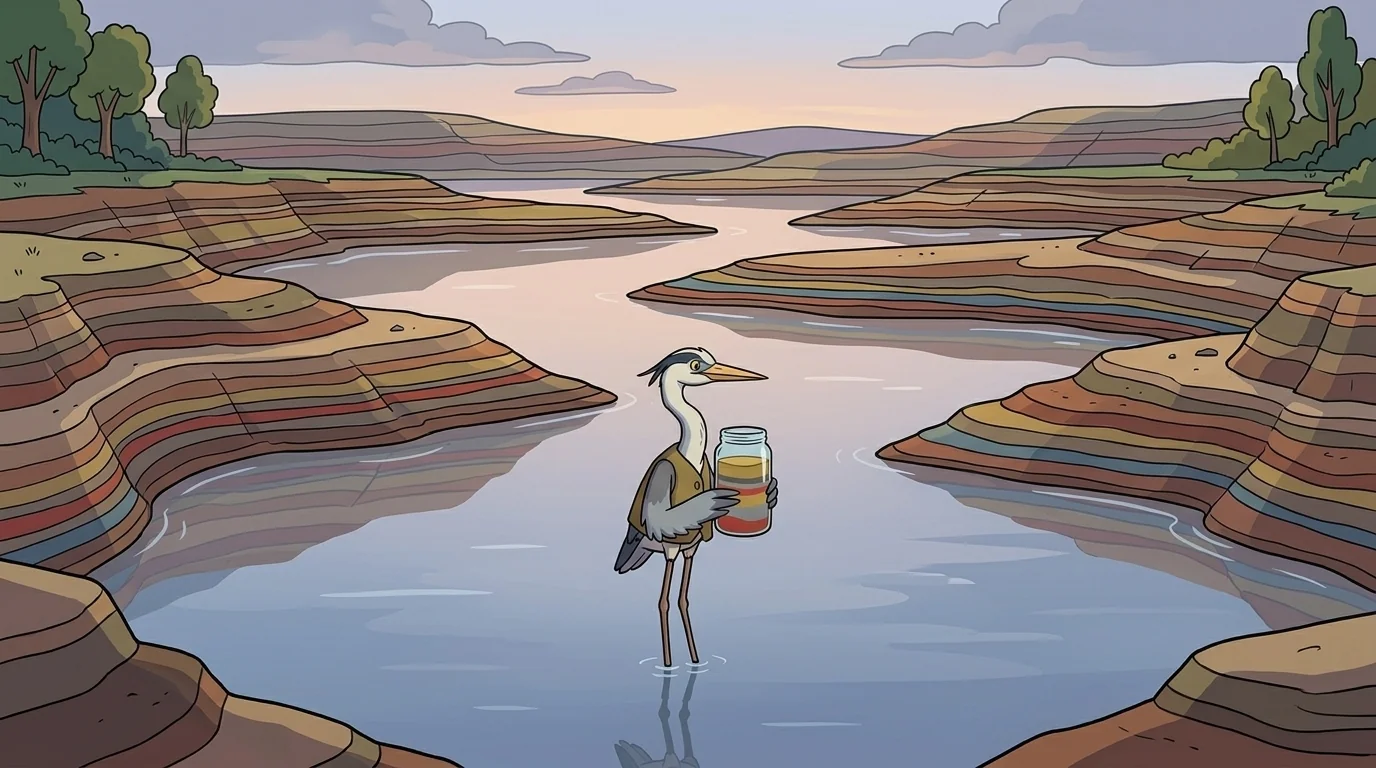
SILT — the pieces that erosion carries away must come to rest somewhere. They settle in layers, one atop another, oldest at the bottom, newest on top. Those layers are a calendar written in stone: read from the bottom up, and you read the passing of time.
Loading audio…
Press play to listen along. The line being read lights up as you go.
Show full transcript
Loading transcript…
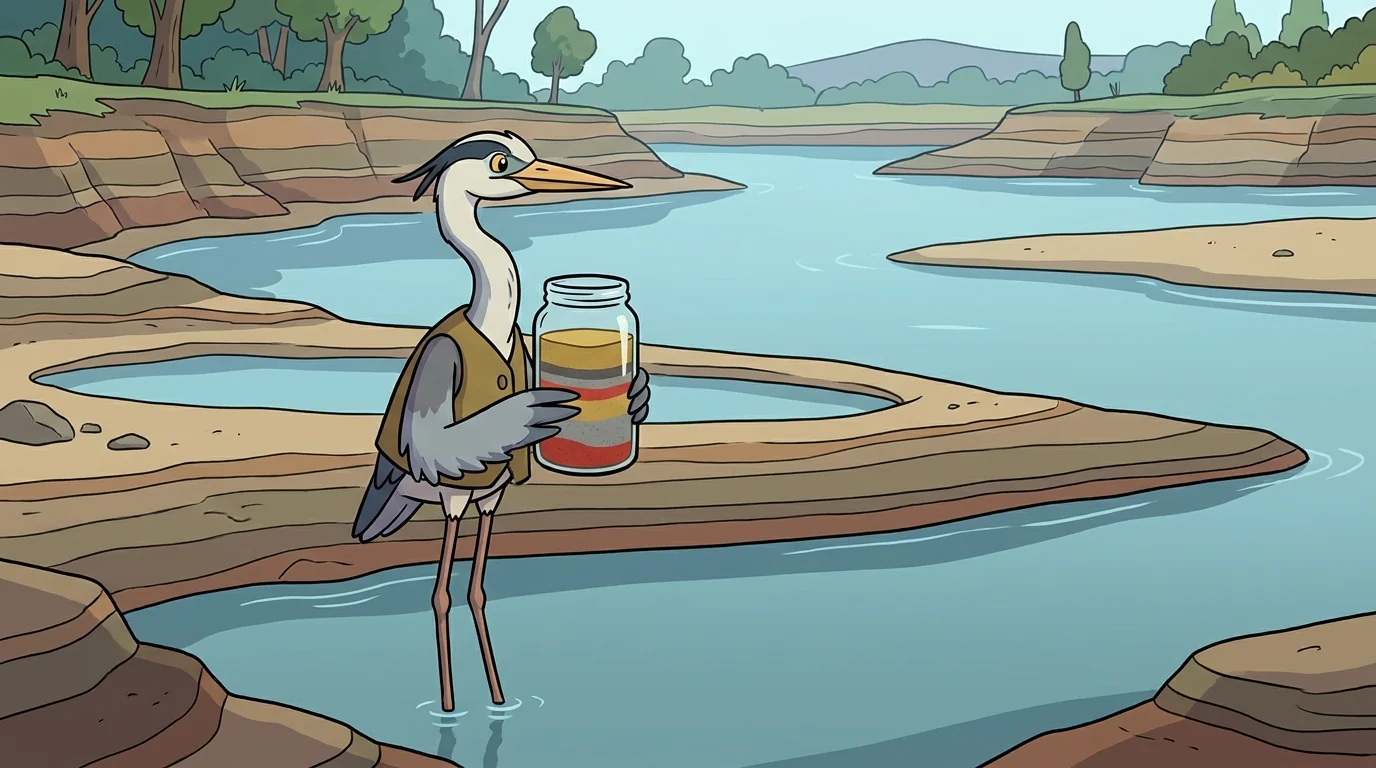
In the TectonicForge model room, a quiet heron named Silt stood very still beside her layer-jar — a tall glass of colored sand settled in neat stripes — while a young student stared at a cliff face of banded rock and saw only a pretty pattern, with no idea it was a book she could read.
Silt had long careful legs and loved calm, still places. The student — a hurried squirrel — shrugged at the striped cliff. "It's stripey. Pretty, I guess. Just... layers of rock. So what?" Silt tipped her layer-jar gently, and the colored sands stayed in their bands. "Watch what these stripes actually are. When erosion carries loosened rock away, all those grains have to come to rest somewhere — a lake bottom, a sea floor, a river's slow bend. They settle out of the water and lie down in a layer. Then more grains arrive and settle on top. Then more. Each new layer lies over the older ones." She pointed to the bottom of her jar. "So the layer at the bottom settled first — it's the oldest. And each layer up is younger than the one beneath it, all the way to the newest on top." She traced up the stripes. "That's not just a pattern. It's a calendar, written in stone. Read a cliff from the bottom up, and you're reading the passing of time — this layer, then this one, then this one, in the exact order they happened. The rock remembers when."
The squirrel looked at the banded cliff again, differently. "So the stripes aren't just decoration... they're time, stacked up in order?"
"Every layer a chapter, oldest at the bottom," Silt said. "The ground keeps an honest record of everything that settled on it, in the order it came. You just have to know how to read it."
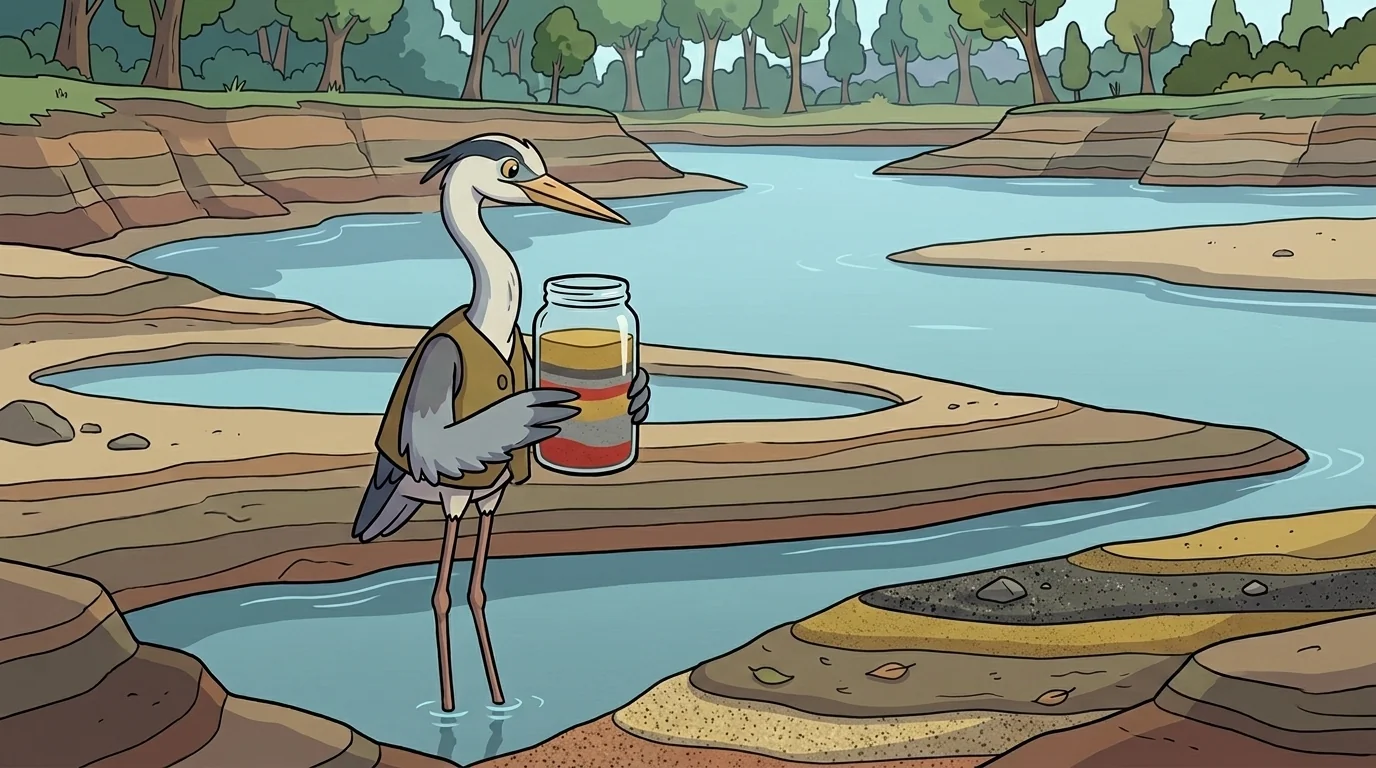
Silt had not always known how to read the layers. When she was young, she'd thought the past simply vanished.
She'd wondered what her marshland had been like long, long ago — before her, before the old herons — and felt sure it was unknowable, gone, erased by time. The past was just gone, she thought, leaving no trace; you could only ever know the present moment, standing on top of a world with no memory. It made her feel oddly untethered, as if everything before now had simply been washed away.
An old keeper named Strata, who had spent a lifetime reading cliff faces, showed her otherwise. She dug a careful core down through the marsh floor and laid the layers out in order. "You think the past is gone," Strata said. "But it's right here, under your feet, laid down in order and waiting to be read. This dark band was a flood, long ago. This pale one, a dry age. This shell layer, a time the sea reached here. The past didn't vanish — it settled, and the ground kept it, oldest at the bottom, in perfect order." Silt understood then that time doesn't erase itself — that the world keeps a patient, honest record of everything that has settled on it, and that the past is not gone at all, only layered beneath the present, legible to anyone who learns to read from the bottom up.
She came to the TectonicForge model room as a young keeper, drawn to the one place that read the ground as a book of time rather than a heap of stone.
The chief keeper set a banded cliff-sample before her. "This rock is fifty million years of history," she said. "Where does the story start?"
The old past-is-gone Silt would have shrugged. This Silt pointed firmly to the very bottom band. "It starts here — the bottom layer settled first, so it's the oldest, the beginning of the story. Then I read upward, layer by layer, each one younger, each one a later chapter, all the way to the top, which is the most recent. Bottom to top is oldest to newest. That's how you read time in stone."
The chief keeper nodded. "Most young keepers start reading at the top, where their eyes land," she said. "You started at the bottom, where time starts. Knowing that the oldest layer lies deepest — that's the key that unlocks the whole record. You belong here."
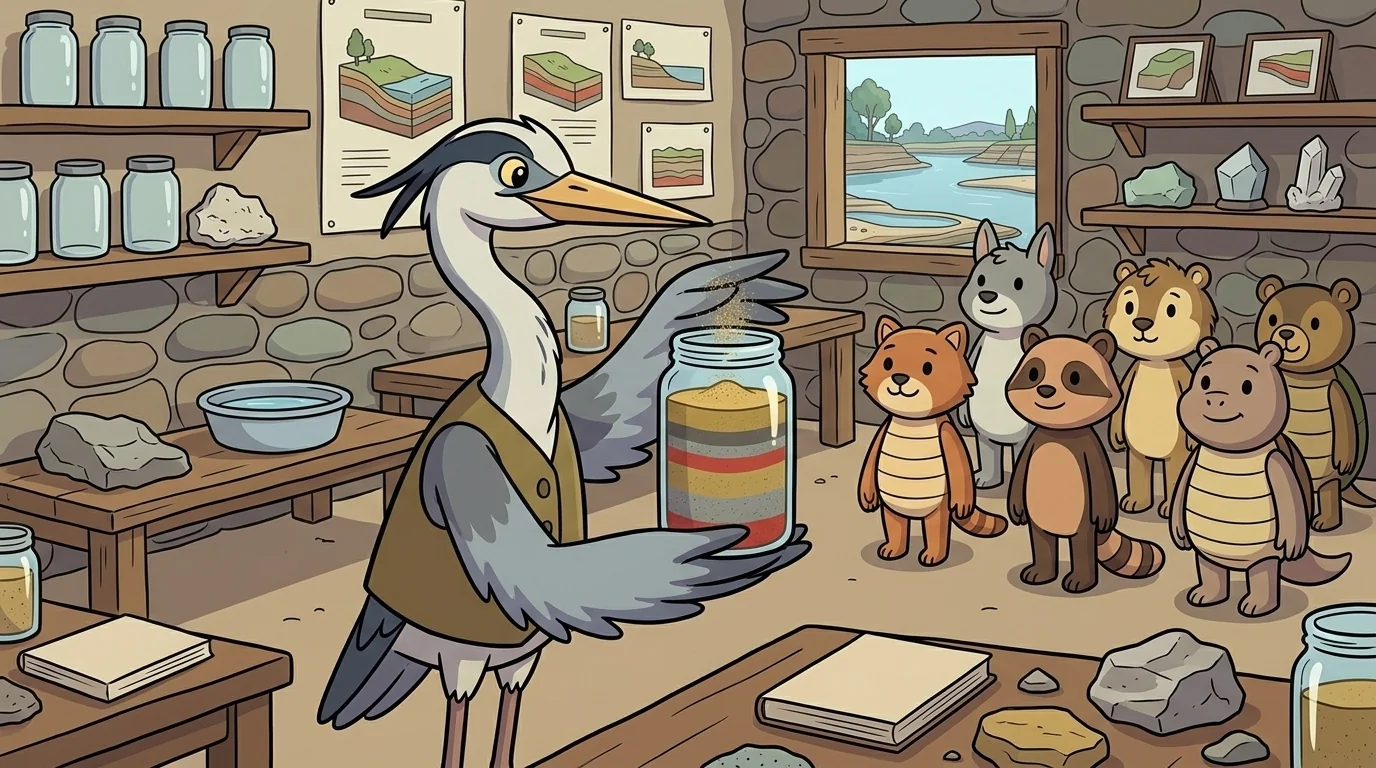
Over the years, Silt's layer-jar drew every student who felt the past was lost.
One afternoon a wistful young toad set down a plain grey stone. "I wish I knew what this place used to be," she said. "But the past is gone. You can't ever really know what came before." Silt tipped her layer-jar, the bands holding steady. "Come look at what the ground remembers." She showed the toad a cliff-core, band by band. "This layer was a warm sea — see the tiny shells? This one, a desert — fine wind-blown sand. This dark one, a great flood. All of it settled here, in order, oldest at the bottom, and the ground kept every chapter." The toad stared at the stacked history. "So the past isn't gone... it's just underneath, kept in order, if you know how to read it?" "Kept honestly, in the order it happened," Silt said gently. "The world doesn't forget. It writes everything down in layers and holds it for whoever learns to read. Nothing that truly settled is ever really lost." The toad looked at the ground beneath her feet as though seeing it for the first time, and Silt watched the untethered sadness settle into a quiet, rooted wonder.
When the model room had quieted, the toad came back with a smaller question.
"Doesn't it ever feel lonely," she asked, "standing so still, reading old layers, while everything else rushes on?"
Silt thought about a marshland she'd once believed was a place with no memory, and an elder named Strata who read her its whole buried story.
"It used to feel lonely," she said, standing tall and still by her jar. "I thought stillness meant being left behind while the world moved." She traced the settled bands. "But standing still is how you read the layers — you can't rush it, and you can't skim. And once I learned to read them, I was never untethered again. I stand on the whole honest record of everything that came before me, kept in order, legible, mine to read. I'm not left behind by time. I'm connected to all of it — every flood and sea and desert that ever settled here, still present, still readable, right beneath my careful feet."
She felt it as she said it — a still, deep-rooted calm spreading through her, her long legs planted easy in the shallows, her breath quiet as settling sand. Not the untethered loneliness of a world with no memory. The grounded, connected peace of standing on a patient record of everything that ever was, kept honestly in order, waiting to be read.
"That's the feeling I keep now," she told the toad, her layer-jar bright with its ordered bands. "Not left behind. Standing still on the whole book of time — reading the layers, oldest to newest, and belonging to all of it."
The TectonicForge ensemble
Silt is part of TectonicForge's distributed-narrative cast. Each character embodies a different curricular primitive; together they teach the full subject.
-

Sink
Convergent/subduction boundary — the heavier plate finds its way down; it takes a long time; that's okay
-

Spread
Divergent boundary + new crust — when something pulls apart, something new is forming in the middle
-

Slide
Transform boundary + stored energy — two plates sliding past; they catch, they hold, then they let go
-

Vent
Volcanism + magma chemistry — eruptions tell us what was happening below
-

Tremor
Seismology + earthquake preparedness — earthquakes are the Earth telling its story; we can read the lines; we can be ready
-

Churn
Mantle convection — the engine that drives the plates — 'Deep heat moves the whole map.'
-

Heave
Mountain-building — folding + uplift at collisions — 'Push long enough and mountains rise.'
-
Remake
The rock cycle — igneous, sedimentary, metamorphic — 'Nothing is ever really finished.'
-

Scour
Weathering + erosion — wearing down the land — 'Water and time win.'