
Straight, Trip and Topper
SETUP AND PAYOFF (Advanced) — a laugh is engineered, not lucky. The setup builds an expectation (Straight's calm baseline gives the absurdity a reality to spike against; Trip's two matched beats prime a prediction) and the payoff violates it (Trip's third-beat swerve), then a topper re-escalates off the crest (Topper). The through-line is comedic timing — the beat: hold for the crest, top at the peak, never step on the prior laugh. Three separate crafts, one built structure.
A story read by Straight, Trip and Topper
Loading audio…
Press play to listen along. The line being read lights up as you go.
Show full transcript
Loading transcript…
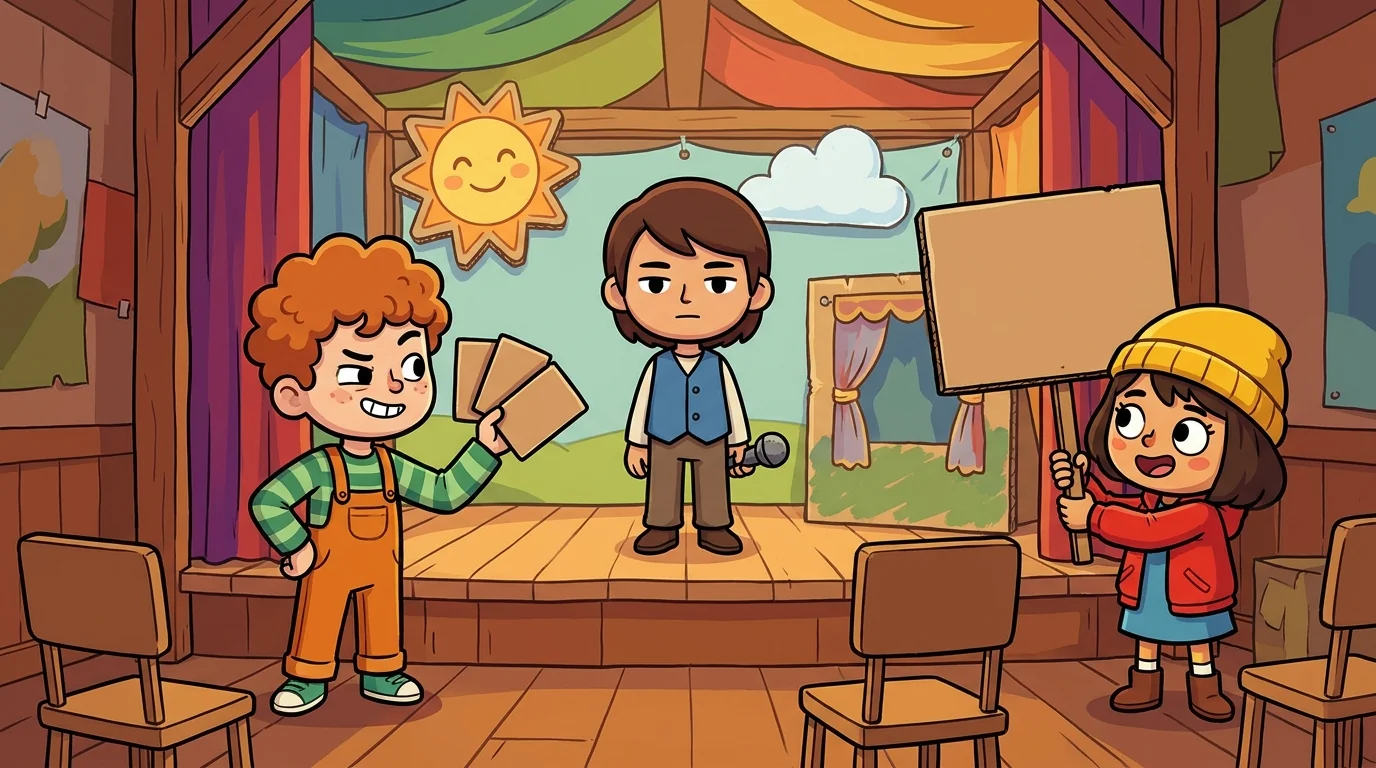
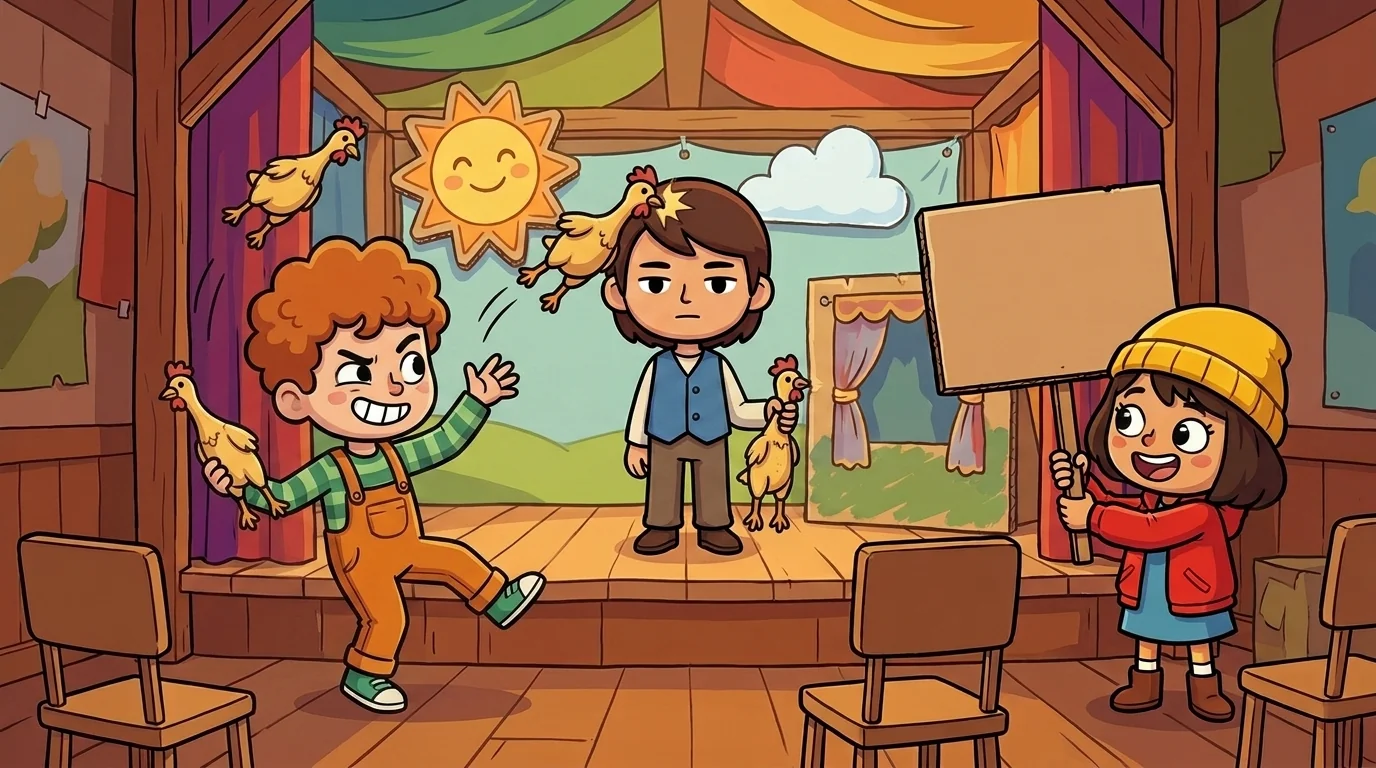
People thought jokes just happened — that funny people were simply born that way and the rest weren't. Three friends on the little stage knew the opposite: a laugh is a machine, built from named parts with a shared timing, and they were about to assemble one in front of everybody. Straight stood dead center, calm and sincere, not trying to be funny at all. Trip stood ready with three cards — one, two, three. And Topper waited off to the side, holding the last, biggest card, watching for the exact right second. "Everyone thinks I'm the boring one," said Straight. "Watch what the boring one is actually for."
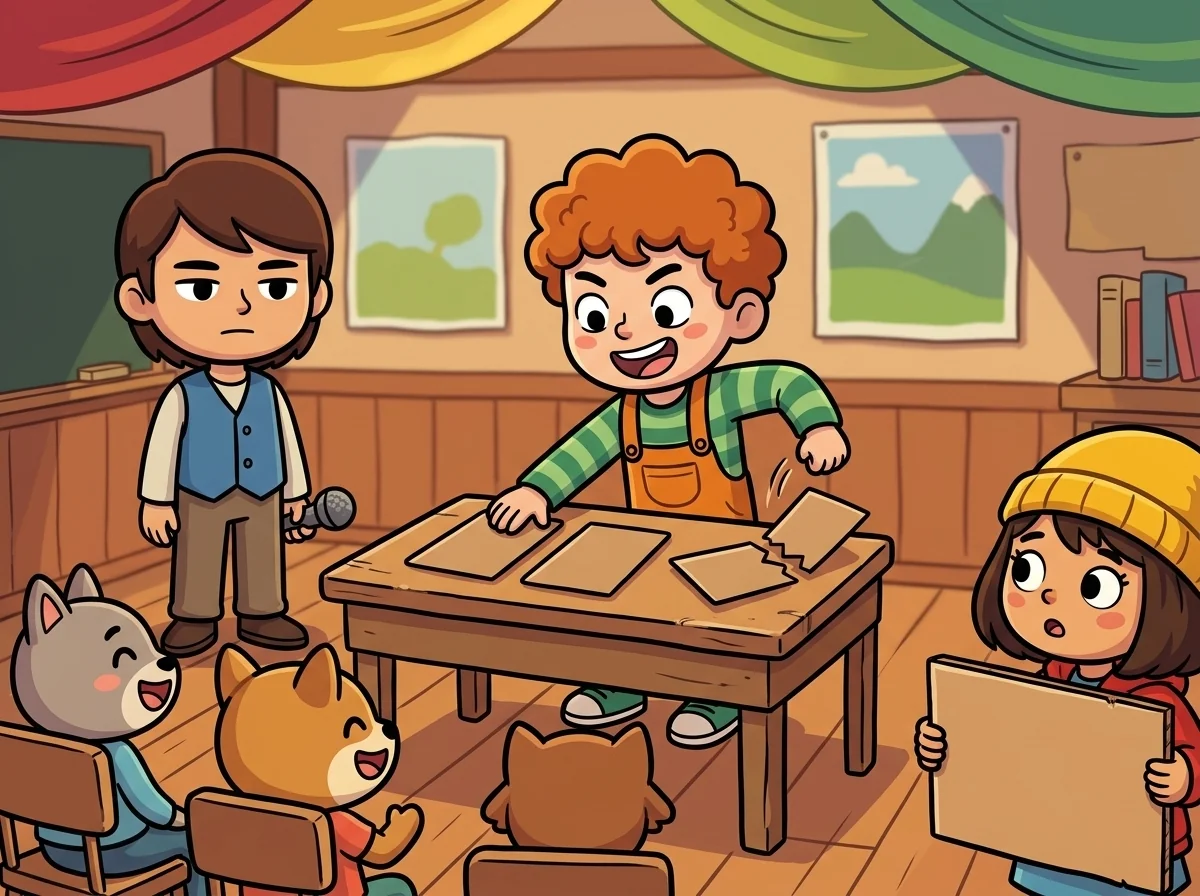
Straight went first, because a joke needs a baseline before it can have a spike. While a chaotic partner flailed beside him — juggling rubber chickens, tripping over nothing — Straight simply reacted like a normal person: calm, sincere, unbothered. "That's the contrast principle," he said as a chicken bonked off his head. "Funny is measured against normal, and I'm the normal. I'm the reality anchor the absurdity spikes against. If we were both being silly there'd be no baseline — nothing to measure the deviation from, just noise. One calm face beside the chaos, and the chaos finally has something to be chaotic against. The setup starts with someone playing it straight."
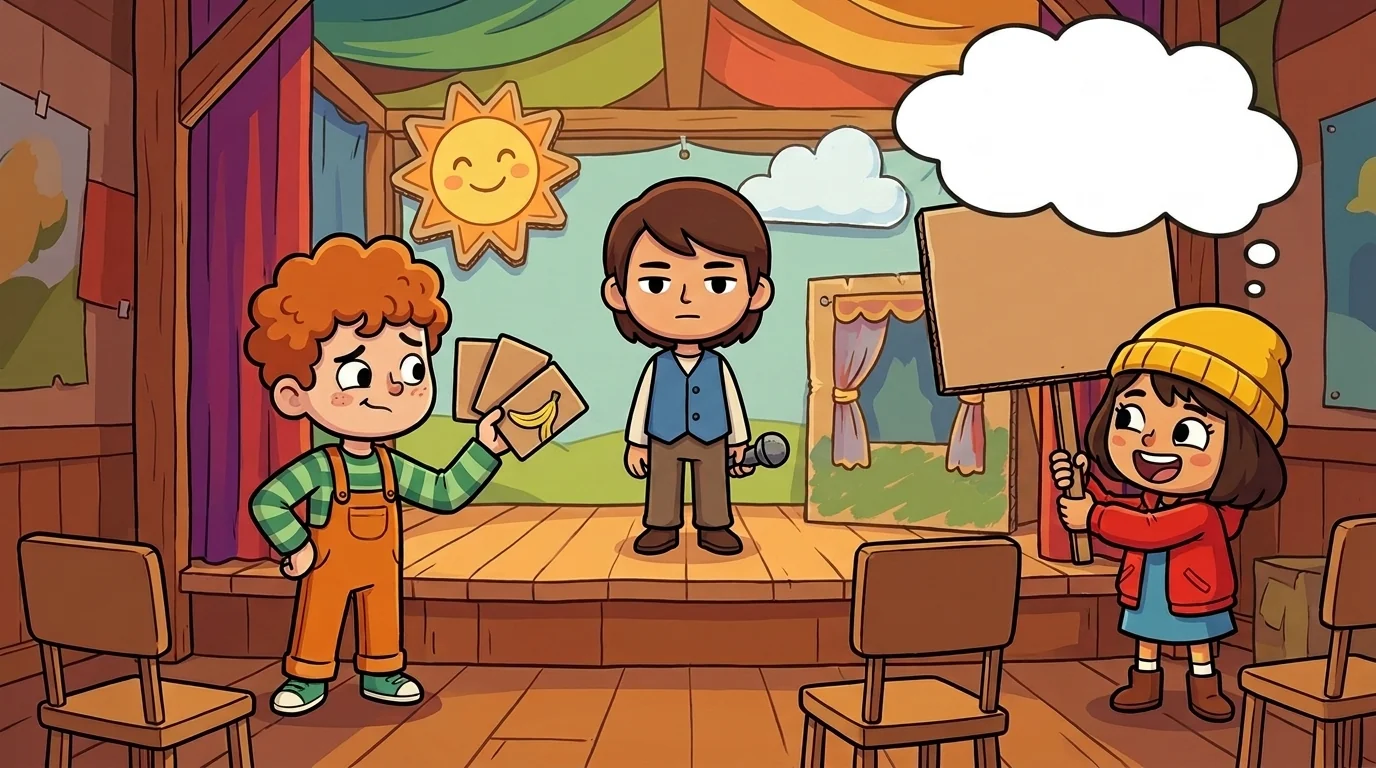
Then Trip stepped up with his three cards, because the setup's other half is a prediction you build to break. "Watch the shape," he said. "Two beats to set a pattern, one to snap it." He built it: "At the talent show, the first act juggled. The second act sang." Two matched, ordinary beats — the audience's brains quietly filling in and the third will be impressive too — "and the third act..." he snapped it, "...read the entire lunch menu aloud, with feeling." The room laughed. "That's the comic triple," Trip said. "The first two beats build an expectation; the third violates it, and the violation is the payoff. Not two — two's no pattern. Not four — four goes stale. Three. Set, set, break. The setup builds the prediction; the payoff is the swerve."
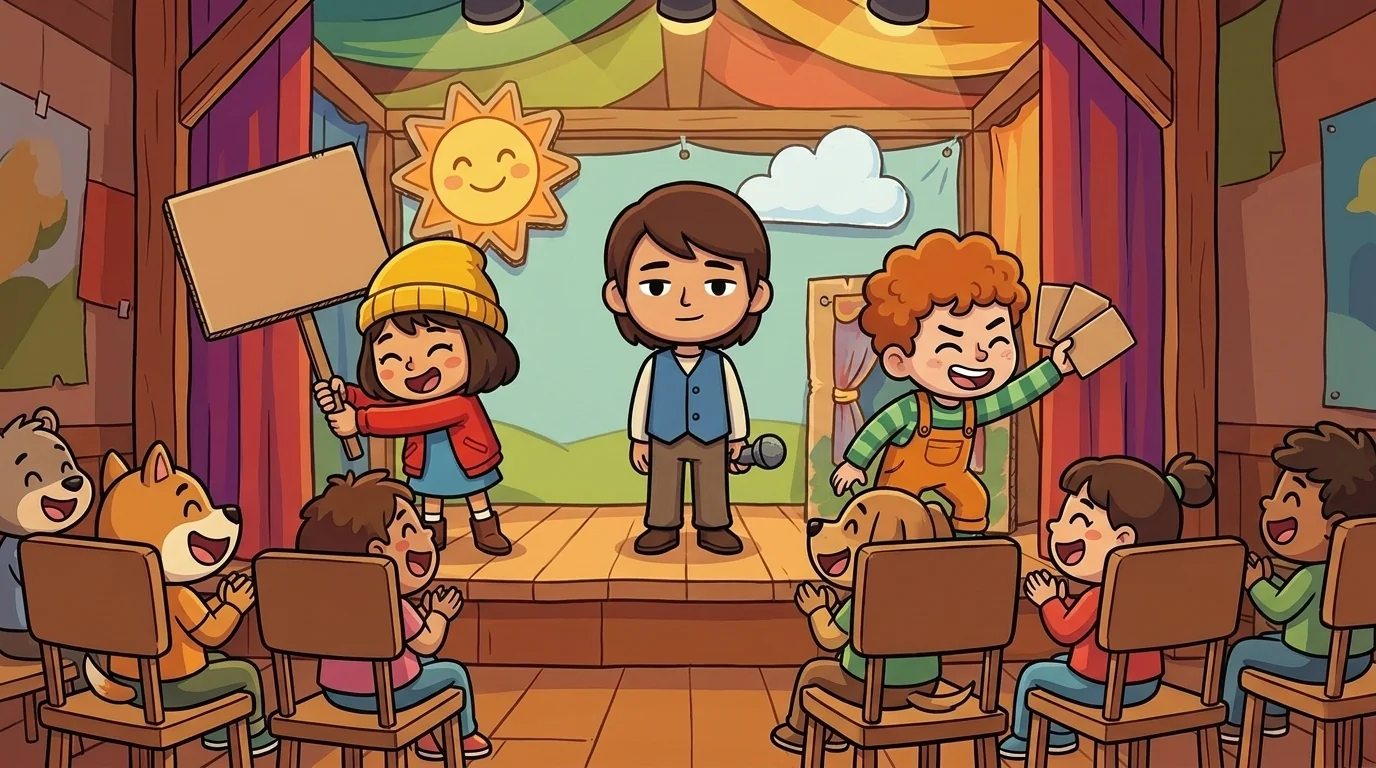
And then, right as that laugh crested, Topper pounced, because a payoff can be escalated. "Here's what amateurs miss," he said, watching the laugh peak. "They land a good joke and stop — they let the laugh die. But a laugh at its crest is a launch ramp, and if you've got a bigger beat, you launch off it." He waited for the exact top of the lunch-menu laugh and capped it: "...and he got a standing ovation. From the lunch lady." The room went up again, higher — a laugh stacked on a laugh. "That's a topper," he said. "Escalation: each beat strictly bigger than the last. But it lives or dies on the timing — top too early and you step on the first laugh, too late and it's gone cold. Right at the crest, one laugh becomes two."
The three took a bow — Straight still perfectly serious, Trip holding three spent cards, Topper holding the biggest one now played — and named the thing they'd just proven together. A laugh is a built structure: a setup that raises an expectation (a calm baseline plus a primed pattern) and a payoff that violates it (the third-beat swerve), sometimes re-escalated by a topper off the crest, all held together by one invisible craft — comedic timing, the beat: the held pause, the crest caught at its peak, the refusal to step on the laugh before it's paid out. "Good baseline," said Trip. "Good three," said Topper. "Good topper," said Straight, finally almost smiling. There is a real and generous joy in making people laugh, and a quiet pride in knowing it isn't luck or magic but a craft you can actually learn and assemble — the calm that makes silliness pop, the three-beat shape that primes and breaks a prediction, the topper that stacks a bigger laugh on the peak, and the timing that binds them. Comedy looks effortless when it's good; behind every easy laugh is a little machine, carefully built, and learning to build it is a way of giving people one of the best things there is — a reason, together, to laugh.
The WitQuest ensemble
Straight, Trip and Topper is part of WitQuest's distributed-narrative cast. Each character embodies a different curricular primitive; together they teach the full subject.
-

Quirk
Puns and double-meanings
-

Knot
Riddles (compressed-info puzzles where you decode the answer from constrained clues)
-

Switch
Anagrams (rearranging letters to form a different word — "listen" → "silent")
-

Lilt
Idioms and figurative language (phrases whose literal meaning ≠ their actual meaning — "raining cats and dogs")
-

Hop
Lateral thinking (finding a non-obvious angle on a problem; sidestepping the assumed framing)
-

Trip
The rule of three (two beats set a pattern; the third breaks it — the break is the laugh)
-
Dry
Deadpan delivery (saying something ridiculous with a calm, serious face — the flat delivery is the joke)
-

Boomerang
The callback (bringing back an earlier joke later, when it's half-forgotten — funnier the second time)
-

Topper
The topper / escalation (capping a joke with an even bigger one, raising the stakes each time)
-

Straight
The straight man / the setup (reacting normally so the absurdity stands out — comedy needs someone to be normal)