
Fogg
ATMOSPHERICS (Advanced) — haze does two jobs the eye can't ignore: it creates ATMOSPHERIC PERSPECTIVE (distant things lose contrast and go blue because air scatters the light between you and them, so the eye reads depth) and it makes light VOLUMETRIC (a beam is invisible in clean air but glows when particles scatter it — god-rays). Backlight the haze, keep it thin, and let it move — density is a dial, and less is almost always right.
Loading audio…
Press play to listen along. The line being read lights up as you go.
Show full transcript
Loading transcript…

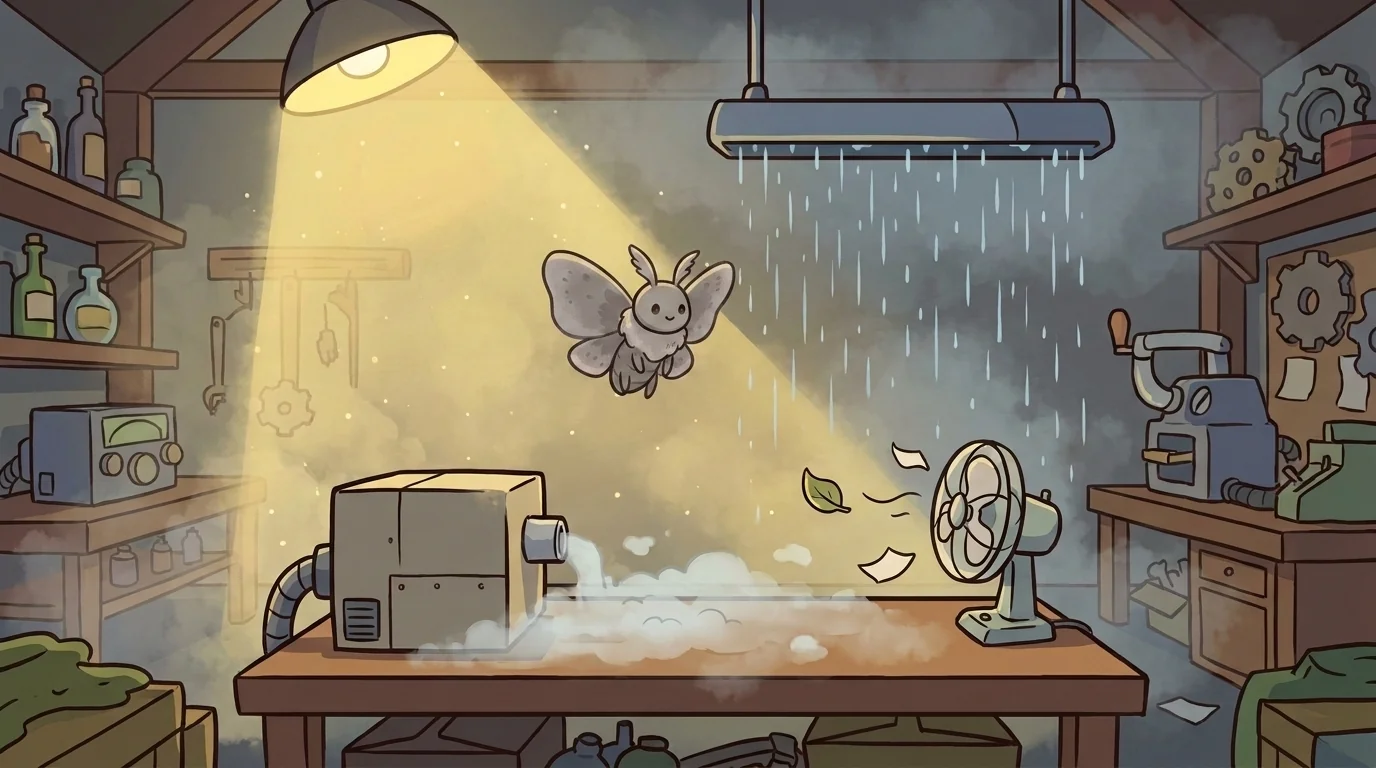
Fogg is a small grey moth with soft dusty wings, hovering in a shaft of lamplight where the beam has gone visible and solid because the air is full of gentle haze. Below her: a fog box breathing a slow ground-mist, a rain bar dripping a curtain, a little fan turning a leaf. She drifts through her own weather, watching how the light lands on the air.

Her craft is atmospherics — making weather on set so a scene gains depth and mood — and the Advanced version, she says, is understanding the two jobs haze does, and why the eye can't help believing them. "Job one is atmospheric perspective. Look at a real mountain range: the near ridge is dark and sharp and full colour, the far ridge is pale, low-contrast, and blue. That's not the mountains — it's the air between you and them. Air scatters light, and the more air stacked up, the more a distant thing loses contrast and shifts toward blue. Your eye has spent your whole life reading less contrast, more blue as farther away. So when I lay a thin haze across a shallow stage, the far things fade exactly like real distance, and the eye feels a depth that isn't physically there." That's the same fade Matte paints into her mountains and Titch needs behind her tiny city — Fogg just makes it out of real air.
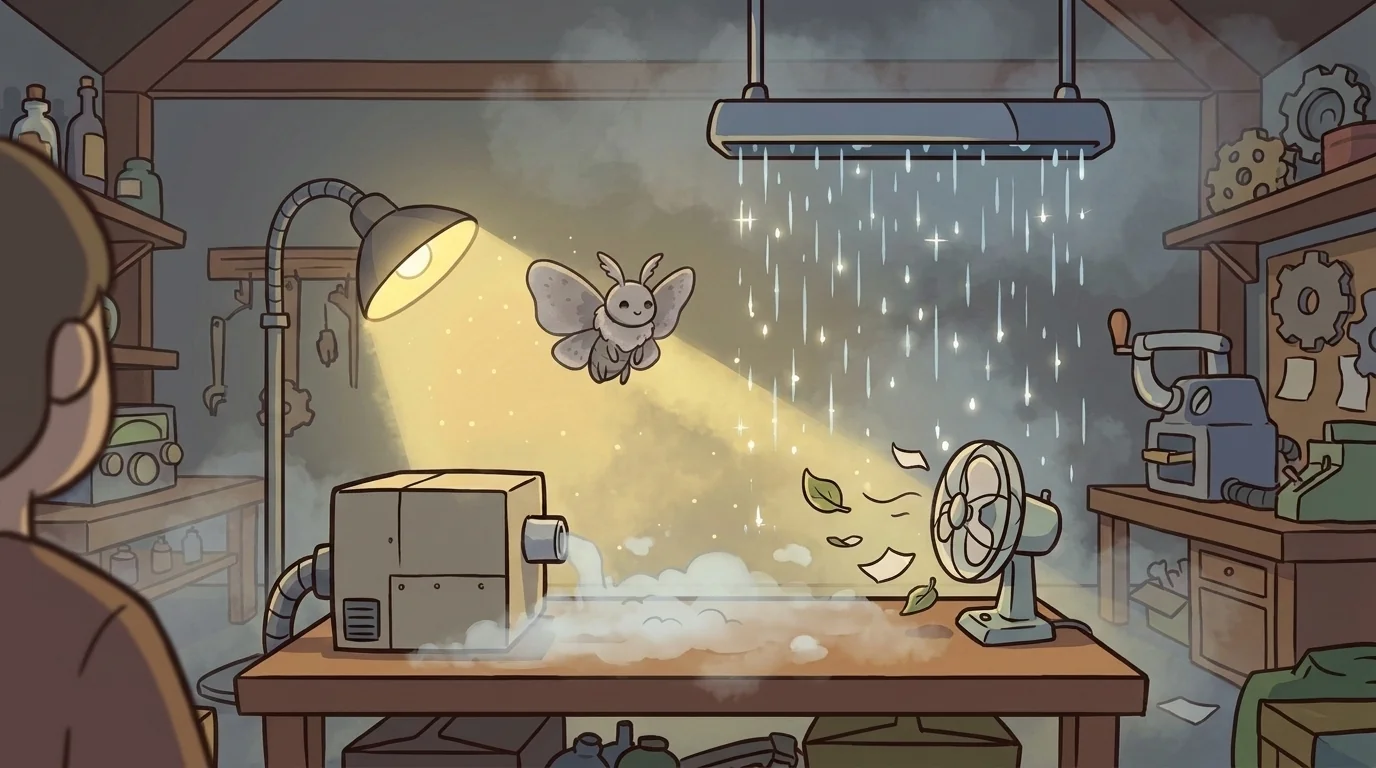
"Job two is volumetric light. A beam of light in clean air is invisible — there's nothing for it to bounce off, so you see only where it lands, never the beam itself." She drifts into her lamp-beam so it lights her wings. "Fill the air with fine particles — haze, dust, mist — and the light scatters off every one, so the beam itself lights up. God-rays. A single visible shaft can turn a plain hallway into somewhere holy, or haunted, or warm. And the trick to seeing it is backlight — put the light behind or to the side of the haze, aimed roughly toward the camera, so the particles glow. Light the haze flat from the front and it just goes grey and dead."
Fogg grew up among moths at the edge of a marsh, in a family who read the evening air. They knew which mist meant safe and which fog meant lost, and how the last light slanted through the reeds. The air is never empty, they whispered, wing to wing. It carries the mood of the whole place. When she came to EffectsForge with a jar of marsh-mist, Render asked her what atmospherics were. Making the air on set, Fogg said, so a scene reads deep and feels a certain way. Haze scatters light, which is why distance goes pale and blue, and why a backlit beam turns visible. Use it thin, backlight it, and let it move. Render nodded, and told her she was appointed.
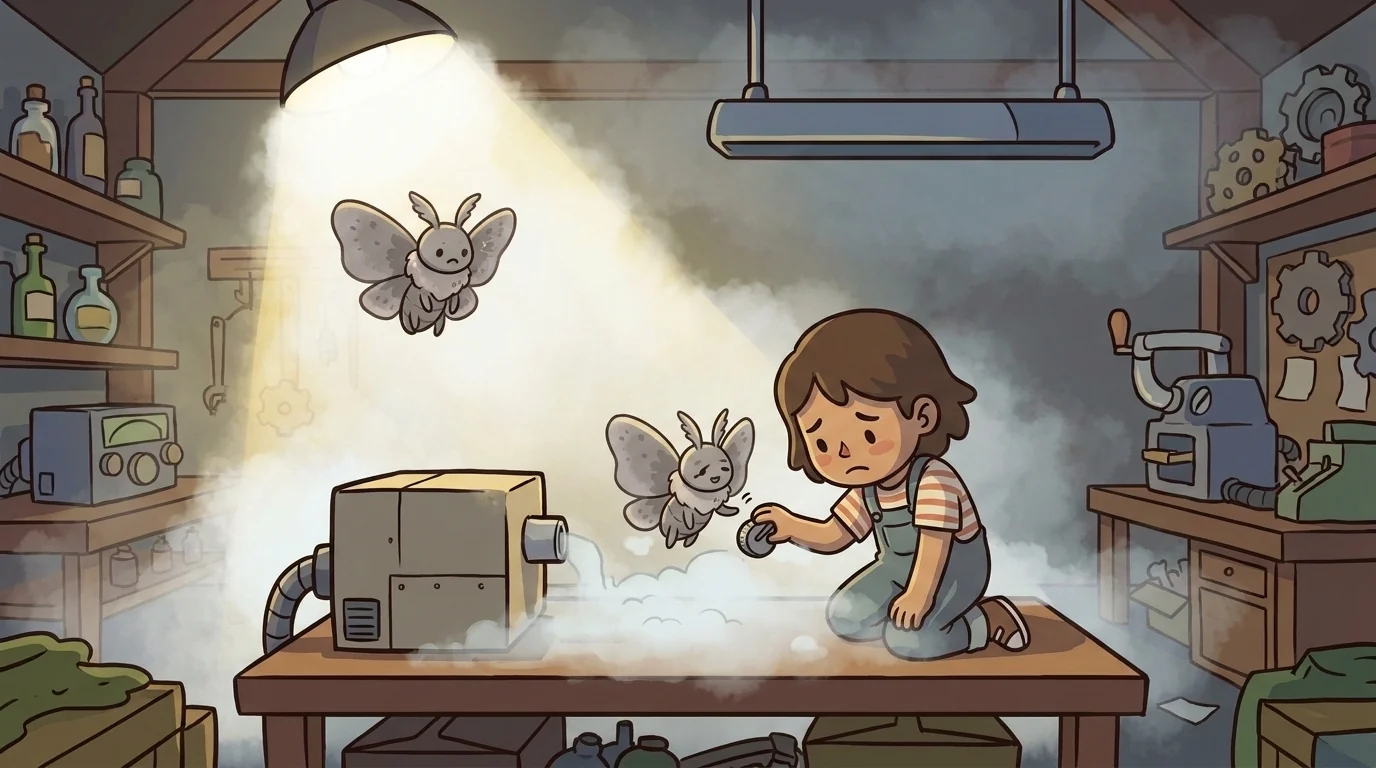
In her workshop she runs the demos in order. She breathes a low mist across a bare floor and switches on one side light — a slanting beam blooms in the haze and the empty room goes hushed and strange. She runs the rain bar in front of a lamp so each drop flashes, "because rain lit from the front reads as nothing — light it from behind or the side so it sparkles." Then the habits, as one gentle rule-set: keep the haze thin (a veil, not a blanket); backlight it (so fog and beams glow instead of going flat grey); layer it by distance (a touch more haze on the far things than the near, so the fade tracks depth); let a little wind move it (still fog looks dead — drifting fog looks alive); and always ask what should this place feel like before turning anything on. Her one firm law: "Less than you think. A whisper of haze reads as miles and mood. A wall of fog reads as 'someone left the machine on.'" Her own first fog that morning had gushed out a blinding white wall; she'd simply eased the dial down, breath by breath, until it hung right. "Too much fog isn't a disaster. It's a dial. You turn it down."
A kid watching a beam hang in the haze asked, "So the spooky misty forest, the beam in the old attic — that's a fog box and a lamp?" "A fog box, a rain bar, a fan, and a light aimed just so — behind the haze," Fogg said, drifting through the beam. "Now stand in it." The kid stepped into the thin mist with the side-light slanting through, and the plain studio went somewhere — deep and full of mood — and a soft wondering hush settled over them: the whole feeling of a place, made of air. Then they nudged the fog dial too far and the beam drowned in white blank, and the small flustered I wrecked it knot pulled tight — until Fogg fluttered close: "Just turn it down, breath by breath — density's only ever a dial." And the knot loosened into something calm and curious. That mood-made-of-air hush, plus the gentle permission to dial the weather up and down, was to Fogg the whole quiet delight of the two jobs of haze.
The EffectsForge ensemble
Fogg is part of EffectsForge's distributed-narrative cast. Each character embodies a different curricular primitive; together they teach the full subject.
-

Crunch
Foley sound — practical sound effects from everyday objects
-

Trick
Forced perspective — the optical illusion that resizes worlds
-

Skin
Prosthetic makeup — craft + chemistry for character, never realistic injury
-

Step
Stop-motion animation — frame by frame, one decision at a time
-

Lamp
Lighting design — the silent author of mood
-

Keye
Chroma key — a chameleon who erases one flat color so a whole new world shows through the hole
-

Matte
Matte painting — paints the part of the world too big to build and blends the seam so the eye can't find where the set ends
-

Servo
Animatronics — foam skin over a jointed frame driven by motors and cables, so a built creature breathes, blinks, and moves on cue
-

Titch
Miniatures — builds it small and perfect, shoots it right, and a thing held in two hands reads as enormous on screen