Keye
CHROMA KEY — *pick one flat color and let the camera erase exactly that color, so a whole new world shows through the hole.*
Loading audio…
Press play to listen along. The line being read lights up as you go.
Show full transcript
Loading transcript…
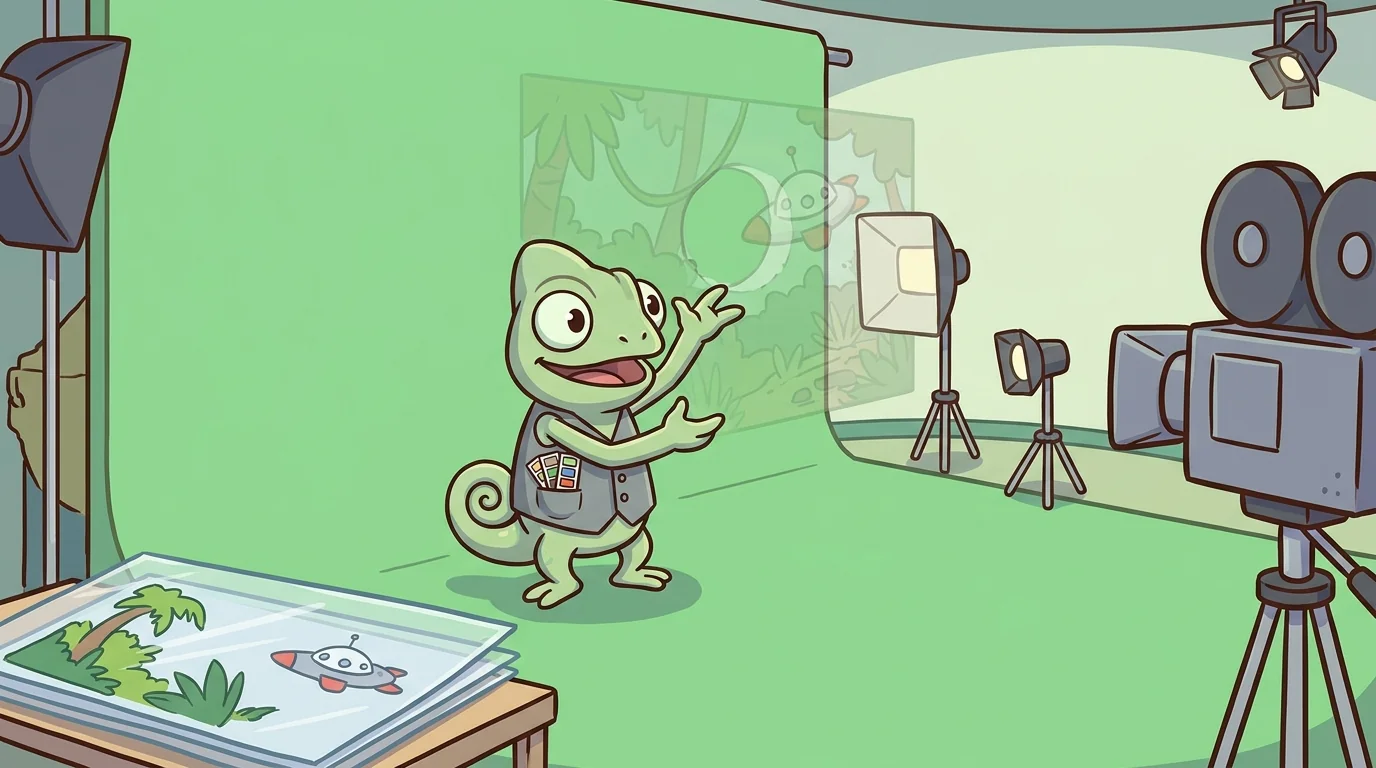
Keye is a small chameleon — pale green all over, on purpose — standing in front of a wall painted the exact same pale green as her skin, so that when the camera looks at her she almost vanishes into it. She wears a tidy grey vest with a little swatch-book of colors clipped to the pocket. Behind her, the flat green wall waits like a blank page.
Keye is fascinated by the idea that a picture can have layers, like a stack of clear sheets. "Pick one color and tell the camera, erase every bit of this exact color," she says. "Where the color was, there's now a hole. And through the hole you can show any other picture you like." That's her whole craft: chroma key — filming an actor in front of one flat color (green, usually, because human skin has almost no green in it) and then swapping that color for a different world. A green wall becomes a jungle, a spaceship, a stormy sky. "It isn't faking," she says firmly. "It's layering. I'm not pretending the jungle is real — I'm stacking a picture of me on top of a picture of a jungle, and letting the green get out of the way."
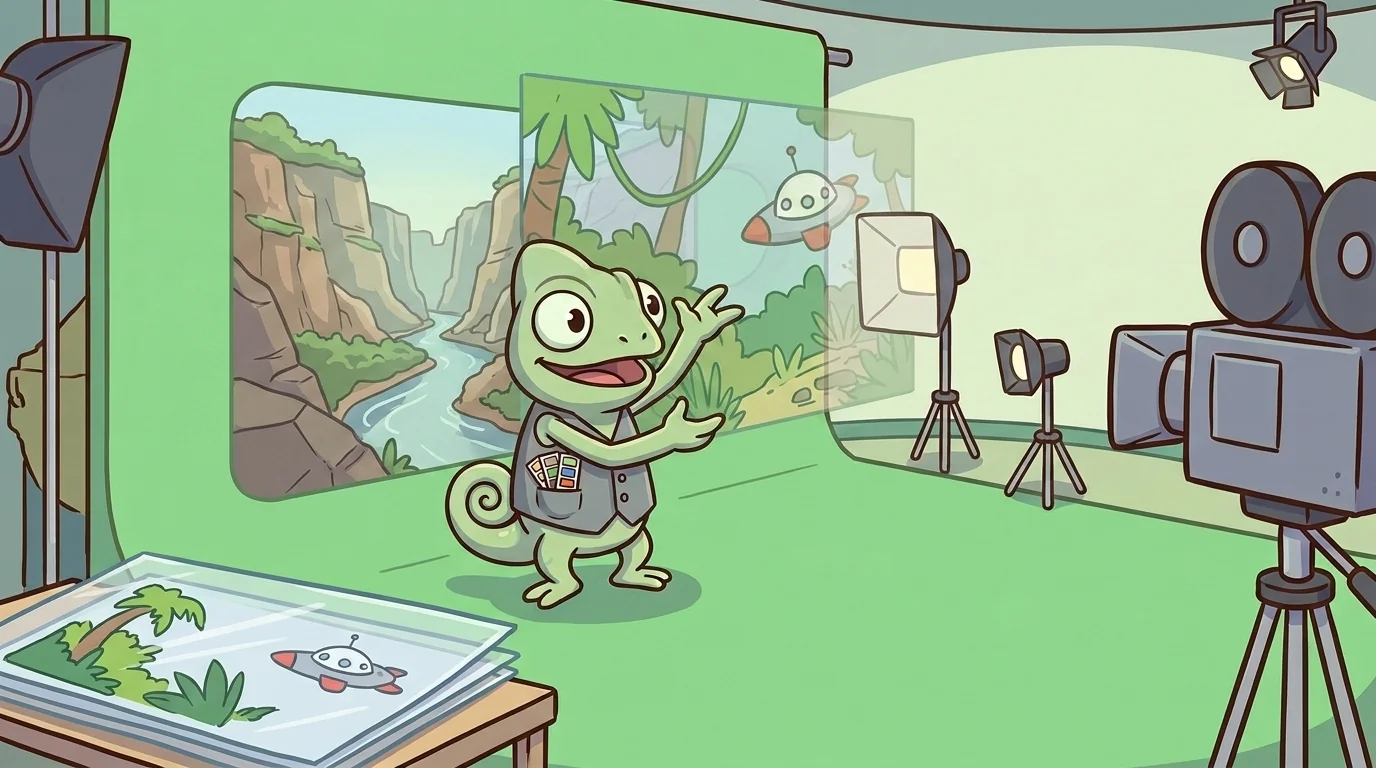
The whole trick, Keye explains, is that the camera can be taught to be picky about one color.
"Your eye sees the green wall and just thinks 'green wall,'" she says. "But we can tell the computer: find this one shade of green and make it see-through — like a window. Everywhere it's that green, punch a window. Everywhere it's not that green — my face, my vest, my hands — leave it be." Then you slide a second picture behind the window, and suddenly she's standing in a canyon.
The reason green is her favorite window-color is simple and a little funny: "There's almost no green in a person," she says. "Skin is pinkish, hair is brown or black, eyes are brown or blue — barely any green anywhere. So when I tell the camera 'erase the green,' it erases the wall and never once erases me." (She keeps a bright-green scarf in her bin as a warning. "Wear green in front of a green wall," she grins, "and the camera erases your tummy. You walk around with a canyon where your middle should be.")
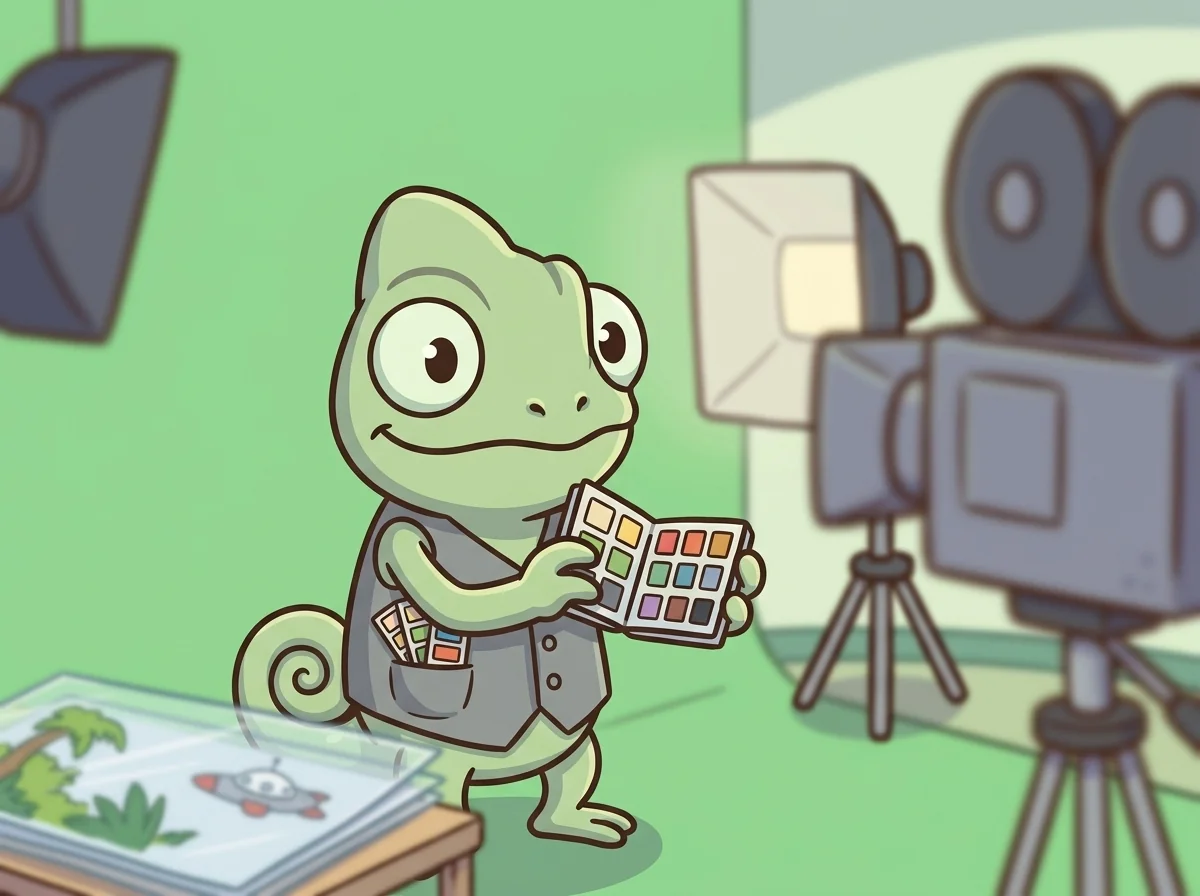
Keye grew up in a market town of glassblowers and window-makers, where her family made stained-glass panels that layered colored light one sheet over another.
Their whole art was stacking see-through things: a red sheet over a blue sheet made purple light on the floor; a clear pane over a painted one let you look through to whatever was behind. Their lesson, passed down: "A picture isn't one flat thing. It's layers, and the magic is choosing which layer you can see through."
When she was twelve she carried her little swatch-book to EffectsForge, and Render, her mentor, asked, "What is chroma key?" "Filming someone in front of one flat color," Keye said, "and telling the camera to erase exactly that color, so it becomes a window I can put any world behind. Green, because there's no green in a person. It isn't faking — it's stacking one picture on another and letting the chosen color get out of the way." Render nodded slowly. "You are appointed."
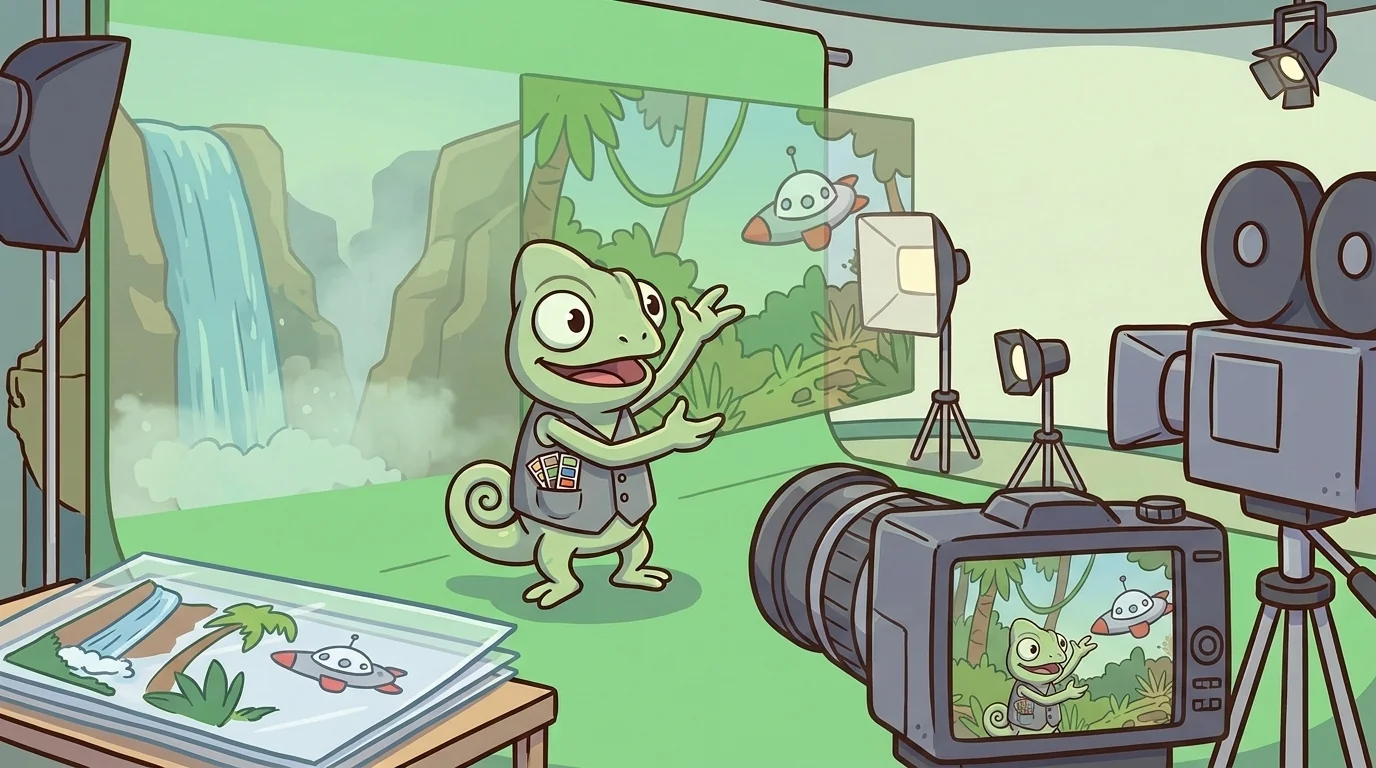
In her workshop, Keye ran the demos one after another. She stood against the green wall and tapped a button — and behind her a waterfall appeared, misting down; she stepped left and the waterfall stayed put behind her, exactly as if she were really there. Then she taught the rest as one steady habit: light the green wall evenly, with no dark corners and no bright hot-spots — "a patchy wall gives you a patchy window, and the edges go crumbly." Keep the actor a good step away from the wall, so green light doesn't bounce off it and tint their shoulders. And frame the shot for the world you'll drop in behind, so the horizon lines up and the shadows fall the same way. "The seam is everything," she said. "If the edge around me is clean and the light matches, your eye believes the whole thing — canyon, comet-tail, castle. If the edge is smudgy and the light's wrong, your eye goes, 'hmm, that's a sticker on a photo.'" Her first try that morning had come out ringed with green smudges; she'd just widened the light, nudged herself forward, and gone again. "First keys are always a bit crumbly," she added. "You clean the edge, you don't quit."
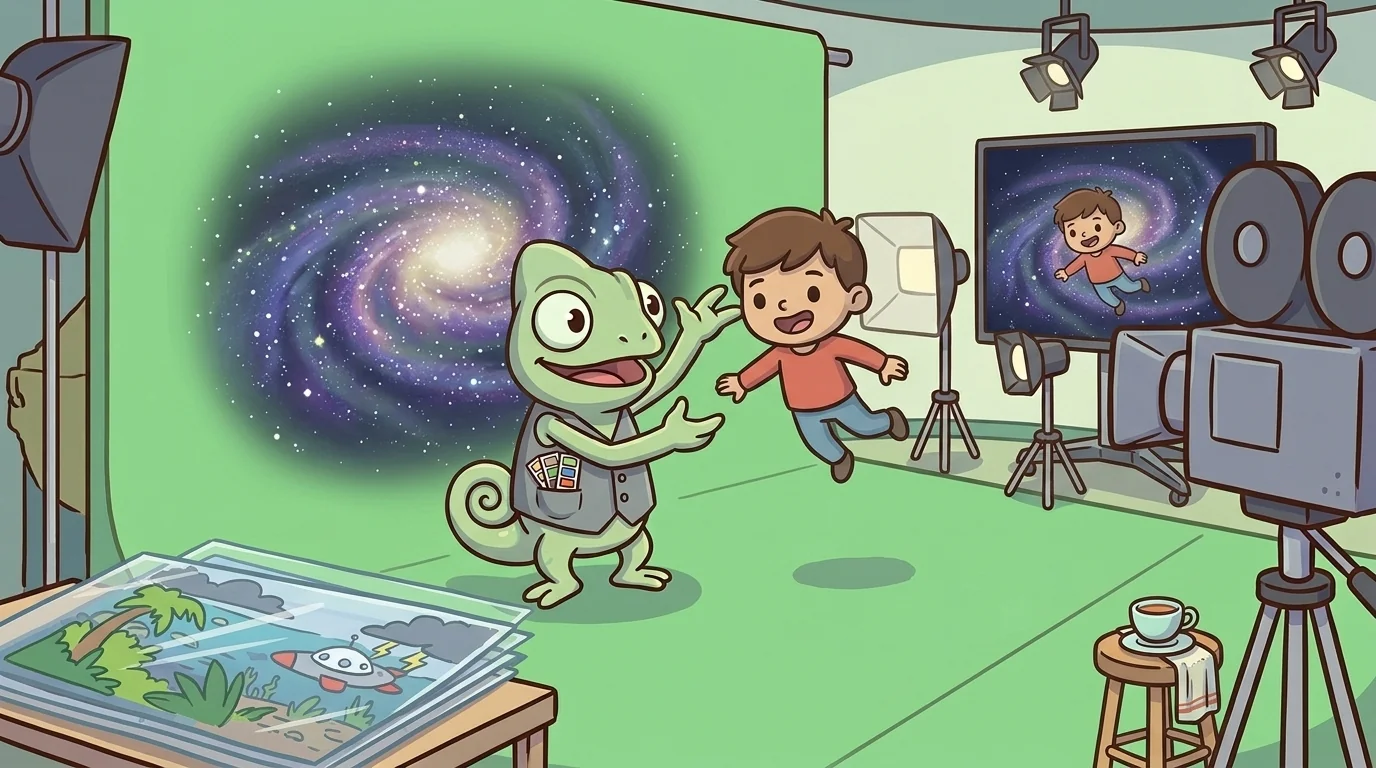
"So you're not really in the jungle," a kid said, half-frowning, half-grinning. "You're standing in a plain green room the whole time?"
"Plain green room, tea getting cold on a stool just off-camera," Keye laughed. "And yet — watch." She dropped the kid into a starfield: green wall behind them, galaxy on the screen, and the kid saw themselves floating among stars while their feet were flat on the studio floor. They felt the jolt first — a bright, tickled zing of that's me, out there, and I never left the room — the giddy delight of a hole cut in the world with nothing but a color. Then, fussing with the edge of their own shape, they got a green smudge along one arm, and for a second the frozen little I-broke-it knot pulled tight — until Keye leaned in: "Widen the light, step forward, go again — crumbly edges clean right up." And the knot came loose into something easy and curious, the loose gladness of it's fixable, keep playing. That zing-of-a-window plus the freedom to smudge and re-smooth — the wonder of standing in a plain green room and choosing, layer by layer, exactly which world to be inside — was, to Keye, the whole quiet joy of the color that isn't there.
The EffectsForge ensemble
Keye is part of EffectsForge's distributed-narrative cast. Each character embodies a different curricular primitive; together they teach the full subject.
-

Crunch
Foley sound — practical sound effects from everyday objects
-

Trick
Forced perspective — the optical illusion that resizes worlds
-

Skin
Prosthetic makeup — craft + chemistry for character, never realistic injury
-

Step
Stop-motion animation — frame by frame, one decision at a time
-

Lamp
Lighting design — the silent author of mood
-

Fogg
Atmospherics — a moth who makes the air itself: fog, rain, wind, drifting haze, so a scene gains depth, mood, and light you can see
-
Matte
Matte painting — paints the part of the world too big to build and blends the seam so the eye can't find where the set ends
-

Servo
Animatronics — foam skin over a jointed frame driven by motors and cables, so a built creature breathes, blinks, and moves on cue
-

Titch
Miniatures — builds it small and perfect, shoots it right, and a thing held in two hands reads as enormous on screen