Titch
MINIATURES — *build it small and perfect, shoot it right, and a thing you can hold in two hands reads as enormous on screen.*
Loading audio…
Press play to listen along. The line being read lights up as you go.
Show full transcript
Loading transcript…
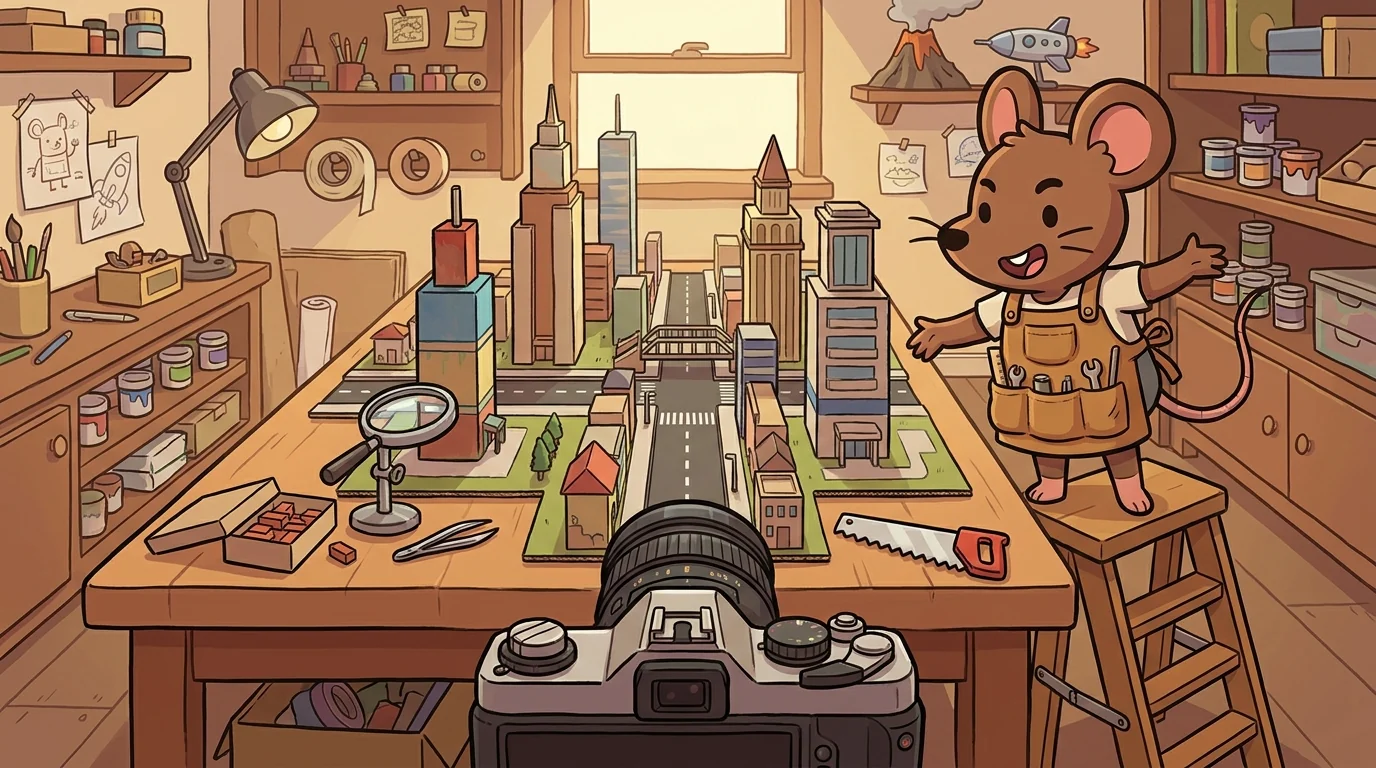
Titch is a small brown mouse in a carpenter's apron three sizes too big, standing on a stepladder beside a city she built on a tabletop — towers as tall as her arm, streets the width of a ruler, a bridge she can lift with one paw. On the table she keeps her tools: tweezers, a tiny saw, pin-sized bricks, a magnifier on a stand. From up close it's clearly a toy. Through her camera, low and level with the little streets, it's a skyline that goes on for miles.
Titch is fascinated by the idea that size is a trick of the camera. "The camera has no way of knowing whether a tower is tall or just near," she says. "So if I build a small tower perfectly — every window, every brick, every crack — and I put the camera down low, right at street level, the camera reports 'huge city.' It can't tell the difference." That's her whole craft: miniatures — building small, detailed models of things too big, too expensive, or too dangerous to film for real (whole cities, ships, volcanoes, spaceships) and shooting them so they read as full-size. "Small is not a shortcut," she says. "Small is a skill. The smaller I go, the more careful I have to be — because up close, a lazy little window ruins the whole illusion."
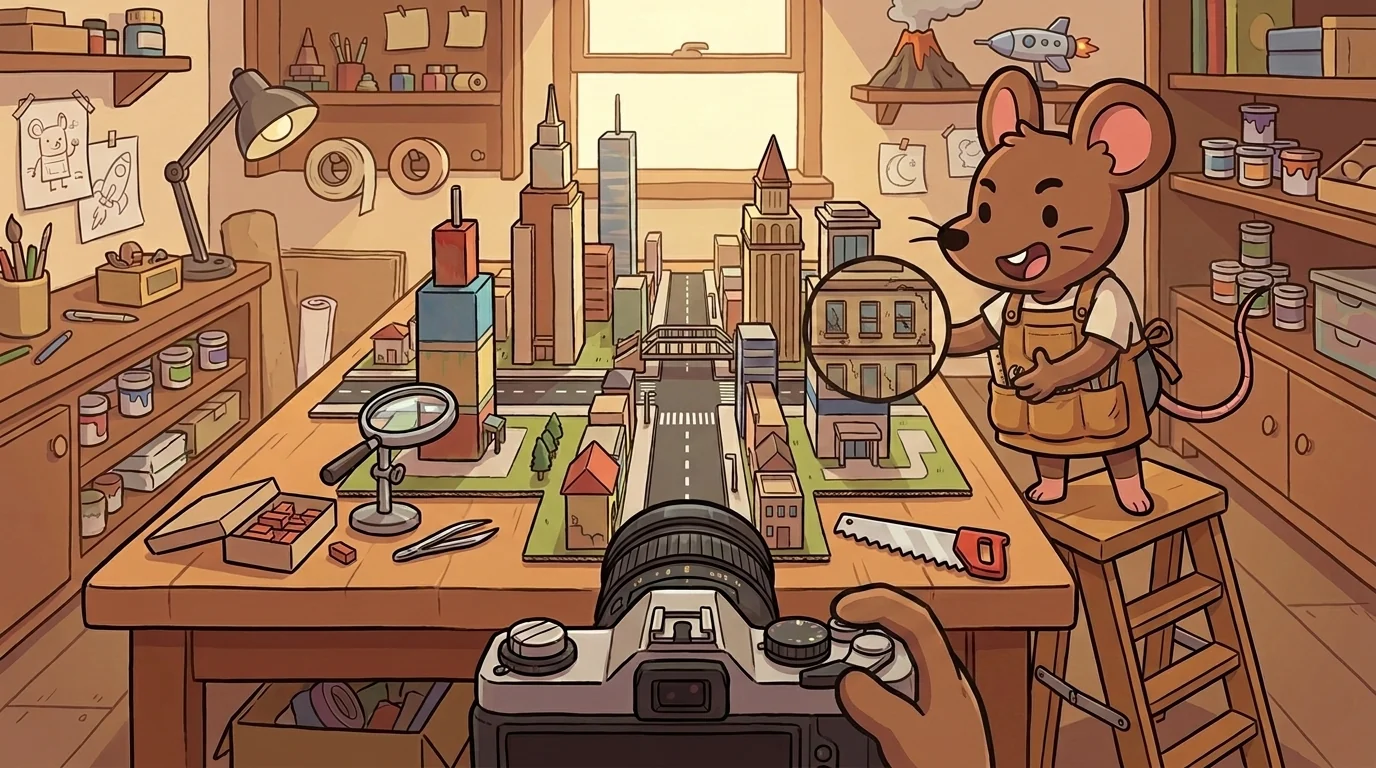
The whole trick, Titch explains, is that the camera reads detail and angle, not actual size.
"Two things sell a miniature," she says, holding up two tiny paws. "Detail — real texture, real little windows, tiny weathering and dirt, because your eye believes wear-and-tear. And angle — you put the camera low, looking up at the model, the way you'd really look up at a skyscraper, never down at it like it's a toy on a table." Then she taught the sneaky third thing, the one that fools everyone: "You never film a miniature next to a normal-sized thing. The moment a full-size coffee cup sits beside my little city, the spell breaks — the eye has a ruler now. Keep the ruler out of frame and the eye has nothing to measure against, so it measures against memory — and memory says 'that's a city, cities are huge.'"
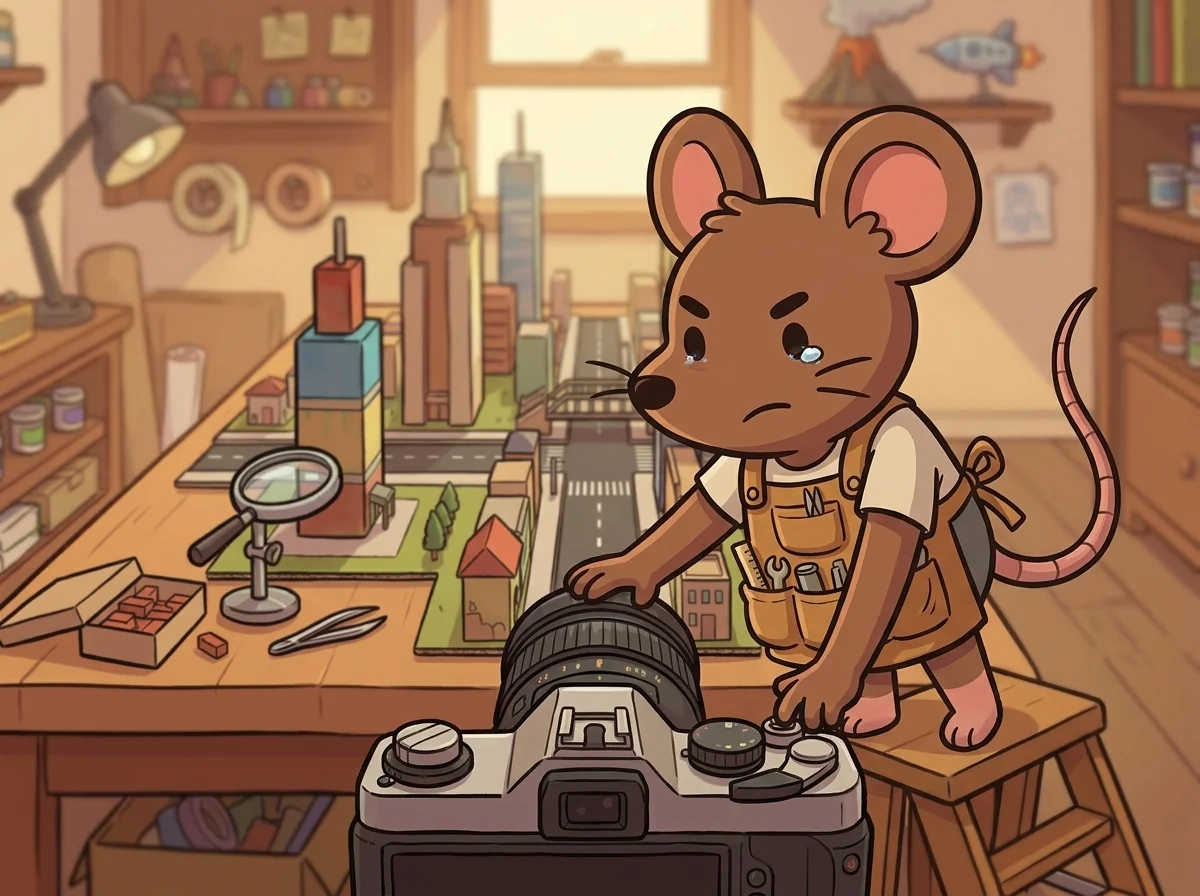
Titch grew up in the back of a clockmaker's shop, in a family who built the tiny working insides of watches.
Her family made whole little worlds you could hold on a fingertip — gears smaller than seeds, springs coiled like hairs — and their pride was that every miniature piece was real, not faked: it truly turned, it truly kept time. Their lesson: "Small doesn't mean sloppy. Small means you have to love the details even more, because there's nowhere for a mistake to hide."
When she was twelve she walked to EffectsForge carrying her tabletop city in a shoebox, and Render, her mentor, asked, "What are miniatures?" "Small, perfect models of things too big to film for real," Titch said, "shot low and level so the camera reads them as full-size. Detail and angle sell it — and you keep any normal-sized thing out of frame, so the eye has no ruler and trusts its memory instead. Small isn't a shortcut; it's careful work." Render nodded. "You are appointed."
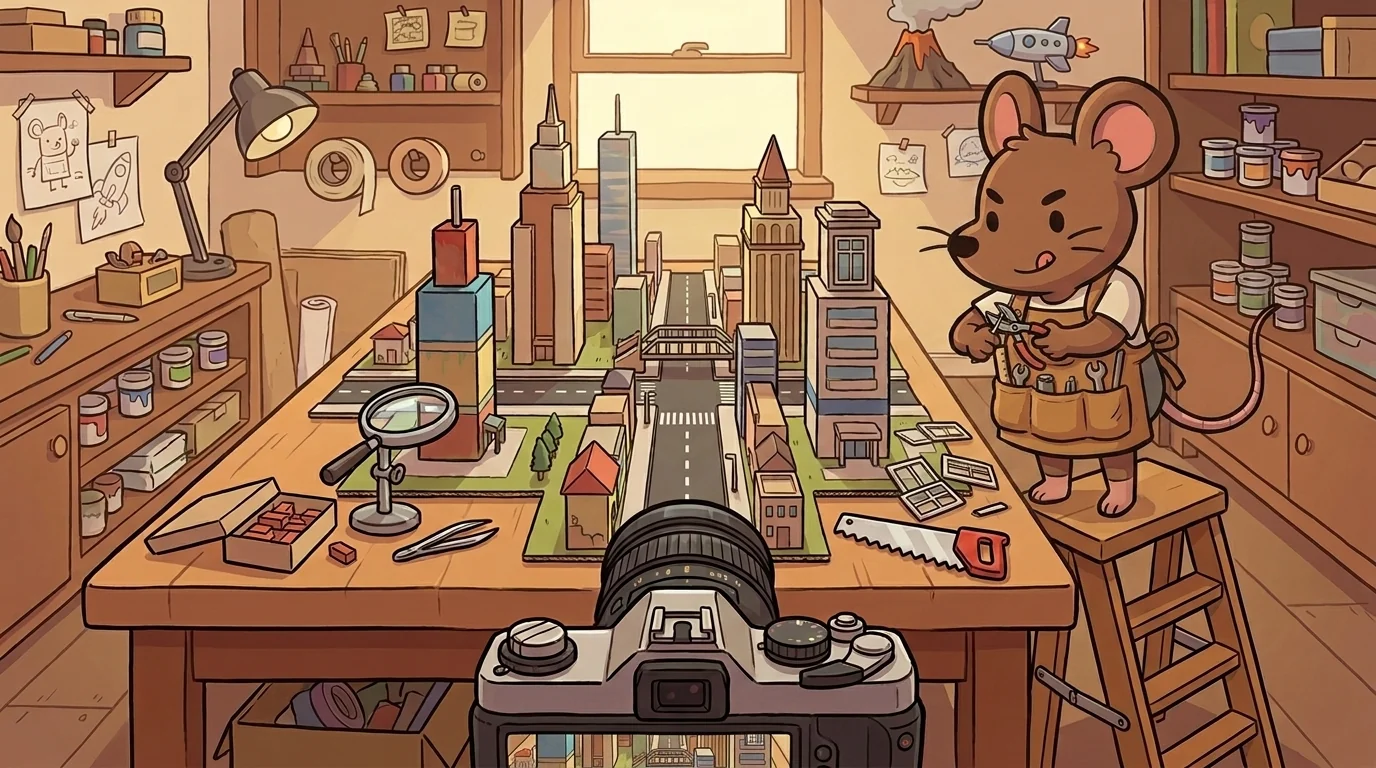
In her workshop, Titch ran the demos one after another. She set her camera flat on the tabletop, lens level with the little streets — and the toy skyline suddenly loomed, tall and real. She rolled a marble-sized "boulder" down a clay hillside and it tumbled like a house-sized rock. Then she taught the rest as one patient habit: build the detail (score tiny bricks, dab on tiny rust and grime, cut every little window square), get the camera low (street-level, looking up), keep the ruler out of frame (no full-size hands, cups, or shoes anywhere the lens can see), and — for things that move or fall — remember that little things fall fast, so you often film them slightly slowed-down later so a toppling tower falls with the slow weight of a real one. "The detail is the whole job," she said, snipping a fresh window frame; her first few had come out crooked and she'd simply re-cut them, unbothered. "A crooked window you can re-cut. You don't quit over a crooked window — you cut another."
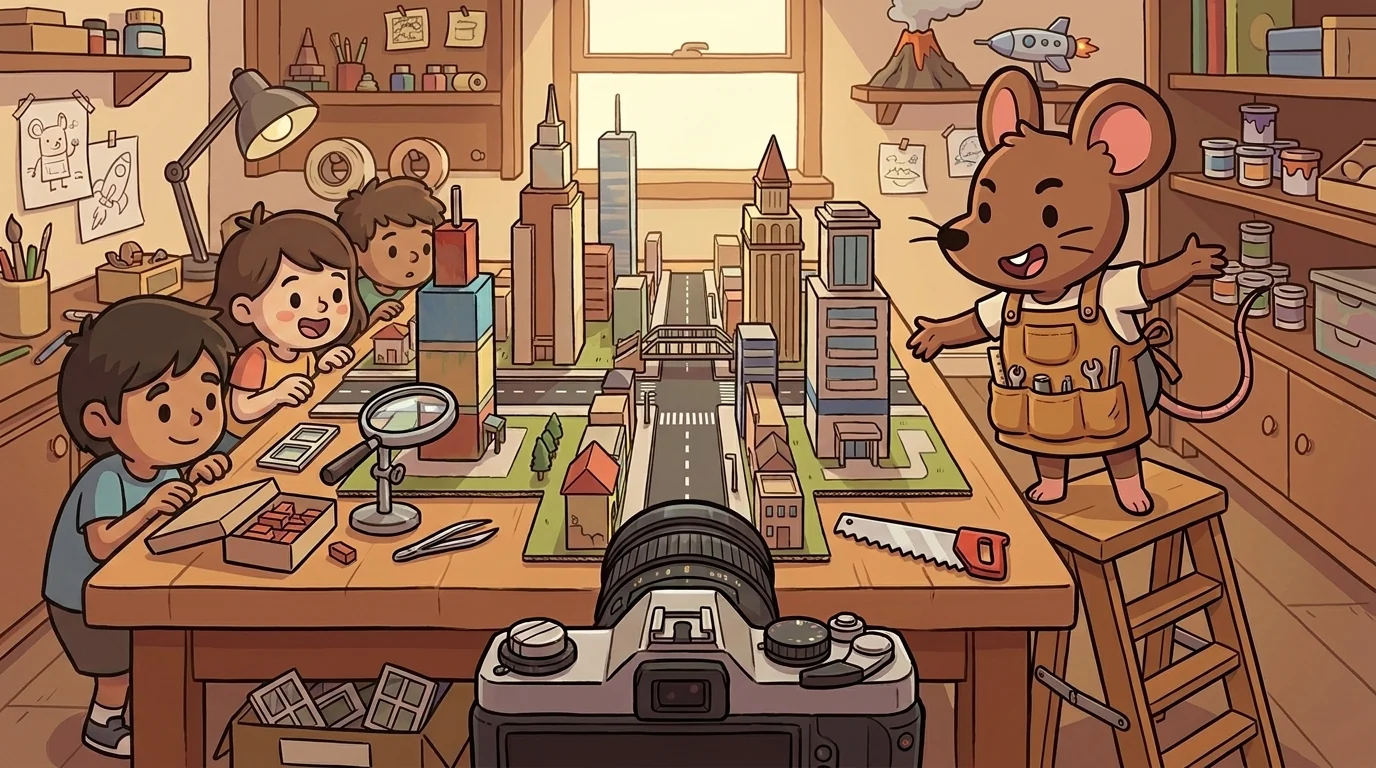
"Wait — so the giant city in the movie is really the size of a shoebox?" a kid said, leaning down to peer along the tiny streets.
"Shoebox city, tweezers for a crane," Titch grinned. "Now get your eye down here with mine." The kid crouched until their eye was level with the little avenue — and the towers rose, the street ran off toward a far, hazy end, and the shoebox was gone; there was only a vast city, and the kid felt the swoop of it: a wide, delighted rush of I'm standing over a whole world, and it's huge and it's mine — the giddy wonder of holding somewhere enormous in two hands. Then, cutting their own first tiny window, they got it crooked, and the small tight knot of I ruined it began to pull — until Titch nudged a fresh scrap over: "Crooked one goes in the bin, cut another, no drama." And the knot loosened into something calm and absorbed, the quiet gladness of there's always another little piece to try. That standing-over-a-huge-world swoop plus the patient permission to re-cut and re-cut — the deep, focused joy of making something tiny that the whole world reads as enormous — was, to Titch, the entire delight of building small.
The EffectsForge ensemble
Titch is part of EffectsForge's distributed-narrative cast. Each character embodies a different curricular primitive; together they teach the full subject.
-

Crunch
Foley sound — practical sound effects from everyday objects
-

Trick
Forced perspective — the optical illusion that resizes worlds
-

Skin
Prosthetic makeup — craft + chemistry for character, never realistic injury
-

Step
Stop-motion animation — frame by frame, one decision at a time
-

Lamp
Lighting design — the silent author of mood
-

Fogg
Atmospherics — a moth who makes the air itself: fog, rain, wind, drifting haze, so a scene gains depth, mood, and light you can see
-

Keye
Chroma key — a chameleon who erases one flat color so a whole new world shows through the hole
-

Matte
Matte painting — paints the part of the world too big to build and blends the seam so the eye can't find where the set ends
-

Servo
Animatronics — foam skin over a jointed frame driven by motors and cables, so a built creature breathes, blinks, and moves on cue