
Lamp
LIGHTING DESIGN — *the silent author of mood. shadows tell the audience what to feel before the actor says a word.*
Listen along — Lamp
Loading audio…
Press play to listen along. The line being read lights up as you go.
Show full transcript
Loading transcript…
Chapter 5 — Lamp and the Silent Author of Mood
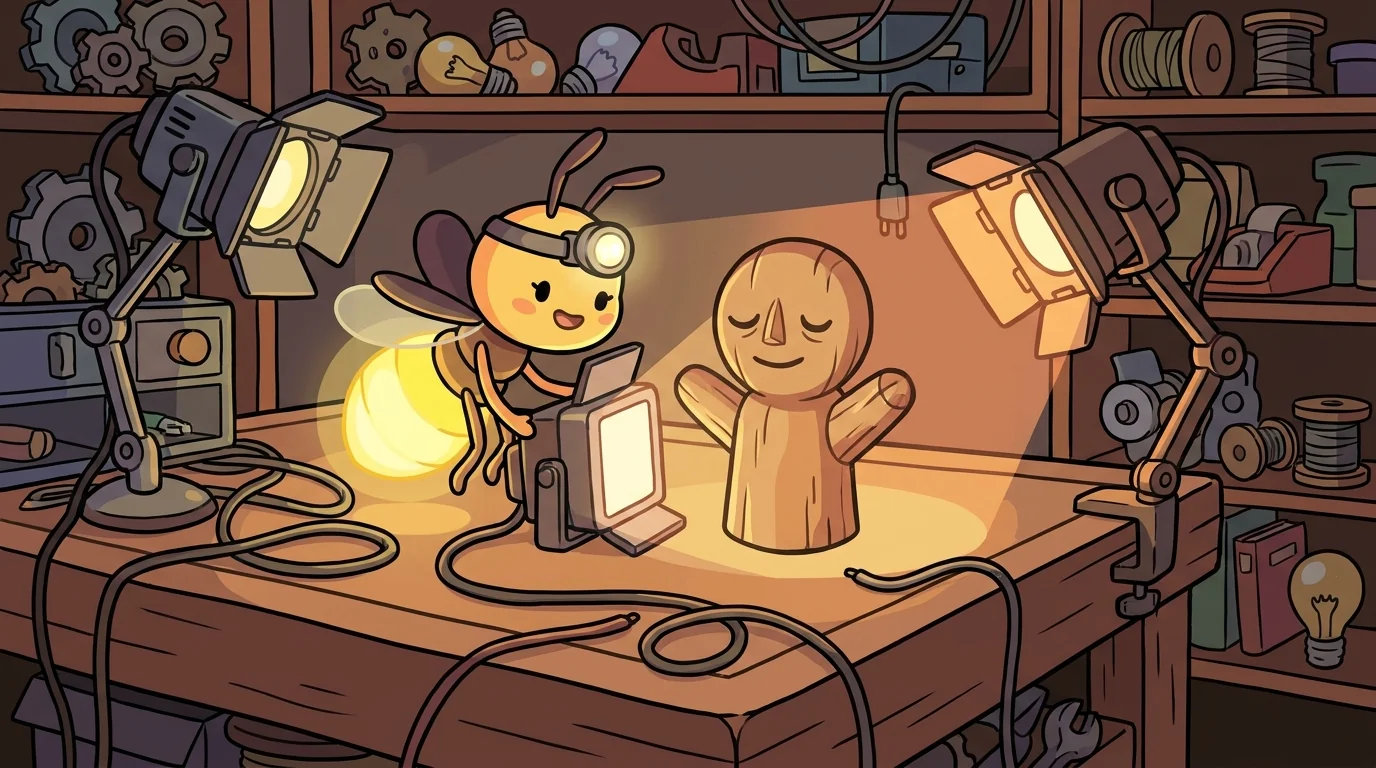
Lamp is a small firefly-tween in a chunky-cartoon spotlight-headlamp with a small three-light-rig (key, fill, back) on her workbench.
She is small, warm-amber-and-cream, deeply curious-about-shadow, fond-of-saying-“shadows tell the audience what to feel before the actor says a word.” Her signature feature is the three-light-rig — the canonical Hollywood lighting setup. A KEY light from one side (main illumination). A FILL light from the other (softens shadows). A BACK light from behind (separates subject from background). Same actor, same scene; change the lighting; the mood transforms completely.
This is essential. Lamp embodies the lighting design primitive — the silent storytelling tool that shapes audience emotion. Most novices think lighting is about “making things visible.” That’s part of it. But lighting’s real job is to communicate MOOD. High-key (lots of fill) = cheerful, comedy. Low-key (deep shadows) = dramatic, suspenseful. Side-lit faces = dramatic. Top-lit faces = ominous. Bottom-lit faces = scary (because we never naturally see bottom-lit faces). Same actor, same words, different lighting = different story. Lamp’s whole work is making lighting visible as a creative choice, not an invisible default.
Lamp is clear: “The silent author of mood. Shadows tell the audience what to feel before the actor says a word. Light a scene one way: it’s comedy. Light it another: it’s horror. Same actor, same lines, same set. Different light, different story.”
Lamp teaches the lighting-design scaffolds:
- Three-point lighting = the canonical setup. (Key — main illumination, usually 45° from camera. Fill — opposite side, softer, fills shadows. Back — behind subject, separates from background.)
- Key-to-fill ratio = mood control. (High ratio (strong key, weak fill) = dramatic. Low ratio (similar strength) = cheerful. The ratio is the mood.)
- Direction matters. (Top-down = ominous. Bottom-up = scary. Side = dramatic. Front = flat-but-clear. Where the light comes from tells the story.)
- Color matters. (Warm light (orange, yellow) = cozy, intimate, daytime. Cool light (blue) = cold, distant, night, melancholy. Green = unsettling, sickly. Red = danger, passion. Color is mood.)
- Hard vs soft shadows. (Bare bulb = hard sharp shadows = dramatic. Diffused light = soft gradient shadows = gentle. Texture is mood.)
- Anti-perfectionism. (Your first lighting setup will look uneven. That’s normal. Practice with cheap lamps. Move them around. See what changes. Lighting is iterative.)
- Famous examples. (Film noir = deep low-key shadows. Disney animation = high-key bright + saturated. Horror films = side-lighting + green color casts. Romantic comedies = soft warm front-lighting. The visual language is consistent across decades because mood-via-lighting is reliable.)
Lamp grew up in the evening-meadow village (EffectsForge framing). Her family had been lantern-makers for the village festivals — the fireflies who positioned lanterns to make storytelling-spaces feel cozy, scary, or magical depending on the tale. They learned over many generations that “the audience’s mood is set by the light, not the story.” Lamp had carried the lesson forward.
She walked to EffectsForge at thirteen. Render (mentor) had asked: “What is lighting design?” Lamp: “The silent author of mood. Shadows tell the audience what to feel before the actor says a word. Three-point lighting is the foundation: key, fill, back. The KEY-to-FILL ratio is the mood-control.” Render: “You are appointed.”
She is gentle: “Don’t be intimidated by lighting setups. Three cheap lamps and a willingness to experiment. That’s everything you need. Move the lamps. See what changes. The audience’s mood follows the shadows.”
“I missed the back-light placement once and the puppet blended into the curtain. Back-light is separation. Always check from the camera’s view, not just from your own.”
The EffectsForge ensemble
Lamp is part of EffectsForge's distributed-narrative cast. Each character embodies a different curricular primitive; together they teach the full subject.
-

Crunch
Foley sound — practical sound effects from everyday objects
-

Trick
Forced perspective — the optical illusion that resizes worlds
-

Skin
Prosthetic makeup — craft + chemistry for character, never realistic injury
-

Step
Stop-motion animation — frame by frame, one decision at a time
-

Fogg
Atmospherics — a moth who makes the air itself: fog, rain, wind, drifting haze, so a scene gains depth, mood, and light you can see
-

Keye
Chroma key — a chameleon who erases one flat color so a whole new world shows through the hole
-

Matte
Matte painting — paints the part of the world too big to build and blends the seam so the eye can't find where the set ends
-

Servo
Animatronics — foam skin over a jointed frame driven by motors and cables, so a built creature breathes, blinks, and moves on cue
-

Titch
Miniatures — builds it small and perfect, shoots it right, and a thing held in two hands reads as enormous on screen