
Matte
MATTE PAINTING (Advanced) — paint the part of the world too big or impossible to build, and defeat the SEAM. The eye only doubts a picture when it can find the edge, so the painting and the real plate must share ONE light direction, the same ATMOSPHERIC PERSPECTIVE (distance goes hazy-blue and low-contrast), and a boundary blended along HIGH-FREQUENCY detail (treeline, fog, rooftops) where no single edge can be found. Ninety of a hundred careful minutes go into the last inch on each side of the join.
Loading audio…
Press play to listen along. The line being read lights up as you go.
Show full transcript
Loading transcript…
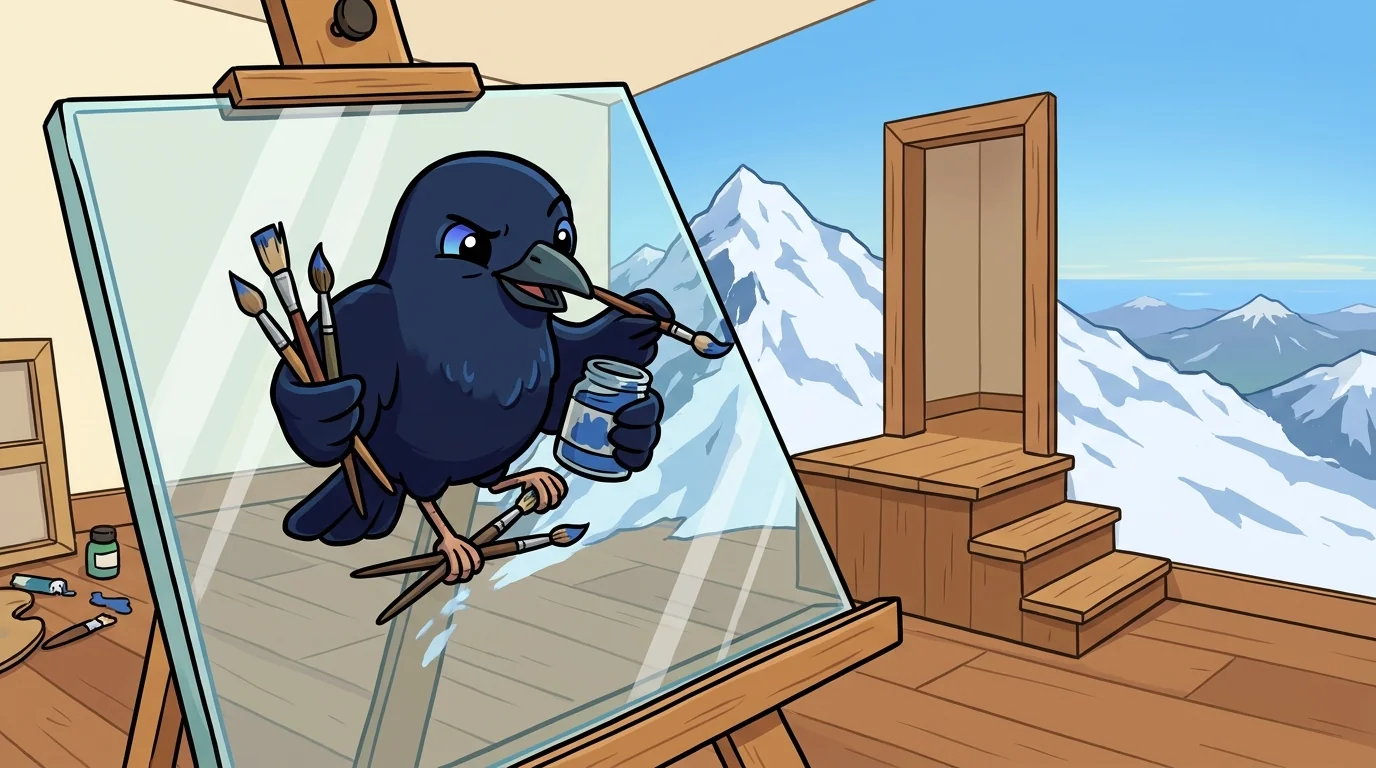
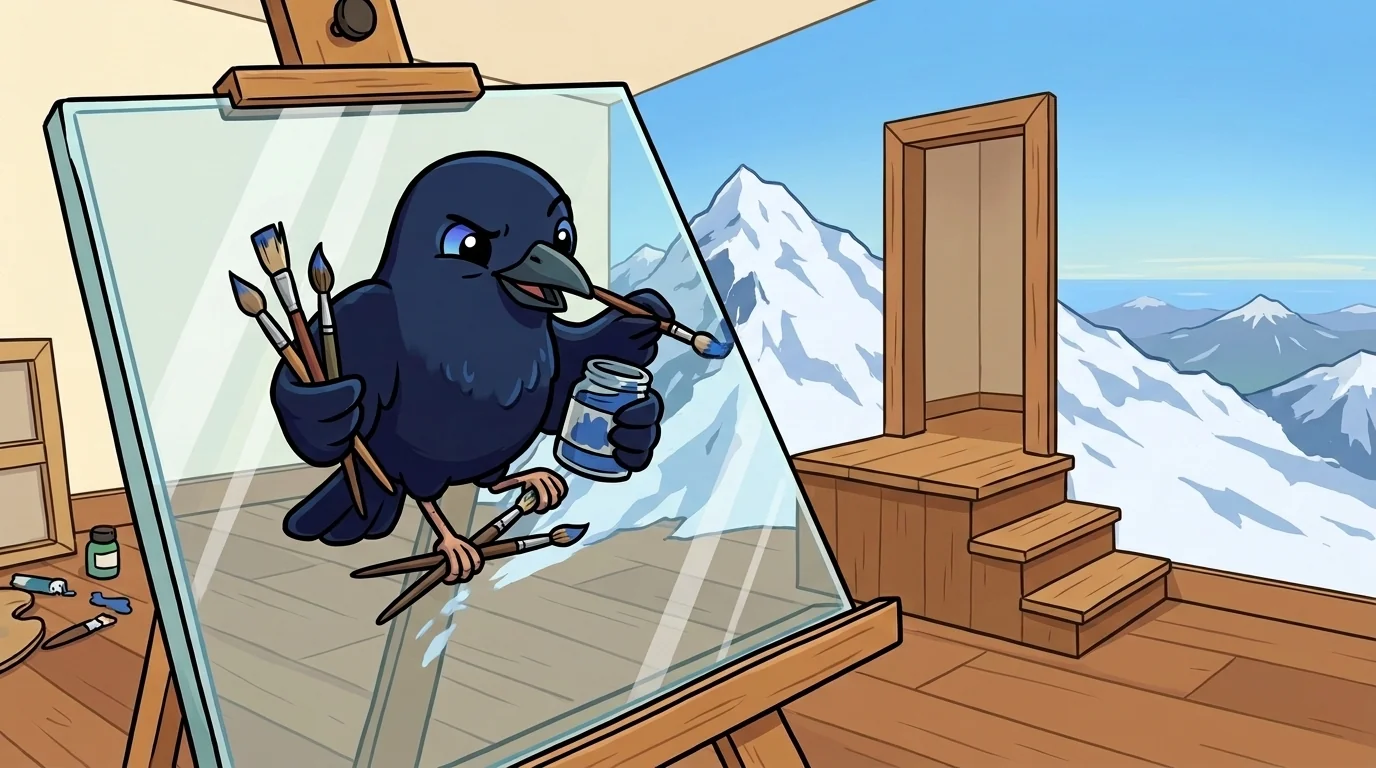
Matte is a small satin bowerbird — deep blue-black with a sharp bright eye — perched at a huge tilted glass easel, painting a mountain range that isn't there. Past the glass sits a plain studio corner: a real doorway, a few real steps. Through her painting, that little corner opens onto snow peaks stretching to the horizon. She squints from glass to steps and back, chasing one thing: the exact spot where paint should stop pretending and the real world take over.
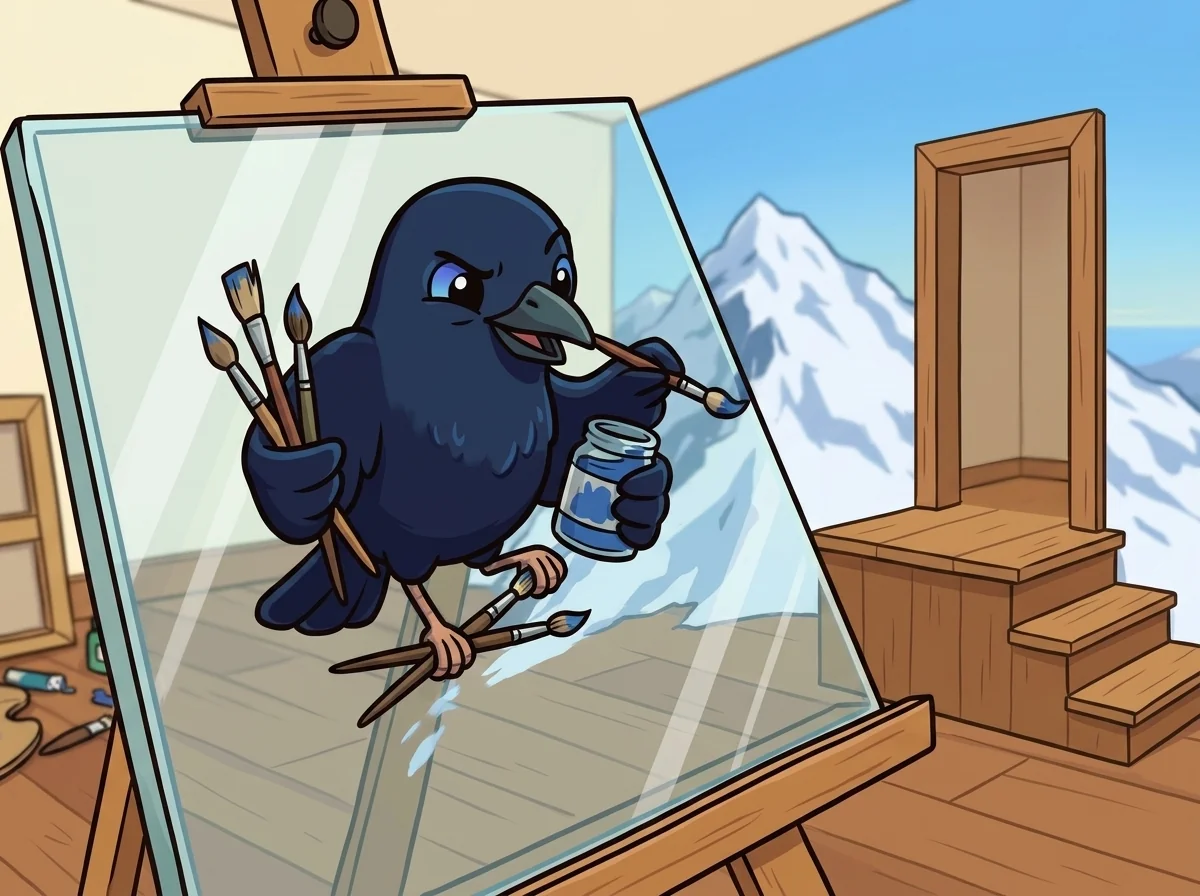
Her craft is matte painting — painting the impossible or too-expensive part of a scene and joining it to the small real set so smoothly the eye can't find the join. "The set only needs to be real where the actor stands and touches," she says. "Nobody walks on the far mountains or the giant palace, so I don't build them — I paint them, and I hide the seam." The Advanced version, she says, is that the whole art is a war on the seam, and it has three fronts.
"The eye only doubts a picture when it can find the edge — a hard line where 'painting stops, photo starts.' Give it that line and it says 'ah, that bit's fake.' So I never leave a hard line, and I fight it three ways. One: one light. If the sun's on the left in the real set, it's on the left in my mountains — same direction, same warmth, same shadow angle. A painted castle lit from the wrong side is caught in half a second, even by someone who couldn't tell you why." She dips her brush. "Two: atmospheric perspective. Real distance is never crisp — the farther a thing, the more the air between washes out its contrast and pushes it toward blue. So my far ridge goes pale, soft, hazy-blue; my near ledge stays sharp and full-colour. A crisp, saturated far mountain looks pasted on, because the eye knows distance should fade. It's the very fade Fogg makes out of real air — I make it out of paint."
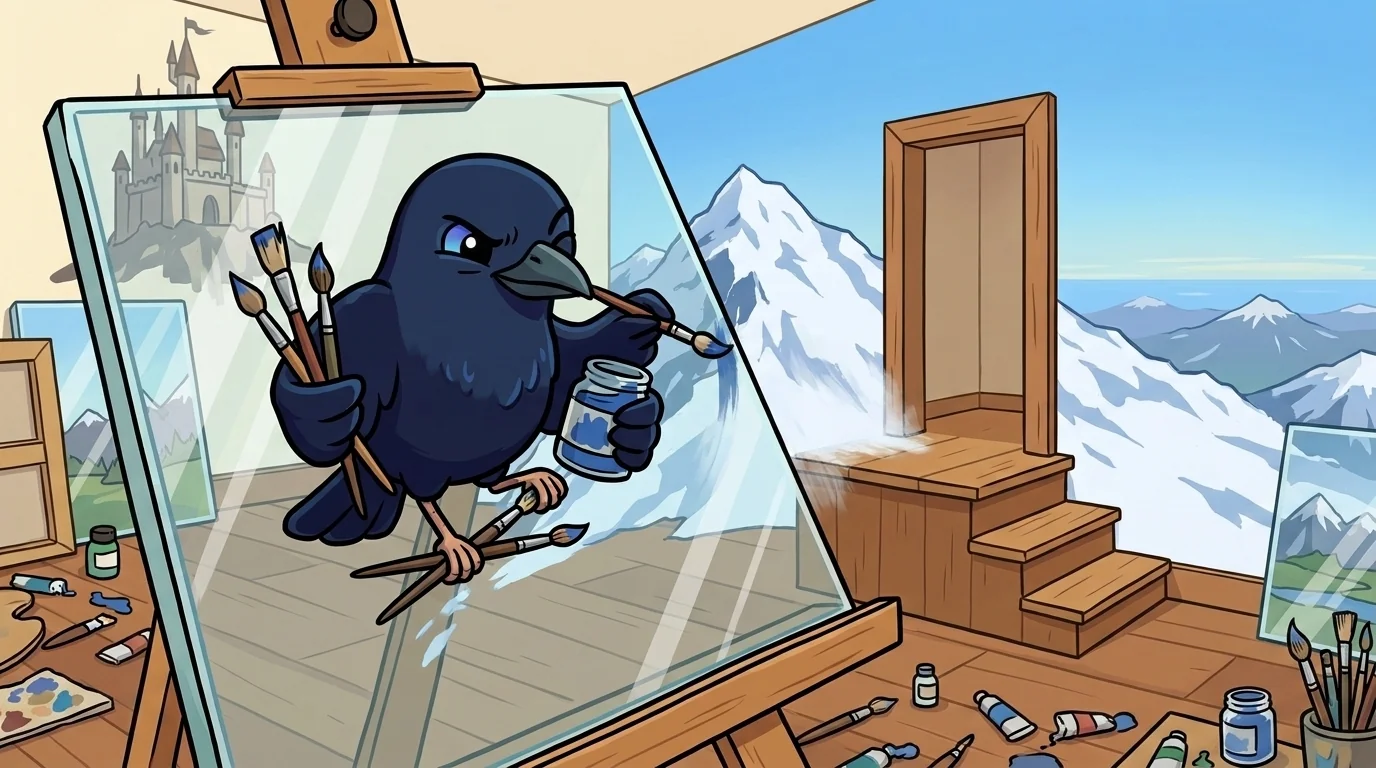
"Three: blend the join along something busy." She feathers a line of trees across the boundary. "Never cut the seam across a smooth, empty area — a clean sky, a flat wall — because there the eye can trace the exact line. Hide it along high-frequency detail: a treeline, a fog bank, the ragged top of a wall, a row of rooftops. Where a thousand little edges jitter, the eye can't tell one brushstroke from one leaf, and the seam disappears into the noise." Her secret is patience with the boundary: "Ninety of my hundred careful minutes go into the last inch on each side of the seam. Painting a nice mountain is the easy half. Making it look like it's really standing behind the real doorway — that's the job." (She adds the modern note: "These days we paint on layers and slide them at slightly different speeds as the camera moves — near layers shift more than far — so the painting gains parallax and feels like real space, not a flat backdrop.")
Matte grew up among bowerbirds famous for their decorated courts, who knew an ancient trick: place big things near the front and small things toward the back and a short court looks long and grand — the eye is fooled into distance. "You don't make a thing big," they taught. "You make the eye believe it's big — and belief lives in the details at the edges." At EffectsForge, Render asked, "What is matte painting?" "Painting the part too big to build," Matte said, "and joining it to the real set so the eye can't find the seam — one light, distance gone hazy-blue, and the join blended along busy edges. Painting the mountain is easy; hiding where it meets the real world is the craft." Render nodded. "You are appointed."
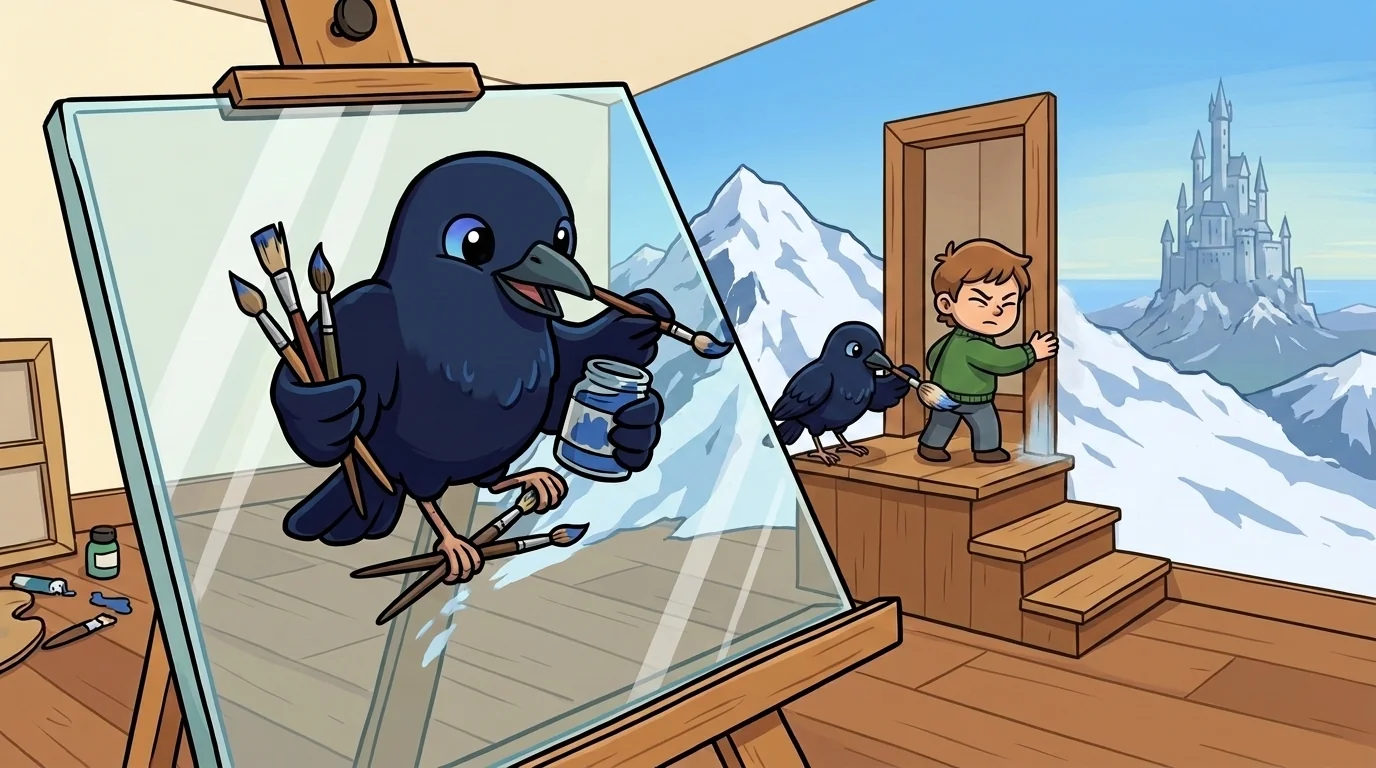
In her workshop she runs the demos in order: a soaring castle painted above a plain wall, sharing its shadow so it seems to grow from it; a far ridge painted crisp and bright — "see how pasted-on it looks?" — then softened hazy-blue until it sits back in real distance; a seam cut across empty sky, obvious as a scar, then re-hidden along a treeline until it melts. Then the habit, as a squint-test: "Squint at the join. A bad seam jumps out as a line; a good seam just melts." Her first blend that morning had shown a faint line where painting met photo; she hadn't scrapped it — she'd feathered the edge softer and softer until it dissolved. "A visible seam isn't a failure. It's a note to keep blending."
"So half the world in the movie is a painting, and I never noticed?" a kid said, staring from the little real steps up to the painted peaks. "Half the sky, most of the castle, all those mountains — paint," Matte said gently. "And the reason you never noticed is the seam." She had them squint at the join, then relax, then squint again — and each time they lost the line, painting and steps folding into one place, the kid felt a slow, dizzy pull, a soft wondering rush of I could walk up those steps and keep going, right into the paint. Then they tried their own join and left a hard edge, and the pinched mine looks fake knot tightened — until Matte dipped a soft brush: "Not fake — just un-blended. Feather it, feather it, watch." And the knot eased into something patient and absorbed: the gladness of rough edges are just edges I haven't softened yet. That step-into-the-picture pull, plus the calm permission to feather a seam for as long as it takes, was to Matte the whole quiet delight of painting what can't be built.
The EffectsForge ensemble
Matte is part of EffectsForge's distributed-narrative cast. Each character embodies a different curricular primitive; together they teach the full subject.
-

Crunch
Foley sound — practical sound effects from everyday objects
-

Trick
Forced perspective — the optical illusion that resizes worlds
-

Skin
Prosthetic makeup — craft + chemistry for character, never realistic injury
-

Step
Stop-motion animation — frame by frame, one decision at a time
-

Lamp
Lighting design — the silent author of mood
-

Fogg
Atmospherics — a moth who makes the air itself: fog, rain, wind, drifting haze, so a scene gains depth, mood, and light you can see
-

Keye
Chroma key — a chameleon who erases one flat color so a whole new world shows through the hole
-

Servo
Animatronics — foam skin over a jointed frame driven by motors and cables, so a built creature breathes, blinks, and moves on cue
-
Titch
Miniatures — builds it small and perfect, shoots it right, and a thing held in two hands reads as enormous on screen