
Titch
MINIATURES (Advanced) — the camera reads DETAIL and ANGLE, not real size, so a small perfect model reads as enormous when you (1) build fine detail + weathering (the eye trusts wear-and-tear), (2) shoot LOW and level looking UP as at a real skyscraper, (3) keep any normal-sized object OUT OF FRAME so the eye has no RULER and measures against memory instead, and (4) respect the PHYSICS OF SCALE — small things fall fast, so you film them OVERCRANKED (high-speed) and play it back slowed, giving a toppling model the slow weight of a real structure.
Loading audio…
Press play to listen along. The line being read lights up as you go.
Show full transcript
Loading transcript…
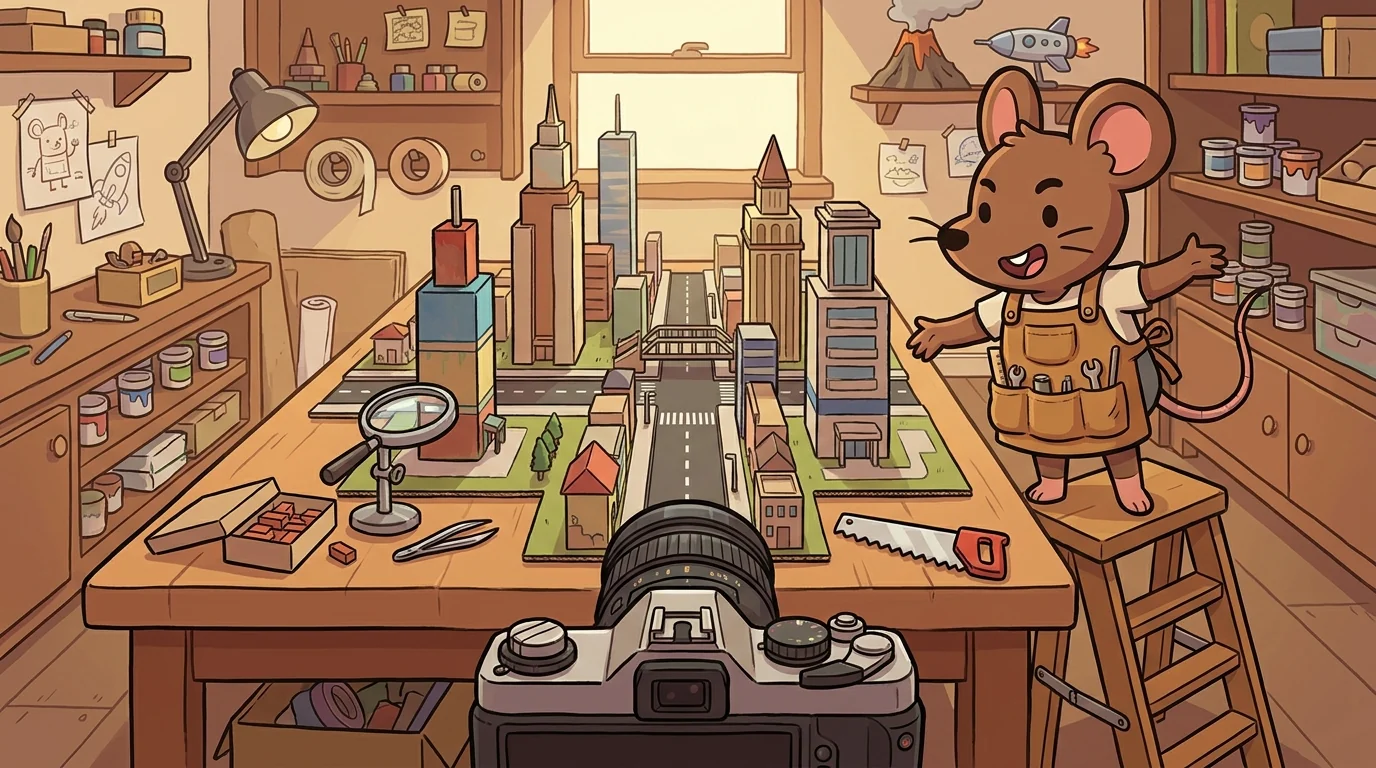
Titch is a small brown mouse in a carpenter's apron three sizes too big, on a stepladder beside a city she built on a tabletop — towers as tall as her arm, streets the width of a ruler, a bridge she can lift with one paw. Her tools: tweezers, a tiny saw, pin-sized bricks, a magnifier on a stand. From up close it's clearly a toy. Through her camera, low and level with the little streets, it's a skyline that goes on for miles.
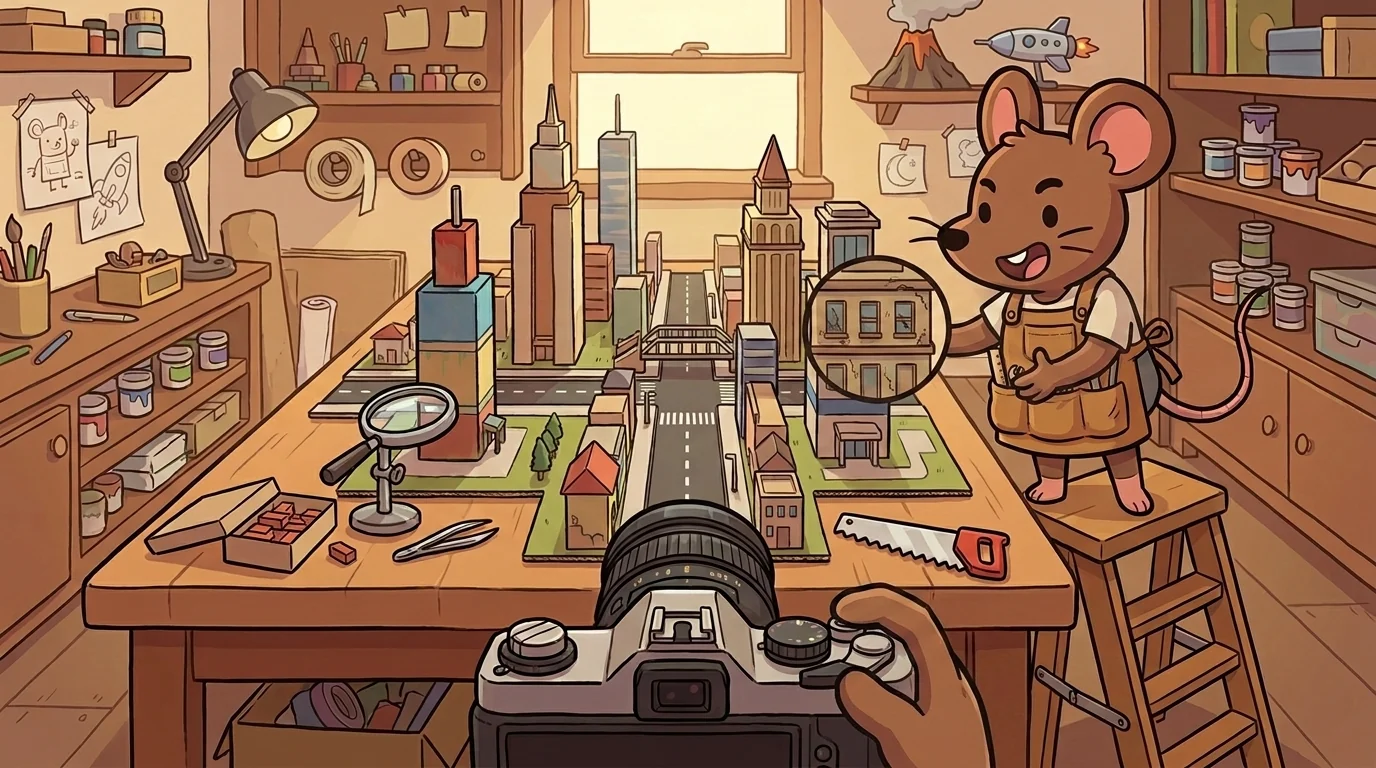
Her craft is miniatures — small, detailed models of things too big, too costly, or too dangerous to film for real, shot so they read full-size. "The camera has no way of knowing whether a tower is tall or just near," she says. "It reads detail and angle, not actual size." The Advanced version, she says, is the four things that make a hand-sized model read enormous — and the last one is physics.
"One: detail and weathering. The smaller I go, the more careful I have to be — up close, a lazy little window ruins the whole illusion. So I score every brick, cut every window square, and — this is the secret — I add wear: tiny rust, grime, water-stains, chipped paint. Your eye deeply believes wear-and-tear, because real things age. A too-clean model reads as a toy; a weathered one reads as a place that's been rained on for a hundred years."
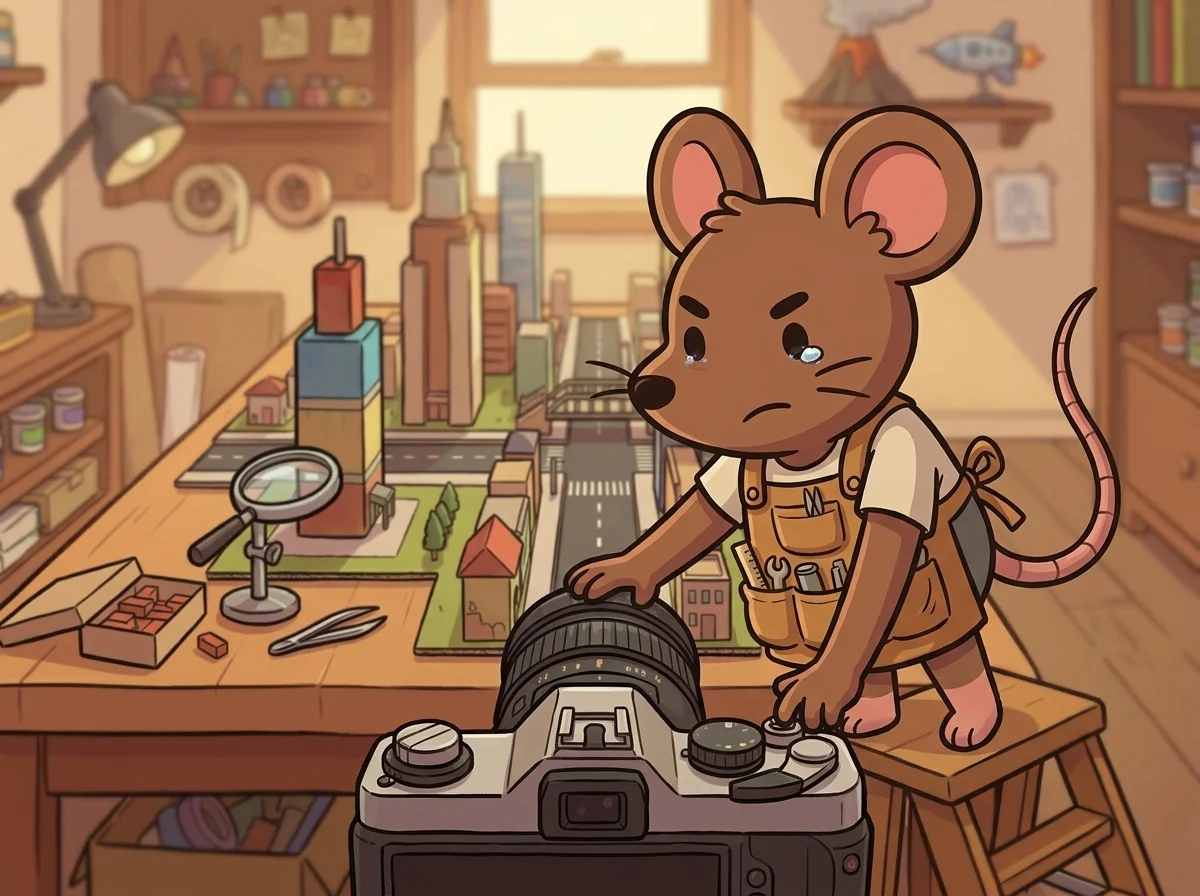
"Two: angle. I put the camera low, looking up at the model, exactly the way you really crane your neck up at a skyscraper — never down at it like a toy on a table. The angle you'd only ever get from below a huge thing tells the eye 'this is huge.'"
"Three — the one that fools everyone — the missing ruler." She sweeps a paw around the table's edge. "Never let a normal-sized thing share the frame. The instant a full-size coffee cup or a hand sits next to my little city, the eye has a ruler and the spell snaps. Keep every known-size object out of frame and the eye has nothing to measure against — so it measures against memory, and memory says 'that's a city, cities are huge.'"
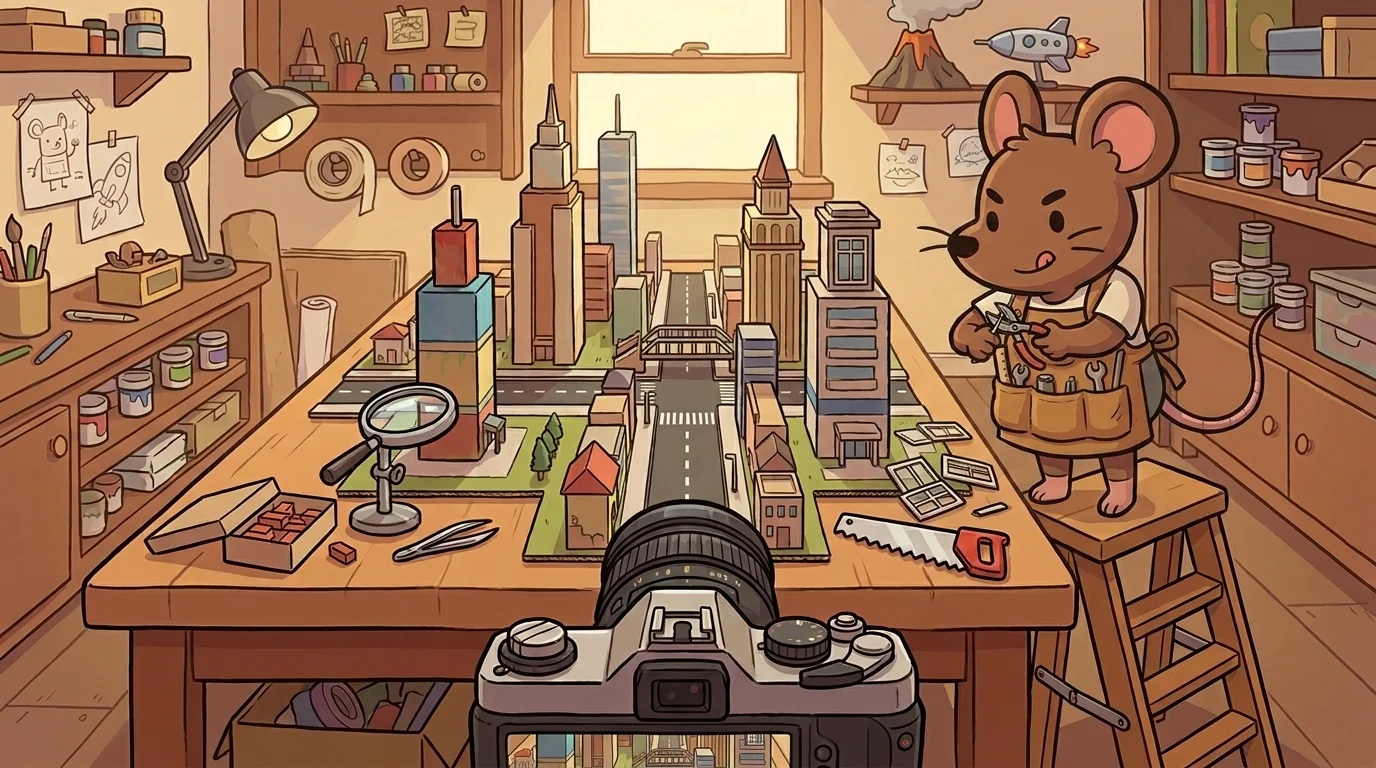
"Four: the physics of scale." She rolls a marble-sized 'boulder' down a clay slope and it tumbles too fast, too light — plink, plink. "Here's what betrays a miniature that moves. Little things fall fast and light — a toy tower topples in a blink, and your eye reads 'small and light' instantly. A real building falls slow, with huge weight. So I film the collapse overcranked — the camera running at high speed, many more frames a second — and played back at normal speed it slows down, and the little tower topples with the ponderous, slow-motion weight of a real one. Water and fire and smoke give miniatures away the same way — they're the hardest things to shrink, because a splash the size of a spoon never falls like a wave." (She adds: "And I open the lens a little so the near and far of my tiny street aren't all razor-sharp — real distance has some softness, and a fully-sharp miniature can read flat.")
Titch grew up in the back of a clockmaker's shop, in a family who built the tiny working insides of watches — gears smaller than seeds, springs coiled like hairs — and whose pride was that every miniature piece truly turned. "Small doesn't mean sloppy," they taught. "Small means you love the details more, because there's nowhere for a mistake to hide." At EffectsForge, Render asked, "What are miniatures?" "Small perfect models of things too big to film for real," Titch said, "shot low and level, weathered and detailed, with every known-size thing kept out of frame so the eye has no ruler. And moving miniatures get overcranked, because little things fall too fast — high-speed playback gives them real weight. Small isn't a shortcut; it's careful work." Render nodded. "You are appointed."
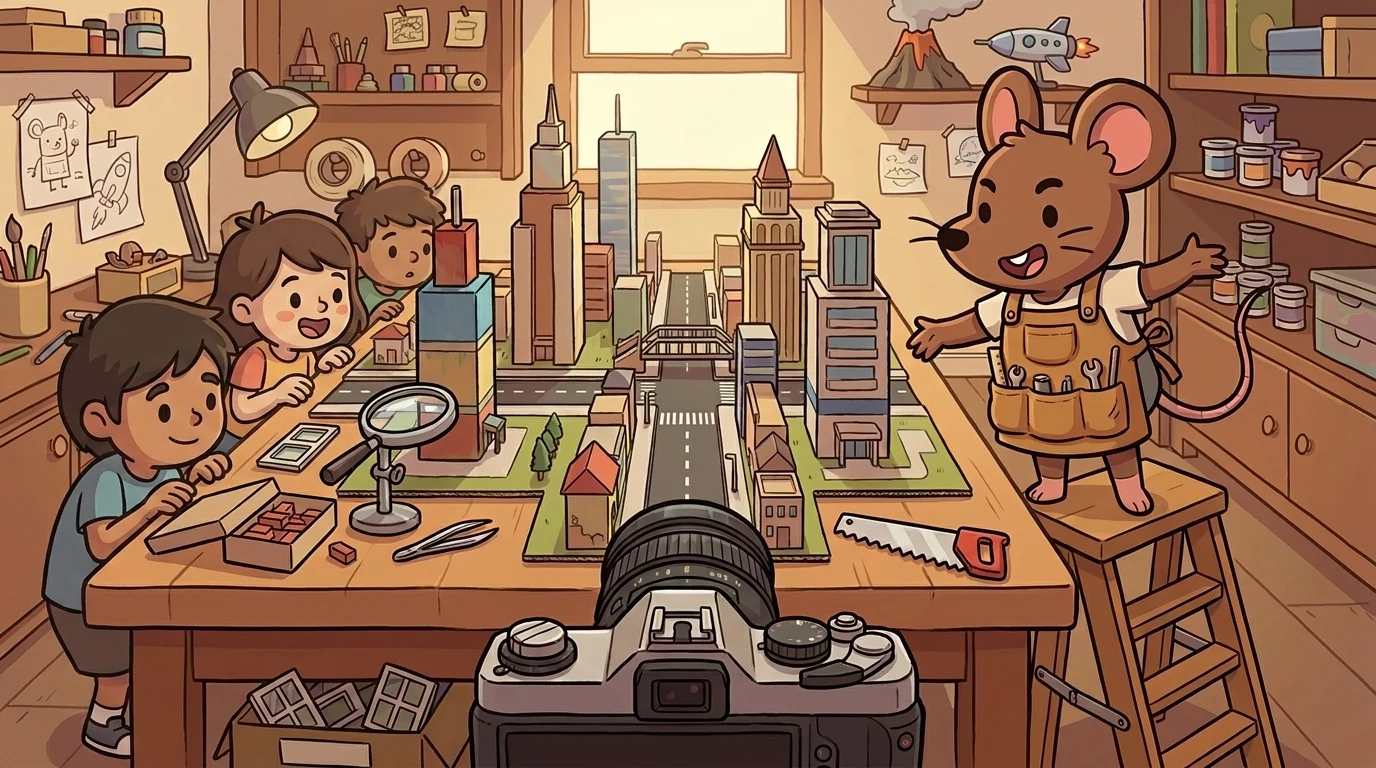
In her workshop she runs the demos in order: the camera flat on the table, lens level with the streets, and the toy skyline suddenly looms; a clean model beside a weathered one — "see how the grimy one reads real and the clean one reads toy?"; a hand set briefly in frame that instantly shrinks the whole city back to a shoebox; and the marble-boulder filmed normal (too fast, too light) then overcranked and slowed until it tumbles with house-sized weight. Then the habit, patient and plain: detail and weathering, camera low, ruler out of frame, and overcrank anything that moves or falls. Her first window-frames that morning had come out crooked; she'd simply re-cut them, unbothered. "A crooked window you re-cut. You don't quit over a crooked window — you cut another."
"Wait — the giant city is really the size of a shoebox?" a kid said, leaning to peer along the tiny streets. "Shoebox city, tweezers for a crane," Titch grinned. "Now get your eye down here with mine." The kid crouched until their eye was level with the little avenue — and the towers rose, the street ran off toward a hazy far end, the shoebox gone; there was only a vast city, and the kid felt the swoop: a wide, delighted rush of I'm standing over a whole world, and it's huge and it's mine. Then, cutting their own first tiny window crooked, the tight I ruined it knot began to pull — until Titch nudged a fresh scrap over: "Crooked one to the bin, cut another, no drama." And the knot loosened into calm, absorbed focus: the gladness of there's always another little piece to try. That standing-over-a-huge-world swoop, plus the patient permission to re-cut and re-cut, was to Titch the entire delight of building small.
The EffectsForge ensemble
Titch is part of EffectsForge's distributed-narrative cast. Each character embodies a different curricular primitive; together they teach the full subject.
-

Crunch
Foley sound — practical sound effects from everyday objects
-

Trick
Forced perspective — the optical illusion that resizes worlds
-

Skin
Prosthetic makeup — craft + chemistry for character, never realistic injury
-

Step
Stop-motion animation — frame by frame, one decision at a time
-

Lamp
Lighting design — the silent author of mood
-

Fogg
Atmospherics — a moth who makes the air itself: fog, rain, wind, drifting haze, so a scene gains depth, mood, and light you can see
-

Keye
Chroma key — a chameleon who erases one flat color so a whole new world shows through the hole
-

Matte
Matte painting — paints the part of the world too big to build and blends the seam so the eye can't find where the set ends
-

Servo
Animatronics — foam skin over a jointed frame driven by motors and cables, so a built creature breathes, blinks, and moves on cue