Spread and Prise
DISTRIBUTE AND FACTOR
Loading audio…
Press play to listen along. The line being read lights up as you go.
Show full transcript
Loading transcript…
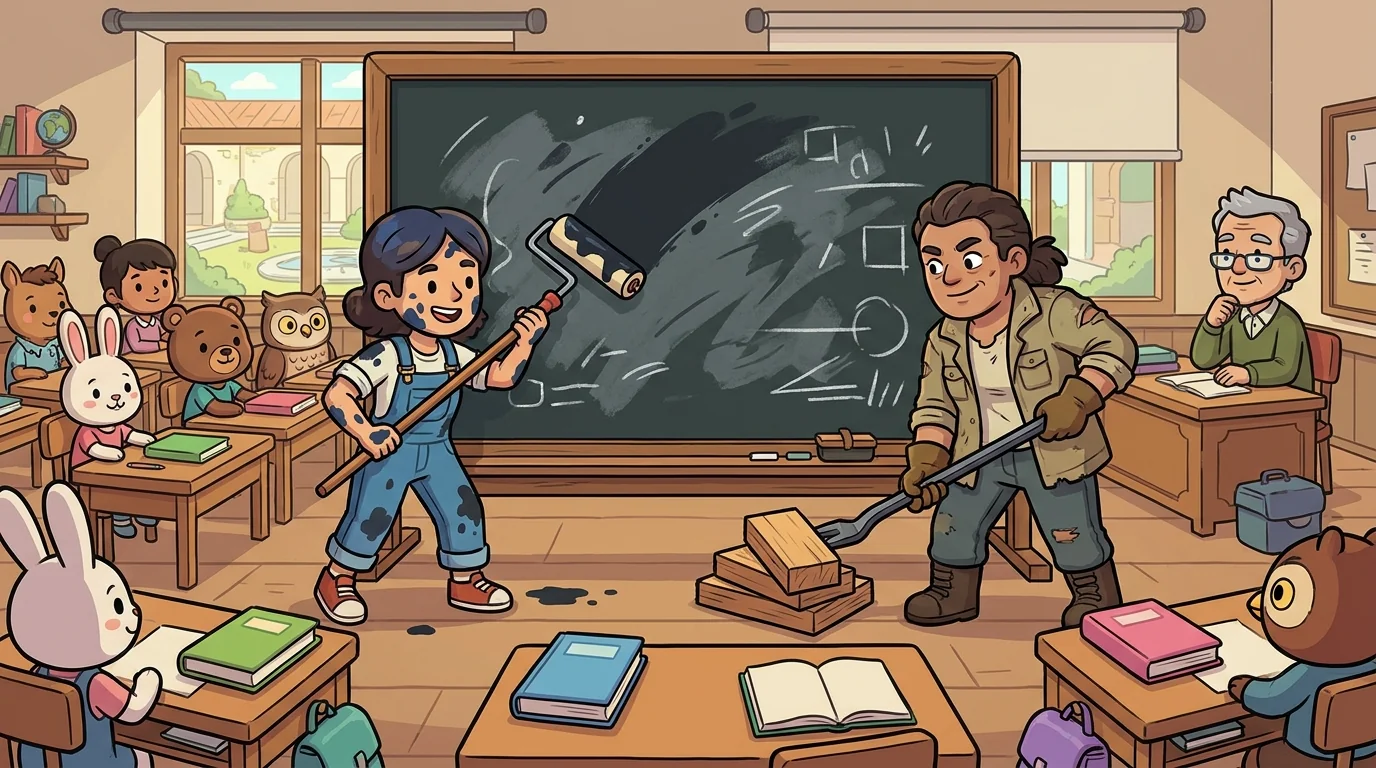
For a whole season, Spread and Prise had taught in classrooms at opposite ends of the academy hall, and for a whole season the children had thought of them as opposites — because that is what they seemed to be.
Spread, the inky printer with her roller, opened things out. Give her a tidy little parcel like 3(x + 4) and she would roll her multiplication across it until it lay open and spread: 3x + 12.
Prise, the dockworker with her worn pry-bar, did the reverse. Give her a spread-out heap like 3x + 12 and she would find what its parts shared and pull it back into a tidy parcel: 3(x + 4).
The children could not decide which of them was right. So one afternoon the academy master did a sensible thing: she put Spread and Prise in the same room, at the same board, and asked them to teach together.
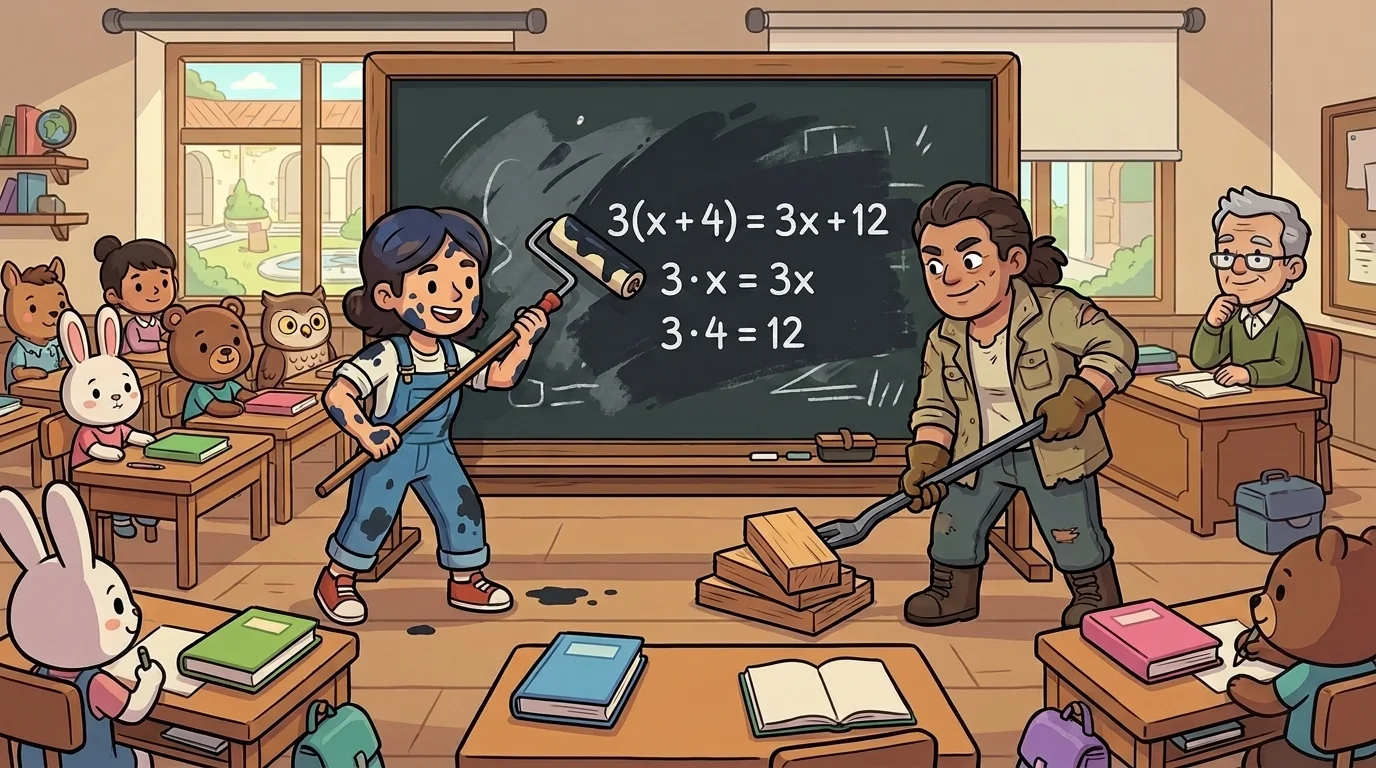
Spread went first, because Spread liked to begin.
She wrote 3(x + 4) on the board and set her roller beside it. "A parcel," she said. "A three, waiting outside a bracket that holds x and 4. My whole job is to roll the three across everything inside." She rolled her hand from left to right. "3 times x is 3x. 3 times 4 is 12. The parcel lies open: 3(x + 4) = 3x + 12. Nothing was lost. It only changed shape — from folded to flat."
The children copied 3(x + 4) = 3x + 12. It felt like unwrapping something.
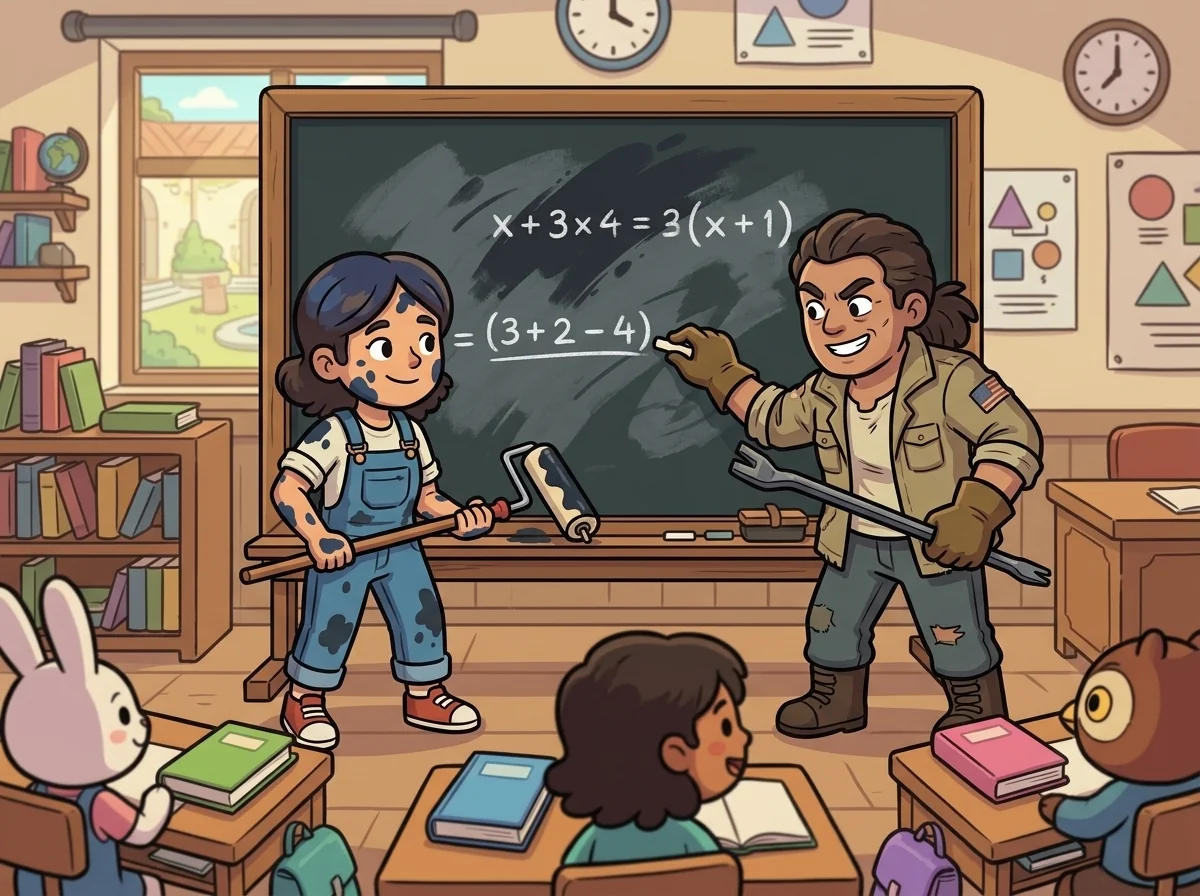
Then Prise stepped up, pry-bar in hand, and rubbed out nothing — she simply pointed at the flat expression Spread had left: 3x + 12.
"Now watch me put it back," said Prise. "A flat heap. But look what its parts share. 3x carries a three. 12 is 3 × 4 — it carries a three too. Both share the three, the same shared strap I'd prise out on the docks." She set her chalk like a bar against the expression. "So I pull the three to the front, and tuck what's left in the bracket: 3x + 12 = 3(x + 4)."
The children looked from Prise's line to Spread's line — and there was a small, delighted silence in the room, because the two lines were the same line, written the two ways.
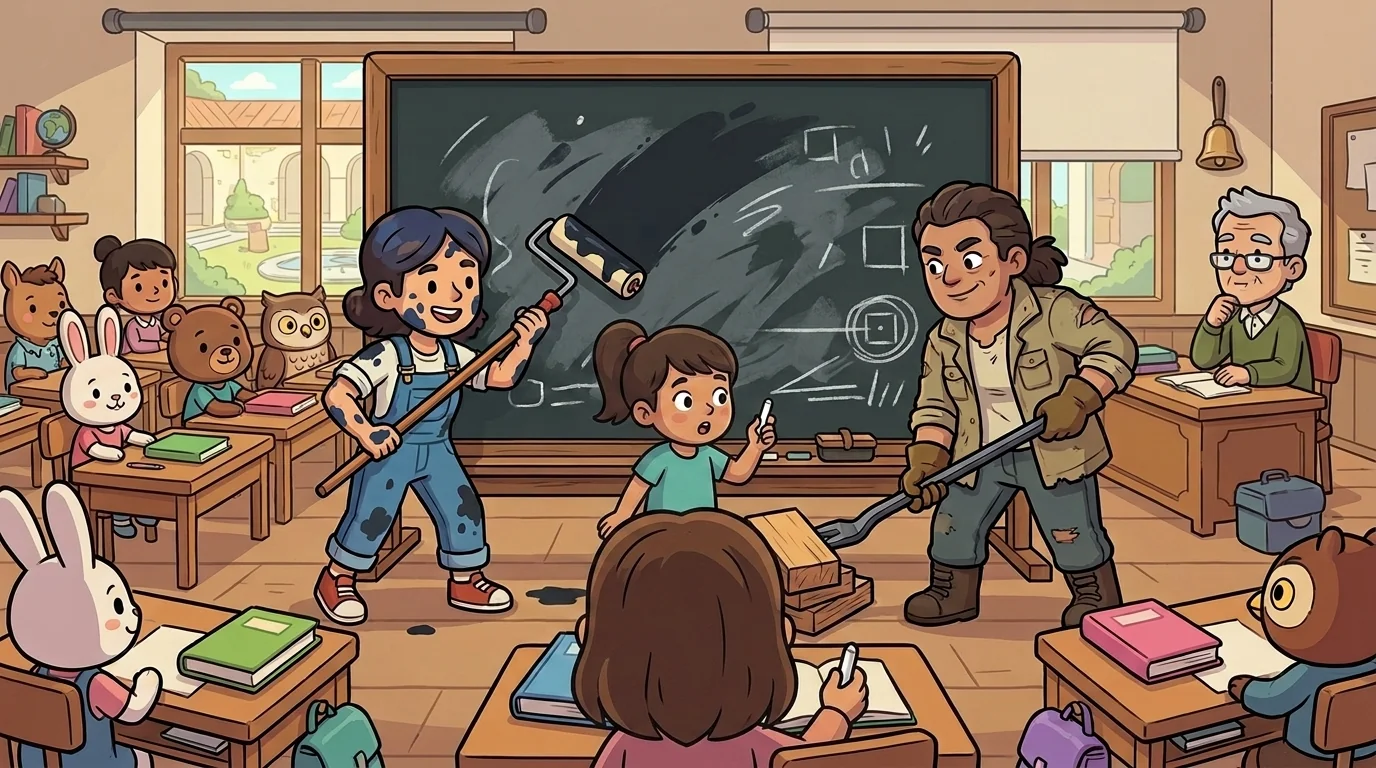
The academy master smiled and handed a fresh piece of chalk to a girl in the middle row. "You try. Both ways. Start here." She wrote 2(x + 5).
The girl took a breath. First she did Spread's job: she rolled the two across. "2 times x is 2x. 2 times 5 is 10. So 2(x + 5) = 2x + 10." She had spread it open.
"Good," said Spread. "Now give it to Prise's hands."
The girl looked at her own 2x + 10. "Both share a two," she said slowly. "2x has a two, and 10 is 2 × 5. So I pull the two out front — 2(x + 5)." She stopped, and her eyes went wide. "It's back where I started. I rolled it open and then I pulled it closed, and it's the same."
"The same road," said Prise, "walked both ways." She and Spread looked at each other with the particular fondness of two people who have argued for a season about who undoes whom, and have just watched a child prove they were never really opposites at all. "When you're not sure your factoring is right," Prise added, "spread it back open and see if you land where you began. And when you're not sure your spreading is right —"
"— prise it back closed," finished Spread, "and see the same." She held up her inky hands. "One road. Two directions. If you can walk it both ways, you can never get lost on it."
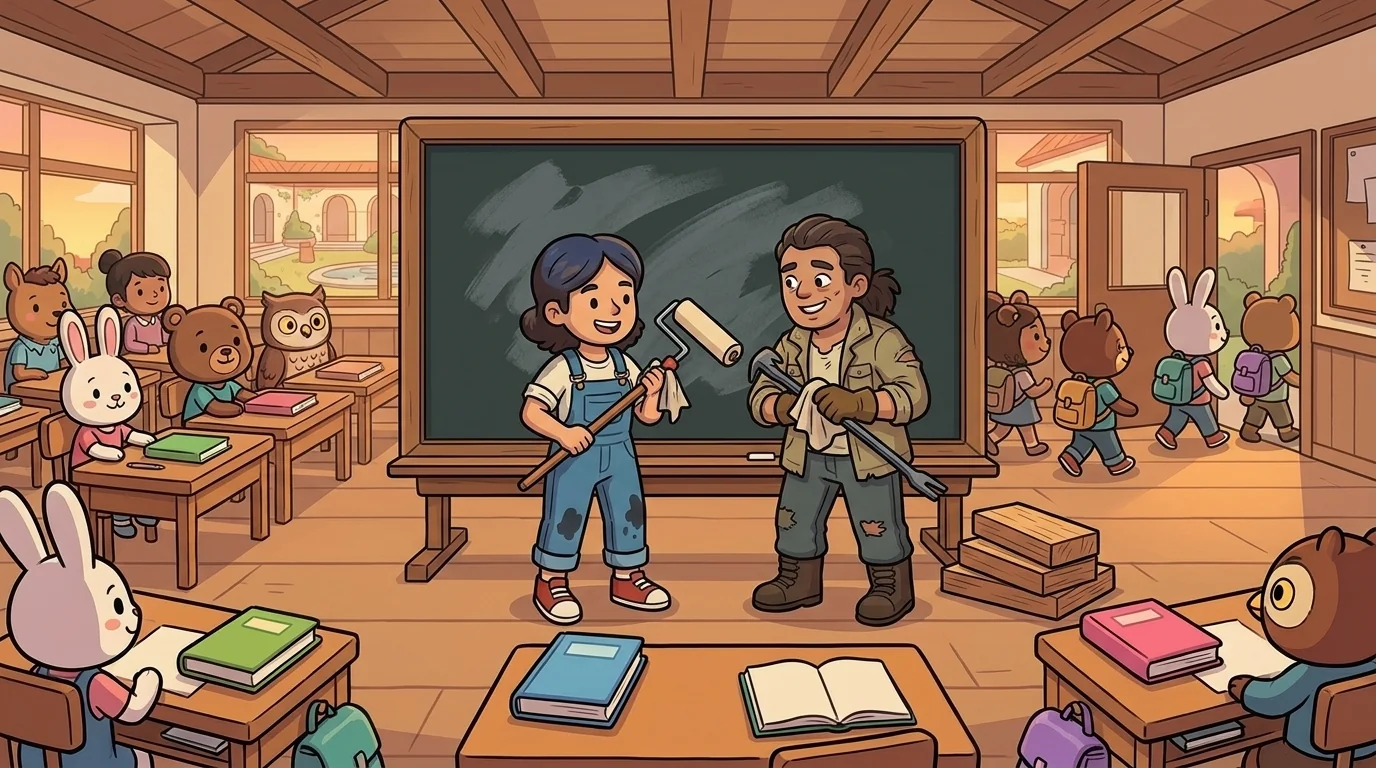
After that, Spread and Prise taught the last kits of the term together, at one board, and the children stopped thinking of them as opposites. They came to see them the way you see the two directions of a single familiar path — the way home and the way out, which are, of course, the very same road.
The lesson the two of them hope the children carry is a quiet one, and it is not only about brackets. It is that a thing and its undoing are partners, not enemies; that being able to go a step and take it back is what lets you move without fear; and that when you are unsure, the surest comfort is to travel back and find yourself exactly where you began.
When the hall empties, Spread rolls her roller clean and Prise wipes her bar, and the two of them walk out together — one who spreads, one who gathers — feeling the warm, matched gladness of a pair who spent a season thinking they were opposite and turned out to be two ends of the same good road.
Hear it as an audio drama
A short play starring Spread and Prise, from EquationQuest. Different voices, same idea. Listen any time after you read.
Loading audio…
Read the drama script
- Narrator: From Spark and Anvil and EquationQuest — this is Spread, in chapter 1 of the EquationQuest cast.
- Narrator: This drama uses an AI-generated voice. Voiced via Gemini 2.5.
- Narrator: Spread is a fence-painter-tween who carries a load across every post; Prise is a dockworker-tween with a worn pry-bar who gathers the shared part back out. Their classrooms face across one corridor.
- Narrator: The students swore the corridor was a road that ran both directions — because Spread and Prise weren't teaching two things. They were teaching one thing, walked forwards and backwards.
- Spread: Everything I roll OUT, Prise can gather back IN.
- Prise: And everything I pull IN, Spread can roll back OUT. Same road. We just walk it opposite ways.
- Narrator: Spread went first, and wrote three, times, open-bracket two-x plus three close-bracket.
- Spread: The three stands outside; the brackets hold a two-x and a three. My job is to carry that outside three to EVERYTHING inside — and this is the rule people break most: reach every term, not just the first.
- Spread: Three times two-x is six-x. And — don't stop — three times three is nine. So it rolls out to six-x plus nine.
- Spread: Leave the second three alone and you'd write six-x plus three, and the whole load is wrong. Distributing means distributing — to all of it.
- Narrator: Then Prise leaned in through the doorway with her pry-bar.
- Prise: Now watch me walk it backwards. Six-x plus nine — two loads that look separate. Six is three times two; nine is three times three. Both carry a three. I prise the shared three back out to the front: three, times, open-bracket two-x plus three close-bracket.
- Prise: Look where we are — exactly where Spread began. Neither of us changed the value one whit. Same load, opposite pull. We only changed which coat it wears.
- Student: So if I forget which is which — I can just check! Roll it out, then gather it back, and if I land where I started, I did it right.
- Spread: That's the best tool either of us can give you.
- Prise: The road runs both ways precisely so you can walk back and catch your own mistakes. The reversibility isn't a trick. It's your proof.
- Spread: Same road.
- Prise: Two ways. Spread spreads across every term; Prise gathers the shared part out. And the load is the very same load the whole time.
- Narrator: You've been listening to a Spark and Anvil chapter, written by the Spark and Anvil writing team for ages 9 to 14.
- Narrator: Apps stay free forever.
- Narrator: Curriculum aligned to Common Core math.
- Narrator: Released under Creative Commons BY-NC-SA 4.0 for educational reuse. Visit Spark and Anvil for the full transcript.
The EquationQuest ensemble
Spread and Prise is one of the friends in EquationQuest. Each friend shows you one idea by how they act; meet them all and you have the whole subject.
-

Lever
Maintaining balance — do the same thing to both sides
-

Solo
Isolating the variable — moving everything else away from x
-

Undo
Inverse operations — addition ↔ subtraction, multiplication ↔ division
-

Spread
Distribution — multiplying across parentheses
-

Flipper
The sign-flip in inequalities when multiplying/dividing by a negative
-

Corral
Combining like terms — you can only add or subtract terms of the same kind; gather the like ones together
-

Leaven
Exponents — repeated multiplication; the small raised number counts how many times
-

Marshal
Order of operations — the agreed sequence for working an expression (PEMDAS)
-

Prise
Factoring — find the part two or more terms share and pull it out front
-

Stead
Substitution — put a known value in place of a variable, then simplify