
Dabble
REVERSIBILITY — *a flipped tile can be flanked and flipped back; nothing is lost forever, so a lead can change and a loss is never final — play calm, play on.*
Dabble the Dabbling Duck
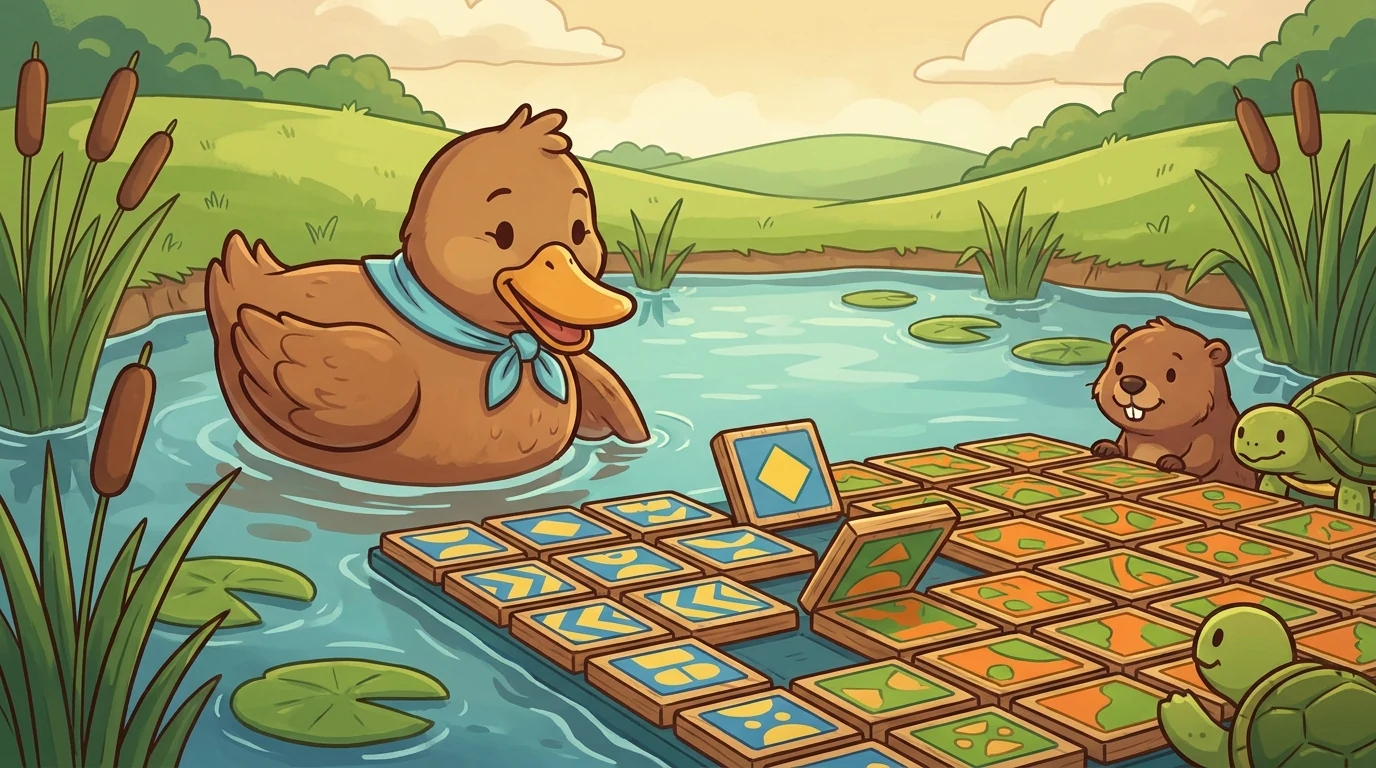
Dabble is a round, comfy dabbling duck who paddles calmly at the edge of the board, dipping her bill in the water and coming up with a smile. She’s the mentor of FlipPals — the friendly grown-up at the pond who watches over every game and keeps it kind. Dabble doesn’t win or lose. Dabble makes sure everyone feels okay.
Dabble’s big, warm truth is this: a flip can flip back.
When Kip flanks a middle and a tile turns to his color, it might feel, for a second, like that tile is gone forever. But Dabble paddles over and says gently, “Watch — nothing here is lost for good. That very tile can be flanked again and come right back.” In FlipPals, sides keep turning. A tile that’s theirs this turn can be yours next turn. The lead can swing. The board keeps changing until the very end.
That’s called reversibility, and it’s the reason FlipPals is a calm game, not a scary one. Because a flip can flip back, you never have to panic when the other side gets ahead. You just look for your next good word, your next open middle, your next kind flip.
Dabble’s whole job is to keep the pond anti-shame. When a game slips away from you, she doesn’t say “you lost.” She says, “Good game — and look how the tiles kept turning! Want to play the board again?” When a move doesn’t work, she doesn’t say “wrong.” She says, “Not that line — try another. You can always take it back next turn.”
Nothing is lost for good. So you can play on with a light heart.
Dabble teaches the losing player as warmly as the winning one. “Losing a game is just information,” she says, “not a verdict. It tells you what to try next. Every board is a fresh pond.” She celebrates a clever flip and a brave try that didn’t quite work — because both are real thinking.
You can bring Dabble’s spirit to any game. When something goes against you, take a slow breath like a duck settling on the water, and remember: the tiles can still turn. It’s not over. There’s a next move — and after this game, a whole new board. A game is for playing together, not for feeling small.
When a game ends — win or lose — and both players are still smiling, still friends, still ready for one more, that is Dabble’s true win. She gives a soft, happy quack and feels a deep, cozy gladness — the warm calm of a pond where no one ever has to feel bad. “Good game,” she says to everyone. “The tiles turned, we thought hard, and we can always play again.”
A flip can flip back — nothing’s lost for good, so play on with a light heart. That’s Dabble.
The flippals ensemble
Dabble is part of flippals's distributed-narrative cast. Each character embodies a different curricular primitive; together they teach the full subject.