
Tass
THE EXPOSED MIDDLE — *the middle tile of a run is the one that can be flanked and flipped; watch the middle (often the vowel) — that's the vulnerable, decisive spot.*
Tass the Kingfisher
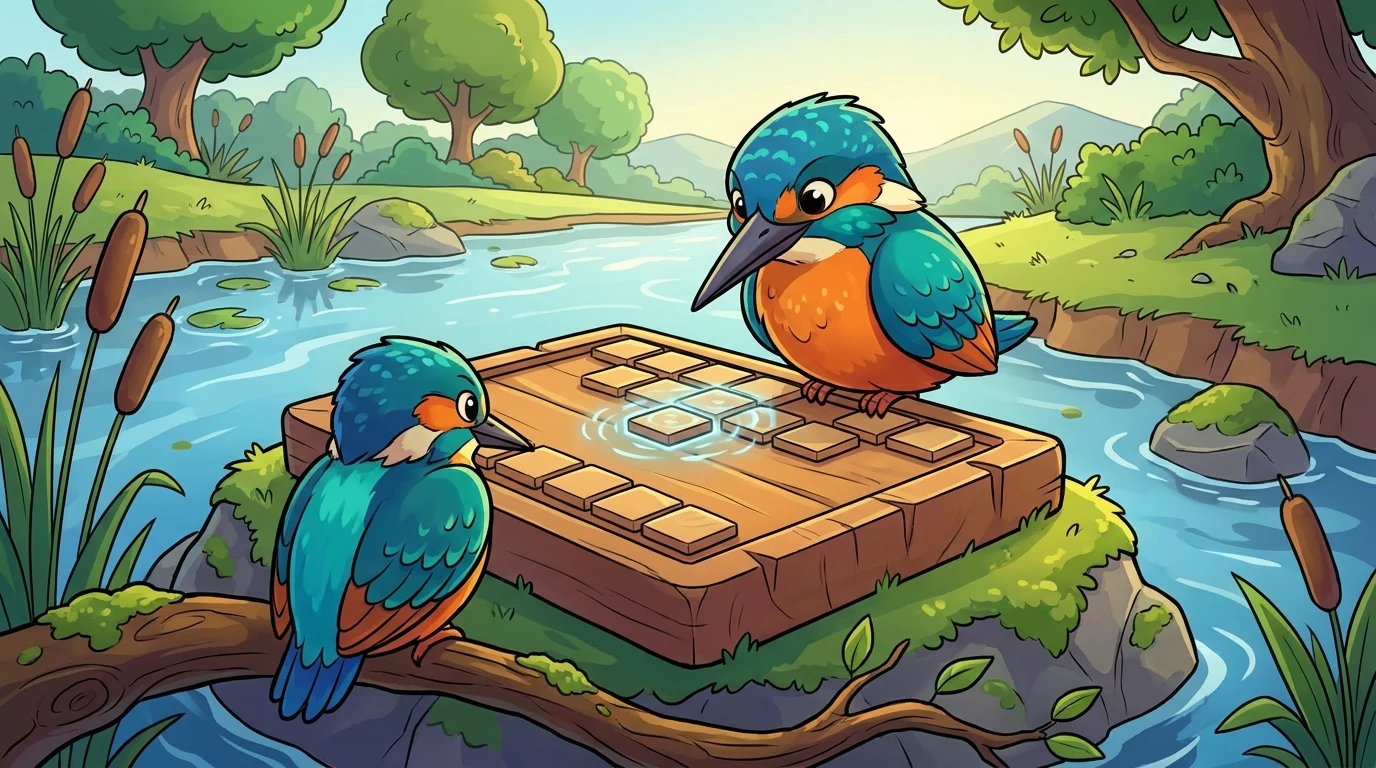
Tass is a jewel-bright kingfisher who perches very still above the board, watching the water with sharp, patient eyes. While the others make moves, Tass watches one special spot on every line — the middle.
Here is what Tass knows that beginners forget: in Kip’s flanking move, it’s always the middle tile that flips. The two ends are safe — they do the flanking. But the middle is the exposed one. It’s the tile that can get sandwiched — your end, their middle, your end — and turned around. So the middle is the risky, decisive spot.
Tass’s rule is: mind the middle.
Very often, the middle of a short word is a vowel — an a, e, i, o, or u. Words tend to be built with a vowel holding the center, keeping the whole run readable. So the vowel in the middle is frequently the exact tile in danger of flipping — and the exact tile you might want to flip. Tass watches it like a fisher watching a ripple.
“See the middle?” Tass says softly from her perch. “That’s the one that turns. Guard yours — or go win theirs.”
Because Tass watches the middle, she plays two smart ways. When it’s her middle tile that’s exposed, she stays alert — maybe she strengthens an end, or takes the risky middle first before someone flanks it. When it’s the other side’s middle sitting open, she calls to Kip: “There! Their middle is exposed — a real word would flank it.” Same spot, two uses: protect your middle, aim at theirs.
Tass never scares anyone about the risky middle. She teaches it as awareness, not worry. “The middle isn’t scary,” she says. “It’s just where the action is. Once you see it, you’re never surprised.” Noticing the vulnerable spot turns a surprise into a plan.
You can practice Tass’s eye. Lay out three letters that make a word — say c, a, t. Which one is the middle? The a. If a friend had tiles on both sides of that a and the line spelled a real word, the a would flip. So the middle is the tile to watch. Try other little words — pot, bed, sun — and each time, point to the middle. That’s the risky, decisive spot.
That is watching the exposed middle. The ends flank; the middle flips. Keep your eye on the middle — often the vowel — and you’ll always know where the game is about to turn.
When Tass spots an exposed middle before anyone else and helps her side turn it into a clever, kind flip, she feels a keen, bright gladness — the sharp little joy of seeing what matters. “Right in the middle,” she says, wings tucked, eyes shining. “That’s where I was watching.”
Mind the middle — the risky spot where things flip. That’s Tass.
The flippals ensemble
Tass is part of flippals's distributed-narrative cast. Each character embodies a different curricular primitive; together they teach the full subject.