Weir and Rewind
A FUNCTION AND ITS INVERSE COMPOSED — chaining a rule to its own undo-rule sends any input straight back to itself; f⁻¹(f(x)) = x, the one chain that lands a number exactly where it began.
Loading audio…
Press play to listen along. The line being read lights up as you go.
Show full transcript
Loading transcript…
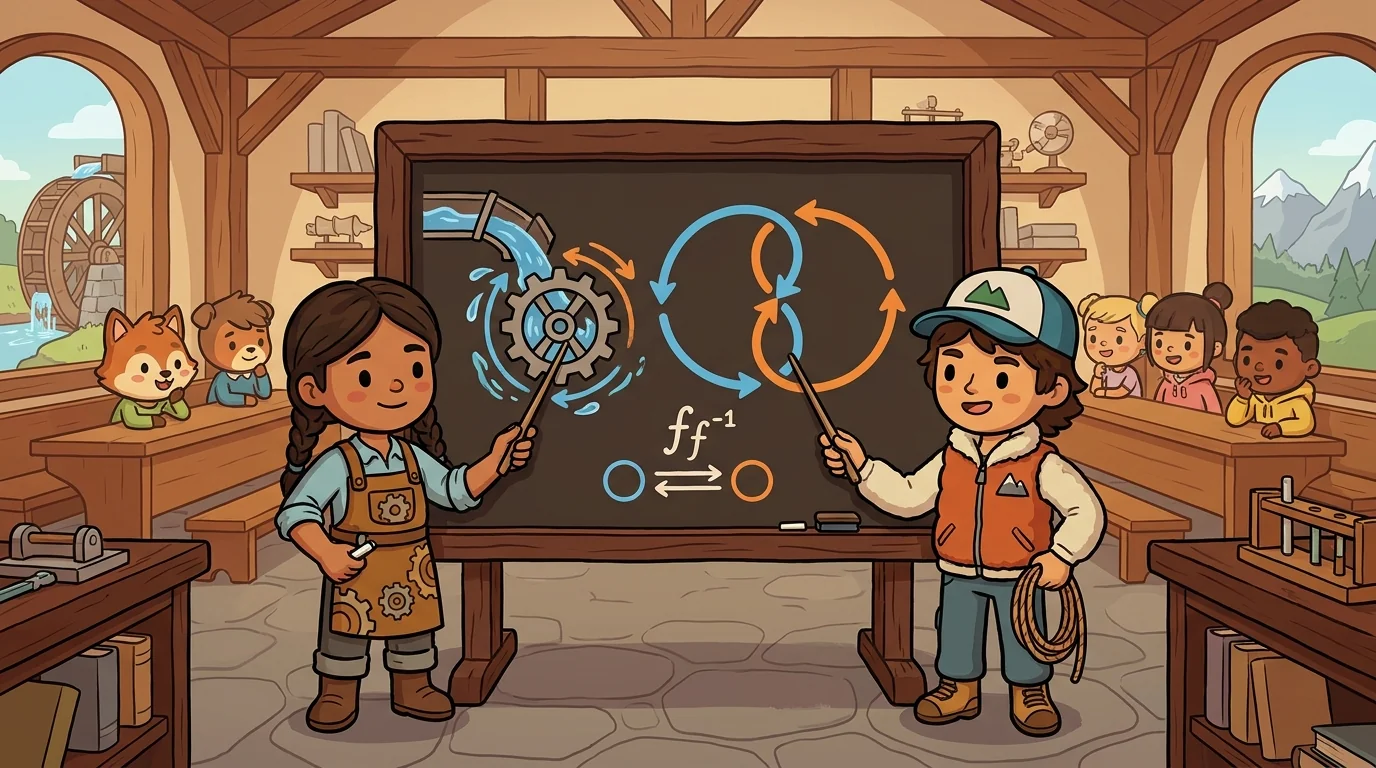
For a whole term, Weir and Rewind had seemed to the children to be doing opposite jobs — and they were, which is exactly why the academy master finally set them at one board together.
Weir, the millwright's daughter, chained rules forward. Give her two functions and she would pour one into the next, output into input, water stepping down her weirs to the wheel.
Rewind, the mountain guide, walked rules backward. Give her a rule and she would find its inverse — the way home — by undoing each step in reverse order.
The children had come to think of Weir as the doer and Rewind as the undoer, and to wonder, a little, which of them was more useful. So the academy master gave them one number and one rule, and asked them to teach together what happens when a chain and its undo are joined.

Weir went first, and set up the forward chain.
"Here is a rule," she said, writing g(x) = 2x + 3. "It doubles, then adds three. Watch it flow. Pour in 5: double to 10, add three, 13." She drew the water stepping down two weirs. "So g(5) = 13. Out the bottom comes thirteen. A clean forward chain."
The children copied it. Thirteen sat at the foot of the hill.
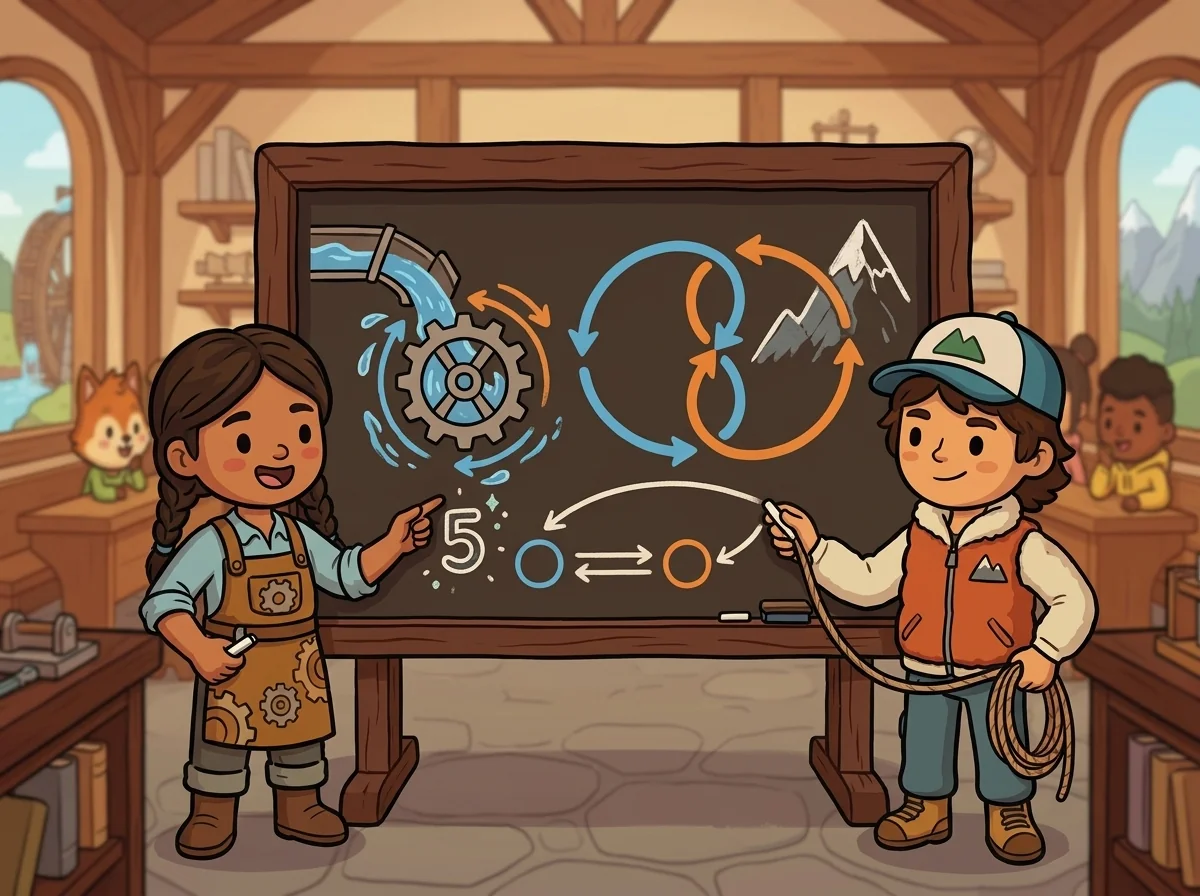
Then Rewind stepped up, uncoiling her rope, and did not rub anything out. She simply took Weir's thirteen and began to walk it home.
"Now I bring it back," she said. "Weir's last step was add three, so my first undoing is subtract three: thirteen becomes 10. Her step before was double, so my next undoing is halve: ten becomes 5." She wrote the inverse beside it: g⁻¹(x) = (x − 3) ÷ 2. "And there it is. Five. The very number Weir started with."
There was a small, delighted stillness in the room — because the number had gone all the way down the hill and all the way back up, and landed on its own doorstep.
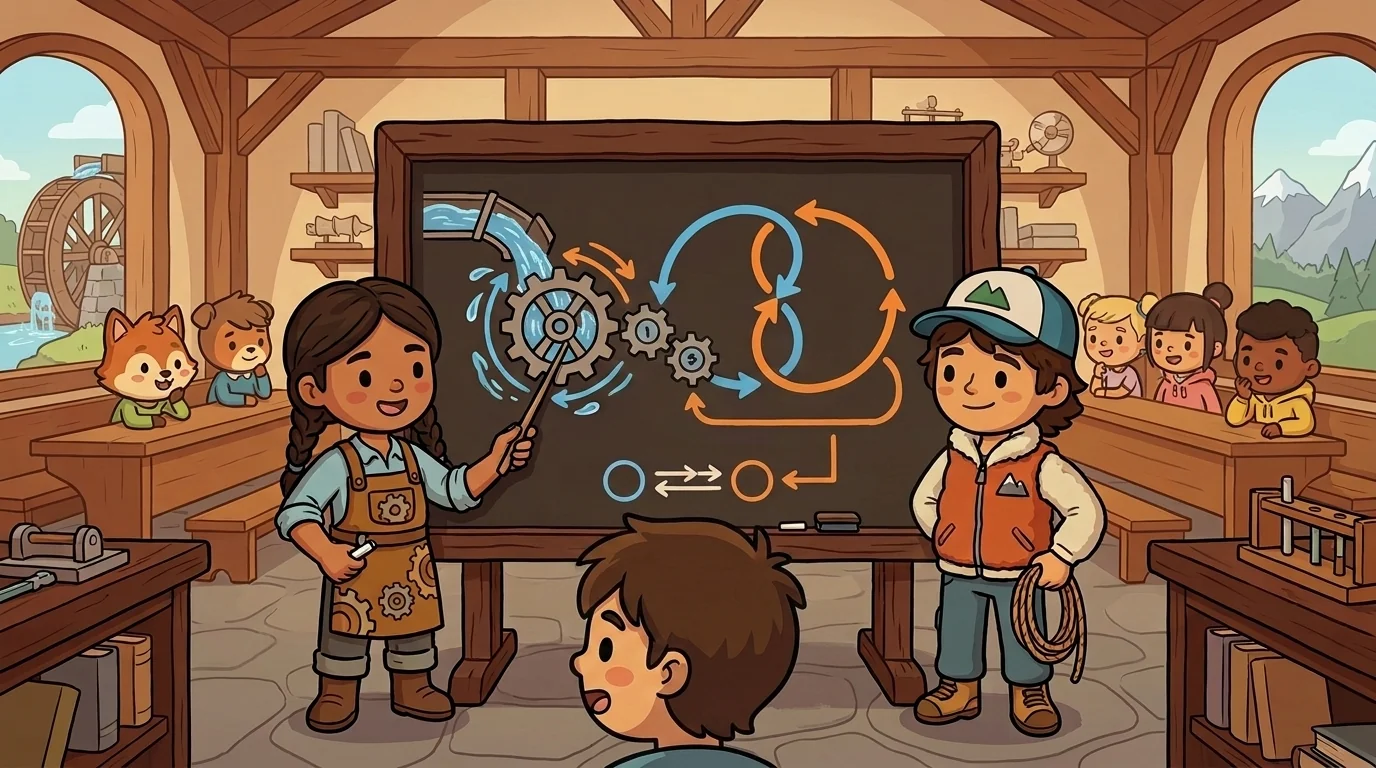
The academy master smiled and handed a fresh piece of chalk to a boy in the second row. "You run the whole chain — Weir's rule, then Rewind's — on a number of your own. Start with 8."
The boy took a breath. First he did Weir's job. "Pour 8 into g: double to 16, add three, 19." He drew the water stepping down. "So g(8) = 19."
"Now hand it to me," said Rewind gently.
He walked it back the way she'd shown him. "Rewind's rule undoes it: subtract three, 16; halve it, 8." He stopped, and looked up, and his eyes widened. "It's 8 again. I sent it out through the rule and back through the undo, and it came home. Exactly. Not a pace off."
"There it is," said Rewind, warm with pride.
"A rule chained to its own inverse," said Weir, "is the one chain in the whole world that changes nothing. You can send any number down it and it lands right back where it began. f⁻¹(f(x)) = x — undoing follows doing, and the two cancel to a clean, honest home."
Weir and Rewind looked at each other — the doer and the undoer — with the particular fondness of two people who spent a season thinking they were opposites and have just watched a child prove they were partners all along. "I could chain rules forward all day," Weir admitted, "and never be sure I could get back. Rewind is how I know I can."
"And I could walk any rule home," said Rewind, "but Weir is the one who shows me the road out in the first place. Doing and undoing. Neither of us is the whole of it."

After that, Weir and Rewind taught the last kits of the term together, and the children stopped asking which of them mattered more. They came to see doing and undoing the way you see the two ends of a good rope — the throwing-out and the hauling-back — each useless without the other, and together able to reach anywhere and always come home.
The lesson the two of them hope the children carry is a quiet one, and it is not only about functions. It is that being able to undo is what makes it safe to do — that a step you can reverse is a step you can take bravely, and that the surest comfort in any venture is knowing there is a way back to exactly where you began.
When the hall empties, Weir sketches her stepped pools and Rewind coils her rope, and the two of them — one who links forward, one who walks back — feel the matched, easy gladness of a pair who found out they were never rivals, only the two directions of one dependable road.
The FunctionForge ensemble
Weir and Rewind is part of FunctionForge's distributed-narrative cast. Each character embodies a different curricular primitive; together they teach the full subject.
-

Stride the Pattern-Walker
Linear functions (constant rate of change)
-

Echo the Sameness-Keeper
Constant functions (zero rate of change; output unchanged regardless of input)
-

Arc the Curve-Catcher
Quadratic functions (parabola — symmetric rate-of-change-changes)
-

Burst the Doubler
Exponential functions (constant *multiplicative* rate of change)
-

Pivot the Rule-Switcher
Piecewise functions (different rules for different input ranges)
-

Rewind the Step-Reverser
Inverse functions (undoing a rule step-by-step to recover the original input)
-

Roundel the Round-Returner
Periodic functions (a pattern that repeats at a fixed interval)
-
Sill the Threshold-Keeper
Domain and range (which inputs are allowed and which outputs can appear)
-

Vale the Valley-Folder
Absolute value (folding the number line at zero so distance is always positive)
-

Weir the Chain-Linker
Composite functions (feeding one rule's output into the next)