Sill the Threshold-Keeper
DOMAIN AND RANGE — the inputs a function is allowed to accept (the domain) and the outputs it can ever produce (the range); some inputs are barred, and only certain outputs ever come out.
A story read by Sill the Threshold-Keeper
Loading audio…
Press play to listen along. The line being read lights up as you go.
Show full transcript
Loading transcript…
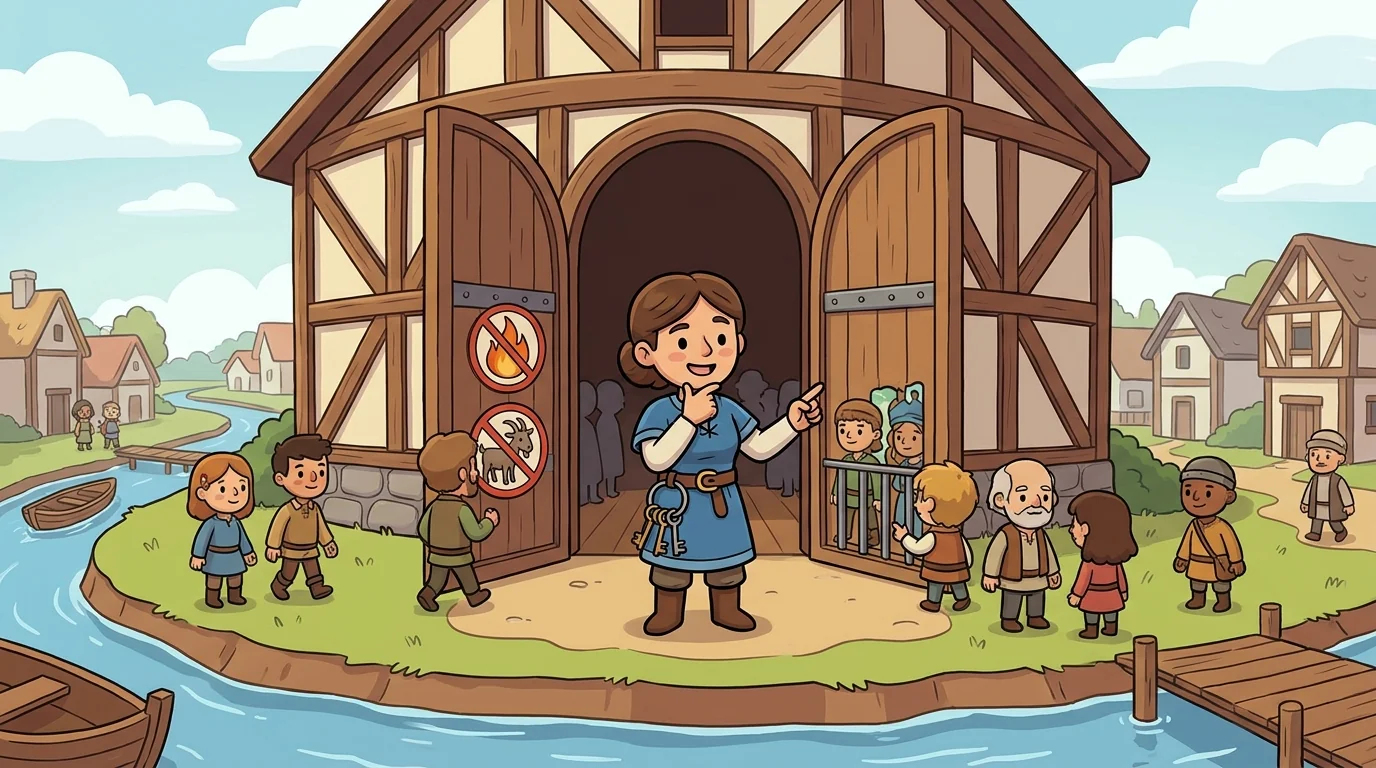
Sill was a hall-keeper — the keeper of the threshold at the great assembly hall of a river town, where every gathering, market, and moot was held.
A threshold-keeper has two boundaries to mind, not one. The first is the doorway in: who is allowed to enter. Not everyone could — the hall barred certain things at the door for good reasons. No open flames (the old timbers). No livestock (the last goat had been a disaster). The in-boundary decided which visitors the hall would even accept.
The second boundary was subtler, and Sill was one of the few keepers who thought about it at all. It was the doorway out: which visitors ever emerged. Because of what the hall was and did, only certain sorts of people ever came back out of it — and never anyone the hall had never let in. The out-boundary was the full set of everyone who could possibly leave.
"Two boundaries," Sill would say, standing in her doorway with her keys. "Who's allowed in. And who can ever come out. Mind them both, and the door runs smooth."
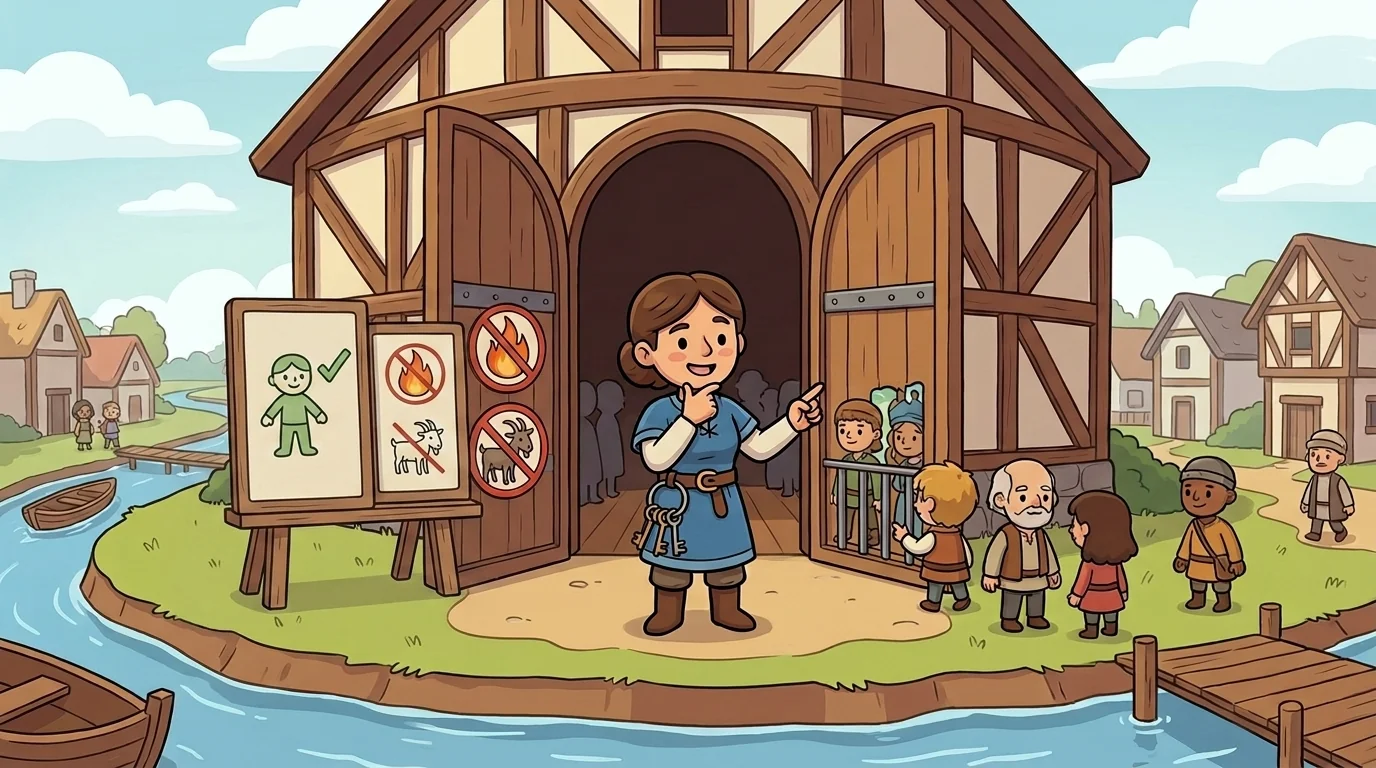
What Sill understood, minding the door for years, was that the two boundaries were not the same, and both were worth knowing before the gathering even began. If you knew who could come in, you knew who to turn away kindly at the step, before a fuss. And if you knew who could ever come out, you were never startled by who appeared — and never fooled by an impostor claiming to have been inside when no such person could have.
She kept two lists on two slates by the door: Allowed In, and Ever Comes Out. Knowing them in advance, she found, saved everyone trouble. Nobody argued at a threshold whose rules were clear.
She had no idea this had a name in the world of numbers.
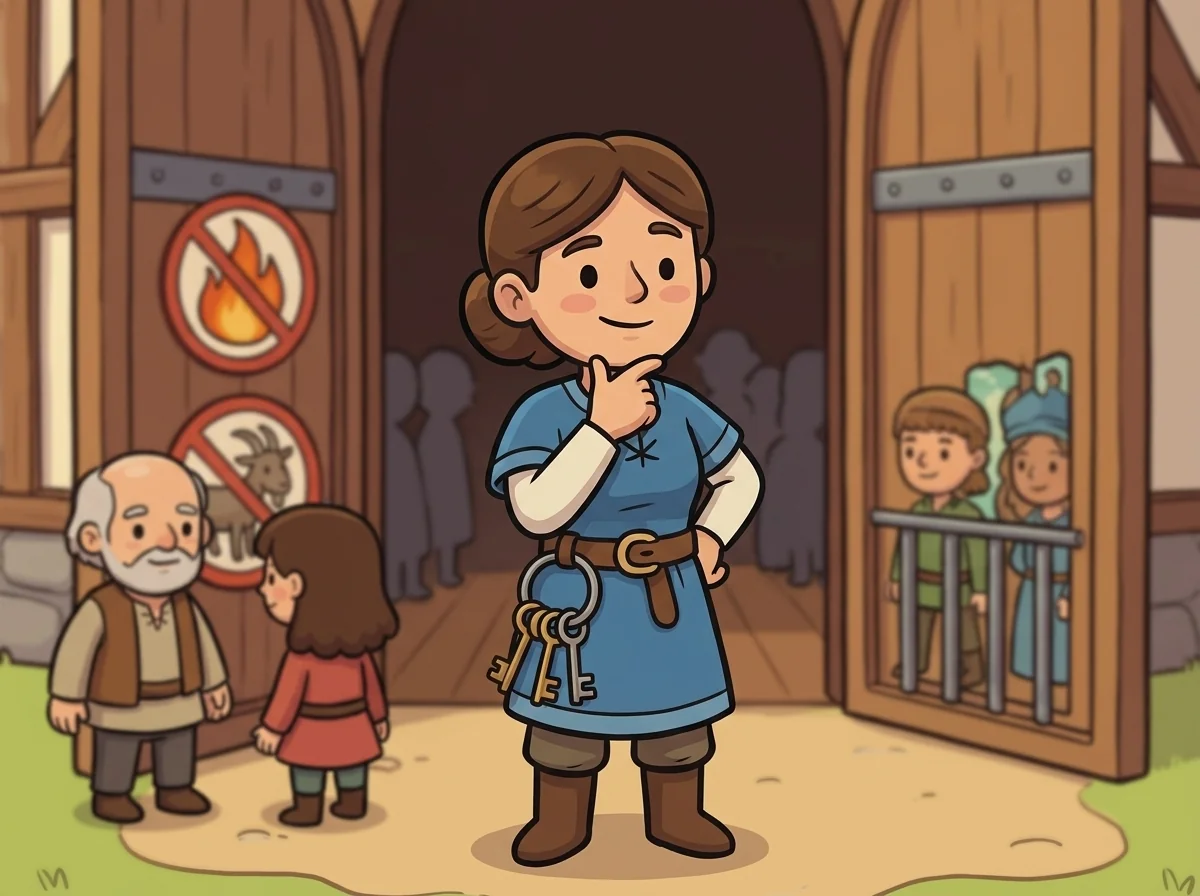
When she was older, the FunctionForge academy, which wanted someone who understood the edges of a rule — what it would take, and what it could give — sent for her. Sill hung up her hall keys and went.

At the academy she taught the children that every function has two boundaries, just like her door.
"A function is a hall," she said. "It has a door in — the domain — the numbers it will accept. And a door out — the range — the numbers it can ever produce." She wrote one up: f(x) = √x, the square-root rule.
"Watch the in-door," she said. "Can I bring it a 9? Yes — the root of nine is three. A 4? Yes — two. Can I bring it a −4?" She shook her head. "There is no ordinary number you can square to get a negative. The root of a negative simply isn't allowed through this door. So the domain — the allowed inputs — is every number from zero upward. Negatives are turned away kindly at the step."
"And the out-door," she went on. "What can this rule ever hand back? A root is never negative. It gives 0, 1, 2, 3 — never a number below zero. So the range — everything that can ever come out — is also zero upward." She wrote both on her two slates. "Two boundaries. What it takes: zero up. What it gives: zero up. Know them before you start, and the rule holds no surprises."
"So you check the door before you send a number in," said a girl.
"Always check the door first," said Sill. "Some numbers a rule cannot take, and some numbers a rule can never give. Knowing which, in advance, is half of understanding any function at all."
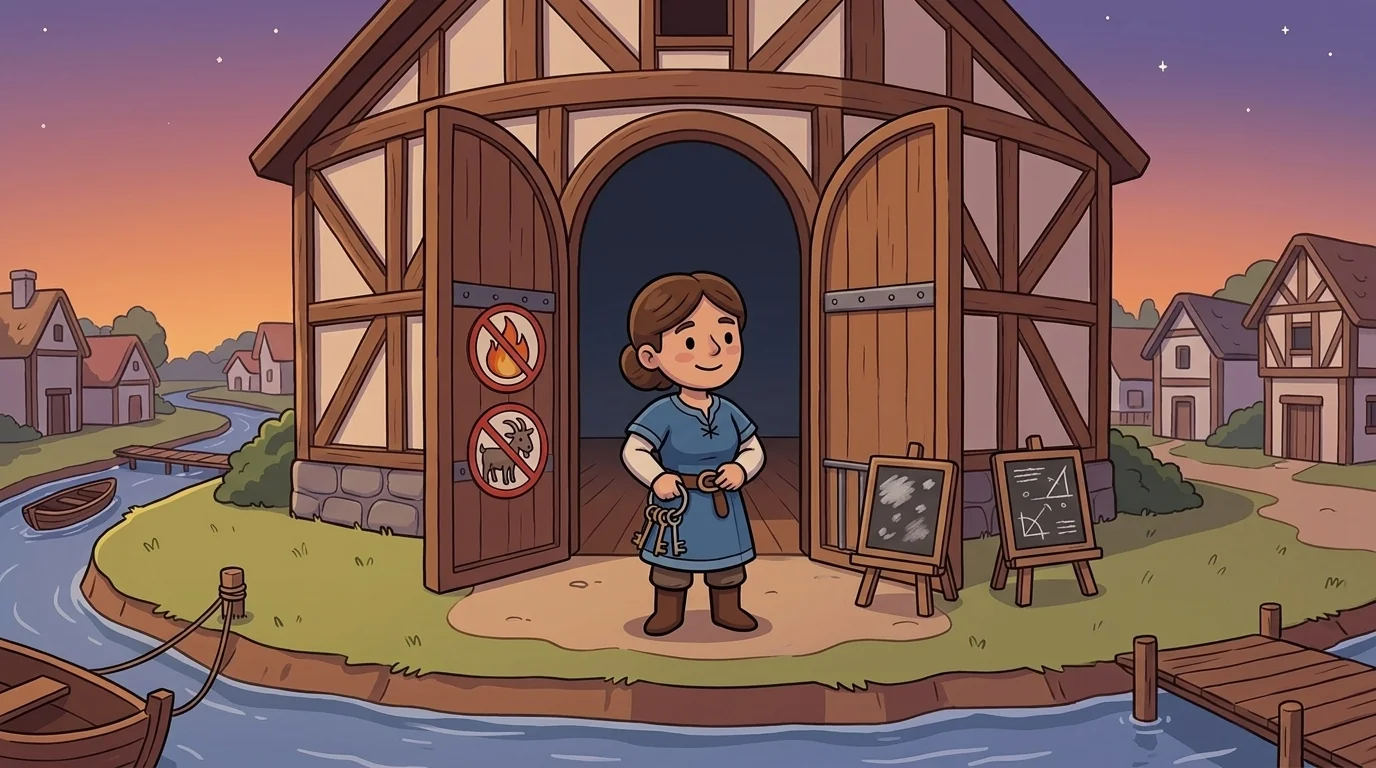
She still keeps the odd assembly door when the town asks and the academy can spare her, and still runs a smooth threshold.
The thing Sill hopes the children carry is that limits, known early, are a kindness — that understanding what a rule can accept and what it can ever return keeps you from banging fruitlessly on a barred door, and lets you work gladly within the room you actually have.
"Mind both boundaries," she tells them, jingling her keys. "What goes in, and what can come out. A rule with clear edges is a rule you can trust."
When the hall empties, Sill sets her two imaginary slates by the door out of habit, and feels the settled, orderly gladness she first felt keeping the great hall: that a threshold with well-known rules is not a wall to resent, but a frame that lets everyone pass in peace.
The FunctionForge ensemble
Sill the Threshold-Keeper is part of FunctionForge's distributed-narrative cast. Each character embodies a different curricular primitive; together they teach the full subject.
-

Stride the Pattern-Walker
Linear functions (constant rate of change)
-

Echo the Sameness-Keeper
Constant functions (zero rate of change; output unchanged regardless of input)
-

Arc the Curve-Catcher
Quadratic functions (parabola — symmetric rate-of-change-changes)
-

Burst the Doubler
Exponential functions (constant *multiplicative* rate of change)
-

Pivot the Rule-Switcher
Piecewise functions (different rules for different input ranges)
-

Rewind the Step-Reverser
Inverse functions (undoing a rule step-by-step to recover the original input)
-

Roundel the Round-Returner
Periodic functions (a pattern that repeats at a fixed interval)
-

Vale the Valley-Folder
Absolute value (folding the number line at zero so distance is always positive)
-

Weir the Chain-Linker
Composite functions (feeding one rule's output into the next)