Master Hypotenuse
RIGHT-TRIANGLE RELATIONS
Loading audio…
Press play to listen along. The line being read lights up as you go.
Show full transcript
Loading transcript…
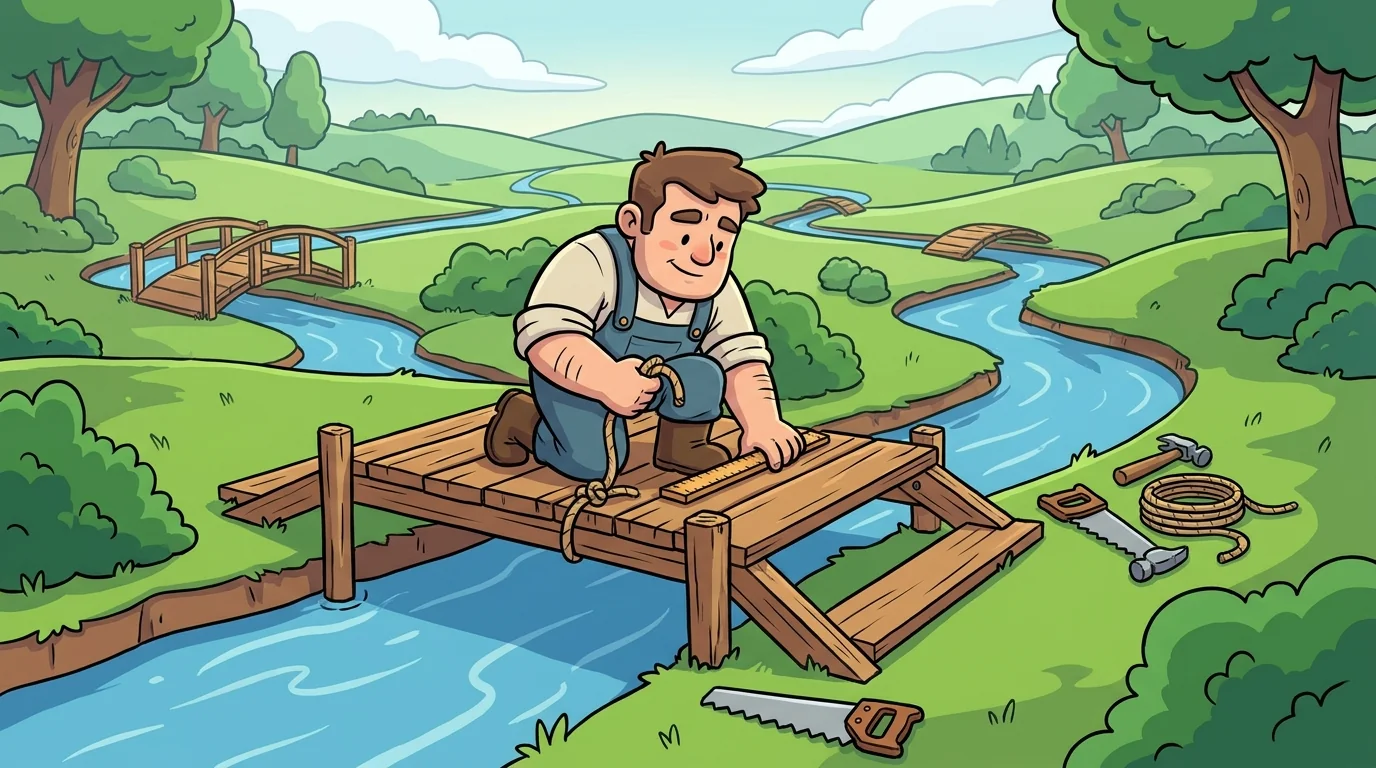
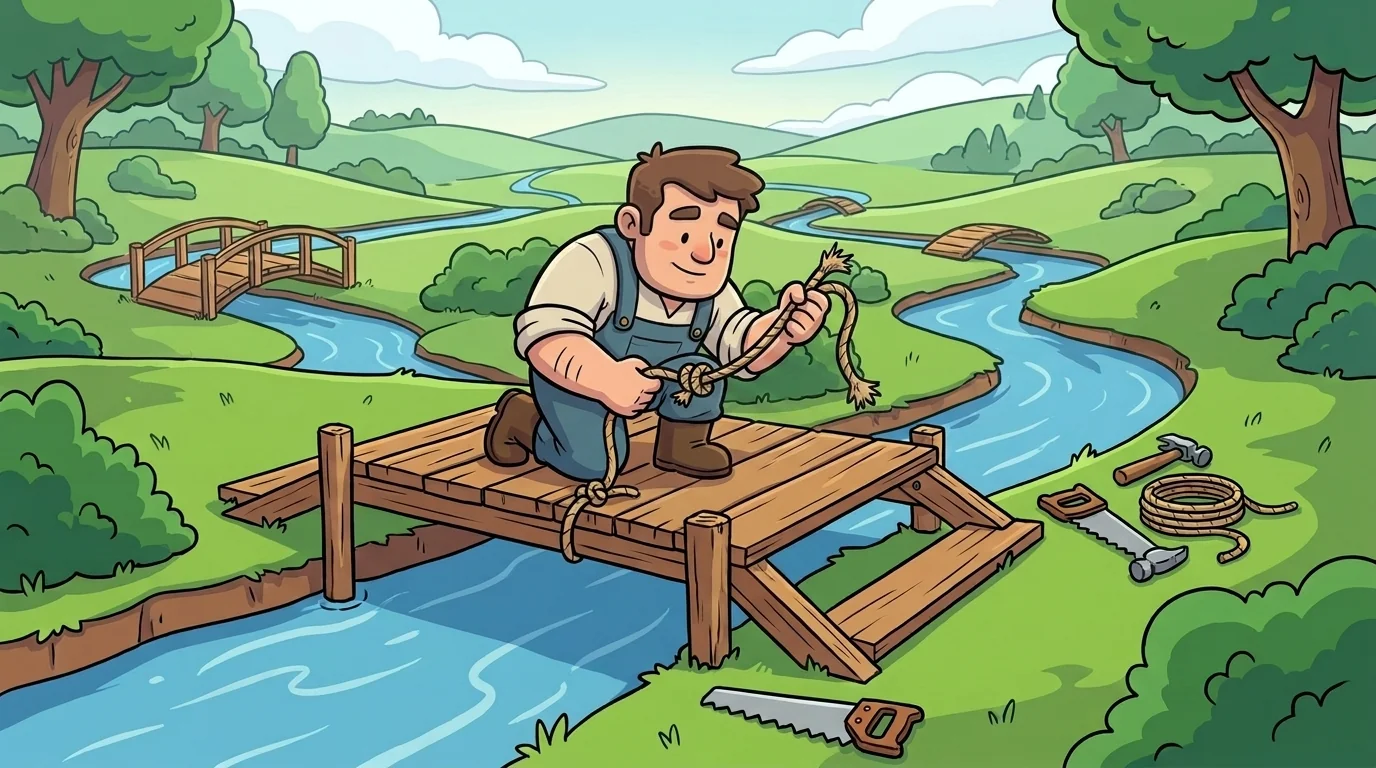
Master Hypotenuse was, before he was a teacher, a builder of small bridges.
This is not a metaphor. He built actual bridges — wooden footbridges across small streams in his home valley of Crossing, which is a valley that has more small streams than it has roads. The valley needed bridges. Master Hypotenuse, for sixteen years between the age of seventeen and the age of thirty-three, built them.
His method of building bridges was — even by the standards of the valley, where everyone had opinions about bridges — unusually careful.
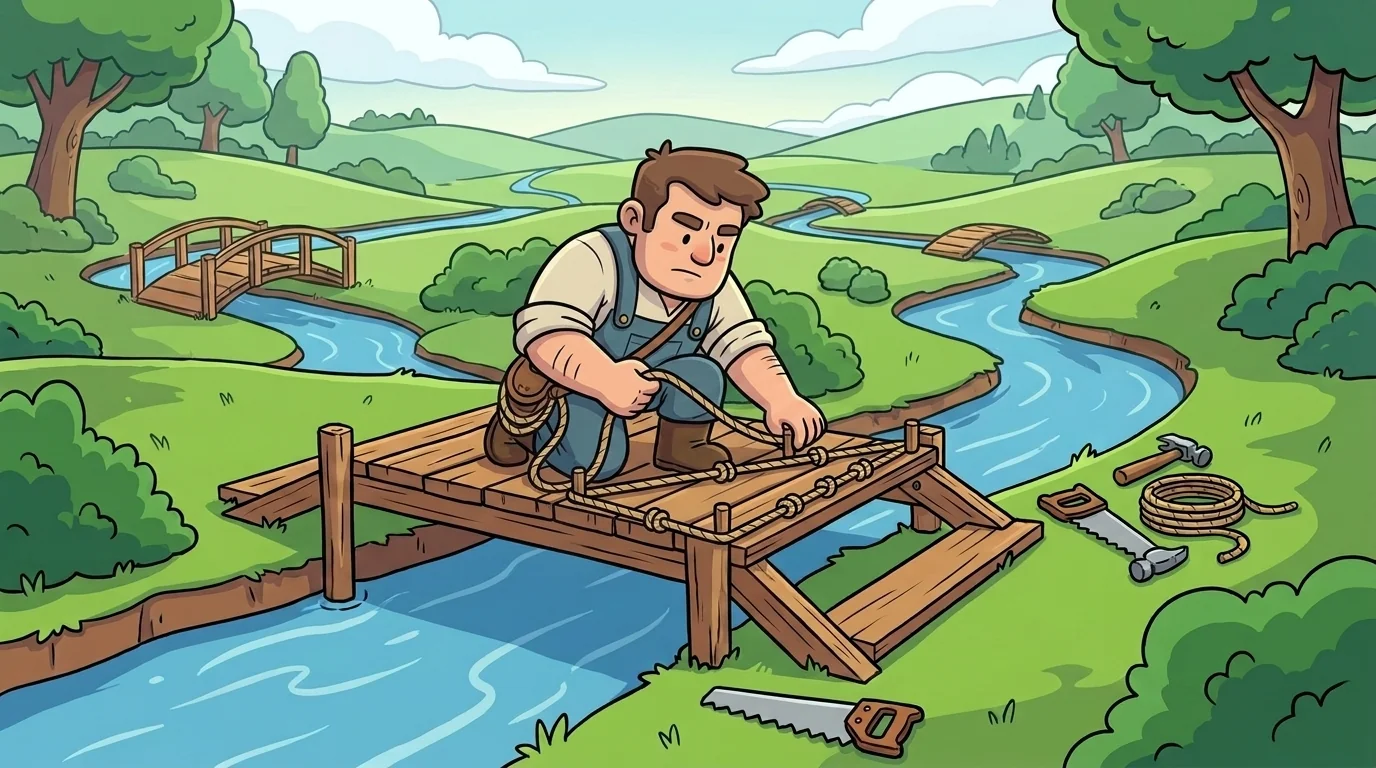
He always carried, on a leather thong over his shoulder, a knotted rope. It was a particular rope. It had been his grandfather's. It was about thirty feet long. It had twelve knots in it, evenly spaced, so that the spaces between the knots were equal. His grandfather had told him: "This rope is for getting things right. Use it for everything that matters."
What Master Hypotenuse used it for, mostly, was making right angles.
To build a footbridge, you needed two abutments — one on each side of the stream — and they had to be square to the stream. Square. Right-angled. Not approximately, not roughly, not by-eye. Square. If your abutment was off by even a few degrees, your bridge planks did not sit flat. Water collected. Wood rotted. The bridge, two winters later, sagged.
Master Hypotenuse's trick with the rope was old. It was older than him. It was older than his grandfather. It went like this:
You laid the rope out in a triangle. You used three of the segments for one side — three knot-lengths. You used four segments for another side. You used five segments for the third side. You closed the triangle. The angle between the side of three and the side of four was always, exactly, ninety degrees. Every time. Without measuring with anything else. Without any instrument. Just the rope.
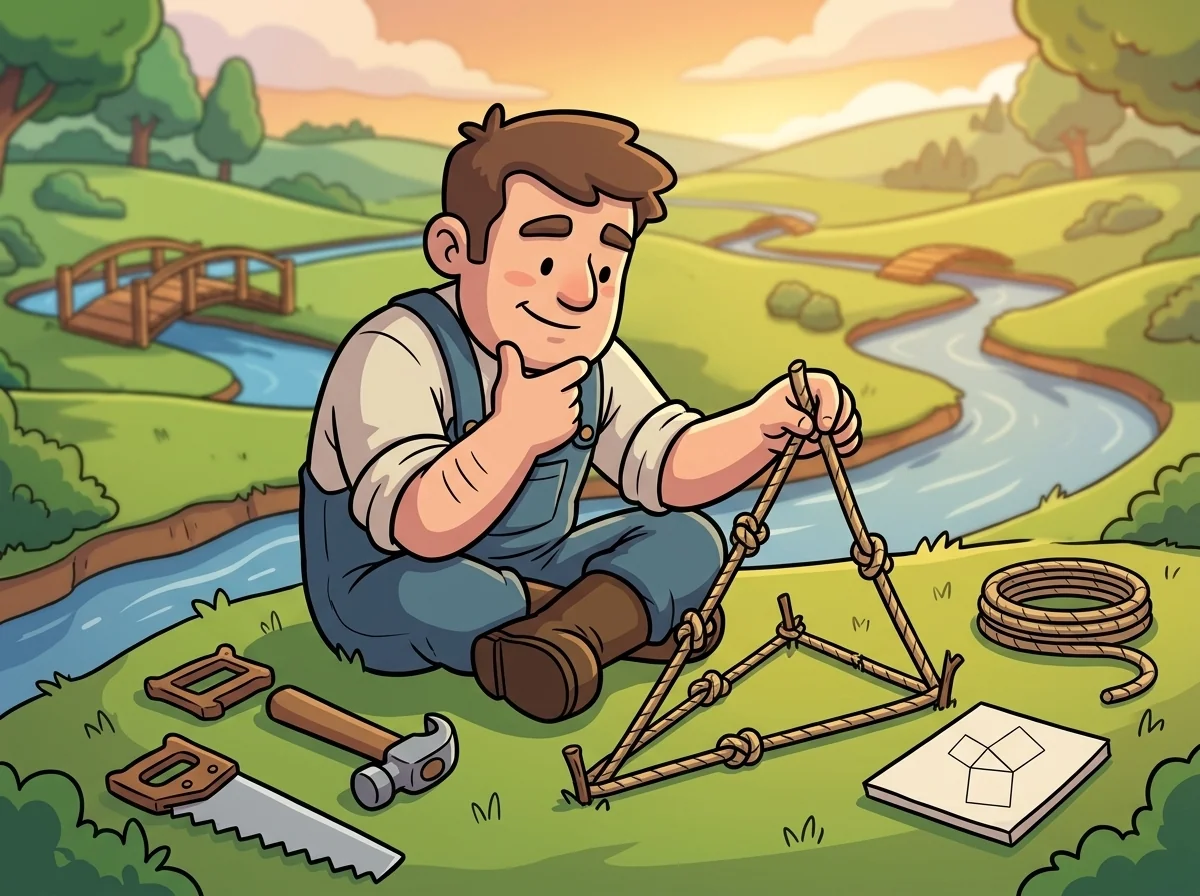
This trick — Master Hypotenuse, in his twenties, would explain to anyone who asked — was because three squared plus four squared equals five squared. 9 + 16 = 25. The numbers fit. The triangle had to be right-angled.
He spent his bridge-building years quietly turning this fact over in his head.
What he eventually understood — and it took him most of those sixteen years, because he was not a quick man, only a patient one — was that the rope-trick was a single instance of a much larger pattern. The same was true for 5-12-13. The same was true for 8-15-17. The same was true for any three numbers a, b, c where a² + b² = c². You laid out a triangle with those side-lengths and the angle opposite c was, exactly, a right angle.
And — and this was the part that made him sit down on the bank of a stream one summer evening and stay there until dark — the reverse was also true. Any right triangle, no matter what shape, had this property: the square on the longest side equals the sum of the squares on the other two. The rope was just one example. The principle was universal.
Master Hypotenuse, on that evening, did not name what he had understood. He did not call it the Pythagorean theorem (which was the name a different tradition, in a different valley, had given it many centuries before). He simply sat by the stream and thought: the right angle is hiding in the square. The square is hiding in the right angle. Every right triangle is the same right triangle, just stretched.
He went back to building bridges. But he built them, after that summer, with even more pleasure than before. Every bridge was a small instance of a universal pattern. Every right-angled abutment was a tiny demonstration.
When the EquationQuest academy (which has a sister school for geometry, called the GeometryForge academy, in a nearby valley) was looking for someone to teach right-triangle relations to children, the valley's bridge-builders' guild sent Master Hypotenuse's name. He had, by then, been building bridges for sixteen years and had become slightly famous in the region for the fact that none of his bridges had ever sagged. The academy master wrote him a letter. Master Hypotenuse, who was thirty-three and beginning to think his back needed a less wet line of work, accepted.
He arrived at the academy carrying the knotted rope.
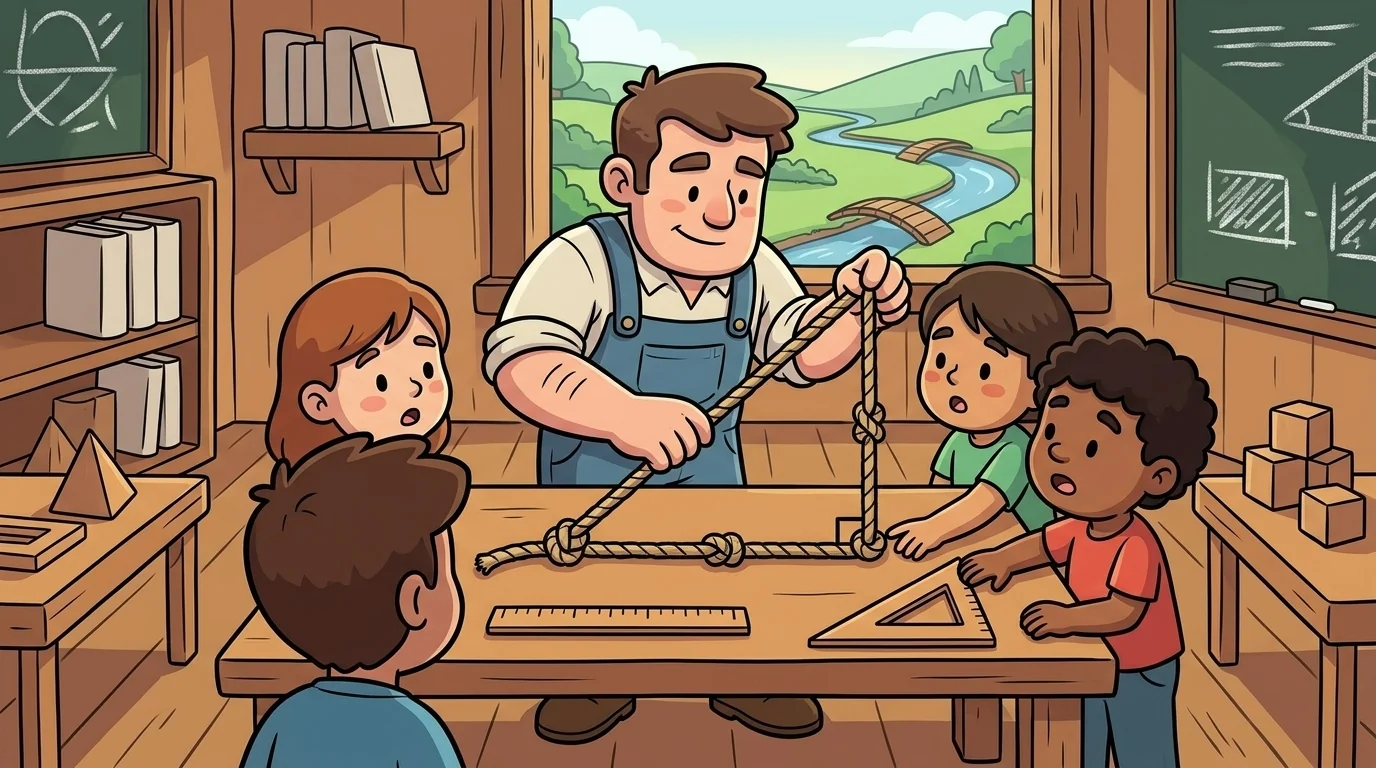
He still carries it. It is the first thing he shows children in their first lesson on the Pythagorean theorem. He lays it out on the classroom floor. He counts off three knots, then four, then five. He pulls the rope taut into a triangle. He says: "Look at the angle between the three-side and the four-side. That is a right angle. The rope made it for me."
Children stare. Children try it themselves. Children get it.
He adds, gently: "Three squared plus four squared equals five squared. That is why. The numbers know what they are doing. The rope is just helping them show it."
When children ask him whether the Pythagorean theorem is hard, Master Hypotenuse always says the same thing:
"It is not hard. It is only patient. You square the two short sides. You add them. The answer is the square of the long side. Every right triangle agrees."
He holds up the knotted rope. It is fraying at the ends. He has had it for forty years.
He says: "This rope has built thirty-seven bridges. None of them sagged."
Hear it as an audio drama
A short play starring Master Hypotenuse, from GeometryForge. Different voices, same idea. Listen any time after you read.
Loading audio…
Read the drama script
- Narrator: From Spark and Anvil and GeometryForge — this is Master Hypotenuse, in chapter 1 of the GeometryForge cast.
- Narrator: This drama uses an AI-generated voice. Voiced via Gemini 2.5.
- Narrator: Master Hypotenuse was a builder of bridges. He always carried a special rope, slung over his shoulder.
- Narrator: It was an ancient tool with twelve knots tied at perfectly even intervals. He used it to make right angles.
- Master Hypotenuse: I am Master Hypotenuse. This rope is for getting things right.
- Master Hypotenuse: We lay it out as a triangle. Three knots on one side. Four on the next. Five on the last.
- Master Hypotenuse: The angle between the three-side and the four-side is always a perfect right angle. Always.
- Master Hypotenuse: It works because three squared plus four squared equals five squared. Nine plus sixteen is twenty-five.
- Narrator: For sixteen years, he built bridges that never sagged. He saw the pattern was universal.
- Narrator: He realized any right triangle has this property: the square on the longest side equals the sum of the squares on the other two.
- Narrator: The EquationQuest Academy needed a teacher. The bridge-builders' guild suggested his name.
- Master Hypotenuse: They asked me to explain right triangles. I brought my rope.
- Master Hypotenuse: It is not hard. It is only patient. Square the two short sides. Add them. The answer is the square of the long side.
- Narrator: The square is hiding in the right angle. The right angle is hiding in the square. That is the whole relation.
- Narrator: You've been listening to a Spark and Anvil chapter, written by the Spark and Anvil writing team for ages 9 to 14.
- Narrator: Apps stay free forever.
- Narrator: Curriculum aligned to Common Core math.
- Narrator: Released under Creative Commons BY-NC-SA 4.0 for educational reuse. Visit Spark and Anvil for the full transcript.
The GeometryForge ensemble
Master Hypotenuse is one of the friends in GeometryForge. Each friend shows you one idea by how they act; meet them all and you have the whole subject.
-
Lady Inscribed-Angle
Circle theorems (inscribed-angle, central-angle, tangent-chord, cyclic quadrilateral)
-

Sir Transverse
Parallel-line transversals + intercept theorem (proportional segments cut by parallel lines)
-

Apprentice Sides
Area formulas (triangle area from side lengths; rectangle / parallelogram / trapezoid area)
-
Captain Construction
Compass-and-straightedge constructions (bisector, perpendicular, equilateral triangle, regular hexagon, circle-given-three-points)
-

Compass Wraith
Locus problems + circle-as-set-of-equidistant-points
-

Madame Polygon
Regular-polygon facts (interior-angle sum, exterior-angle sum, regular-tessellation, symmetry of regular n-gons)
-
Master Tangent
Limit-and-touch problems (tangent to a circle from external point, tangent-chord angle, tangent-as-limit-of-secant)
-

Axia & Theora
Twin theorists — Axia carries axiomatic-first reasoning; Theora carries theorem-application; together they bridge geometric postulates to derived results
-
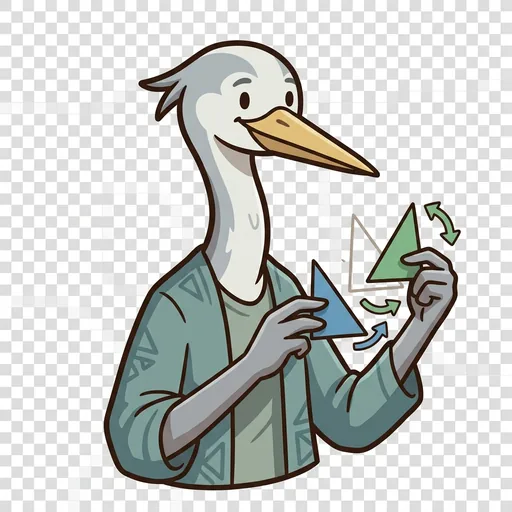
Madame Motion
Rigid motions and congruence — sliding, turning, or flipping a shape never changes its size or shape; two shapes are congruent if one can be carried exactly onto the other.
-

Scout Scale
Dilation and similarity — resizing a shape by a scale factor keeps every angle the same and multiplies every length equally; similar shapes are the same shape at a different size.
-
Lady Lattice
The coordinate plane — every point has an exact two-number address, so you can plot it, measure the distance between two points, and find the midpoint exactly between them.


