Connector Chen
CONJUNCTION
Loading audio…
Press play to listen along. The line being read lights up as you go.
Show full transcript
Loading transcript…

The mayor wanted a new bridge. The Chief of Operations wanted to build a new market. Both were important projects. But they needed the same skilled stonecutters. That's when Connector Chen stepped in. He was Sentence-Town's diplomat.
His job was to make sure everyone worked together. He joined ideas. He connected people. He showed how different parts of the town fit together. Chen didn't just make decisions. He made sure decisions flowed smoothly. He made sure actions linked up. He made sure everyone understood each other.
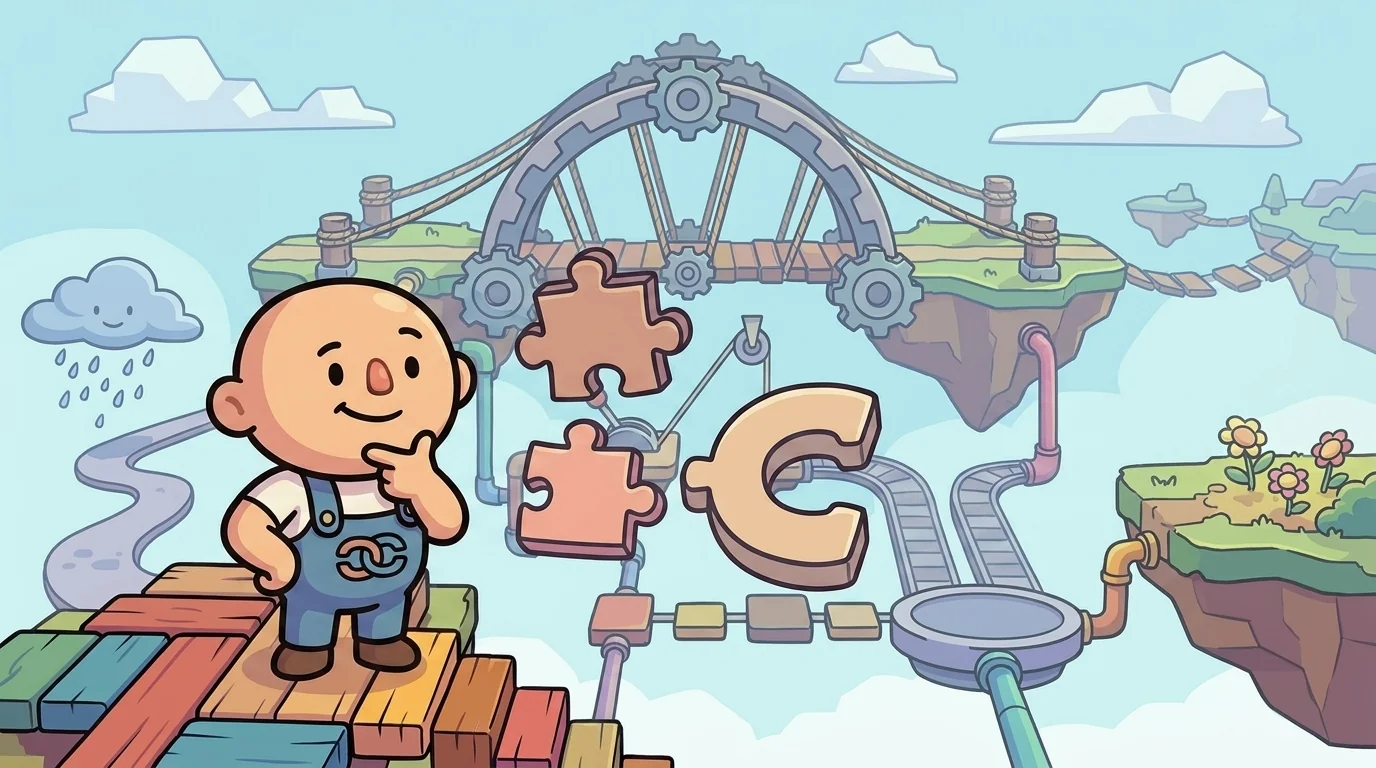
Chen — whose full name was Chen-Lao, often shortened to just Chen — grew up in a household of negotiators. His parents were mediation specialists in the kingdom's capital. They were civil servants. They resolved arguments between merchants. They settled disputes between neighbors. They helped guilds find common ground. They even helped landowners and their tenants. The kingdom had a long history of informal mediation. Chen's parents were known as the best.
Young Chen watched his parents work. He saw that connecting people meant understanding them deeply. Did two parties need to agree on something? Then they needed to be joined by a shared decision. Did they need to contrast with each other? They might disagree, but they still had to coexist. Did one party need to act if something else happened? Or because something was true? Or while something else was going on? Each problem needed a different kind of link.
He noticed these were the same logical relationships that conjunctions showed. The word and joined parties in agreement. But showed a contrast between them. Because signaled a cause for something. If signaled a condition. While signaled two things happening at the same time. Although signaled a concession.
Chen was fifteen when he recognized this connection. He started to categorize his parents' mediations. He thought about which conjunction would best describe the relationship. The argument between the baker and the miller? That was an and-case. Both wanted access to the same well. The brewer and the tavern had a but-case. The brewer wanted bigger barrels, but the tavern wanted smaller ones. The cobbler and his tenant had a because-case. The tenant couldn't pay because his sheep had died. Chen's categorizations were always right.
When Chen was nineteen, he walked to the GrammarForge academy. He carried a thick notebook. Inside, he had categorized six hundred dispute-resolutions. Each one was linked to a conjunction-relationship. The academy master read the notebook with great interest. He appointed Chen to the diplomat role immediately.
Chen has been the academy's conjunction-teacher for fourteen years.

In his classroom, he starts every first-day lesson the same way. On his desk sits a small wooden cube. It has seven faces labelled. (Chen had the academy carpenters make it. A cube usually has six faces. But Chen asked for seven. The seventh is the underside. He calls it "the secret seventh face.") The faces read: and, but, because, although, while, if, or. He rolls the cube. He turns to the class. He says: "The face that lands up tells us today's conjunction. Today we learn it."
He demonstrates. The cube lands on and. He says: "And joins equals. Like, The dog and the cat slept. Two equal subjects joined. Or, The dog slept and the cat slept. Two equal clauses joined. And signals both, equally."
He rolls again. But. He says: "But joins contrasts. Like, The dog slept, but the cat woke up. Two clauses joined with a difference between them. But signals however, by contrast."
He continues through each face. Because joins a cause to its effect. If joins a condition to its consequence. Although joins a concession to a main point. "A concession," he explains, "is something you admit. Like, Although it was raining, we still went to the park. You admit the rain, but you still went." While joins two things happening at the same time. "This is simultaneity," he says. "Like, While the dog slept, the cat watched the birds. Both actions happen together." Or joins alternatives.

The children — always — find the cube delightful. They had thought conjunctions were just small connector words. Chen shows them that each conjunction carries a specific logical relationship. The relationship is the information. The conjunction holds that relationship.
When children ask if conjunctions are hard, Chen always says the same thing:
"They are not hard. They are logical connectors. Each conjunction holds a specific relationship: agreement, contrast, cause, condition, concession, simultaneity, alternative. Once you know the relationship, you know the conjunction."
He still rolls the cube at the start of every lesson. The children sometimes ask to roll it themselves. He always lets them. The cube has, over fourteen years of rolling, acquired a slight worn quality on its corners. Chen will not have it refinished. He says: "The cube has earned its corners."
Hear it as an audio drama
A short play starring Connector Chen, from GrammarForge. Different voices, same idea. Listen any time after you read.
Loading audio…
Read the drama script
- Narrator: From Spark and Anvil and GrammarForge — this is Connector Chen, in chapter 1 of the GrammarForge cast.
- Narrator: This drama uses an AI-generated voice. Voiced via Gemini 2.5.
- Narrator: Connector Chen is Sentence-Town’s diplomat. He carries a small, curious wooden cube with seven faces.
- Narrator: He joins ideas. He connects people. He shows how different parts of the town can fit together smoothly.
- Connector Chen: I am Connector Chen. My job is to join. To link. To ensure decisions flow without conflict.
- Connector Chen: My tools are the logical connectors: *and*, *but*, *because*, *if*. They are the words that link our world.
- Connector Chen: *And* joins equals. *But* joins contrasts. *Because* joins a cause to its effect. Each word holds a different logic.
- Narrator: Chen grew up in a household of negotiators, watching his parents resolve arguments between merchants and neighbors.
- Connector Chen: By fifteen, I knew the lesson. Every problem needed a different kind of link, a specific kind of joining.
- Narrator: At nineteen, he walked to the GrammarForge academy, his notebook filled with six hundred categorized disputes.
- Academy Master: Tell me, young man, what is the true purpose of a conjunction?
- Connector Chen: A conjunction holds a specific logical relationship. It is the agreement, the contrast, or the cause between ideas.
- Academy Master: You are appointed. You are Sentence-Town's new diplomat.
- Narrator: A different link for every problem. A specific conjunction for every relationship. That is the whole job.
- Narrator: You've been listening to a Spark and Anvil chapter, written by the Spark and Anvil writing team for ages 9 to 14.
- Narrator: Apps stay free forever.
- Narrator: Curriculum aligned to Common Core English Language Arts.
- Narrator: Released under Creative Commons BY-NC-SA 4.0 for educational reuse. Visit Spark and Anvil for the full transcript.
The GrammarForge ensemble
Connector Chen is one of the friends in GrammarForge. Each friend shows you one idea by how they act; meet them all and you have the whole subject.
-

Mayor Subject
Subject (noun/pronoun performing the action)
-

Verb Verity
Verb (action / state of being)
-

Object Otto
Direct / indirect object (receiver of the verb's action)
-

Modifier Mike
Adverb (modifies verb / adjective / other adverb)
-

Modifier Madge
Adjective (modifies noun / pronoun)
-

Pronoun Perry
Pronoun (substitute for noun — *he*, *she*, *they*, *it*, *who*)
-

Article Anne
Article (*a*, *an*, *the* — definite vs. indefinite)
-

Preposition Pat
Preposition (spatial / temporal relations — *on*, *under*, *between*, *before*)
-

Clause-Chief Carla
Clause-types (independent / dependent / subordinate / relative)
-

Punctuator Polly
Punctuation guardian (commas, semicolons, apostrophes, colons, dashes)
-

Agreement Ada
Subject-verb agreement (singular subject → singular verb; plural subject → plural verb; tricky cases — collective nouns, *either/or*, indefinite pronouns)