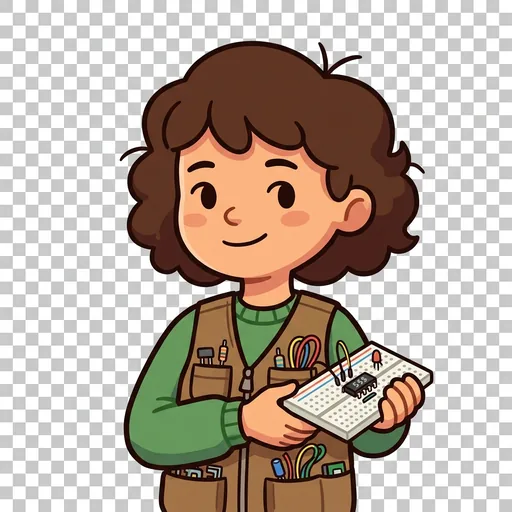
Punctuator Polly
PUNCTUATION — commas, periods, semicolons, colons, apostrophes, quotation marks, dashes, exclamation marks, question marks. The marks that regulate the flow of meaning.
Loading audio…
Press play to listen along. The line being read lights up as you go.
Show full transcript
Loading transcript…
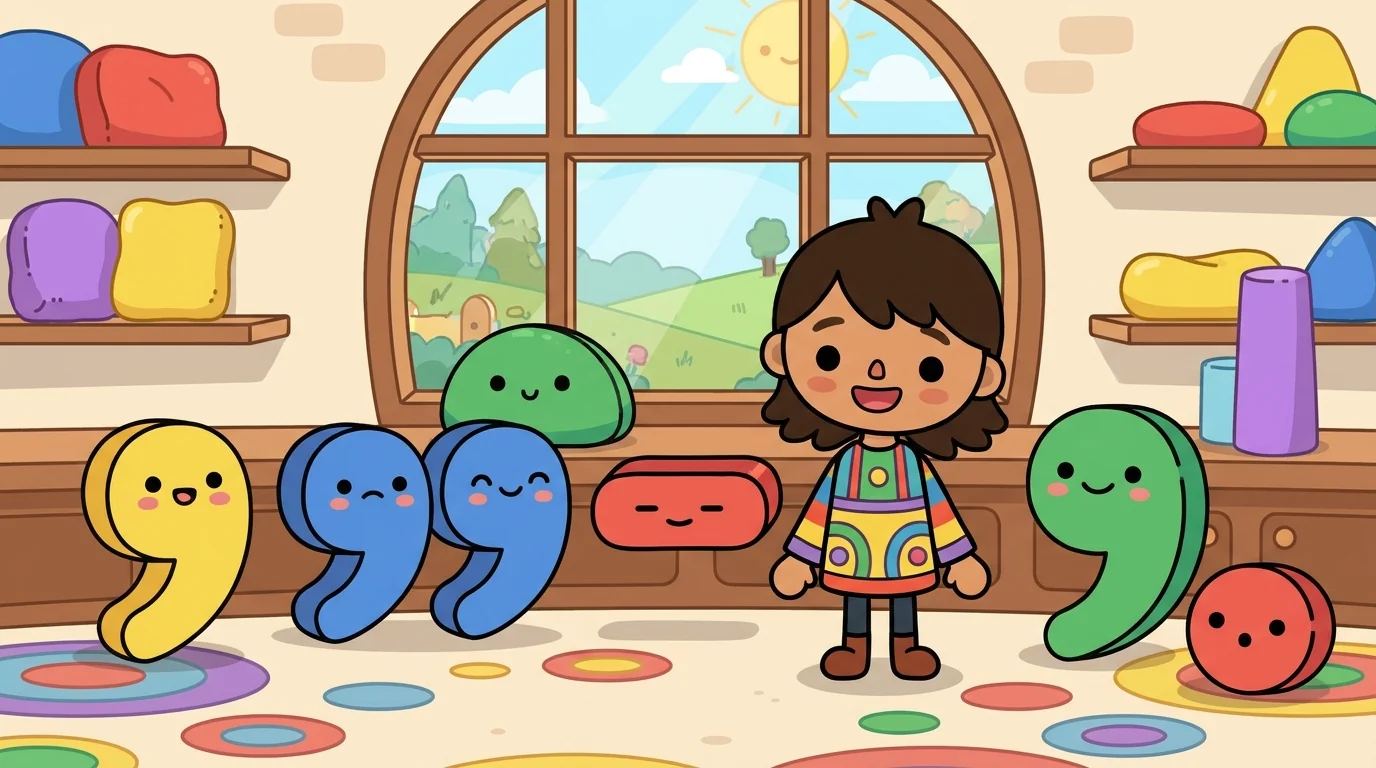
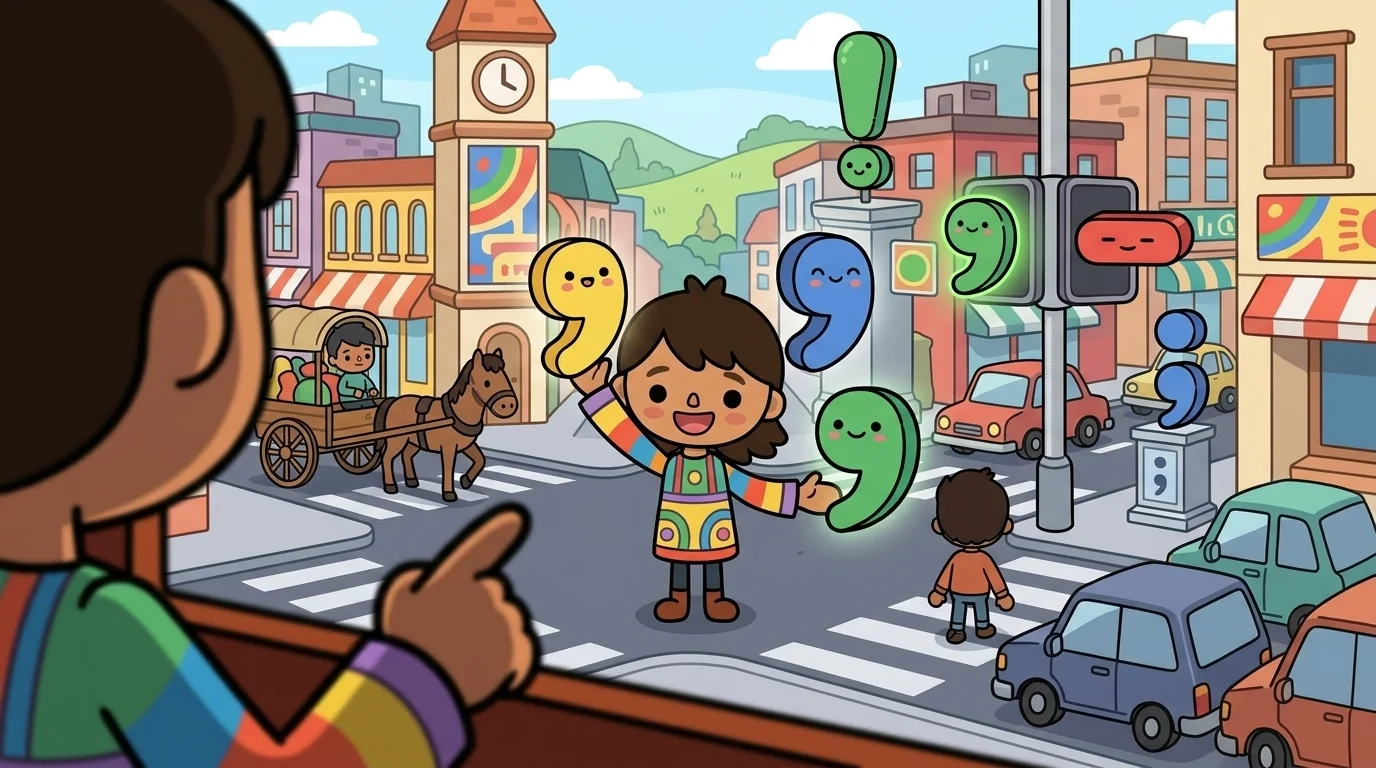
Punctuator Polly is Sentence-Town's traffic-light operator. Her job might seem small. But it's super important. The mayor does her job. The chief of operations does his. Even the person who answers the phone helps out. Everyone has a part to play. But all those parts need to flow smoothly. Like traffic.
When does a sentence end? When does it take a breath? When does someone else start talking? When do you list things? Polly makes sure all of this happens just right. She handles all the flow-control tasks.
Polly's real name is just Polly. She moves fast. She loves tiny, perfect marks. She thinks punctuation builds meaning. It makes sentences make sense.
Without punctuation, a sentence is just a big jumble. Like this: the dog barked the cat ran the children laughed it was a busy afternoon. Polly would say, "That's a mess! You can't even read it!"
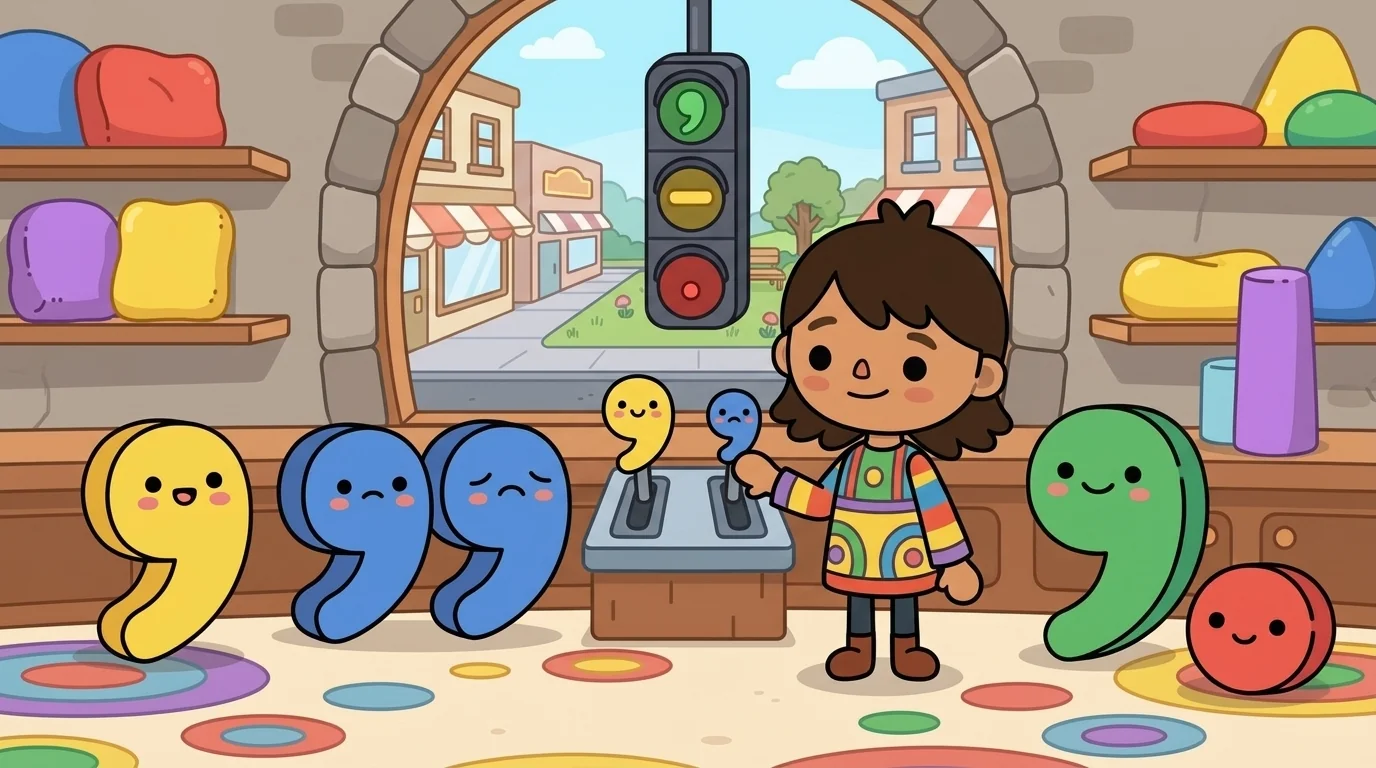
But add the marks: The dog barked. The cat ran. The children laughed. It was a busy afternoon. See? Now it has a beat. You can breathe. It makes sense. Readers can keep up.
Polly grew up in a family of traffic cops. Her mom and dad were both constables. They worked in the kingdom's capital city. They stood at busy corners. They directed horses and carts.
Back then, the city was super busy. So directing traffic was a real job. Constables stood in the middle of big crossings. They used hand-signals. They blew their whistles. They made sure carts and people moved along.
Polly watched her parents all the time. By age ten, she knew a big secret. Traffic moved well when someone guided it. It got stuck when no one did.
A hand up meant STOP. A hand to the side meant GO. A whistle meant "Look here!" These signals were tiny. But they were super powerful.
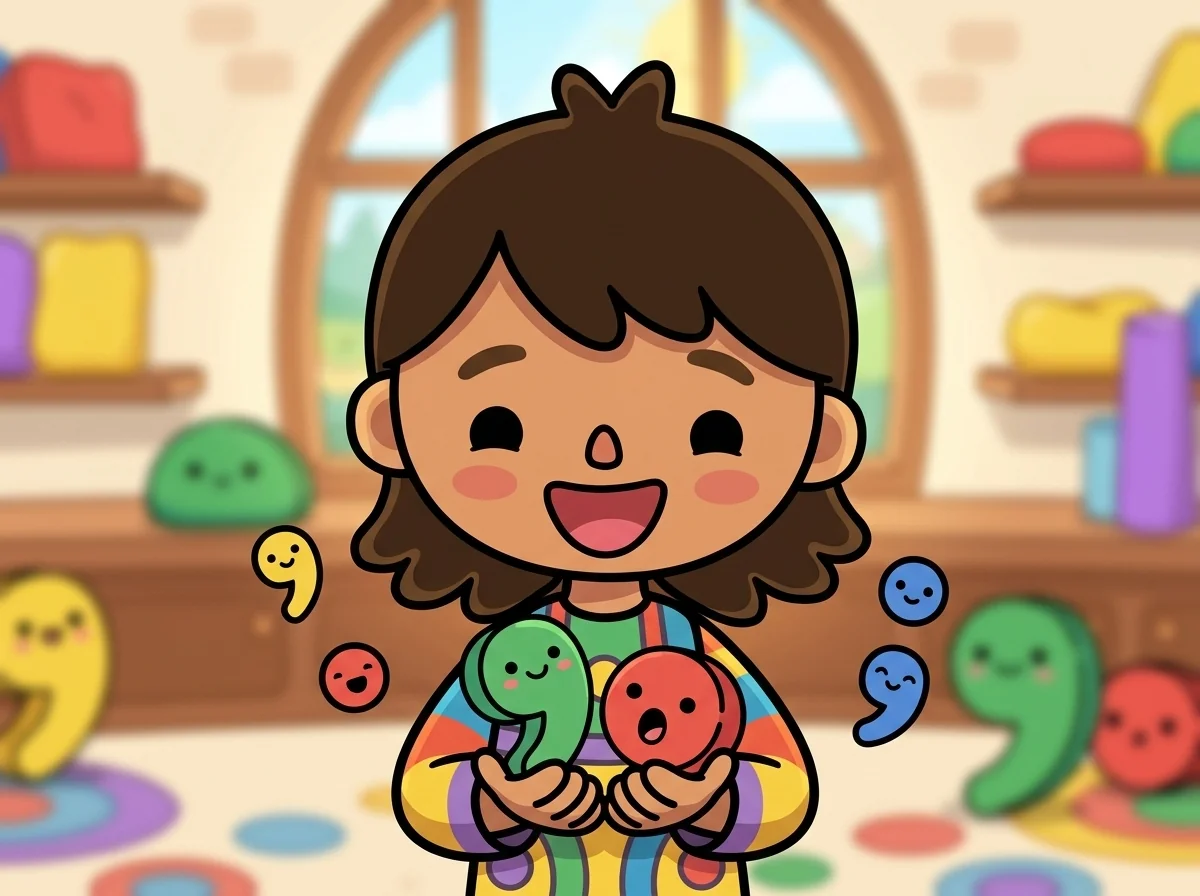
Over the years, Polly figured something out. Punctuation marks did the same thing. But for words.
A period was a STOP sign. A comma was a quick PAUSE. A semicolon meant STOP, but KEEP THINKING. A colon meant "Get ready, something's coming!" Each mark guided the meaning. Just like her parents guided traffic.
When Polly turned eighteen, she went to GrammarForge academy. She has been Punctuator Polly for fifteen years now.
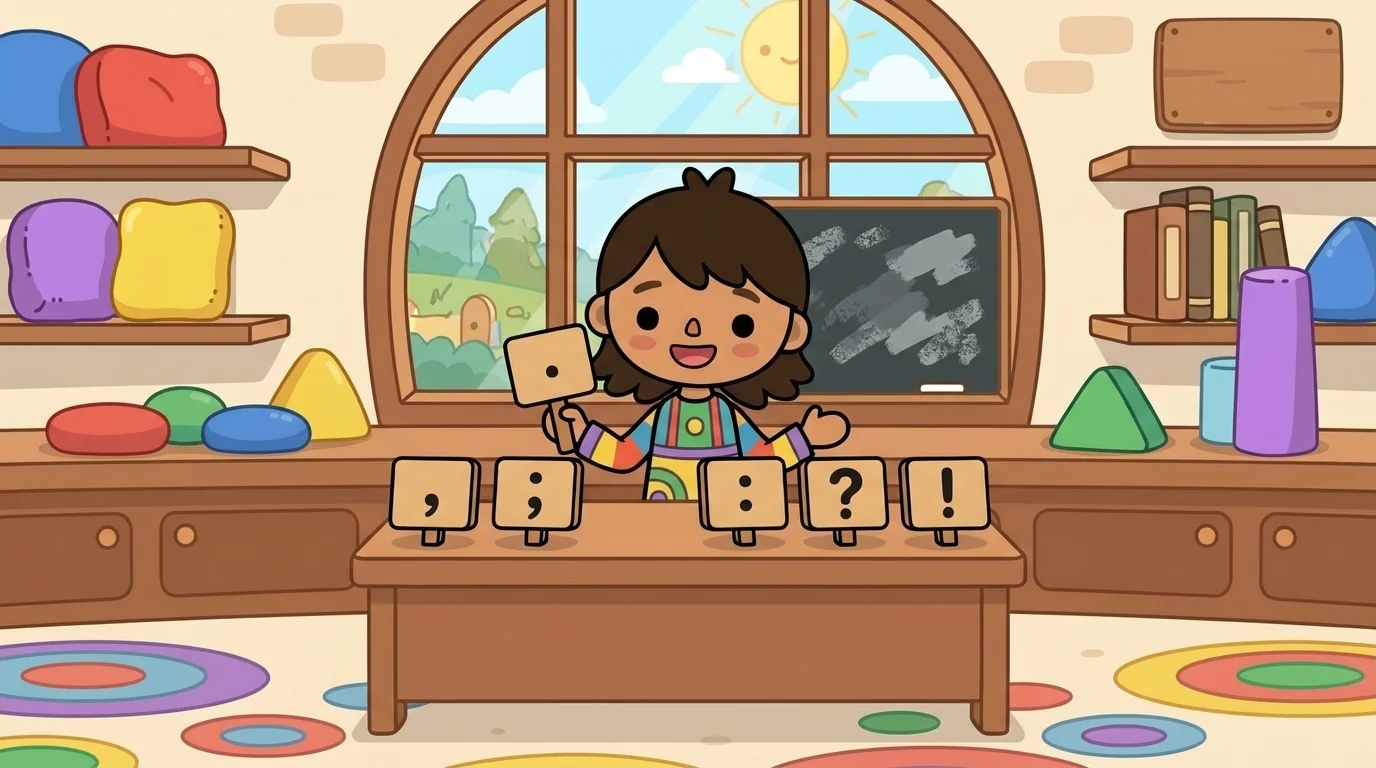
In her classroom, she always starts the first day the same way. On her desk are six small wooden signs. Each sign has a punctuation mark painted on it. There's a period (.), a comma (,), a semicolon (;), a colon (:), a question mark (?), and an exclamation mark (!). She holds them up. One by one. She shows what each mark means.
For the period, she says: "This is a full stop. End of sentence. The reader takes a breath. Then they start a new sentence."
For the comma: "This is a brief pause. The reader does not stop fully. They slow down. Then they continue."
For the semicolon: "This is a stop-but-related signal. You stop all the way. But the next sentence is super close to the first. The semicolon shows they belong together."
For the colon: "This is a here-comes-something signal. It tells you: 'Get ready! What's next will tell you more about what I just said.'"
For the question mark: "This signals the sentence is a question. The reader's voice rises. Like this: 'Are you ready?'"
For the exclamation mark: "This signals the sentence is exciting! Or loud! Your voice gets stronger. Like this: 'I love punctuation!'"
She also teaches about apostrophes. They show who owns something. Like the dog's bone. Or they squish words together. Like can't instead of cannot.
And quotation marks. They show when someone else is talking. "Hello!" she might say. Or "What a great day!"
And dashes. They mean a sudden stop. Or a quick change. "I was reading — wait, the dog is barking again!" Each mark has a special job. It sends a message.
When children ask if punctuation is hard, Polly always says the same thing:
"It's not hard at all," she says. "It's just like sending a message. Each mark tells the reader: 'Stop here!' or 'Take a breath!' or 'Someone else is talking now!' or 'Here's a list!' Just pick the mark that sends the message you want. The reader will get it."
She still keeps those wooden signs on her desk. Sometimes kids ask to hold them. They want to show how a sentence works. Polly always says yes. For fifteen years, she's seen thousands of sentences. All of them punctuated perfectly. Because the kids could see the signals. They could picture each mark. It made sense.
The GrammarForge ensemble
Punctuator Polly is part of GrammarForge's distributed-narrative cast. Each character embodies a different curricular primitive; together they teach the full subject.
-

Mayor Subject
Subject (noun/pronoun performing the action)
-

Verb Verity
Verb (action / state of being)
-

Object Otto
Direct / indirect object (receiver of the verb's action)
-

Modifier Mike
Adverb (modifies verb / adjective / other adverb)
-

Modifier Madge
Adjective (modifies noun / pronoun)
-

Connector Chen
Conjunction (coordinating / subordinating — *and*, *but*, *because*, *although*)
-

Pronoun Perry
Pronoun (substitute for noun — *he*, *she*, *they*, *it*, *who*)
-

Article Anne
Article (*a*, *an*, *the* — definite vs. indefinite)
-

Preposition Pat
Preposition (spatial / temporal relations — *on*, *under*, *between*, *before*)
-

Clause-Chief Carla
Clause-types (independent / dependent / subordinate / relative)
-

Agreement Ada
Subject-verb agreement (singular subject → singular verb; plural subject → plural verb; tricky cases — collective nouns, *either/or*, indefinite pronouns)