Agreement Ada
SUBJECT-VERB AGREEMENT — singular subject takes singular verb; plural subject takes plural verb. *The dog barks.* *The dogs bark.* Tricky cases: collective nouns, *either/or*, indefinite pronouns, intervening phrases.
Loading audio…
Press play to listen along. The line being read lights up as you go.
Show full transcript
Loading transcript…

Agreement Ada is Sentence-Town's protocol officer.
This is the quietly-essential role that makes sure the mayor and the chief of operations are matched in form. Singular subject + singular verb. Plural subject + plural verb. The rule sounds simple. In practice, it has many tricky cases — and Ada handles them all.
Ada — whose given name is Adelaide, often shortened to Ada — is patient with tricky cases. She believes that subject-verb agreement is the deepest expression of the subject-verb relationship. Mayor Subject and Verb Verity are each other's closest professional colleagues. They have to match. If the mayor is the dog (singular), the verb is barks (singular). If the mayor is the dogs (plural), the verb is bark (plural). The matching is protocol. The protocol officer enforces it.

Ada grew up in a diplomatic family. Her parents had both been protocol officers in the kingdom's foreign-ministry — civil servants who specialized in the correct forms of address for various diplomatic interactions. The kingdom had had a particularly elaborate protocol tradition, and Ada's parents had been responsible for making sure every diplomatic letter, every formal meeting, every ceremonial occasion used the correct titles, forms, and sequences.
Ada had grown up learning, viscerally, that form-matching mattered. A letter addressed To His Royal Highness Prince X was different from a letter addressed To Prince X. The form had to match the relationship. If the form was wrong, the diplomatic relationship was damaged.
She recognized, by fourteen, that English subject-verb agreement worked the same way. The form of the verb had to match the form of the subject. Mismatched forms damaged the sentence — they sounded wrong to a careful reader and signaled either carelessness or ignorance. A protocol officer's job, in either domain, was to enforce the matching.
Ada went to the GrammarForge academy at nineteen. She has been Agreement Ada for thirteen years.

In her classroom, she begins every first-day lesson the same way. She holds up a small balance scale (a teaching prop — two small pans on either side of a fulcrum). On the left pan she places a small token labeled Subject. On the right pan she places a small token labeled Verb. She turns to the class. She says: "My job is to make sure these two are balanced. Subject form on one side. Verb form on the other side. They must match. If they do not match, the sentence does not balance."
She demonstrates. She writes on the board: the dog barks. She points at the dog. She says: "Singular subject." She points at barks. She says: "Singular verb (barks is the third-person singular present form). Matched. Balanced."
She writes: the dogs bark. She says: "Plural subject. Plural verb (bark is the plural form). Matched. Balanced."
Then she demonstrates tricky cases.
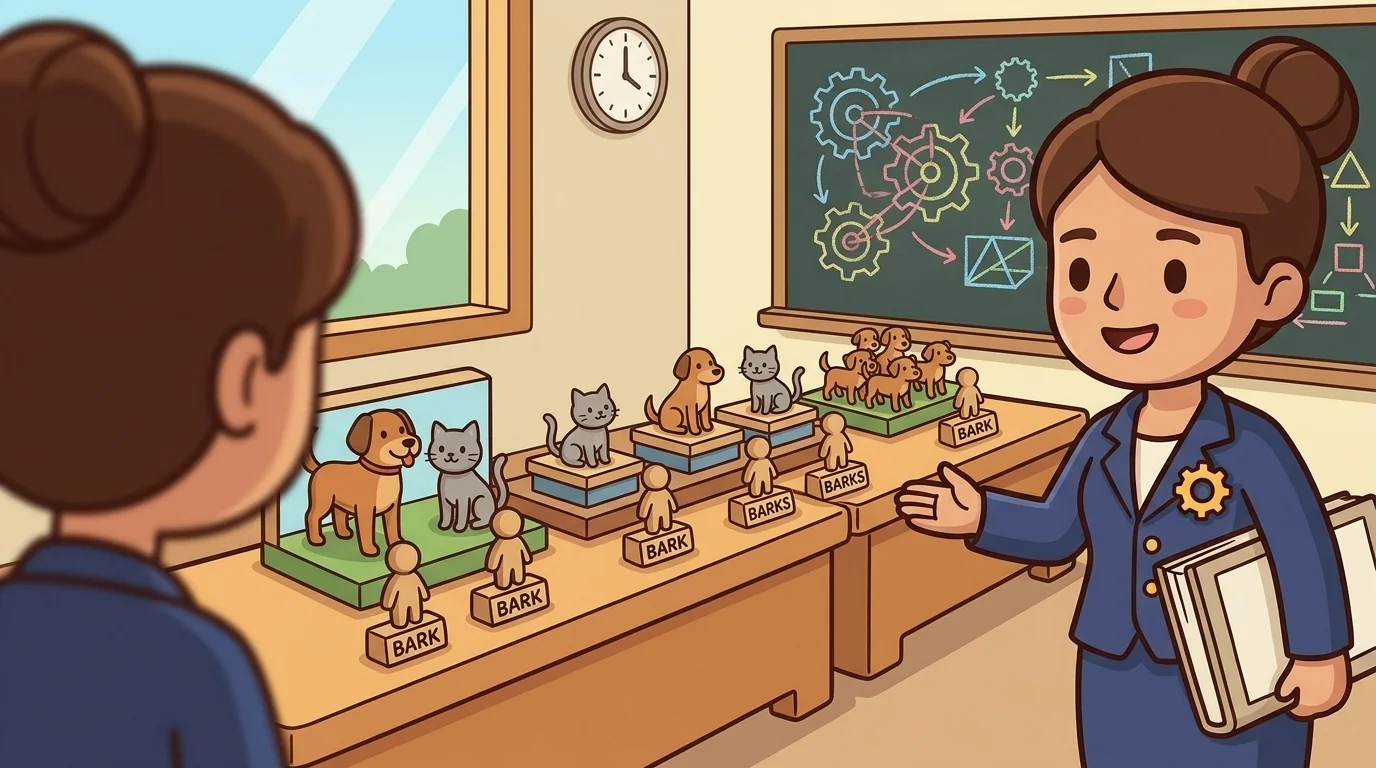
The dog and the cat bark. Compound subject. Two singulars joined by and count as plural. Plural verb. Matched.
Either the dog or the cat barks. Or with two singulars: the verb agrees with the nearer subject. Cat is singular, so barks is singular. Matched.
Either the dog or the cats bark. Or with singular + plural: the verb agrees with the nearer. Cats is plural, so bark is plural. Matched.
The pack of dogs barks. Pack is the head noun (singular collective). The verb agrees with pack, not with dogs. Matched.
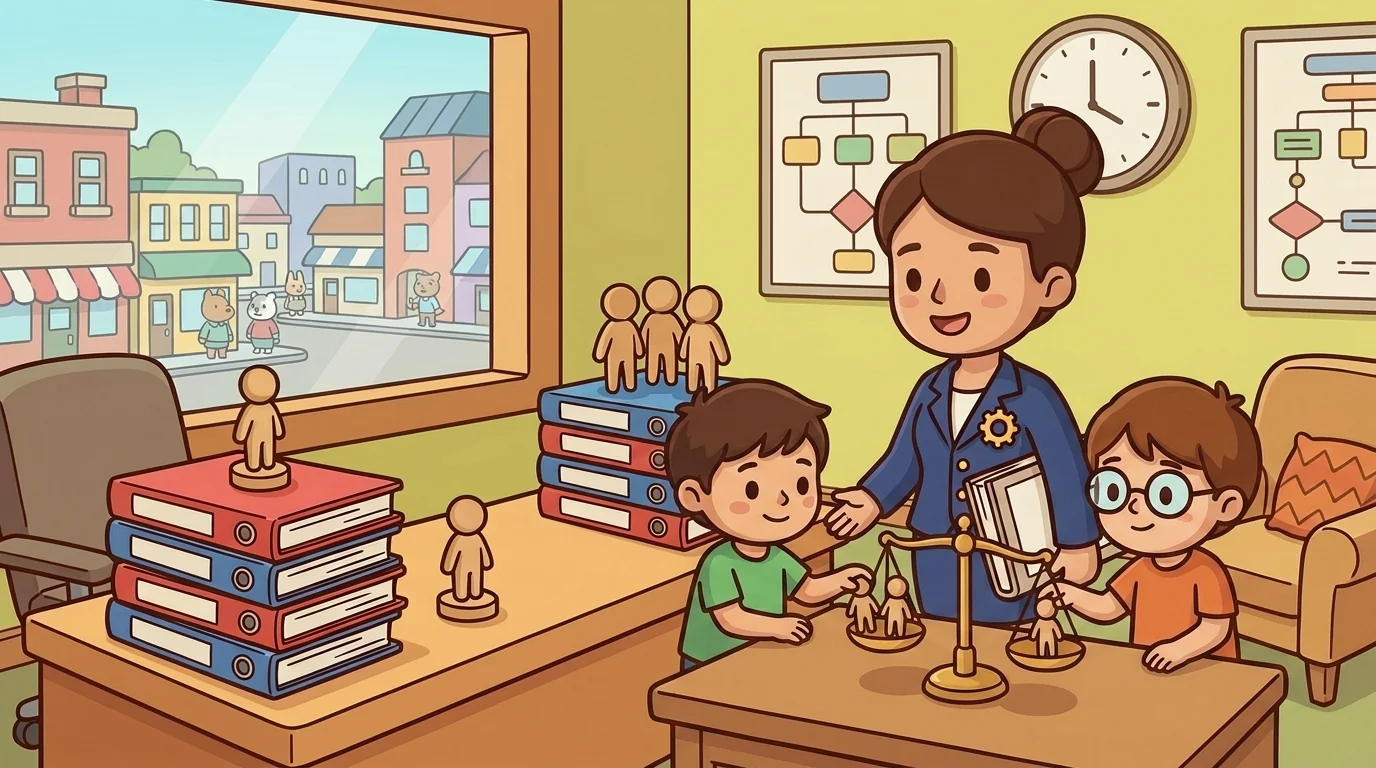
Everyone in the village brings their lunch. Everyone is grammatically singular but uses their and brings in modern English. (Traditional usage would say his or her lunch and brings. Modern usage accepts their. The verb stays singular: brings.)
The children — always — find the tricky cases eye-opening. They had not realized that subject-verb agreement had this many sub-rules. Ada normalizes the complexity: "There are tricky cases. Each tricky case has a rule. Once you know the rules, the cases are tractable."
When children ask whether subject-verb agreement is hard, Ada always says the same thing:
"It is not hard. It is matching. The form of the subject must match the form of the verb. Singular with singular. Plural with plural. Tricky cases have their own rules — and the rules are learnable. Patience handles the rest."
She still keeps the small balance scale on the desk. The children sometimes ask to test their own sentences on it. She always lets them. The scale, by long use, tilts slightly to the left — Ada has been meaning to have it recalibrated for several years. She has not gotten around to it. She says: "The scale tilts. But the principle holds."
The GrammarForge ensemble
Agreement Ada is part of GrammarForge's distributed-narrative cast. Each character embodies a different curricular primitive; together they teach the full subject.
-

Mayor Subject
Subject (noun/pronoun performing the action)
-

Verb Verity
Verb (action / state of being)
-

Object Otto
Direct / indirect object (receiver of the verb's action)
-

Modifier Mike
Adverb (modifies verb / adjective / other adverb)
-

Modifier Madge
Adjective (modifies noun / pronoun)
-

Connector Chen
Conjunction (coordinating / subordinating — *and*, *but*, *because*, *although*)
-

Pronoun Perry
Pronoun (substitute for noun — *he*, *she*, *they*, *it*, *who*)
-

Article Anne
Article (*a*, *an*, *the* — definite vs. indefinite)
-

Preposition Pat
Preposition (spatial / temporal relations — *on*, *under*, *between*, *before*)
-

Clause-Chief Carla
Clause-types (independent / dependent / subordinate / relative)
-

Punctuator Polly
Punctuation guardian (commas, semicolons, apostrophes, colons, dashes)