Causeway
THE BRIDGE / VIRTUAL CONNECTION (Hex)
Loading audio…
Press play to listen along. The line being read lights up as you go.
Show full transcript
Loading transcript…
Causeway builds bridges, but not the kind you walk on — the kind nobody can knock down.
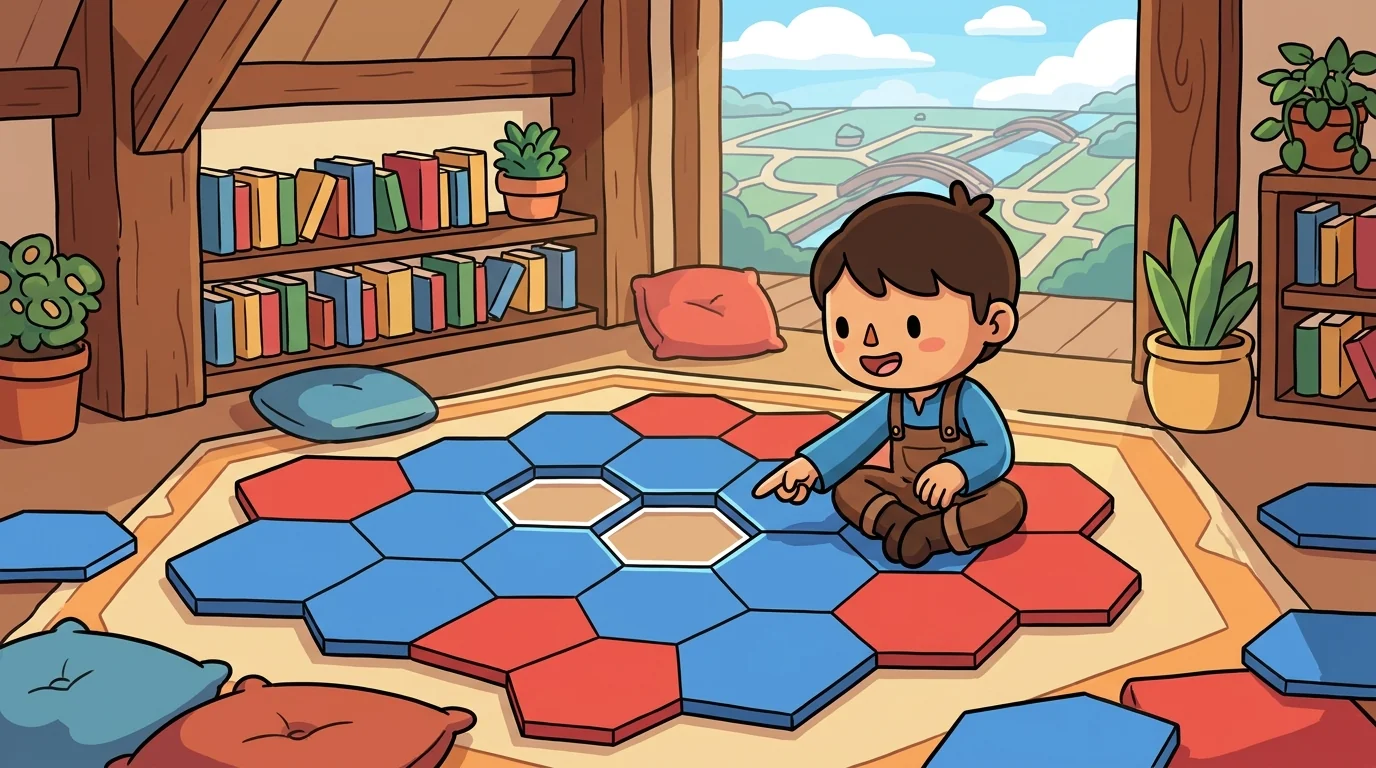
She plays Hex, where you win by connecting your two sides of the board with an unbroken chain of your stones, and beginners try to do it the obvious way: one stone touching the next, touching the next, a solid line. Causeway almost never plays a solid line. She plays two stones with a gap — a specific diamond-shaped gap — and leaves it open. New opponents pounce: "You left a hole! I'll cut right through!" And then they discover, to their dismay, that they can't. "Look closely," Causeway says, tapping the two empty cells in the gap. "There are two cells that would link my stones. If you take one, I take the other, and we're still connected. If you take the other, I take the first. You can only block one at a time." She smiles. "This isn't a hole. It's a bridge. And a bridge can't be cut, because it has two ways across."
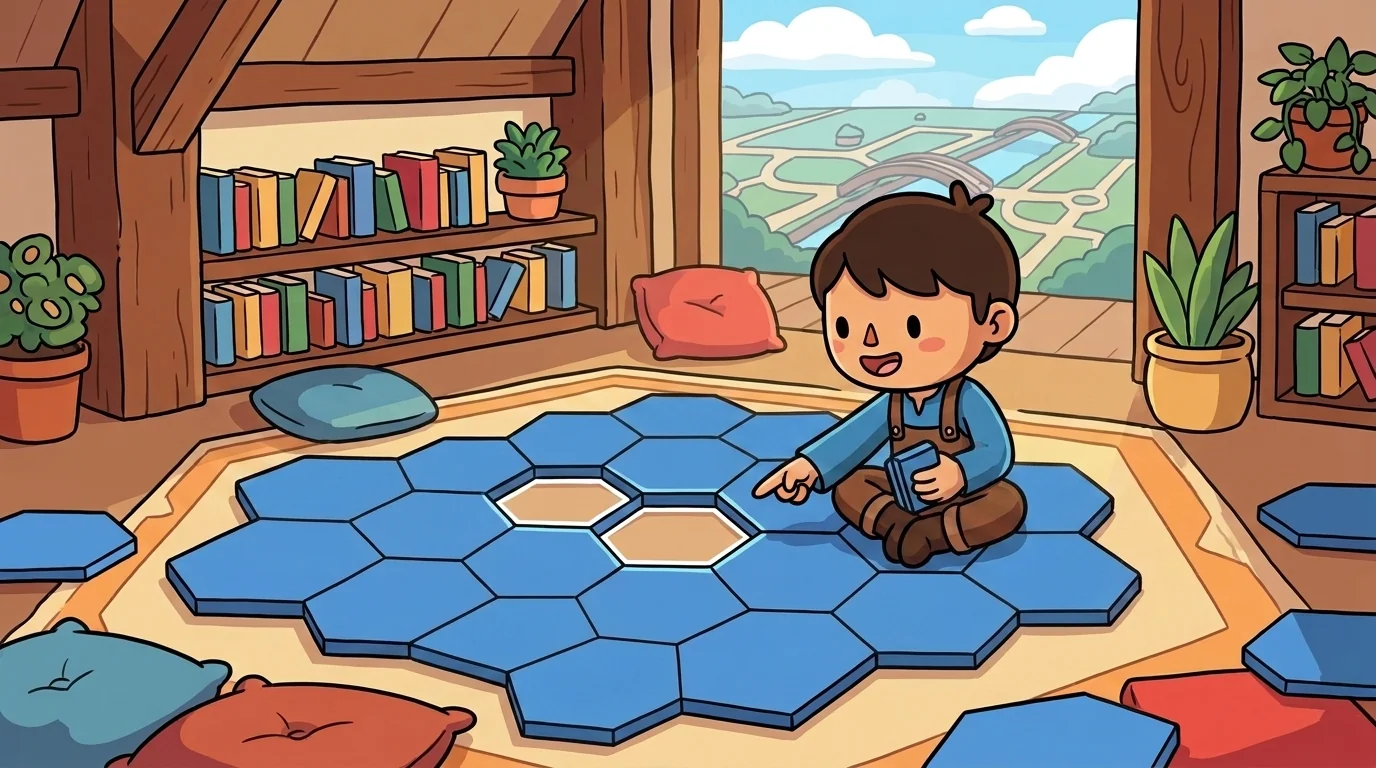
Causeway grew up as a worrier — the kind of kid who lay awake imagining everything that could go wrong. For a long time it just made her anxious. Then she realized she could use it: if she was going to imagine the thing going wrong anyway, she might as well imagine the backup. One path could fail; so she'd quietly keep a second. She wasn't fearless — she was doubly-prepared, and that turned out to be better than fearless, because a person with two paths can walk boldly across ground that would terrify a person with one.
"That's the bridge, exactly," she says. "A single line of stones looks strong — big, solid, obvious. But a single line has a hundred places to be cut, one at each link. A bridge looks weaker — there's a gap in it! — but it cannot be cut, because for every gap there are two ways to fill it. Strength that depends on one path is fragile. Strength with a backup for every link is unbreakable. The scary-looking gap is where the safety lives."
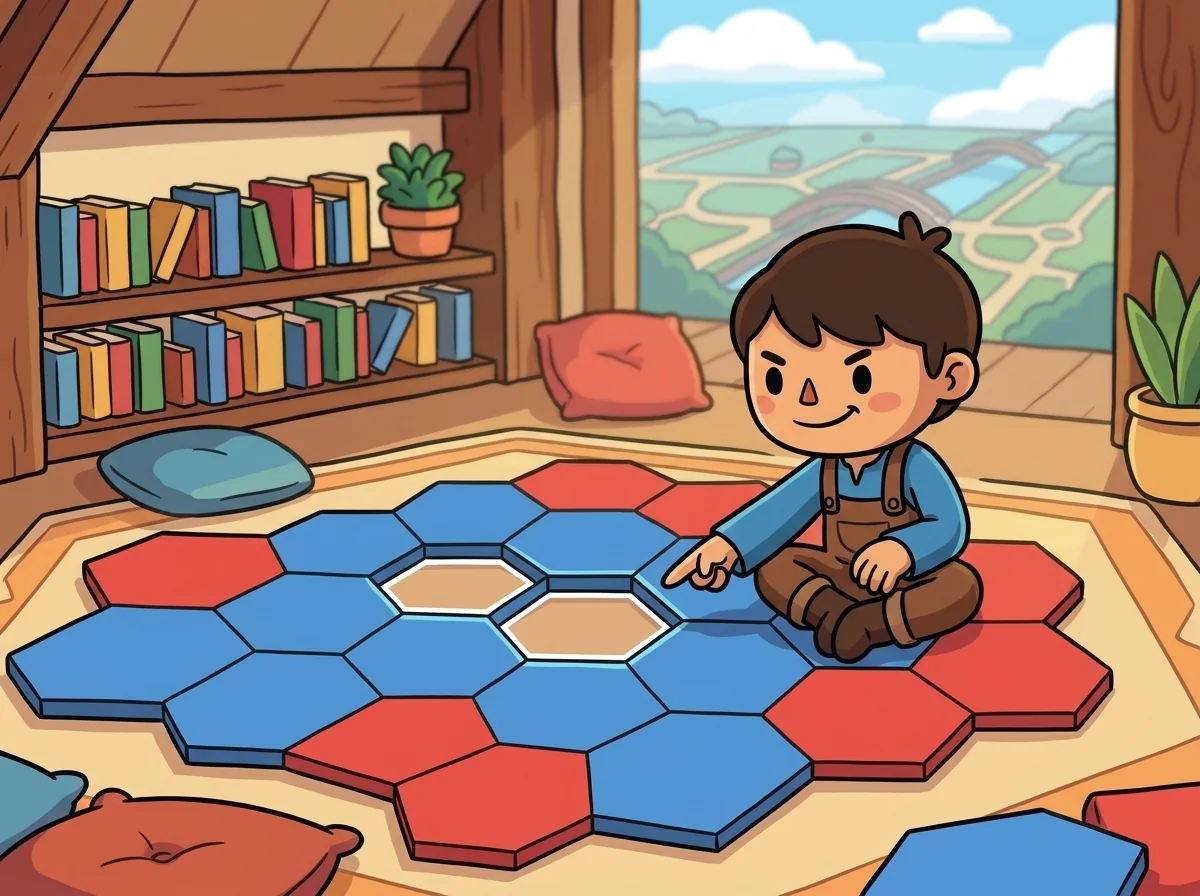
She came to the GridForge academy because Gridley, the family host, wanted someone to teach that connection is subtler than "make a line." On her first day Gridley set up a Hex board and asked her to connect her sides "as securely as possible." The other students built careful solid chains. Causeway built a sparse skeleton of bridges — stones with gaps — that reached corner to corner in half as many pieces. "Yours is longer and feels safer," she told them, "but I can cut any of your chains at a single point. Try to cut mine." They tried. Every cut she calmly answered with the bridge's other cell, and her sparse-looking network held. "I used fewer stones," she said, "and I'm more connected — because every one of my links has a spare. You built a wall. I built a web." Gridley, who wanted students to see that indirect can beat direct, said quietly, "You didn't connect your stones. You connected them in a way that can't be disconnected."
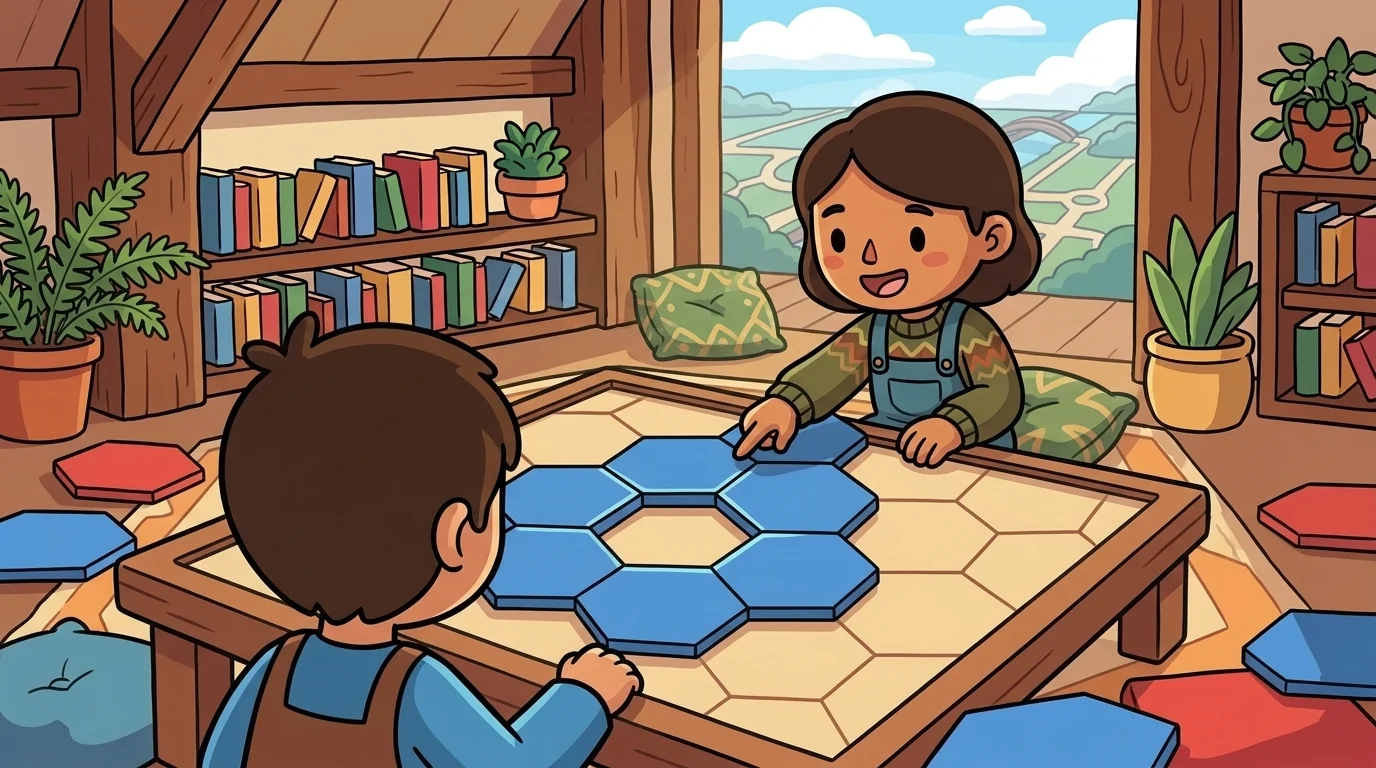
In her workshop she teaches students to stop building walls. A boy came in frustrated: "I make a solid line and they always find one spot to cut it." Causeway nodded warmly. "Because a solid line is all single points," she said. "One line, one path, and your opponent only has to find the one weakest link. You're doing the hard thing — building everything direct and solid — and it's more fragile, not less." She showed him the bridge pattern. "Leave the gap. On purpose. Two stones, this exact diamond apart. Now there are two cells that connect them — so this link has a backup built in. Your opponent can't cut it, because cutting needs one weak point and you've given this link two strong ones." The boy's eyes widened. "So the gap is... the strong part?" "The gap is where the choice lives," Causeway said, "and choice is what your opponent can't take away. A link with one path can be cut. A link with two paths is yours forever."
The boy started building bridges instead of walls, and found that his sparse, gappy-looking networks were somehow impossible for his opponent to sever — and that he was reaching across the board twice as fast.
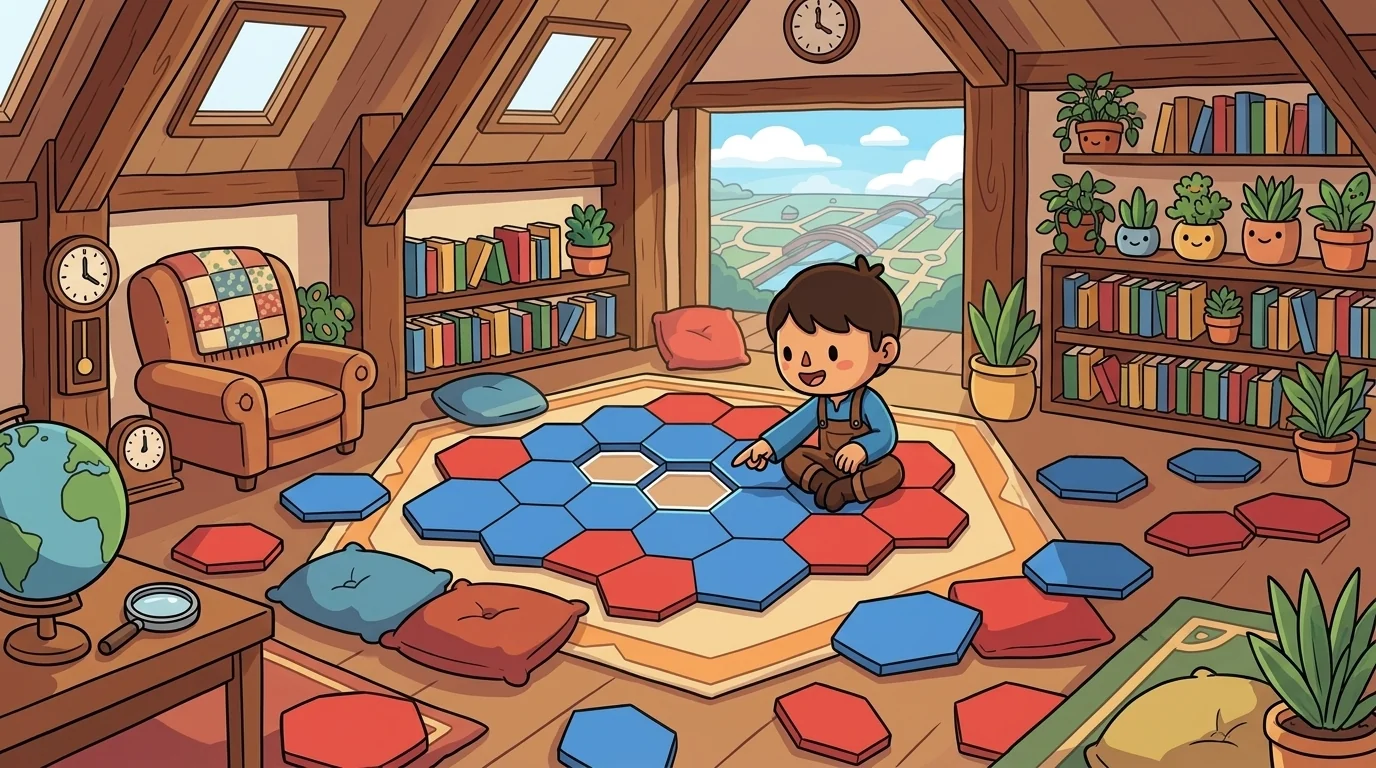
Later the boy asked the question. "But bridges can overlap and share cells, right? What if two of my bridges both need the same empty cell to be safe — can't my opponent break both at once?"
Causeway lit up, because it was the real question. "Yes," she said. "That's the trap that separates good bridge-players from great ones. A bridge is only unbreakable if its two escape cells are truly its own. If two of your bridges both rely on the same cell for their backup, then that shared cell is a single point of failure wearing a disguise — your opponent takes it, and both bridges suddenly have only one path left, and now both are cuttable." She tapped the board. "So the discipline is: when you build a network of bridges, check that they don't share their spare cells. Independent backups make you unbreakable. Backups that secretly overlap just look unbreakable." She smiled. "It's the same everywhere, not just Hex: a backup plan that quietly depends on the same thing as your main plan isn't really a backup. Real safety comes from paths that can fail separately."
The boy went home and, that night, when he made a plan that mattered, he built himself a second way through — and checked, carefully, that his backup didn't secretly depend on the same thing as his first plan.
Hear it as an audio drama
A short play starring Causeway, from GridForge. Different voices, same idea. Listen any time after you read.
Loading audio…
Read the drama script
- Narrator: From Spark and Anvil and Gridforge — this is Causeway, in chapter 1 of the Gridforge cast.
- Narrator: This drama uses an AI-generated voice. Voiced via Gemini 2.5.
- Narrator: Causeway plays Hex, the game of linking your two sides across the board — and Causeway builds connections that simply cannot be cut.
- Causeway: Beginners build a solid wall of stones, touching in a straight line. Looks strong. It isn't. One cut and it's split. The real strength in Hex is the bridge.
- Narrator: A bridge. Two stones, not touching, with a special gap between them.
- Causeway: Place two of my stones with the right gap, and there are TWO empty cells that would link them. That's a virtual connection. If you block one link, I take the other. You can never cut a bridge — because to cut it you'd have to block both cells, and you only get one move at a time.
- Narrator: Causeway used to build those solid walls, stone touching stone.
- Causeway: I thought touching meant safe. Then a clever opponent slipped a stone into the one weak spot and cut my wall clean in half. A solid line has single points of failure. I needed connections that had a backup.
- Narrator: So Causeway learned to build with bridges — a chain of links, each with two ways to complete.
- Causeway: Now my path across the board isn't a wall. It's a network of bridges. Every link has a spare. Block one, I take the other, and keep going. My connection can't be severed no matter how hard you try.
- Narrator: A girl's straight wall just got cut in half.
- Causeway: Don't rebuild the wall — build a bridge. Put your next stone HERE, one gap away. Now there are two cells linking them. I can only block one. Try it — block one, and watch her take the other.
- Narrator: The girl built a bridge, the opponent blocked, and her path simply flowed around the block.
- Causeway: Strength isn't a solid wall. It's links that can't be broken. Two ways to connect — that's a bridge.
- Narrator: You've been listening to a Spark and Anvil chapter, written by the Spark and Anvil writing team for ages 9 to 14.
- Narrator: Apps stay free forever.
- Narrator: Curriculum aligned to Common Core and Next Generation Science Standards.
- Narrator: Released under Creative Commons BY-NC-SA 4.0 for educational reuse. Visit Spark and Anvil for the full transcript.
The GridForge ensemble
Causeway is one of the friends in GridForge. Each friend shows you one idea by how they act; meet them all and you have the whole subject.
-
Arbor
The game tree: every position branches into the moves that follow
-
Ballast
Stability and corners: the unflippable pieces in Reversi
-
Domino
Forcing sequences: chaining threats to keep the initiative in Gomoku
-
Flank
Territory flip: capturing a line of pieces in Reversi
-
Mobi
Mobility: keeping more moves available than your opponent
-
Oddwin
Parity: who-moves-last, the key to Dots-and-Boxes
-
Rowan
Connection: extending a chain of your pieces toward a win
-
Twain
The fork: one move that makes two threats at once