
Octave and Rill
OCTAVE & RILL (Advanced) — a still block chord becomes a climbing, rippling line through two independent spreads: Rill ARPEGGIATES it across TIME (one note at a time), and Octave extends it across REGISTER (up through the octaves). Arpeggiation alone flows but stays on one floor; octave-extension alone rises but only in thuds. Together — an arpeggio that keeps climbing floor after floor — they turn a wall into a river that runs uphill.
Loading audio…
Press play to listen along. The line being read lights up as you go.
Show full transcript
Loading transcript…

A boy sat at the keys with a chord he loved and a complaint he couldn't shake. "It's so heavy. I want my song to feel like it's floating up, going somewhere, like sparkles. But my chord just sits there like a rock. All at once. Thud. How do you make a chord rise?" Octave the elephant-seal pup and Rill the river-otter looked at each other — the one who lived between basement and attic, and the one who turned every chord into a stream — and both lit up, because between them they were the answer. "You un-stack it," said Rill. "And you send it climbing," rumbled Octave. "Both of us. One alone gives you half a sparkle. Together, the whole rising thing."
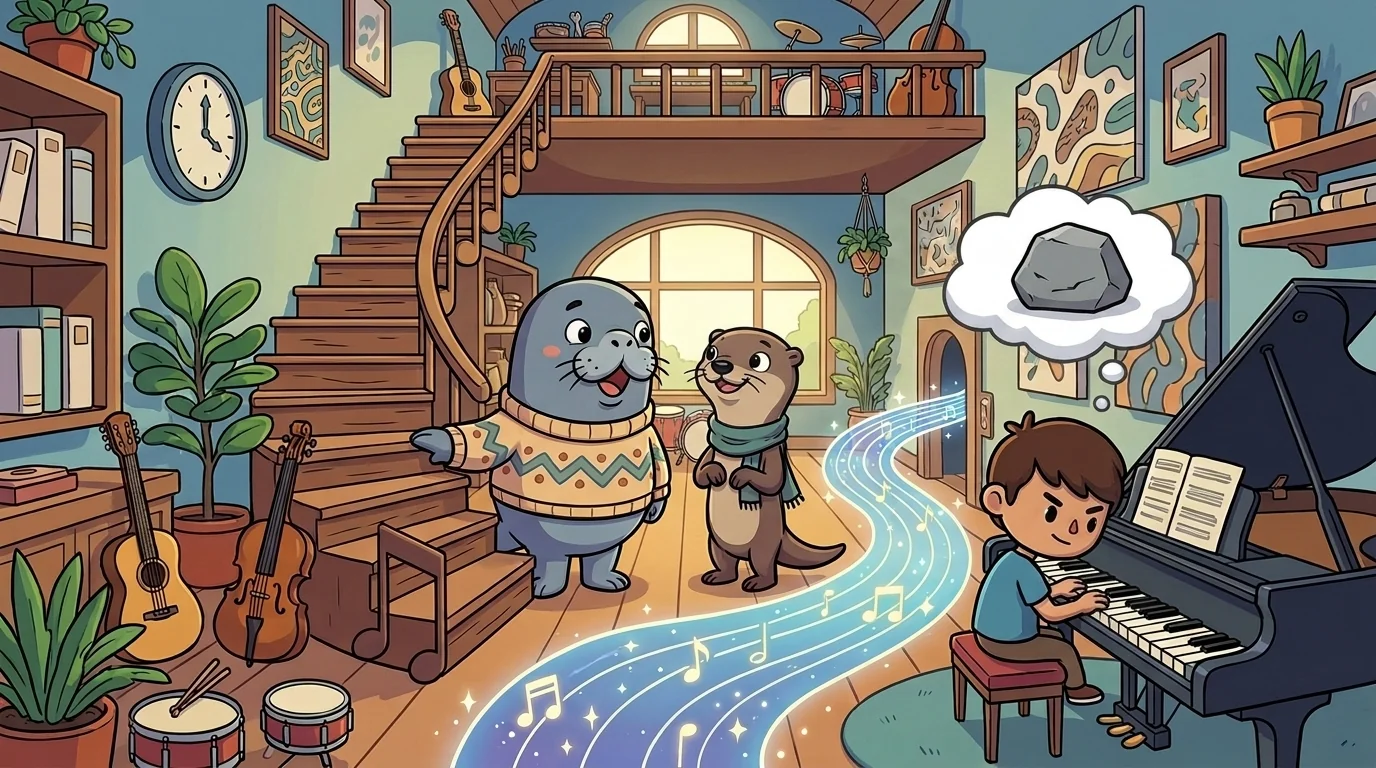
Rill went first, because a chord has to start moving before it can go anywhere. "Play your rock." He struck the block chord — solid, all at once, thud. "Now don't hit them together. Roll them — bottom, middle, top, one after another." He did, and the chord rippled out, sparkling. "There's your first spread. That's an arpeggio — the same notes un-stacked across time, so instead of a wall it's a stream." She rolled it again, quick and light. "Hear how it moved? It's not a rock — it's walking. But it's walking on level ground. It ripples along, but it doesn't rise. For the rising —" she looked at Octave — "you need floors."

Octave took over, because rising means having somewhere higher to go. "A chord doesn't have to stay on one floor," he rumbled. He played the boy's three notes low, in the basement, then the same three notes an octave higher, up in the attic. "Same chord — I just moved it up an octave, a whole floor, and it stays the same notes because the octave is just a doubling. That's the second spread: not time, register." He played basement, then attic, and the room felt like an elevator going up. "But notice — that's rising in thuds, one block per floor. It goes up, but it doesn't flow."
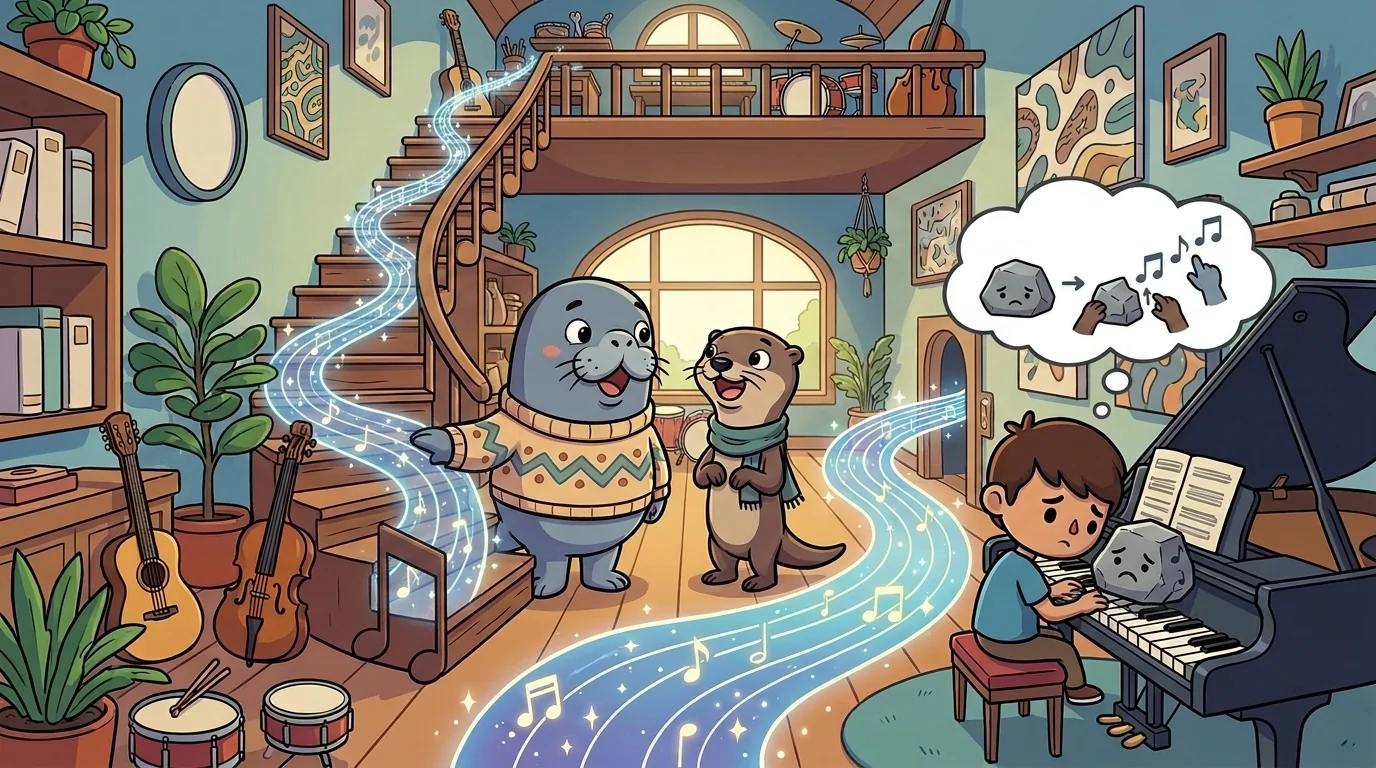
Then they combined, and the rock became a rising river of light. Rill began rolling the chord — bottom, middle, top — and instead of stopping at the top, Octave nudged the next note into the next octave, so Rill kept walking, note by note, right up the staircase of registers: bottom, middle, top — the same notes a floor higher — bottom, middle, top — a floor higher still — climbing and rippling all at once, until the chord that had been a rock was a shimmering line sparkling to the ceiling. "THAT," said Rill, "is a chord that climbs." "Two spreads at once," rumbled Octave. "Rill spreads it across time so it flows. I spread it across registers so it rises. Alone —" "— I flow, but only on one floor," said Rill. "— and I rise, but only one thud per floor," said Octave. "Together — arpeggiated and climbing octave after octave — we turn a heavy block chord into a river running uphill. Same notes the whole way, spread across time and register."

The boy tried it — rolling the chord and letting it climb, floor by floor, note by note — and his heavy chord lifted off the ground and sparkled all the way up, exactly like the floating, rising song in his head. "It's still just my chord. It went from a rock to that. And neither of you could've done it alone?" "Not even close," said Rill. "I roll it out over time — that's flowing. But flowing flat still doesn't go up." "And I stack it up through the octaves — that's rising. But rising all-at-once is still thud, thud, thud. It doesn't flow." Octave rumbled warmly. "It's the two together — time and register, flow and climb. That's the shimmer: a chord that runs uphill like water that forgot which way down is." The boy played it once more, the same three notes rippling and rising, and it sounded exactly like sparkles going up.
And Octave and Rill felt it settle warm and shared between them — that clicked-together, two gentle spreads make one rising river gladness that comes when a thing you thought was heavy and stuck becomes light and climbing, just by spreading it two ways at once. Rill loved the flow. Octave loved the floors. But most of all they loved teaching a kid's heavy chord to climb — the same notes, spread across time and register, turned into a stream that runs uphill toward the light.
The HarmonyForge ensemble
Octave and Rill is part of HarmonyForge's distributed-narrative cast. Each character embodies a different curricular primitive; together they teach the full subject.
-

Triad
Chord-stacking — three tones in vertical alignment (root + third + fifth = the foundation of harmony)
-
Lean
Voice-leading — smooth stepwise motion between chord tones (the smallest possible movements between consecutive chords)
-

Pull
Tension — dissonant intervals (the leading-tone, the suspended 4th, the diminished chord) that *want* to resolve
-

Land
Resolution — the consonant arrival when tension releases (root return; cadence; the V→I gesture)
-

Shift
Modulation — changing keys mid-piece (the moment a song *moves to a different room* harmonically)
-
Ache
Seventh chords — a dove whose coo adds a fourth voice on top; a sweet, unfinished ache that leans the chord forward
-

Octave
Octave — a seal who sings the same note a whole floor up; eight steps from a note back to its own echo
-

Rill
Arpeggio — an otter who un-stacks a chord into a walk; the same tower played one stone at a time, flowing
-

Tumble
Chord inversion — a red panda who re-stacks the same three notes; a different one on the bottom changes the chord's face
-
Umber
Major/minor third — an owl who lowers the middle tone one step; that note decides if a chord sounds bright or dark