Octave
OCTAVE — *the same note, a whole floor up. eight steps from a note back to its own echo. same name, new height.*
Loading audio…
Press play to listen along. The line being read lights up as you go.
Show full transcript
Loading transcript…

Octave sang a low, round, rumbly note that seemed to come up through the floorboards — and then, without changing which note it was, he sang the exact same note way up high, bright and small as a bell.
The two notes rang together, and something wonderful happened: they sounded different — one big and deep, one tiny and bright — and yet completely, obviously the same.
"Same note," Octave said, pleased. He was a big-and-small creature all at once — an elephant seal pup, round and rumbly, with a voice that could go from a foghorn to a whistle. "Low one, high one. Eight steps apart. But say them out loud and they've got the same name. It's the note and its own echo, a whole floor up. Same note. New height."
He sang them together again, the deep and the bright, and they braided into one warm, ringing sound.
"That distance," he said, "the note back to its own echo — that's an octave. The biggest, roundest, most agree-with-each-other distance there is. Two notes so alike they blend into one."

Octave had always lived between the big and the small.
He grew up on a rocky shore where his family were the shore-singers, elephant seals whose calls could rumble low across the water or pipe high over the rocks. And Octave had noticed, young, that his father's great booming call and his own little pup-whistle were, somehow, the same call — the same shape, just one big and one small.
"How can we be singing the same thing," he asked once, "when you're a foghorn and I'm a peep?"
"Because a note keeps its name however high or low it goes," his father rumbled. "I sing it big. You sing it bright. Eight steps apart, but it's the same note wearing a different size. That's the octave, little one. The same voice, a floor up or a floor down — and no matter how far apart, it still recognizes itself."
Octave loved that. That you could change size completely — go from tiny to huge — and still be unmistakably, deep-down, the same.

When Octave was twelve he rolled down the path to HarmonyForge, foghorn and whistle both ready. Refrain, his mentor, was waiting.
"Triad stacked notes. Tumble moved them," Refrain said. "What did you come to add?"
Octave sang a note low, then the same note high. "Height," he said. "A note isn't stuck at one spot. You can sing it, or play it, way down low or way up high — and it's the same note, just a floor up or down. Eight steps, and it comes back to its own echo. That's the octave. It lets you take any note or chord and move it into a rumbly basement or a bright attic without changing which notes they are."
Refrain listened to the low and the high ring as one, and her feathers settled at the roundness of it.
"You'll be teaching the ones who think a note only lives in one place," she said. "Come in."
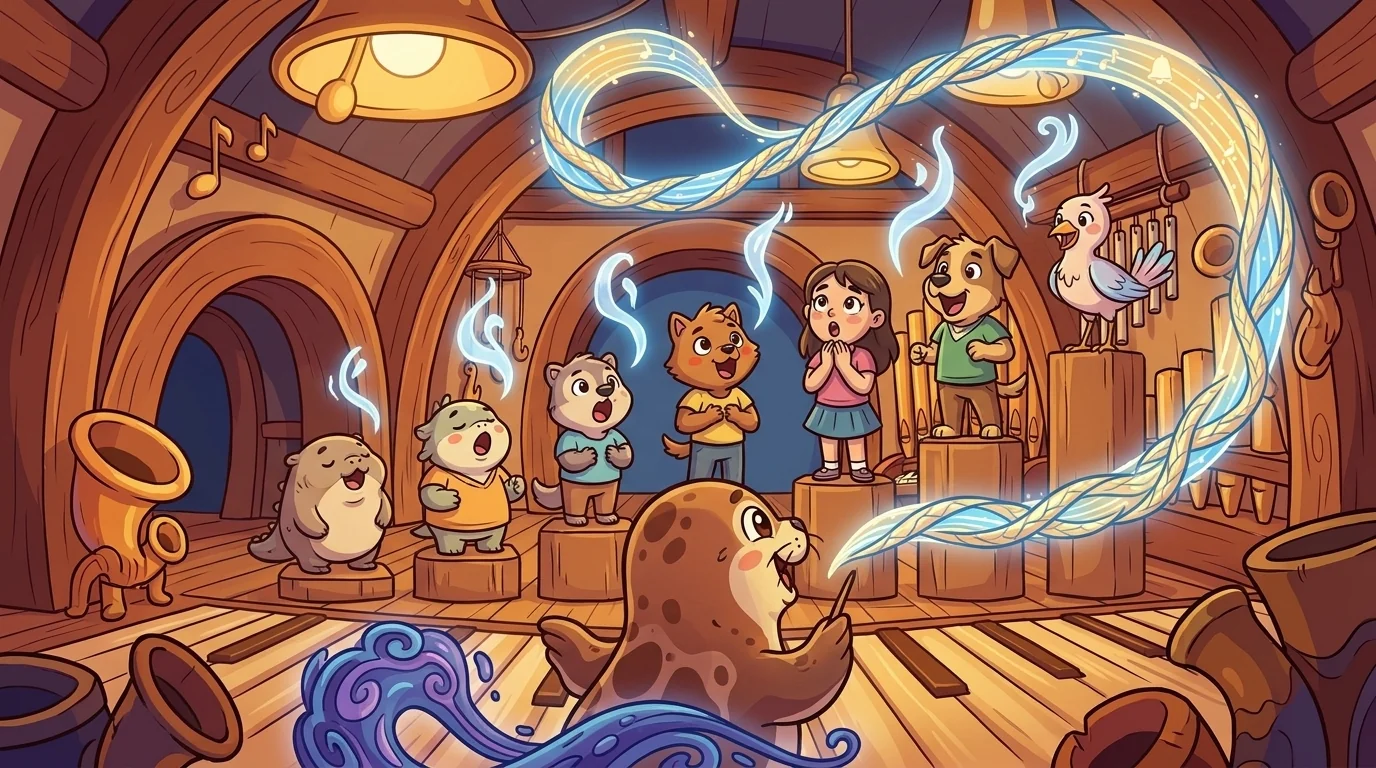
In the workshop, Octave lined the students up like a staircase and had each one sing a step higher than the last — do, re, mi, all the way up — until the eighth one sang.
"There," Octave said, delighted, as the eighth voice rang out. "Listen. The very first note and this eighth note — do they sound related?"
"They sound the same," a girl said, startled. "But higher."
"The same, but a whole floor up. That's an octave — eight steps back to the same note's echo." He had a low singer and a high singer hold the two ends together, and the room filled with that big-round blend. "This is why a boy and a grown-up can sing the 'same' melody even when one's way higher — they're an octave apart, matching note for note, a floor between them. And it's why you can take a chord that's sitting too low and rumbly and lift the whole thing up an octave into something bright and sparkling — same chord, new height, new feeling."
A boy sang a tune low and grumbly, then the same tune an octave up, bright as a whistle, and laughed at how it was the same song wearing a new size.

The boy looked up. "So high-me and low-me are singing the same note? Even though they sound nothing alike?"
Octave rumbled a warm laugh, thinking of his father's foghorn and his own peep braiding into one call across the water.
"Nothing alike on the outside — the same thing underneath," he said. "That's the octave's whole gift. A note can be huge or tiny, a floor down in the basement or a floor up in the attic, and it never loses its name. It always recognizes itself across the distance. That's why the octave sounds so agreeable — the two notes are practically twins, just one big and one small." He sang the low note and the high note one last time, and let them ring together, deep and bright as one. "Same note. New height. Big or small, high or low — still, underneath it all, itself."
The boy sang his low note and his high note together, hearing the twin-ness of them for the first time.
And Octave felt it roll warm and round through him, foghorn-deep and whistle-bright at once — that steady, twinned, the same underneath however the size changes gladness he'd carried since a shore-song taught him that a note keeps its name from the basement to the attic. He'd spend his whole life showing kids the note that echoes itself a floor away — the biggest, roundest agreement in all of music, and proof that you can change size completely and stay, all the way down, the very same you.
The HarmonyForge ensemble
Octave is part of HarmonyForge's distributed-narrative cast. Each character embodies a different curricular primitive; together they teach the full subject.
-
Triad
Chord-stacking — three tones in vertical alignment (root + third + fifth = the foundation of harmony)
-
Lean
Voice-leading — smooth stepwise motion between chord tones (the smallest possible movements between consecutive chords)
-
Pull
Tension — dissonant intervals (the leading-tone, the suspended 4th, the diminished chord) that *want* to resolve
-

Land
Resolution — the consonant arrival when tension releases (root return; cadence; the V→I gesture)
-

Shift
Modulation — changing keys mid-piece (the moment a song *moves to a different room* harmonically)
-
Ache
Seventh chords — a dove whose coo adds a fourth voice on top; a sweet, unfinished ache that leans the chord forward
-

Rill
Arpeggio — an otter who un-stacks a chord into a walk; the same tower played one stone at a time, flowing
-

Tumble
Chord inversion — a red panda who re-stacks the same three notes; a different one on the bottom changes the chord's face
-
Umber
Major/minor third — an owl who lowers the middle tone one step; that note decides if a chord sounds bright or dark