Umber and Tumble
UMBER & TUMBLE — *one chord, many faces. Umber changes its mood (the middle note), Tumble changes its position (the bottom note) — and the three notes never change.*
Loading audio…
Press play to listen along. The line being read lights up as you go.
Show full transcript
Loading transcript…
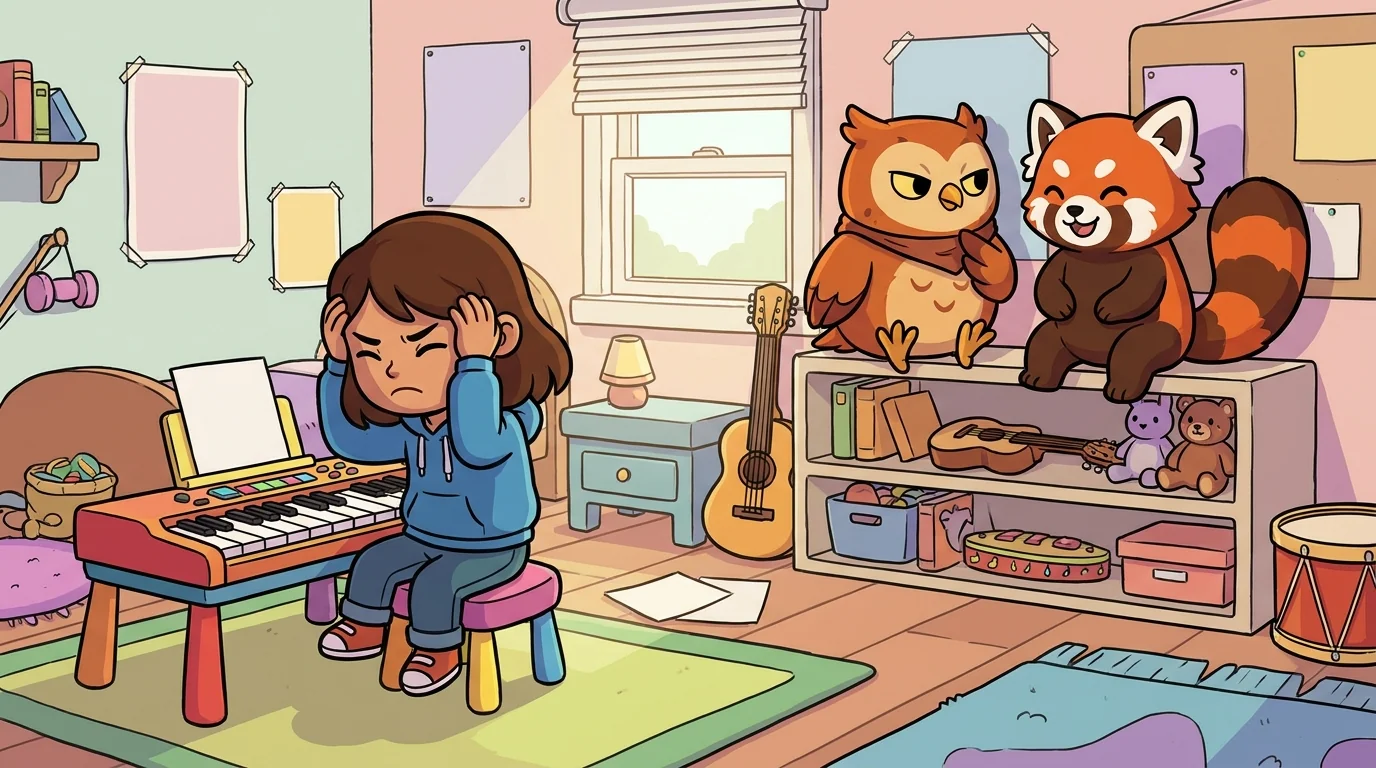
A girl sat at the practice keys, frustrated, playing the same chord over and over. "It's boring," she said. "It's the only chord in my song and it just sounds like itself every single time. How do people make one chord interesting?"
Umber, the autumn owl, and Tumble, the red panda, looked at each other across the keyboard — and both grinned, because this was exactly their favorite question.
"One chord's not boring," said Umber softly.
"One chord's got a hundred faces," said Tumble, ring-tail swishing. "You just haven't met them yet."
"Both of us," Umber decided. "It takes both of us to show her the whole thing."
Because the girl thought a chord had one sound. And to fix that, she'd have to see that the same three notes — never changing which notes they are — could wear a mood and a position, and that reshaping either one gives the chord a brand-new face without ever making it a different chord.
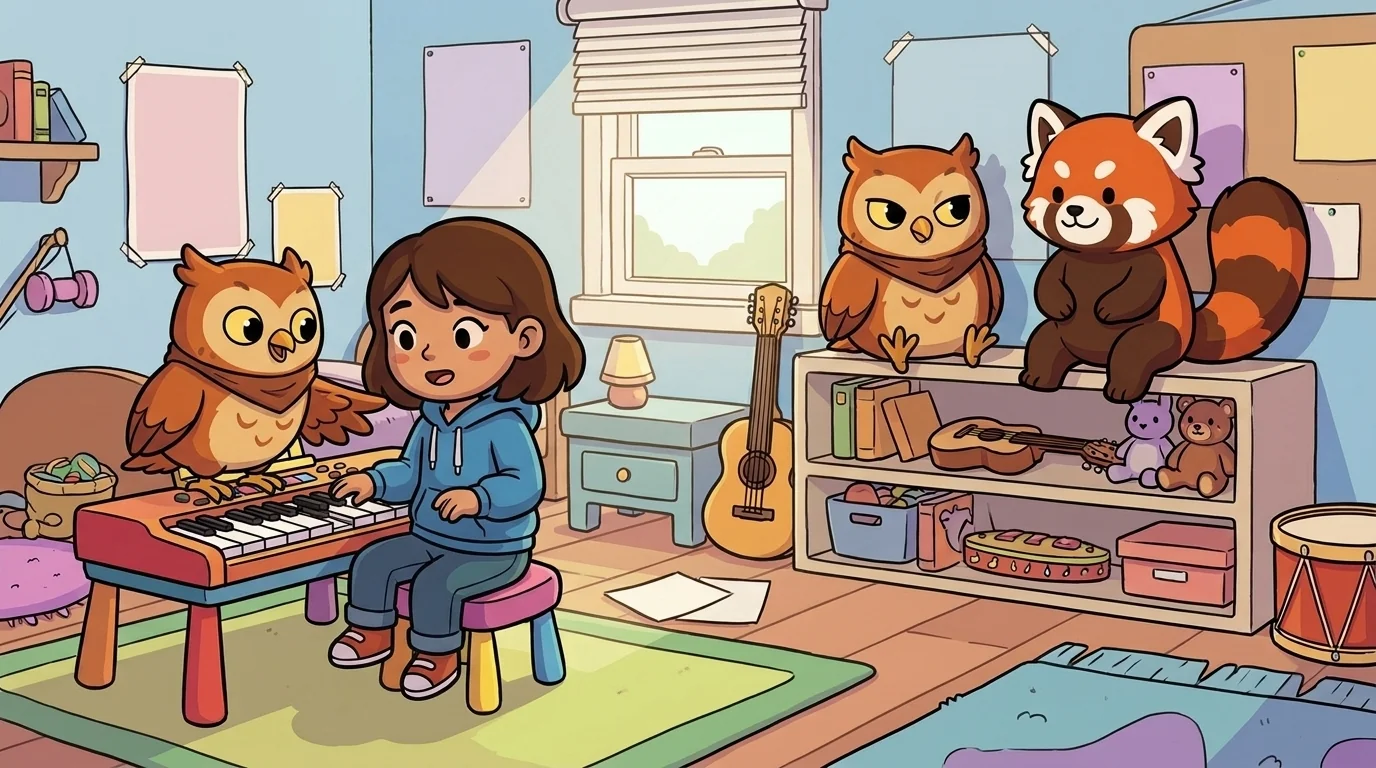
Umber went first, because mood is the change you feel before you can name it.
"Play me your chord," she told the girl. The girl played it — bright and plain. "Okay. Now keep the outside notes, and move only the middle one down a step." The girl did, and the chord went from sunny to shadowed, from yes to oh.
"See that?" Umber said, round eyes glinting. "Same chord. I didn't add a note or take one away. I moved the middle tone — the third — down a hair, and the whole mood turned. Major to minor. Smiling to aching." She had the girl flip it back and forth, bright-sad-bright-sad. "That's one whole set of faces right there. Your one 'boring' chord already has a happy twin and a wistful twin, living in the exact same three notes. The middle note picks which one you hear."
The girl played the bright one, then the shadowed one, and looked genuinely surprised that her boring chord had a second heart.
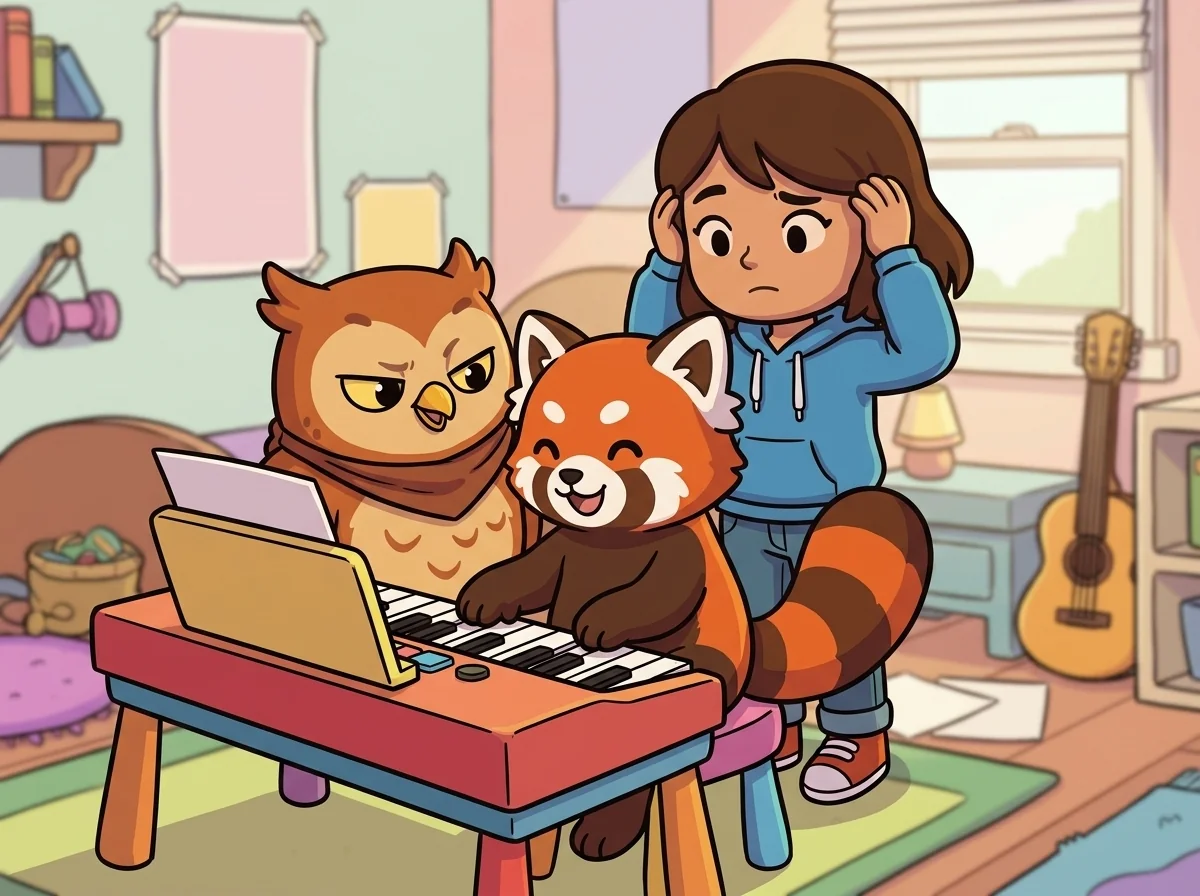
Tumble took over, because position is the change you hear as a whole new light.
"Good — that's the mood," he said. "Now watch the view." He took the girl's chord and, keeping all three notes exactly the same, moved the bottom note up to the top. The chord floated, lighter, like the same room seen from a higher window. He did it again — a third face.
"Nobody left, nobody joined," Tumble said, delighted. "Root, third, fifth, still all here. I just tumbled which one sits on the bottom. Low-and-grounded, floaty-and-bright, rich-and-open — that's three more faces, and they're all still your one chord." He played them in a row. "So now count them up. Umber gave you a bright version and a sad version. I gave you three positions. Stack those together —"
"— and one chord has way more than one face," the girl finished slowly, doing the math in her head.
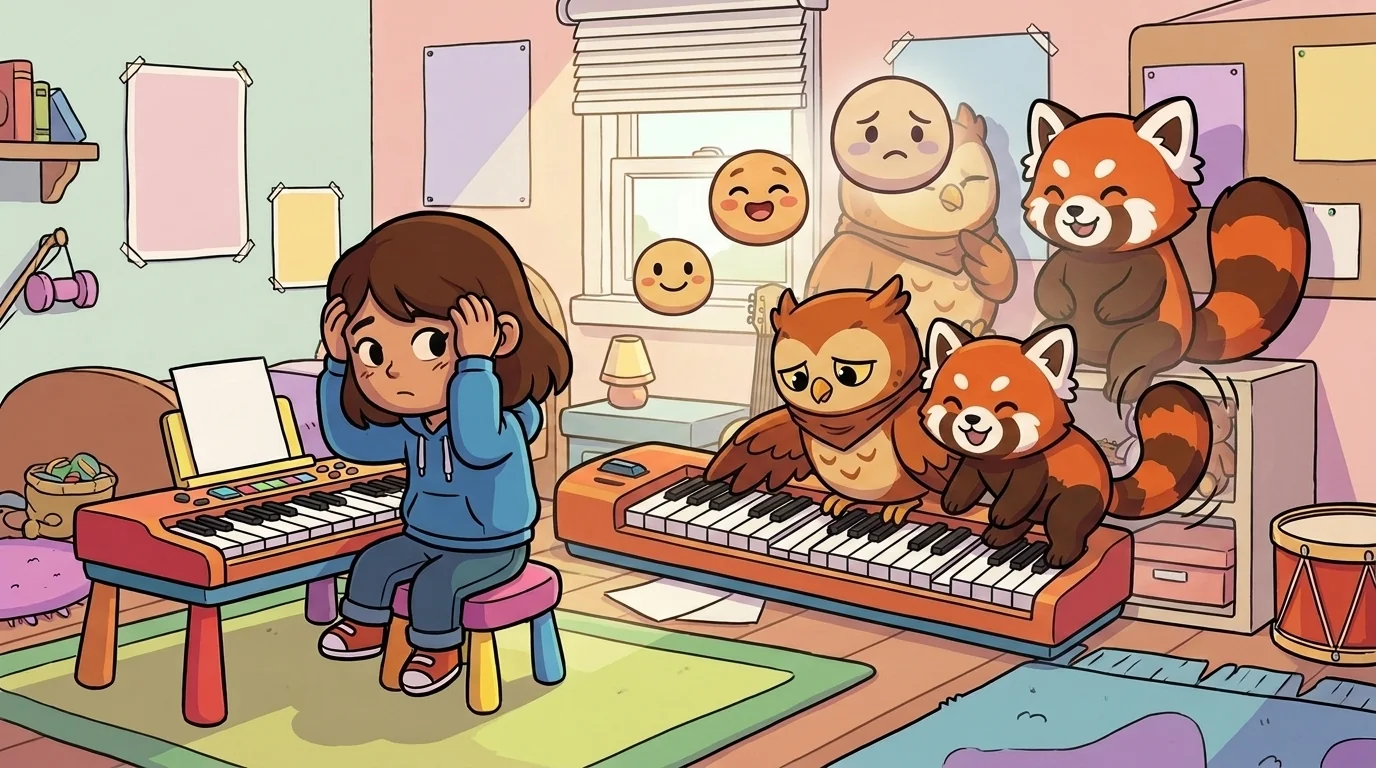
And then the two of them put it together, and the "boring" chord came completely alive.
"Watch what happens when we combine," said Umber. "Bright and low. Bright and floaty. Sad and low. Sad and floaty." She and Tumble traded off, one setting the mood, the other setting the position, and the same three notes rang out in face after face after face — cheerful and grounded, wistful and floating, warm and open, shadowed and bright-topped — each one unmistakably the same chord and yet each one a different feeling.
"This is the secret nobody tells you about one chord," Tumble said, ring-tail swishing with delight. "It was never one sound. It's a whole family of sounds hiding in three notes. Umber changes the mood — the middle note. I change the position — the bottom note. Neither of us ever changes which notes they are. And separately —"
"— I can only give you the moods," said Umber.
"— and I can only give you the positions," said Tumble. "But together, mood times position, we hand you a dozen faces of the one chord you thought was boring. Same three notes. Endless ways to wear them."
The girl played her chord — bright and low, then sad and floaty, then warm in the middle — and her whole song, built on that "one boring chord," suddenly had color and light and motion in it.
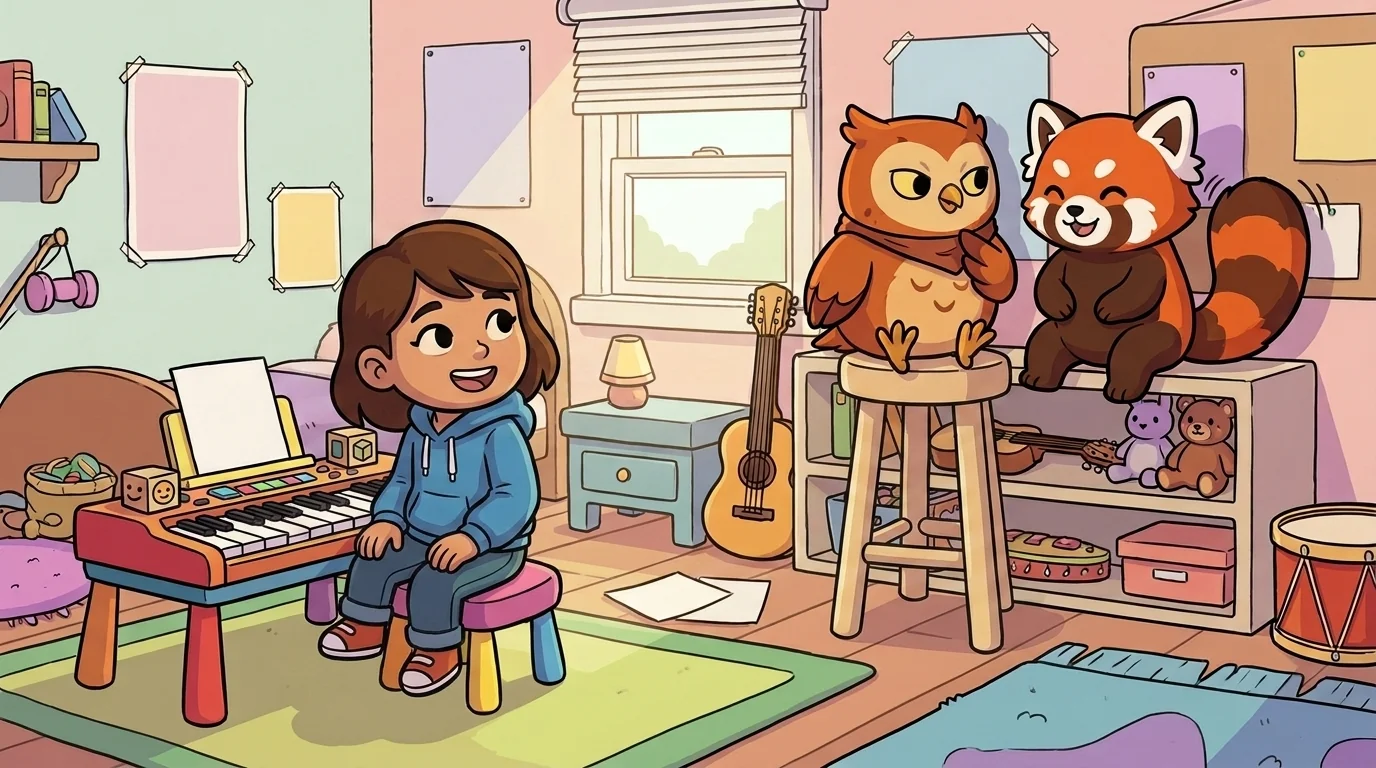
The girl looked up, half-laughing. "So I never needed more chords. I just needed to use the one I had."
"That's it exactly," said Umber, warm. "A chord isn't a single sound. It's a whole set of faces waiting to be shown."
"And it takes both of us to show them," said Tumble. "Mood and position. If she'd only met you, she'd think her chord had two feelings and one look. If she'd only met me, she'd think it had one feeling and three looks. But mood times position —"
"— is how one chord becomes a hundred," Umber finished, "without ever stopping being itself."
The girl looked from the owl to the red panda — one who changed the deep-down feeling, one who changed the outward shape, two very different kinds of change working on the very same three notes — and understood that her chord had never been boring. She just hadn't met its whole family yet.
And Umber and Tumble felt it settle warm and shared between them — that clicked-together, one thing, many faces, all of it still itself gladness that comes when two different kinds of change reveal how much was possible all along. Umber loved the moods. Tumble loved the positions. But what they loved most was this: showing a kid that the same three notes, reshaped a hundred gentle ways, were never boring at all — just waiting for someone to turn them to the light.
The HarmonyForge ensemble
Umber and Tumble is part of HarmonyForge's distributed-narrative cast. Each character embodies a different curricular primitive; together they teach the full subject.
-
Triad
Chord-stacking — three tones in vertical alignment (root + third + fifth = the foundation of harmony)
-

Lean
Voice-leading — smooth stepwise motion between chord tones (the smallest possible movements between consecutive chords)
-
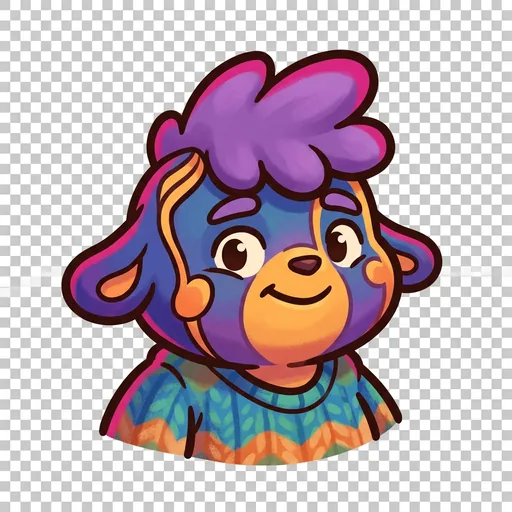
Pull
Tension — dissonant intervals (the leading-tone, the suspended 4th, the diminished chord) that *want* to resolve
-

Land
Resolution — the consonant arrival when tension releases (root return; cadence; the V→I gesture)
-

Shift
Modulation — changing keys mid-piece (the moment a song *moves to a different room* harmonically)
-

Ache
Seventh chords — a dove whose coo adds a fourth voice on top; a sweet, unfinished ache that leans the chord forward
-

Octave
Octave — a seal who sings the same note a whole floor up; eight steps from a note back to its own echo
-

Rill
Arpeggio — an otter who un-stacks a chord into a walk; the same tower played one stone at a time, flowing
-

Tumble
Chord inversion — a red panda who re-stacks the same three notes; a different one on the bottom changes the chord's face
-
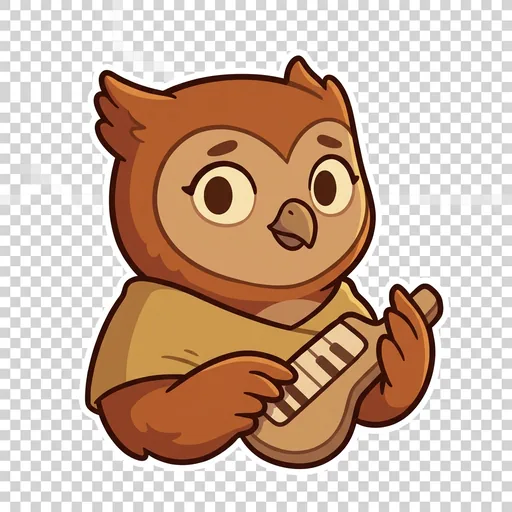
Umber
Major/minor third — an owl who lowers the middle tone one step; that note decides if a chord sounds bright or dark