
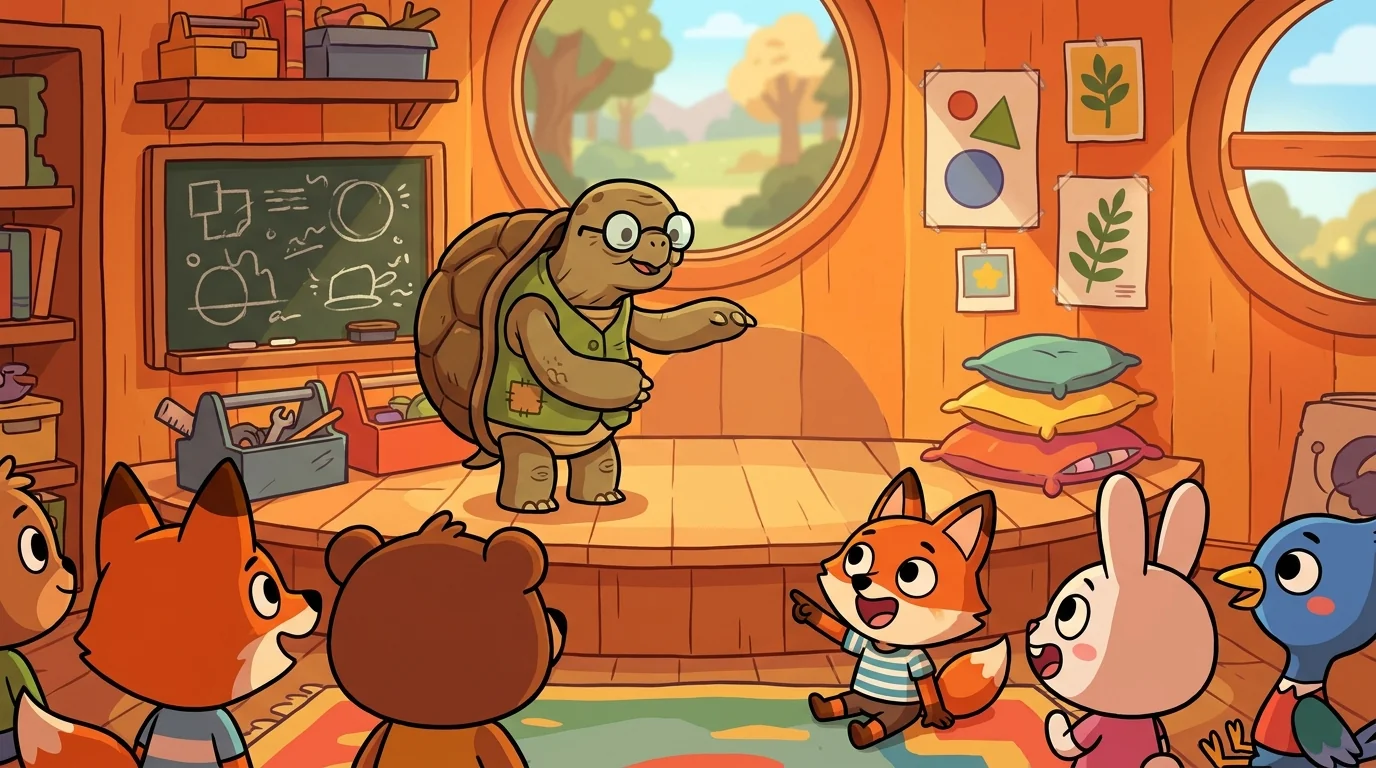
Ground
JUSTIFICATION — make the strangest thing in a scene make sense by giving it an honest reason, so a wild offer feels true instead of random.
Listen along — Ground
Loading audio…
Press play to listen along. The line being read lights up as you go.
Show full transcript
Loading transcript…
Chapter 1 — Ground and the Craft of the Honest Reason
On the little stage in the corner of the ImprovQuest workshop, Ground — a calm old tortoise who never hurried a single thing — sat the older players in a half-circle to teach the move that made a talking, furious refrigerator feel completely true. “You watched me do it,” he said, in his slow, level way. “Now I’ll show you the craft, because justification isn’t quick wit. It’s a habit of mind, and a patient one — which is why a tortoise is the right teacher for it.”
He reminded them of the offer: a delighted kid had declared, mid-scene, that his kitchen fridge could talk, and that it was very cross. “Out-of-nowhere,” Ground said. “The kind of offer that usually breaks a scene by being too silly to stand on. Most players do one of two things with an offer like that, and both are mistakes. They block it — ‘no, fridges can’t talk’ — which kills the kid’s idea and the scene with it. Or they pile on more random — ‘and it’s also a wizard from space!’ — which buries the offer under noise. Justification is the third path, and the only one that builds: you accept the strange thing, and then you find the honest reason it would be true.”
A quick young hare named Dart looked skeptical. “But there IS no reason. It’s a fridge. Fridges don’t talk.”
“There’s no reason yet,” Ground corrected, unbothered. “That’s the whole discipline. A strange offer isn’t nonsense — it’s a true thing that’s simply missing its because. So I asked myself the tortoise question: if this were true, why would it be? And the answer came — of course she’s cross; she’s the oldest thing in the house, she kept my grandmother’s soup cold for forty years, she remembers every recipe this family ever loved, and lately the young ones just slam her door and forget her. The moment the reason arrives, the talking fridge stops being a gag and becomes a lonely old keeper of a family’s whole history. Same offer. Now it’s true.”
He named the method so they could reuse it. “Three moves. First, accept the offer as a fact of this world — no ‘but,’ no blinking. Second, ask the honest question: given that this is true, what would explain it? — and reach for the reason a real person or thing would have, not the wackiest one. Third, speak the reason as if you always knew it — calm, certain, a little fond. The certainty is what sells it; a justification delivered like a guess isn’t a justification, it’s another question. Do those three, and you can make the wildest thing in any scene the truest thing in it.”
Ground had learned the move slowly, as he learned everything. He told them the truth: for a long time, wild offers had made him freeze — he’d wanted every scene to be sensible, so a talking fridge felt like a rule being broken, and he’d either shut it down or gone stiff with disapproval. It was an old improviser, patient as himself, who reframed it: “You keep treating strange as broken. Strange isn’t broken. Strange is just a truth you haven’t found the reason for. Your job isn’t to forbid it — it’s to make it make sense.” The first time Ground stopped defending the rules and started hunting for the reason, a ridiculous offer melted into something tender and whole, and the stiff, disapproving feeling eased into a warm, curious steadiness.
“So don’t fear the strange offer, and don’t out-random it,” Ground finished, patting the invisible fridge one more time, fondly. “Accept it. Ask why it would be true. Answer with quiet certainty. That’s justification — and it’s not only how you save a scene. It’s a kind of generosity: you take someone’s wild idea and, instead of laughing at it or burying it, you find the honest reason that makes it beautiful.”
The ImprovQuest ensemble
Ground is part of ImprovQuest's distributed-narrative cast. Each character embodies a different curricular primitive; together they teach the full subject.
-

Give
Yes-and / offer-acceptance — make-your-partner-look-good cooperative posture (the gift-orb metaphor)
-

Hark
Listening — receiving-before-responding discipline (the answer is in what your partner just said)
-

Don
Character work + physicality — body-finds-voice, find-ONE-thing approach
-

Lay
Scene-building + narrative — patient platform-before-plot foundation-laying (who/where/what/why)
-

Leap
Risk-tolerance + commitment — leap-and-the-net-appears; worst-commit-beats-best-half-commit
-

Ache
Emotional truth (playing a real feeling so the scene lands)
-

Mime
Object and space work (making an invisible object real through consistent handling)
-

Poise
Status (how high or low a character carries themselves shapes the scene)
-

Steep
Heightening (raising the stakes of the one unusual thing, step by step)