
Poise
STATUS — the unseen seesaw of who is up and who is down in a scene, played through bearing; sit tall to take charge, fold small to defer, and you can shift a whole scene by changing how you carry yourself.
Listen along — Poise
Loading audio…
Press play to listen along. The line being read lights up as you go.
Show full transcript
Loading transcript…
Chapter 1 — Poise and the Craft of the Invisible Seesaw
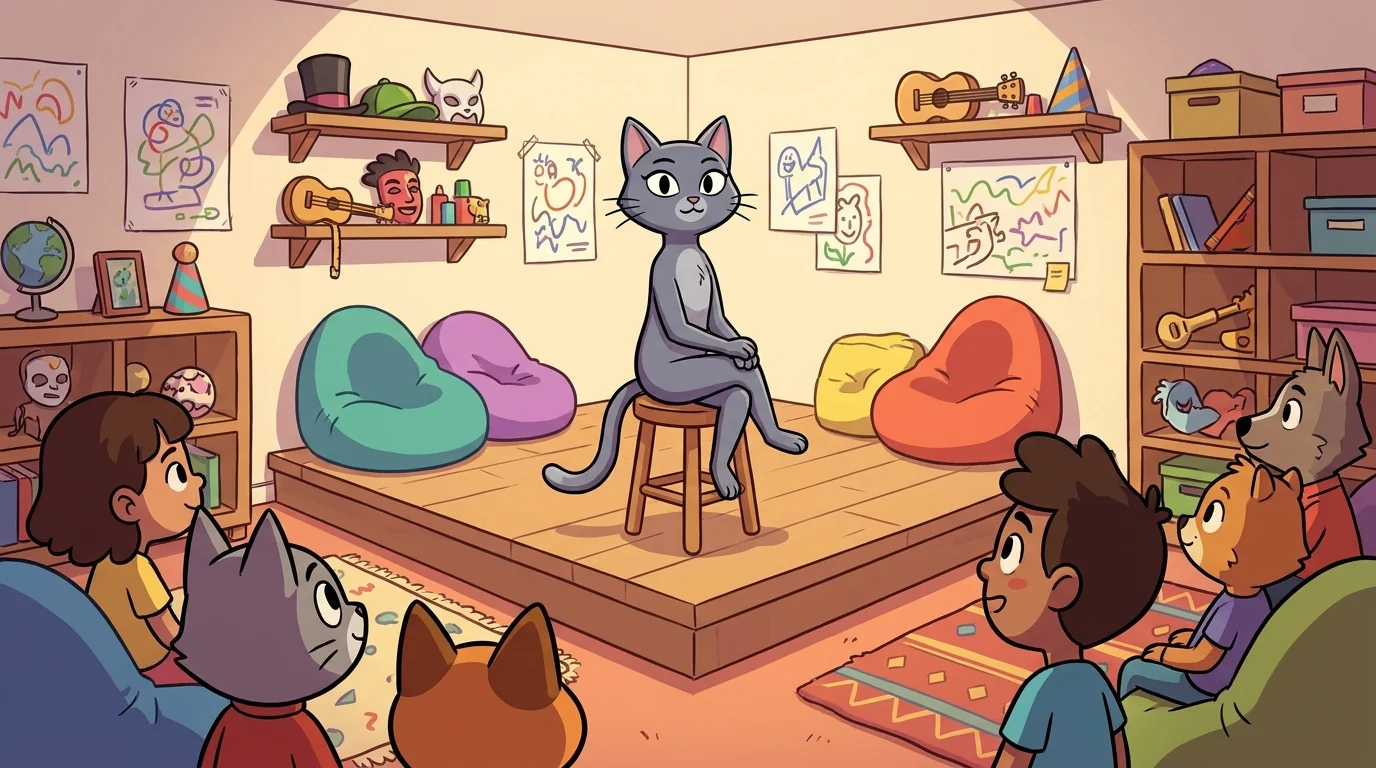
On the little stage in the corner of the ImprovQuest workshop, Poise — a sleek grey cat who could rule a room from a plain wooden stool — gathered the older players to explain the thing she’d done without a single word: sat down, and become the most important creature in the room. “You felt it before you could name it,” she said, spine long, chin level, gaze unhurried. “Today I’ll name it. It’s called status, and once you can see the seesaw, you can play it on purpose.”
She sat tall — and the room tilted toward her. Then she let her shoulders ease down and forward, dropped her chin, flicked her eyes up quick and checking, the way you glance at someone whose good opinion you’re unsure of — and the feeling flipped; now she was the one hoping to be approved of. “Same cat,” she said, sitting tall again. “Same stool. I only changed how I carry myself. That’s the whole of it: status is the unseen seesaw of who’s up and who’s down, and your body is the thing that says which.”
A watchful young lynx named Bramble tipped her head. “So high status is just… being the boss?”
“That’s the first mistake everyone makes,” Poise said. “Status isn’t your rank — it’s what your body is doing right now, and it can flip in a heartbeat. A king can play low (fidgeting, over-explaining, eyes darting for approval) and a servant can play high (still, unhurried, holding the gaze a half-second too long). The signals are small and physical: stillness reads high, fidgeting reads low; a level, unbroken gaze reads high, darting eyes read low; taking up space and taking your time read high, shrinking and rushing read low; letting a silence sit reads high, filling every silence reads low. None of it is loud. That’s why it works on the audience before they know it’s happening.”
She taught them the working principle, and named the trap. “Here’s what beginners get wrong: they think the goal is to play high. It isn’t. The most interesting scenes aren’t the highest status — they’re the ones where the seesaw MOVES. Two players both scrabbling to be top is a stalemate; two both grovelling is a puddle. The scene comes alive when the status shifts — when the low one quietly rises, or the high one takes a fall — because a moving seesaw is a story. So the craft isn’t ‘win the status.’ It’s ‘know exactly where you are on the seesaw, and change it on purpose, at the right moment, for the scene.’”
Poise had learned to feel the seesaw long before she could explain it — and, she admitted, she’d once been stuck on one end of it. Early on she’d played high all the time, sitting tall and cool in every scene, certain that was ‘good acting,’ and her scenes had gone flat and cold because nothing ever moved. It was an old performer who tipped her over: “You’re so busy being impressive you’ve forgotten a seesaw needs two ends. Try losing the status sometimes. A fall is more interesting than a throne.” The first time Poise let her status drop on purpose — folded small, let another player rise over her — the scene came alive, and the have-to-stay-on-top feeling loosened into a free, playful curiosity.
“So watch the seesaw everywhere, not just on stage,” Poise finished, sitting tall, then — with a small deliberate grace — letting her shoulders fold, giving Bramble the high ground for a beat, just to show she could. “Notice who’s still and who fidgets, who holds the gaze and who drops it. Then, in a scene, choose your end of the seesaw on purpose — and be willing to move. Status isn’t about being the boss. It’s about reading the invisible seesaw, and knowing you can shift the whole room just by how you carry yourself.”
The ImprovQuest ensemble
Poise is part of ImprovQuest's distributed-narrative cast. Each character embodies a different curricular primitive; together they teach the full subject.
-

Give
Yes-and / offer-acceptance — make-your-partner-look-good cooperative posture (the gift-orb metaphor)
-
Hark
Listening — receiving-before-responding discipline (the answer is in what your partner just said)
-

Don
Character work + physicality — body-finds-voice, find-ONE-thing approach
-
Lay
Scene-building + narrative — patient platform-before-plot foundation-laying (who/where/what/why)
-

Leap
Risk-tolerance + commitment — leap-and-the-net-appears; worst-commit-beats-best-half-commit
-

Ache
Emotional truth (playing a real feeling so the scene lands)
-

Ground
Justification (giving every choice a reason the audience believes)
-

Mime
Object and space work (making an invisible object real through consistent handling)
-

Steep
Heightening (raising the stakes of the one unusual thing, step by step)