
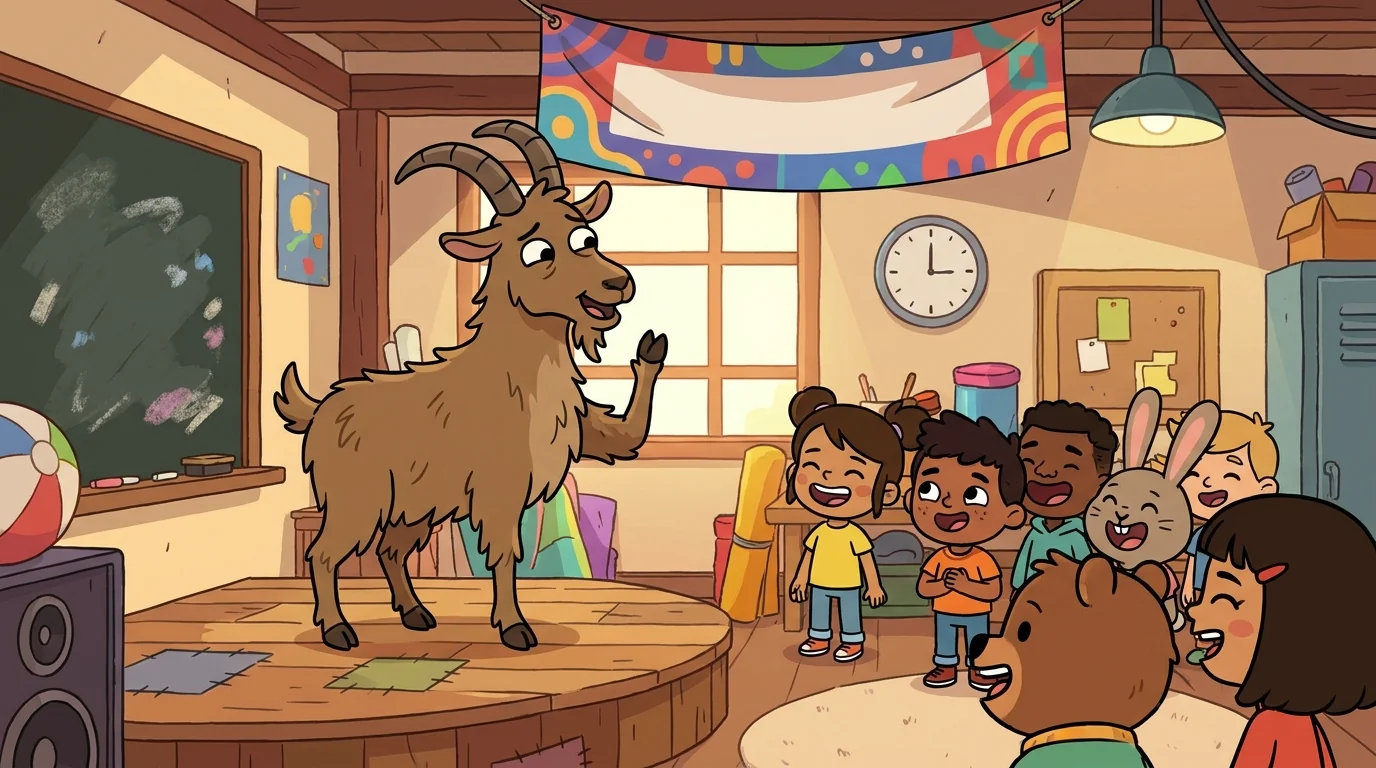
Steep
HEIGHTENING — find the next bigger version of the same funny idea, climbing one clear pattern step by step instead of jumping to something random.
Listen along — Steep
Loading audio…
Press play to listen along. The line being read lights up as you go.
Show full transcript
Loading transcript…
Chapter 1 — Steep and the Craft of the One Path Up
On the little stage in the corner of the ImprovQuest workshop, Steep — a wiry mountain goat who was always a little out of breath from climbing — gathered the older players to teach the move that took the smallest joke in the room and carried it all the way to the sky. “You laughed at the climb,” he said, hooves squared, eyes bright. “Now I’ll show you how the climb works, because heightening isn’t randomly getting bigger. It’s staying on one path, and taking the next honest step up it.”
He reminded them of the tiny offer: a kid had said his imaginary neighbour was so quiet you couldn’t hear him chew. “A beginner does one of two wrong things here,” Steep said. “They drop it and change the subject — and the little idea dies. Or they swap hills — ‘and then a dragon showed up!’ — a brand-new random idea that abandons the one the room already loved. Heightening is neither. It’s finding the next bigger version of the exact same idea. So quiet you can’t hear him chew → so quiet that last winter he sneezed and nobody on the whole street woke up → so quiet that the town clock stopped once and everyone blamed him. Same idea — quietness — climbing one clear slope, bigger and bigger.”
A twitchy young chamois named Scree bounced. “But how do you know what the next step IS?”
“You name the pattern to yourself, then push it,” Steep said. “First, find the game — the one funny thing the audience is actually enjoying. Here it’s impossible quietness. Second, ask: what’s a bigger example of THIS exact thing? Not a different funny thing — a bigger version of the same one. Third, climb one step at a time — the laugh comes from the escalation, from the audience feeling the slope get steeper under a single idea. If you leap three steps at once, you lose them; if you switch hills, you lose them; but if you climb the same hill one honest notch at a time, they climb it with you, and that shared climb is the funniest thing in improv.”
He warned them about the two edges of the path. “There’s a discipline to it, because a climb can go wrong two ways. Too slow — repeating the same size joke without going higher — and the audience stalls; the slope has to keep rising. Too wild — reaching for a bigger laugh by abandoning the pattern — and you’ve jumped hills; the climb breaks. The craft is the narrow line between: always bigger, always the same idea. That line is what improvisers mean when they talk about finding the game of the scene — the one pattern worth climbing, ridden all the way up.”
Steep had learned it by failing at both edges. He told them so, still a little breathless. Early on he’d been a hill-jumper — every time a scene got a laugh, he’d panicked and thrown in something new, certain that novelty was what got laughs, and his scenes had scattered into confetti that never built to anything. It was an old improviser who set him straight: “You keep starting new climbs. Pick one hill and go UP. The laugh isn’t in the surprise. It’s in the slope.” The first time Steep stayed on a single idea and just kept climbing it, the room went helpless the way they had today, and the must-keep-surprising-them feeling settled into the steady joy of a good ascent.
“So when you find a laugh, don’t run from it and don’t just repeat it,” Steep finished, catching his breath at the top of his imaginary slope. “Name the one idea that’s working, and climb it — the next bigger version, then the next, one honest step at a time. Don’t jump to a new hill. Find the next step up the same one. That’s heightening, and it’s the whole art of building a scene that goes somewhere.”
The ImprovQuest ensemble
Steep is part of ImprovQuest's distributed-narrative cast. Each character embodies a different curricular primitive; together they teach the full subject.
-

Give
Yes-and / offer-acceptance — make-your-partner-look-good cooperative posture (the gift-orb metaphor)
-

Hark
Listening — receiving-before-responding discipline (the answer is in what your partner just said)
-

Don
Character work + physicality — body-finds-voice, find-ONE-thing approach
-

Lay
Scene-building + narrative — patient platform-before-plot foundation-laying (who/where/what/why)
-

Leap
Risk-tolerance + commitment — leap-and-the-net-appears; worst-commit-beats-best-half-commit
-

Ache
Emotional truth (playing a real feeling so the scene lands)
-

Ground
Justification (giving every choice a reason the audience believes)
-

Mime
Object and space work (making an invisible object real through consistent handling)
-

Poise
Status (how high or low a character carries themselves shapes the scene)