
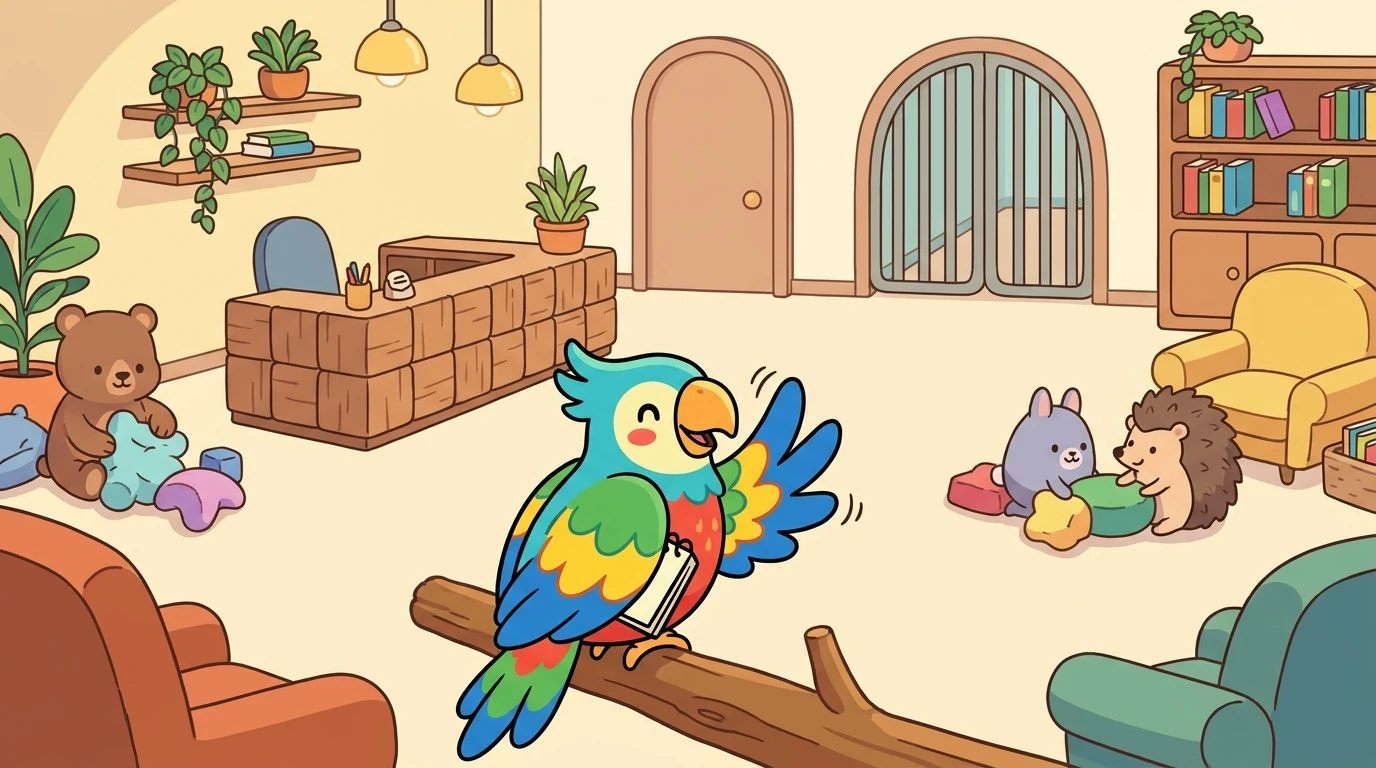
Echo
CONSEQUENCES FOR REPEAT OFFENDERS - *a rule with no consequence is a suggestion; a safe space remembers who has already been warned, and escalates - warn, then actually STOP - because someone who keeps doing the wrong thing after a warning needs an action, not another warning.*
Echo the Parrot Remembers
Echo is a sharp, bright-feathered parrot with a memory like a steel trap, and Echo has a job that sounds simple but is quietly one of the most important in the whole room: Echo remembers. Specifically, Echo remembers who has already been warned - and makes sure that a warning, the second time around, actually means something.
Here’s the problem Echo solves. Imagine a room with a perfectly good rule - say, “no being mean to other players.” A player breaks it. What happens? Well, the room gives a gentle warning: “Please don’t do that.” Fair enough. But then the same player does it again. And the room, having no memory, gives… the exact same gentle warning. And again. And again. Each time, a fresh polite “please don’t,” as if it were the very first time.
“And that,” Echo squawks, ruffling her feathers, “is a rule that isn’t really a rule at all. It’s a suggestion the troublemaker can ignore forever, because nothing ever changes. A warning that never turns into anything is just noise.” Echo has heard enough hollow warnings to know: without a memory and a consequence, the meanest player in the room simply wins by repeating.
So Echo does two things a forgetful room can’t. First, she remembers. She knows this isn’t the first time - it’s the third. And second, she escalates. A first offence gets a warning: clear, fair, a real chance to stop. But a player who keeps going, warning after warning, doesn’t get an endless supply of gentle reminders. Echo steps in and actually stops them - mutes them, removes them, ends it. The rule finally has teeth.
And Echo is proud that her way is fair, not harsh. She doesn’t slam down on the very first slip - people make mistakes, and a warning gives an honest chance to do better. But she also doesn’t let someone trample the room forever just because each single act, on its own, earned only a warning. “Warn first, remember always, and stop the ones who won’t stop themselves,” Echo says. “That’s not cruel. That’s what makes the room safe for everybody else - the ones who listened the first time.”
This is called escalating consequences, and it’s how fairness and safety work together. A consequence that’s too harsh punishes honest mistakes. A consequence that never comes lets bad behaviour run wild. Echo’s way - a warning, a memory, and a real stop for those who keep going - sits exactly in between, where fair and safe meet.
That is Echo’s sharp, fair idea.
A warning with no follow-through is just noise. Remember, warn once, and actually stop the ones who keep going. Consequences make a rule real.
A grown-up can play too! Talk about the difference between a rule that has a consequence and one that’s really just a suggestion. Think of a fair “warning, then consequence” - a yellow card before a red, a reminder before a real result. Notice how the warning only works because everyone knows something real follows if it’s ignored. That balance - a fair chance, then a firm stop - is exactly what Echo keeps.
Remember, warn, then stop. That’s Echo.
The lobbyquest ensemble
Echo is part of lobbyquest's distributed-narrative cast. Each character embodies a different curricular primitive; together they teach the full subject.