
Gable
THE UNVERIFIABLE CLAIM - *a safety gate can only enforce what it can actually CHECK; asking 'how old are you?' collects a CLAIM, not a fact - and any claim you can't verify can simply be faked - which is why real safety leans on things you can check, not on trusting what someone types.*
Gable the Bear and the Question That Can’t Be Checked
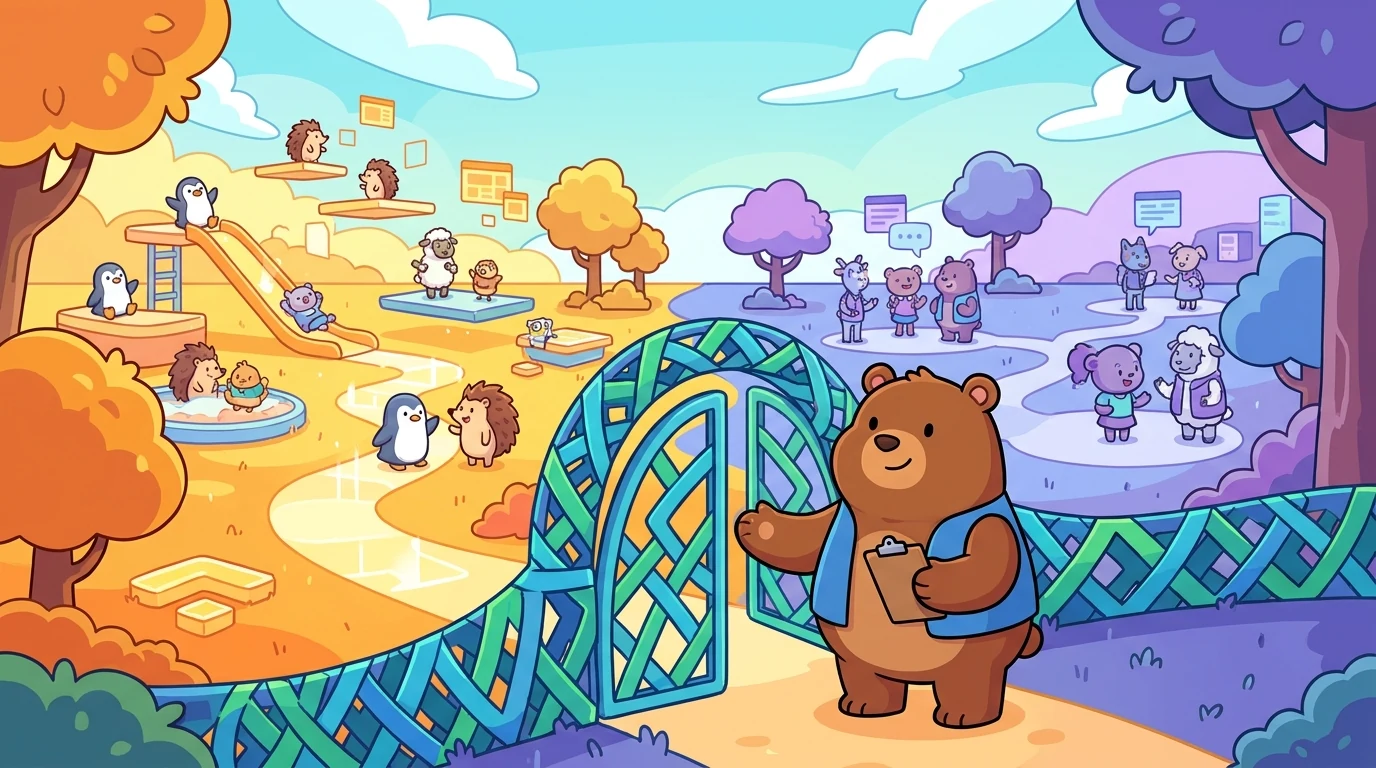
Gable is a big, sturdy, well-meaning bear who guards the contact gate of the shared room - the gate that decides who is allowed to talk to whom. It’s an important job, and Gable takes it seriously. If you want two players kept apart, or one group allowed to chat only among themselves, Gable is the one who makes it happen. He’s strong, he’s reliable, and - as he’s about to learn - he has exactly one weakness.
Gable’s gate works by asking. When a new player arrives wanting to join a conversation, Gable asks the sensible-sounding question: “How old are you?” And whatever the player says, Gable believes, and sorts them accordingly. A player who says they’re twelve goes in with the twelve-year-olds. Simple. Fair. Safe… isn’t it?
Then, one day, a troublemaker walks up to Gable’s gate. This player is not twelve. But when Gable asks, the troublemaker just… says “twelve.” And Gable, believing what he’s told, opens the gate. The troublemaker strolls right in.
Gable is stunned. “But - he said he was twelve!” And here, gently, Usher explains the thing that Gable - and a great many real systems - get wrong. “Gable,” says Usher, “you didn’t check his age. You checked what he typed. Those aren’t the same thing at all.”
This is one of the most important ideas in all of online safety, and it has a name worth knowing: an unverifiable claim. When you ask someone online “how old are you?” or “what’s your name?”, you are not collecting a fact. You’re collecting a claim - a thing they say about themselves. And a claim that you have no way to check is a claim that anyone can simply fake. The gate feels safe, but it’s only ever as honest as the person standing at it - which, for a troublemaker, is not honest at all.
“So a gate that trusts a claim isn’t really a gate,” Gable says slowly, the truth sinking in. “It’s a gate with a doormat that says please be honest.” Exactly, says Usher. And that’s why the safest designs don’t lean on trusting what strangers type. Instead of asking harder and harder questions - which a liar just answers with harder and harder lies - a good designer builds the room so the stranger’s claim matters less. Keep groups small and known. Don’t let unknown players contact each other freely at all. Make the safe path the only path, so a faked answer has nowhere to go.
That is Gable’s hard-won, important idea.
A gate can only enforce what it can check. A claim you can’t verify can be faked - so build so you don’t have to trust the claim.
A grown-up can play too! Talk together about the difference between a fact you can check and a claim you just have to believe. Online, almost everything a stranger types about themselves is the second kind. Then ask the designer’s question: not “how do we get people to be honest?” but “how do we build this so one person’s dishonesty can’t cause harm?” That shift - from trusting words to not needing to - is the heart of safe design.
When Gable finally rebuilds his gate so it no longer depends on believing a stranger’s claim - keeping the room’s contacts small, known, and safe by design - he gives a rumbling, satisfied nod. “I’ll still ask questions,” he says. “But I’ll never again bet someone’s safety on the answer. A gate should hold, whether the person at it is honest or not.”
Don’t trust the claim - build so it can’t be faked. That’s Gable.
The lobbyquest ensemble
Gable is part of lobbyquest's distributed-narrative cast. Each character embodies a different curricular primitive; together they teach the full subject.