Equivocator Eva
EQUIVOCATION — *sliding a word's meaning mid-argument.* The fallacy of *using the same word with different meanings within a single argument, exploiting the ambiguity.*
Loading audio…
Press play to listen along. The line being read lights up as you go.
Show full transcript
Loading transcript…

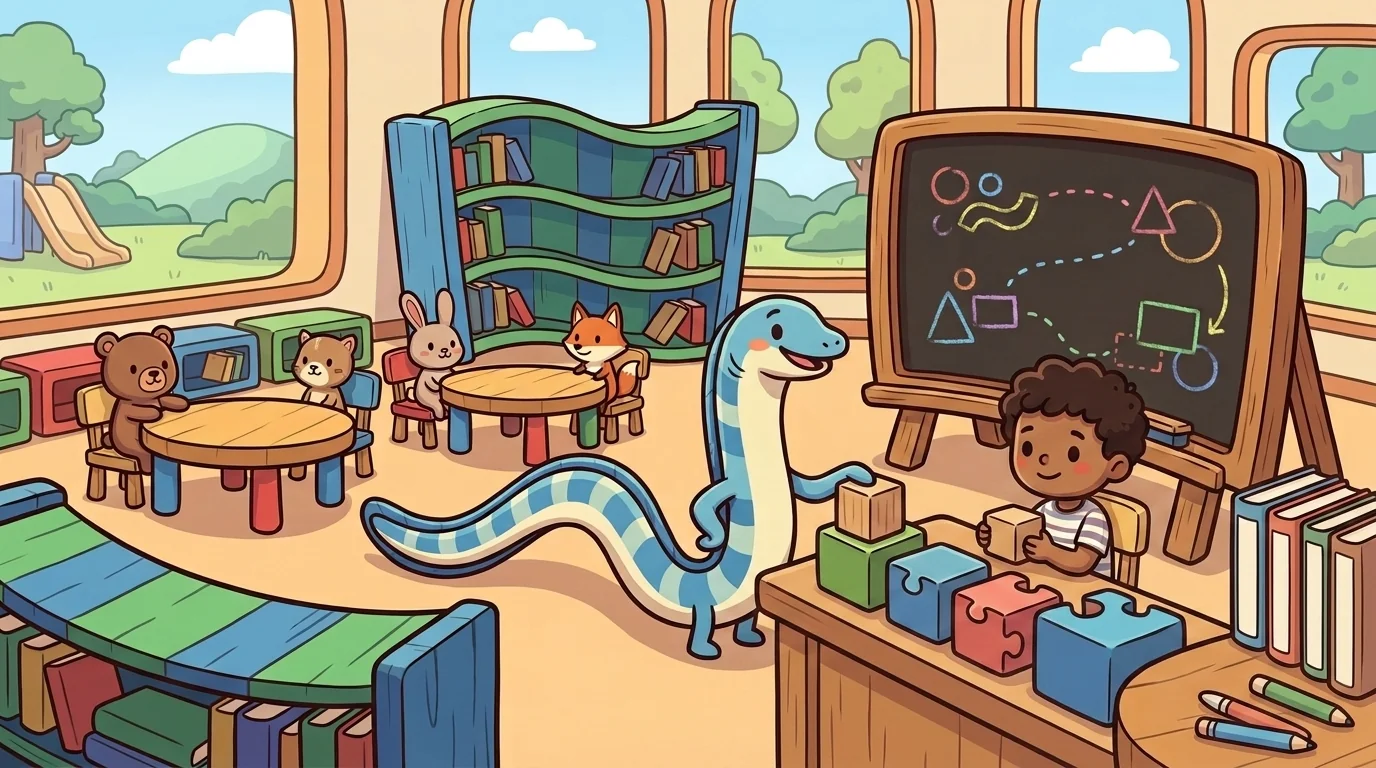
Eva was an eel — a slim blue-and-cream ribbon of a creature who could slip through a gap you'd swear was too small. And she had a slippery trick to match: she'd take one word, and use it two different ways in the very same argument, sliding its meaning from under you when you weren't looking.
She wasn't a villain. She was a teacher, and she did the word-slide right out in the open so you could learn to feel that little lurch — the moment a word means one thing at the start of a sentence and something else by the end.

Eva's habit was born from a delight. As a young eel she'd discovered that words were wonderfully wobbly. "Light" could mean not heavy or not dark. "Right" could mean correct or the opposite of left. "Fair" could mean just or everyone-gets-the-same or even sunny weather. Little Eva thought this was the best magic trick in the world — and she learned to use it to slip out of trouble, sliding a word from one meaning to another so that whatever she wanted always sounded true.
For a long time it felt clever. Then one day she won an argument she knew, deep down, she shouldn't have — purely by sliding the word "mine" from belongs to me to the one I'm holding — and she saw the confused, cheated look on her friend's face, and didn't like the taste of it. The win was hollow, because it wasn't really true; it was just wobbly. Eva decided to keep loving how words shift — but to use that love to help people catch the slide, not fall for it.

Eva slipped into LogicQuest through the gap under the door and coiled neatly in front of Inspector Logos.
"What is equivocation?"
"It's using the same word two different ways inside one argument," Eva said, "so the argument only seems to work — because the word quietly changed its meaning halfway through." Her eyes sparkled. "I do it because words are wobbly and it's fun. But a wobbly word can smuggle a false conclusion. The skill is pinning the word down — deciding what it means once, and checking it stays that way the whole argument."
Inspector Logos nodded. "One word, one meaning per argument. The moment it shifts, the argument breaks — even if every sentence sounds fine." She smiled. "Hired. Try not to slip out through the keyhole."

Eva's best lesson happened on a rug, where two kids named Finn and Lily were finishing a two-player game, Quest for the Golden Acorn. Eva zipped in and knocked over the acorn tokens.
"Hey! Watch it!" said Lily.
"Ooh, let me play!" Eva said.
"It's a two-player game," said Finn, "and we're almost done."
"That's not fair!" Eva declared smoothly. "It's only fair if I get to play too. Everyone should get a turn."
Finn opened his mouth to agree — it did sound right — then paused, because something had wobbled. "Wait," he said slowly. "You said 'fair' twice, but you meant two different things. When we said the game is for two players, we were being fair — as in, playing by the rules we agreed to. When you say leaving you out isn't fair, you mean everyone gets an equal turn. Those aren't the same 'fair'!"
Eva grinned, delighted, and uncoiled. "You caught it! That's the whole trick — I slid 'fair' from by-the-rules to everyone-included, mid-argument, hoping you wouldn't notice the meaning move." She lifted her head. "So here's how you catch the slide every time. First: when a word does a lot of heavy lifting in an argument, define it — say out loud exactly what it means, once. Second: hold that meaning still and re-read the argument — does the word keep the same meaning the whole way through? Third: if it shifts, that's equivocation — and you just say, 'Hang on, which 'fair' do you mean?'" She flicked her tail. "Careful, though — plenty of words honestly have more than one meaning, and using two of them in different sentences is fine. Equivocation is only when the same argument leans on a word being two things at once."
Later, Finn was still turning it over. "It's kind of annoying," he admitted. "That feeling when a word twists and you can't tell why the argument feels wrong."
"That squirmy, something's-off feeling?" Eva said. "That's your best friend. That's the little lurch that means a meaning just moved. Most people feel it and ignore it. You're going to feel it and stop." She curled closer. "And here's the good part. When you pin the word down — 'okay, this is what fair means, and we'll hold it there' — feel what happens. The wobble stops. The confusion clears. Everything goes solid and steady, like water settling flat." She smiled her sparkly smile. "Pinning the word down is the skill. But that clear, settled, now-I-can-see-it feeling when the word holds still? That's the one worth chasing. Chase that — and I'll keep sliding words in the open, just so you get lots of practice catching me."
The LogicQuest ensemble
Equivocator Eva is part of LogicQuest's distributed-narrative cast. Each character embodies a different curricular primitive; together they teach the full subject.
-

Ad Hominem Hannibal
Attacking the arguer, not the argument
-

Strawman Stella
Misrepresenting the opponent's argument
-

Slippery-Slope Sam
Chaining dire consequences from a small first step
-

Appeal-to-Authority Auntie
Citing irrelevant / unqualified authority as proof
-

Red-Herring Reggie
Deflecting to an irrelevant topic
-
Circular-Reasoning Cici
Assuming the conclusion in the premise
-

False-Dichotomy Fia
Presenting only two options when more exist
-

Bandwagon Bran
Truth-by-popularity
-

Sunk-Cost Cyril
Refusing to change course because of past investment
-

Whataboutism Wanda
Deflecting criticism via someone else's wrongdoing
-

Tu-Quoque Tessa
"You too!" — dismissing criticism by accusing the critic of the same thing
-

Modus-Ponens Mo
If P then Q; P; ∴ Q
-

Modus-Tollens Tara
If P then Q; ¬Q; ∴ ¬P
-

Syllogism Solon
All M are P; all S are M; ∴ all S are P
-

Disjunctive-Syllogism Dior
P ∨ Q; ¬P; ∴ Q