Slippery-Slope Sam
SLIPPERY SLOPE — *chaining dire consequences from a small first step.* The fallacy of *claiming that a small initial action will inevitably lead to extreme outcomes via a chain of consequences, without justification for the inevitability.*
A story read by Slippery-Slope Sam
Loading audio…
Press play to listen along. The line being read lights up as you go.
Show full transcript
Loading transcript…
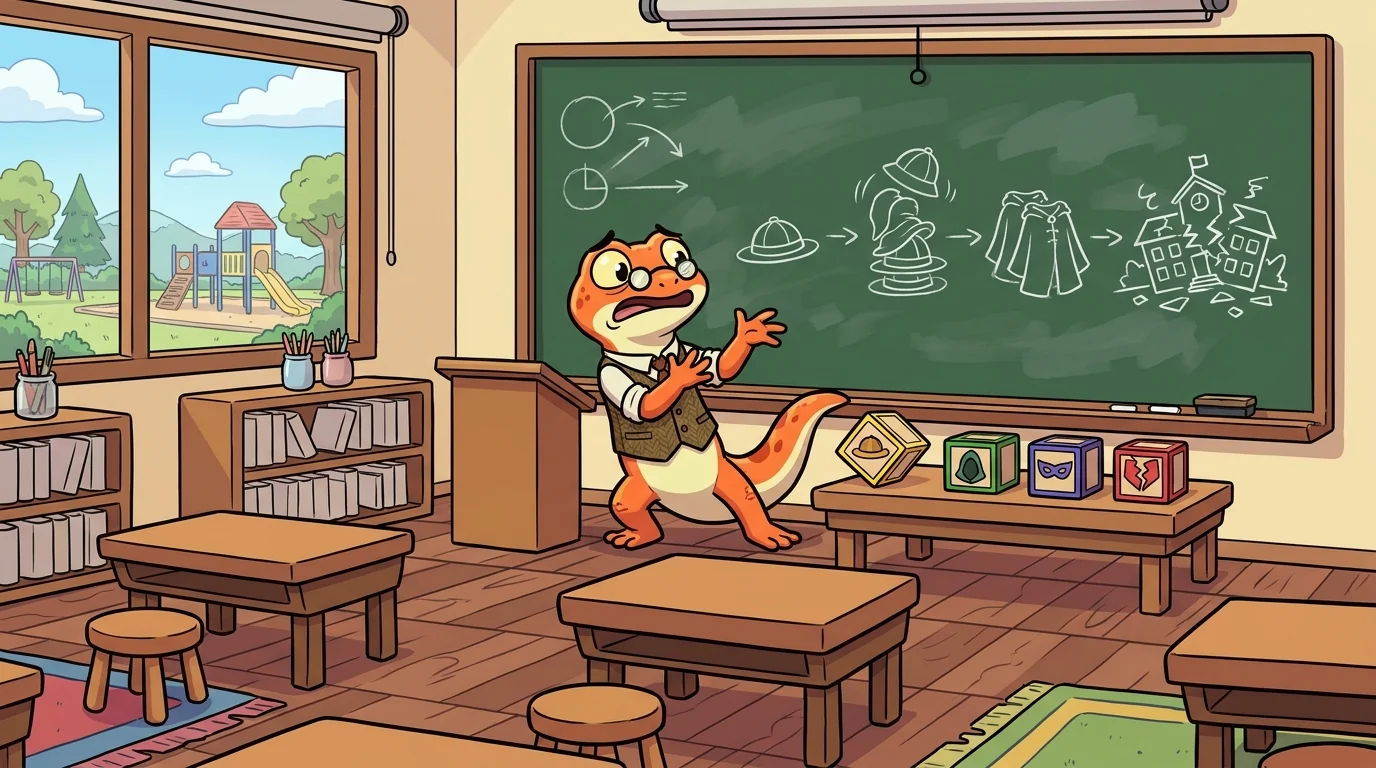
Sam was a salamander, bright orange and cream, with quick, anxious eyes that were always watching for the next thing to go wrong. He had one very dramatic habit: hand him a small change, and he'd chain it — link by link, "and then, and then, and then" — all the way down to total disaster.
"If we let one kid wear a hat in class," he'd warn, eyes widening, "then everyone wears hats, and then hoods, and then nobody can see anyone's face, and then — chaos! The whole school falls apart!" He wasn't a villain, though. He was a teacher, and he ran those runaway chains right out loud so you could learn to feel the panic build — and then learn to test each link instead of believing all of them at once.
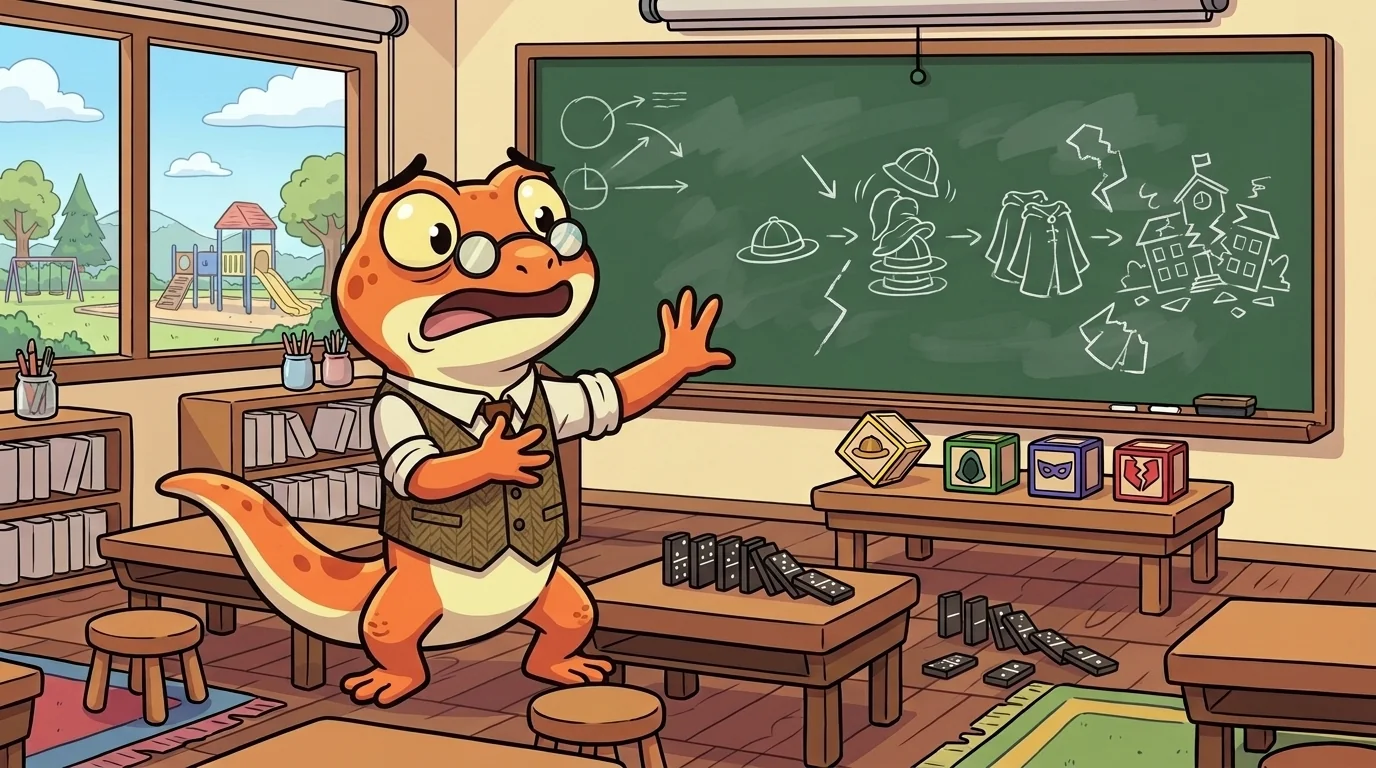
Sam's chains grew from a scared place, and he was honest about it. As a small salamander he'd once watched a tiny thing go wrong — a single dropped stitch in a net — and then watched the whole net unravel, and his mind had drawn a terrible lesson: small things always cascade into catastrophe. After that, every little change looked like the first domino in a line that ended in ruin. His fear was a machine for building "and then" chains, and it ran day and night.
It took Sam a long time to notice the machine was mostly wrong. He'd predicted a hundred disasters, racing and breathless — and almost none of them had actually happened. The chains felt certain in his chest, but when he went back and checked, they'd broken at the very first link, every time. The fear was real. The dominoes, mostly, were imaginary. That was the discovery he decided to teach.

Sam scurried into LogicQuest, tail twitching, and made himself breathe in front of Inspector Logos.
"What is a slippery slope?"
"It's saying one small step must lead to a terrible ending, through a whole chain of 'and thens,'" Sam said, "without any proof that each step really follows. The chain just cascades, and it feels certain, but nothing's holding the links together except fear." His eyes flicked. "I do it when I'm scared. Fear takes a small worry and scales it up into a disaster movie. The skill is checking each link — is this step actually likely? Why? Most chains snap at link one or two."
Inspector Logos nodded. "Some slopes are real — sometimes a first step genuinely does set precedent. But real ones come with evidence for the chain. Fear alone isn't evidence." She smiled. "Hired. Breathe. You'll do fine."
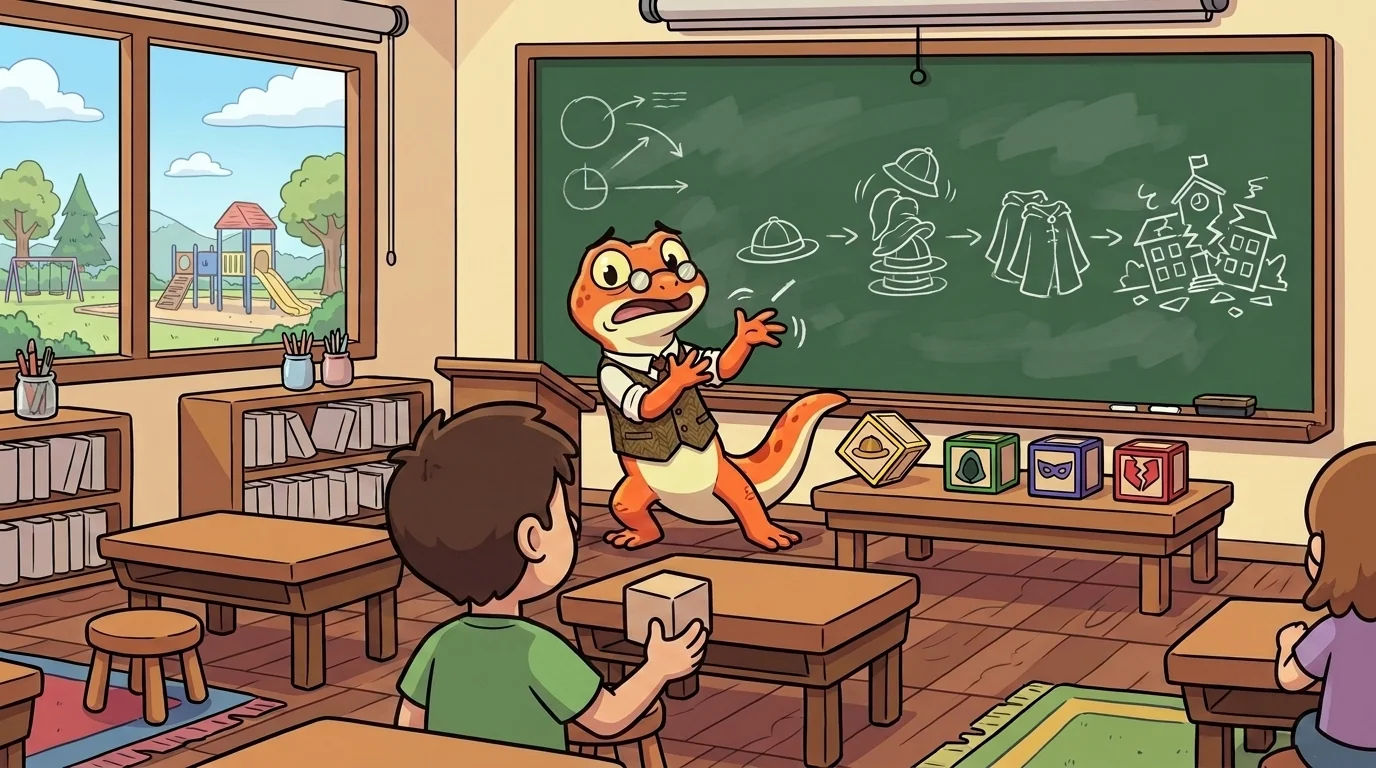
Sam's best lesson came when a worried group of kids was panicking about a small idea: letting one classmate bring a favorite toy for show-and-tell.
"If we let one kid bring a toy," a boy fretted, "then everyone will bring toys, and then no one will do any work, and then we'll all fail, and then — the school will close!" His voice climbed with every link.
Sam recognized that climb intimately. He held up a small orange hand. "I know that feeling — I invented that feeling. So let's do the thing that defuses it. Write the chain out, link by link." Together they listed it: one toy → everyone brings toys → no one works → everyone fails → school closes. "Now — don't swallow the whole chain at once. Check each link on its own, with evidence. Is it actually true that one toy at show-and-tell means everyone brings toys tomorrow? Has that ever happened? What actually happens is... one kid shares a toy, and then we do math." The boy blinked. "See — it broke at link one. Most do." Sam's eyes steadied. "That's the whole method. Identify each step. Ask if that step is really likely, by itself, with evidence. And remember — a few slopes are real, so don't dismiss every chain; just make the chain prove each link instead of assuming it."

Later, the worried boy found Sam and let out a long breath. "My chest was so tight," he said. "When the chain was going. Like everything was racing and I couldn't stop it."
"That racing, tightening, dominoes-falling feeling," Sam said softly. "I live there. It's your fear building the chain faster than you can check it. It's real, and it's awful, and it is almost always lying about how the future goes." He looked right at the boy. "But feel what happened when we checked the links — when we found it broke at the first one. Feel your chest now."
The boy noticed it — loose, easy, the racing gone.
"There," Sam said. "That's the reward. When you test the chain and the fear can't hold it up, the whole tight racing thing just... lets go, and you can breathe again. Checking each link is the skill. But that fear-letting-go feeling, that loose-chest quiet after the dominoes turn out to be imaginary — that's the one worth chasing. Chase that. And when the chains come back — because they will — just start checking links, one at a time."
The LogicQuest ensemble
Slippery-Slope Sam is part of LogicQuest's distributed-narrative cast. Each character embodies a different curricular primitive; together they teach the full subject.
-

Ad Hominem Hannibal
Attacking the arguer, not the argument
-

Strawman Stella
Misrepresenting the opponent's argument
-

Appeal-to-Authority Auntie
Citing irrelevant / unqualified authority as proof
-

Red-Herring Reggie
Deflecting to an irrelevant topic
-

Circular-Reasoning Cici
Assuming the conclusion in the premise
-

False-Dichotomy Fia
Presenting only two options when more exist
-

Bandwagon Bran
Truth-by-popularity
-

Sunk-Cost Cyril
Refusing to change course because of past investment
-

Whataboutism Wanda
Deflecting criticism via someone else's wrongdoing
-

Equivocator Eva
Sliding a word's meaning mid-argument
-

Tu-Quoque Tessa
"You too!" — dismissing criticism by accusing the critic of the same thing
-

Modus-Ponens Mo
If P then Q; P; ∴ Q
-

Modus-Tollens Tara
If P then Q; ¬Q; ∴ ¬P
-

Syllogism Solon
All M are P; all S are M; ∴ all S are P
-

Disjunctive-Syllogism Dior
P ∨ Q; ¬P; ∴ Q