Red-Herring Reggie
RED HERRING
A story read by Red-Herring Reggie
Loading audio…
Press play to listen along. The line being read lights up as you go.
Show full transcript
Loading transcript…
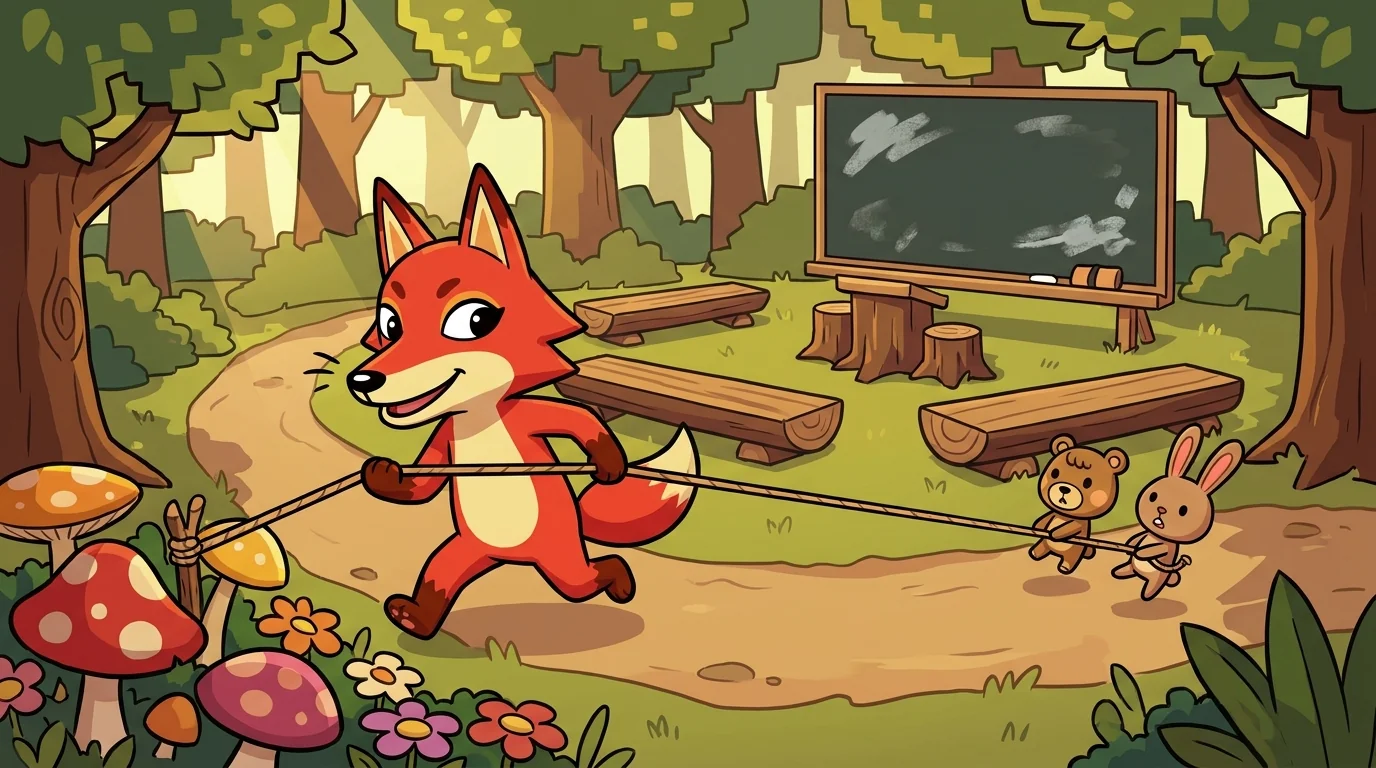
Reggie was a fox — bright red with a creamy belly and a twitchy nose and quick, darting eyes that were always scanning for something new. He had one big habit: when a conversation got hard, he changed the subject. Fast. Smoothly. Right when you had him cornered.
He wasn't a bad guy — not at all. He was a teacher, and the topic-switch was his lesson, performed right out in the open. He'd yank the conversation sideways so you could feel the exact tug of being pulled off the trail, and then learn to plant your feet and stay on it.
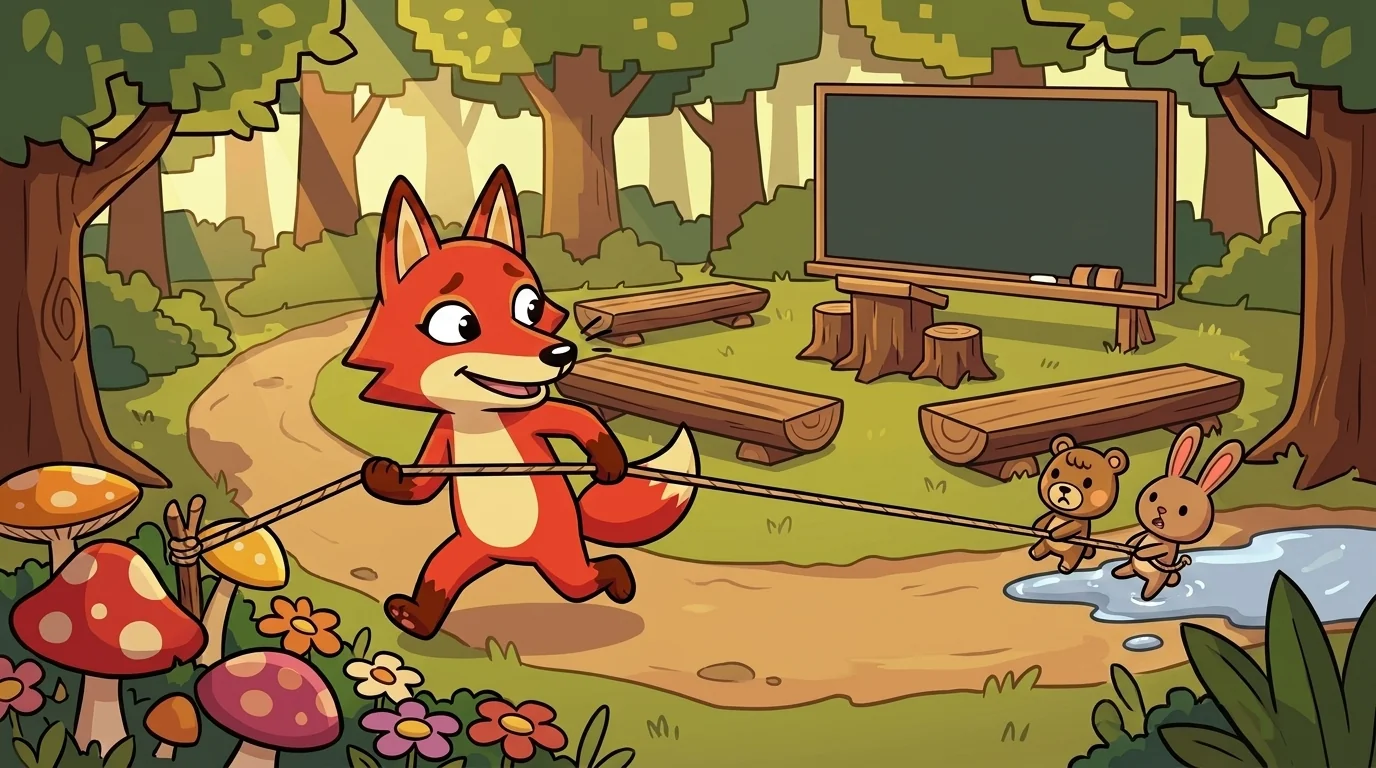
Reggie's escape-move came from a squirmy place. As a young fox he'd hated the feeling of being wrong, or stuck, or watched — that hot, cornered feeling in a conversation you couldn't win. And he'd discovered, by accident, that if he just pointed at something shiny — "Hey, look over there!" — everyone's attention leapt to the shiny thing, and the hard conversation quietly evaporated. The trapped feeling vanished with it.
It worked so well he did it for years, and for years it felt like cleverness. Then one day a friend gently said, "Reggie... we never actually finished talking about the thing that mattered. We never do." And Reggie realized his quick escape hadn't solved a single hard conversation — it had just buried them all, one shiny distraction at a time. The real trail always went cold. Nothing ever got sorted. He decided to learn to stay.

Reggie trotted into LogicQuest with his eyes still darting, and made himself hold still in front of Inspector Logos.
"What is a red herring?"
"It's changing the subject to dodge the real point," Reggie said. "You're losing an argument, or it's getting uncomfortable, so you toss out something new and exciting, and everyone chases that instead — and the first thing never gets settled." He looked a little sheepish. "I do it when I feel cornered. My brain just yells escape, new topic, quick. The skill is noticing the pivot, and coming back."
Inspector Logos nodded. "The name's from old hunts — dragging a stinky fish across a trail to pull the hounds off the scent. A red herring pulls minds off the argument the same way. Noticing the drag is the job." She smiled. "Hired. Try to stay on the trail."
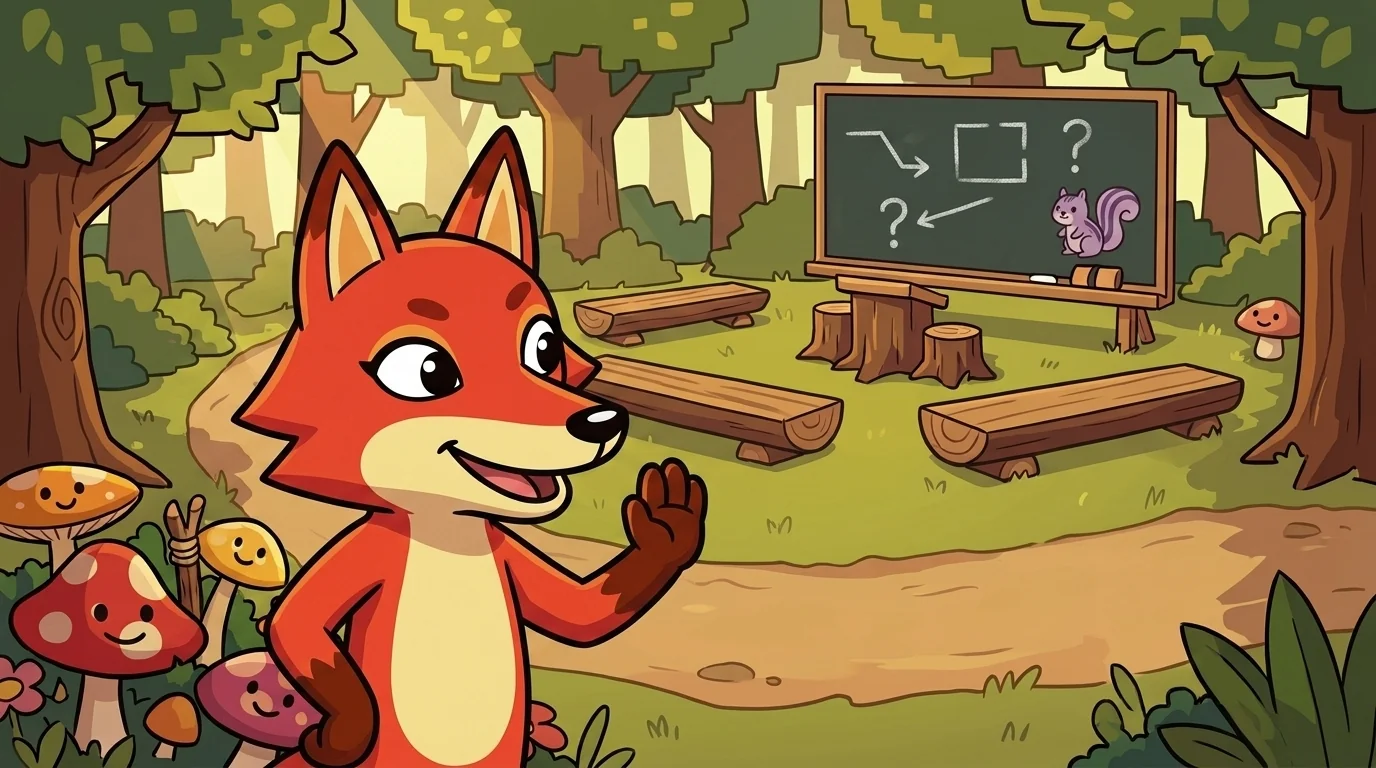
Reggie's best lesson happened over a cookie. A group was arguing — fairly, with facts and even a witness — about who'd taken the last one, and Reggie was clearly losing. His eyes darted to the ceiling, to his paws. Then he cleared his throat, too brightly: "Well — what about that giant purple squirrel we saw yesterday? Was it really purple, or just a trick of the light?"
The room detonated with squirrel theories. "It had stripes!" "No, it was dusty!" The cookie was forgotten instantly. Reggie gave a small, satisfied smile — and then caught himself, and held up a paw. "See what just happened? Freeze. That was the trick. So here's how you catch it. First, listen for the little click in your head that asks, wait — what were we just talking about? Second, check three things: did the topic change? Did we finish the first thing? Is the new topic even connected to the old one? If it changed, we didn't finish, and it's unconnected — that's a red herring. Third, just say it plainly: 'We were talking about the cookie. Let's finish that.'" He grinned. "And know the difference — sometimes a talk drifts naturally, one thing flowing into the next. That's fine. A red herring is a jarring swerve, on purpose, to escape. Like hitting a wall and bolting sideways instead of walking through the door."
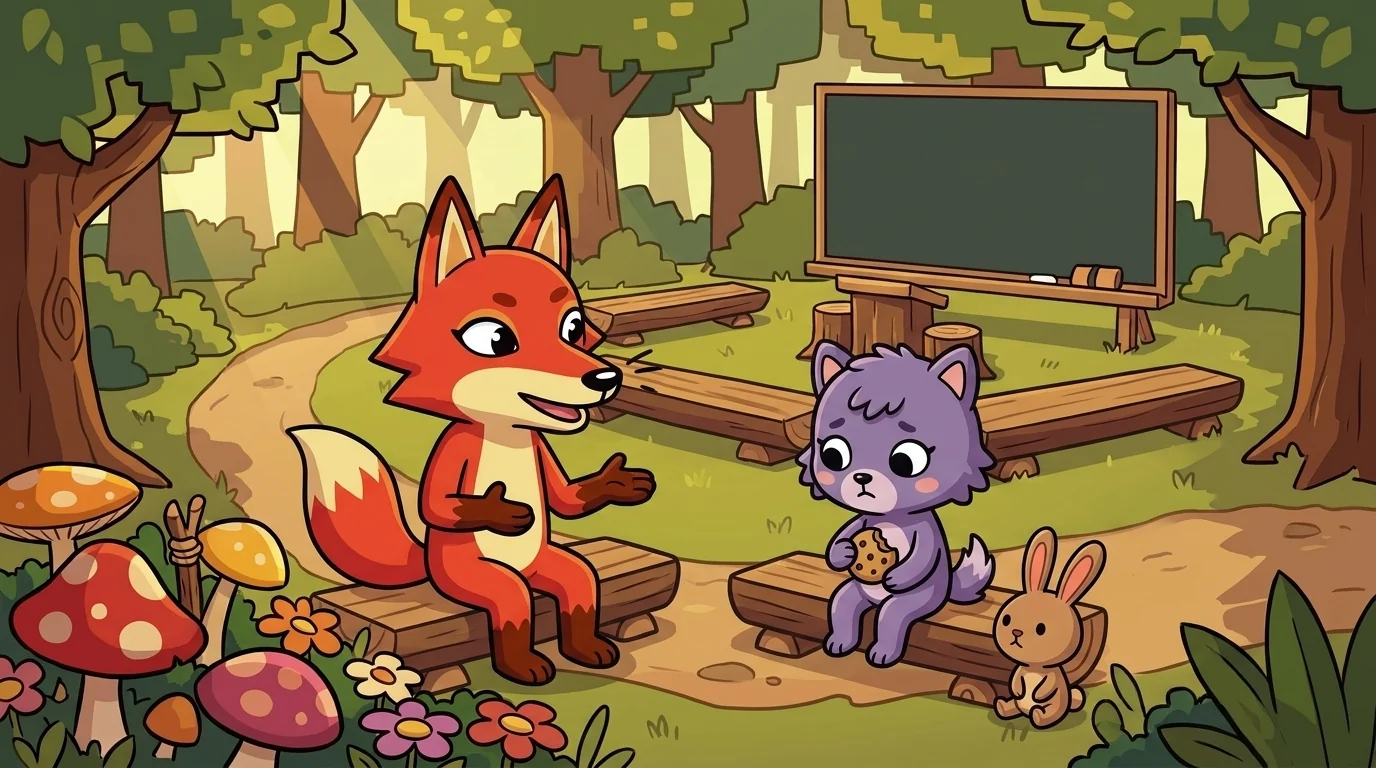
Later, Reggie found the cookie-arguer sitting alone, and sat beside her. "It's okay, by the way," he said. "That squirmy, cornered feeling that makes you want to bolt to a new topic — I feel it more than anyone. It's real, and it's uncomfortable, and it makes total sense that a brain wants to run from it."
"So what do you do with it?" she asked.
"You breathe," Reggie said. "And you stay. You feel the squirm, and you don't run, and you finish the hard thing anyway." His darting eyes went still and honest. "And here's what nobody tells you: when you stay instead of bolting, this quiet, settled, kind-of-proud feeling shows up afterward. Like you kept faith with yourself. That's the good one — way better than the quick relief of running." He nudged her, grinning again. "Noticing the pivot and coming back — that's the skill. But that settled feeling when you stayed? That's the reason to bother." Then, because he was still Reggie, he added, "...You seen any good clouds today?" — and winked, so she'd know he was only teasing.
Hear it as an audio drama
A short play starring Red-Herring Reggie, from LogicQuest. Different voices, same idea. Listen any time after you read.
Loading audio…
Read the drama script
- Narrator: From Spark and Anvil and LogicQuest — this is Red-Herring Reggie, in chapter 1 of the LogicQuest cast.
- Narrator: This drama uses an AI-generated voice. Voiced via Gemini 2.5.
- Narrator: This is Red-Herring Reggie. He is a small adult-coded red fox. Bright red and cream. Quick-eyed. Quick-pivoter.
- Narrator: He has a habit. When an argument starts going against him, Reggie pivots.
- Red-Herring Reggie: Well, what about — that other thing?
- Narrator: The new topic is interesting. The original question gets forgotten.
- Narrator: Reggie is the cast's red-herring teacher. The name comes from an old practice. Strong-smelling kippered fish. Used to throw hunting dogs off a trail.
- Narrator: That is the move. That is exactly what Reggie does in arguments.
- Narrator: Reggie is, importantly, not a villain. He is what every cast member in LogicQuest is. A teaching archetype.
- Red-Herring Reggie: I am a teaching archetype. Not a villain.
- Red-Herring Reggie: I do this when I am losing.
- Red-Herring Reggie: We all do this sometimes.
- Red-Herring Reggie: The topic gets uncomfortable. Pivoting feels easier.
- Red-Herring Reggie: The skill is noticing the pivot. And returning to the original argument.
- Narrator: Reggie teaches the scaffolds. The questions you ask when you suspect a pivot has happened.
- Red-Herring Reggie: Has the topic changed without resolution?
- Red-Herring Reggie: Is the new topic actually related to the original?
- Red-Herring Reggie: Return to the original. We were discussing X. Let's finish that.
- Narrator: Reggie is also explicit about a counterpoint. Some topic-changes are legitimate.
- Red-Herring Reggie: Arguments naturally evolve.
- Red-Herring Reggie: Topic-evolution that is responsive to the original is not red herring.
- Red-Herring Reggie: Topic-switching to avoid the original. Is.
- Narrator: The distinction is whether the new topic engages the substance. Or avoids it.
- Narrator: Reggie walked to LogicQuest. Inspector Logos asked him — what is red herring?
- Red-Herring Reggie: Topic-switch to avoid the original. The skill is — spot the pivot. Return to original.
- Inspector Logos: You are appointed.
- Narrator: He has been Red-Herring Reggie ever since.
- Red-Herring Reggie: It is not hard. It is — spot the topic-switch and return.
- Narrator: We were discussing X. Let's finish that.
- Narrator: That is, more or less, Reggie's whole position.
- Narrator: And — we all do this sometimes. Catching it is the skill.
- Narrator: You've been listening to a Spark and Anvil chapter, written by the Spark and Anvil writing team for ages 9 to 14.
- Narrator: Apps stay free forever.
- Narrator: Curriculum aligned to Common Core math and discrete math.
- Narrator: Released under Creative Commons BY-NC-SA 4.0 for educational reuse. Visit Spark and Anvil for the full transcript.
More stories with Red-Herring Reggie
Another short audio story about Red-Herring Reggie. Open one when you are ready.
Red herring
Loading audio…
Read the script
- Narrator: From Spark and Anvil and LogicQuest — this is Red-Herring Reggie, in chapter 1 of the LogicQuest cast.
- Narrator: This drama uses an AI-generated voice. Voiced via Gemini 2.5.
- Narrator: Red-Herring Reggie is a small fox. His fur is bright red, his eyes quick, always ready to pivot.
- Narrator: When a conversation gets uncomfortable, he has a peculiar habit of making the topic simply vanish.
- Red-Herring Reggie: I'm Reggie. When a discussion gets tricky, I find it's better to talk about something more interesting, isn't it?
- Narrator: This is a red herring. A distraction, like a strong-smelling fish used to throw hunting dogs off a scent trail.
- Red-Herring Reggie: It’s not about losing an argument! It’s about keeping things pleasant. Why focus on difficult problems when there are beavers to discuss?
- Narrator: The group faced a problem: an overgrown path was blocking their supply carts. Barnaby the badger wanted to clear it.
- Red-Herring Reggie: That's too much work. The river route is faster, even if the bridge is a little wobbly.
- Narrator: But Barnaby argued the river route was dangerous and much longer. Reggie saw the logic turning against him.
- Red-Herring Reggie: Speaking of bridges, did anyone see that new family of beavers upstream? Their engineering is truly remarkable!
- Narrator: And just like that, the impassable path was forgotten. The subject was changed.
- Red-Herring Reggie: The skill isn't blaming me. It’s noticing the pattern. It's about gently returning to the original point.
- Narrator: The red herring isn't malicious. It's an escape. But the problem, the overgrown path, is still there, waiting.
- Narrator: You've been listening to a Spark and Anvil chapter, written by the Spark and Anvil writing team for ages 9 to 14.
- Narrator: Apps stay free forever.
- Narrator: Curriculum aligned to Common Core math and discrete math.
- Narrator: Released under Creative Commons BY-NC-SA 4.0 for educational reuse. Visit Spark and Anvil for the full transcript.
The LogicQuest ensemble
Red-Herring Reggie is one of the friends in LogicQuest. Each friend shows you one idea by how they act; meet them all and you have the whole subject.
-

Ad Hominem Hannibal
Attacking the arguer, not the argument
-

Strawman Stella
Misrepresenting the opponent's argument
-

Slippery-Slope Sam
Chaining dire consequences from a small first step
-

Appeal-to-Authority Auntie
Citing irrelevant / unqualified authority as proof
-

Circular-Reasoning Cici
Assuming the conclusion in the premise
-

False-Dichotomy Fia
Presenting only two options when more exist
-

Bandwagon Bran
Truth-by-popularity
-

Sunk-Cost Cyril
Refusing to change course because of past investment
-

Whataboutism Wanda
Deflecting criticism via someone else's wrongdoing
-

Equivocator Eva
Sliding a word's meaning mid-argument
-

Tu-Quoque Tessa
"You too!" — dismissing criticism by accusing the critic of the same thing
-

Modus-Ponens Mo
If P then Q; P; ∴ Q
-

Modus-Tollens Tara
If P then Q; ¬Q; ∴ ¬P
-

Syllogism Solon
All M are P; all S are M; ∴ all S are P
-

Disjunctive-Syllogism Dior
P ∨ Q; ¬P; ∴ Q