Whataboutism Wanda
WHATABOUTISM
Loading audio…
Press play to listen along. The line being read lights up as you go.
Show full transcript
Loading transcript…

Wanda was a small weasel — warm brown with creamy patches, a nose that never stopped twitching, and quick eyes that darted around, always sniffing out trouble, or a way out of it. She had one signature move: the second anyone said she'd done something wrong, her ears would flatten, her tail would flick, and she'd point at someone else. "But what about them?"
She wasn't a villain. She was a teacher, doing the deflection right out in the open — pointing at a third person's mess to pull attention off her own — so you could learn to feel that quick little puff of relief it gives... and notice how fast it fades, leaving the real problem exactly where it was.

Wanda's deflection grew from a squirmy dislike: she hated being told what to do, hated the feeling of blame landing on her. And she'd learned young that if she just pointed somewhere else fast enough — "but Jimmy left his boots out!" — everyone's eyes would swing away from her, at least for a moment, and the squirmy feeling would ease.
It worked, in the smallest, shortest way. The eyes swung away — and then swung right back, because her own mess was still sitting there. Jimmy's boots never once tidied Wanda's socks. Her deflection didn't erase a single thing she'd done; it just bought her three seconds and left the actual problem to fester. She used the trick for years before she admitted it never fixed anything — it only moved the spotlight. That was the trick she decided to teach.

Wanda slipped into LogicQuest, nose twitching, and darted her quick eyes up at Inspector Logos.
"What is whataboutism?"
"It's dodging a criticism about me by pointing at some other person's wrongdoing," Wanda said. "Somebody says 'your room's a mess,' and I say 'well what about their room?' — so we stop talking about mine." Her tail flicked. "I do it when I don't want to face what I did. It gives a quick puff of relief. The skill is spotting the deflection and going back to the first problem — the one that's actually mine to fix."
Inspector Logos nodded. "Someone else's mess, somewhere else, never cleans up yours. Catching the deflection is the job." She smiled. "Hired. Try to sit still."
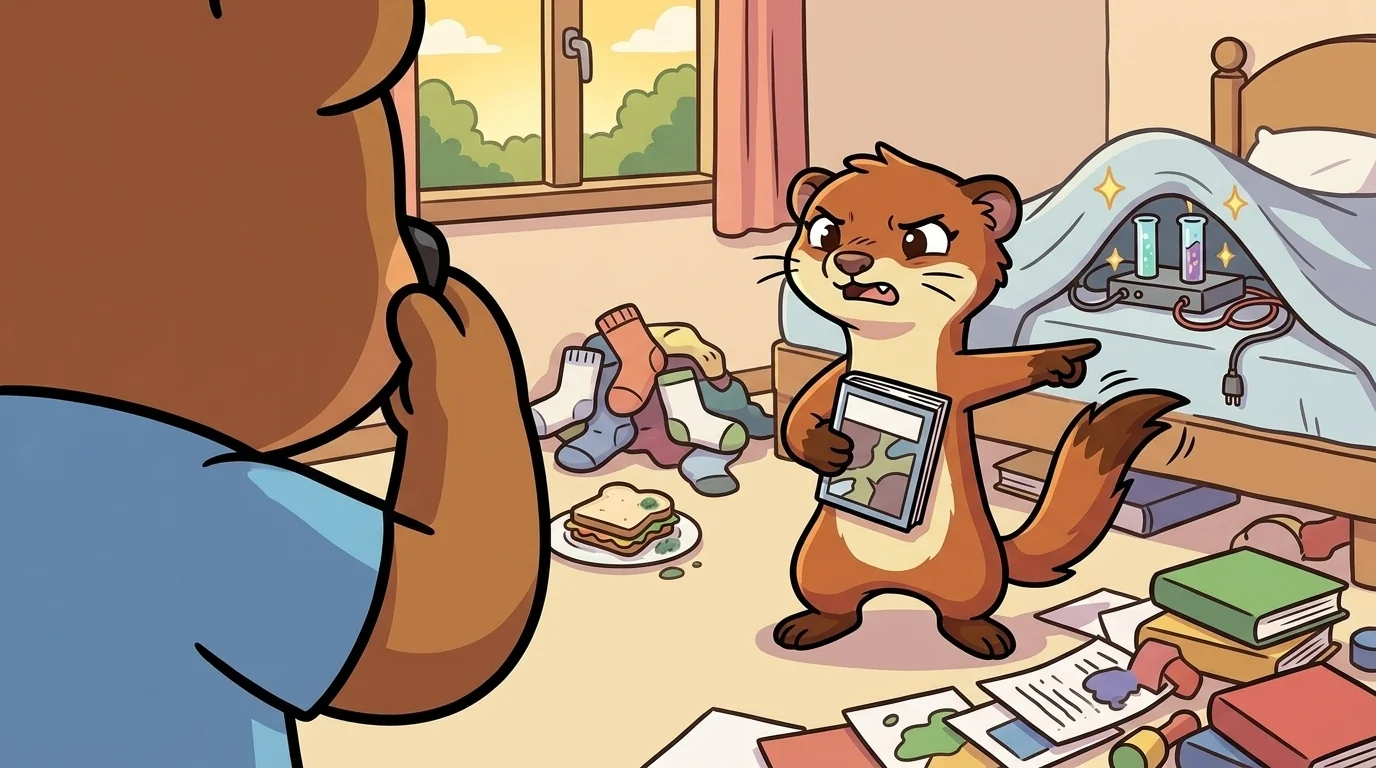
Wanda's lesson landed one sunny afternoon when her friend Pip stood in her doorway, holding her nose. "Wanda, your room is a disaster!" A pile of socks sat beside a half-eaten sandwich; a forgotten science project glittered under a bedsheet.
Wanda's nose twitched, and — there it was — the move fired. "Oh, my room? What about your room, Pip? I saw a whole tower of books in your corner yesterday!"
"My books are neat! And they're not moldy sandwiches!"
And Wanda caught it — the flick, the point, the swing of the spotlight — and made herself set the comic down, because this was the lesson. "Okay. Freeze. Watch what I just did. Pip pointed at my mess, and I pointed at Pip's books — a totally different room — so nobody'd look at my sandwich." She sat up. "Here's how you catch a deflection every time. First: did they actually talk about the first problem, or just push it away toward someone else? Second: is it even true that the other person did it? Sometimes it isn't. Third: even if it is true — does that make your problem okay? Almost always, no. And to get back on track, you just say: 'Okay — but we were talking about this. What about this?'" She glanced, a little sheepish, at her sandwich. "Pip's books don't make my socks tidy. Only tidying my socks does that."

Later, after Wanda had actually cleaned her room — socks in the basket, sandwich in the bin — she sat in the doorway of a room that finally smelled okay, and her twitchy nose went still.
"That puff of relief," she said quietly, "when you push the blame onto someone else? It feels good for exactly one tiny second. I know it better than anybody." She looked back at the clean room. "But it never lasts, because the mess is still yours, still waiting. What actually feels good — really good, deep-down settled — is this. Fixing your own thing, and letting it be done, and sitting in a room that's actually clean." She gave a small, honest smile. "Spotting the deflection is the skill. But that settled, nothing-left-hanging feeling when you handle your own mess instead of pointing away — that's the one worth chasing. It's the feeling I'm still learning to chase myself. Come catch me whenever my nose starts twitching toward someone else."
Hear it as an audio drama
A short play starring Whataboutism Wanda, from LogicQuest. Different voices, same idea. Listen any time after you read.
Loading audio…
Read the drama script
- Narrator: From Spark and Anvil and LogicQuest — this is Whataboutism Wanda, in chapter 1 of the LogicQuest cast.
- Narrator: This drama uses an AI-generated voice. Voiced via Gemini 2.5.
- Narrator: This is Whataboutism Wanda. She is a small adult-coded weasel. Warm brown and cream. Quick-eyed. Quick-deflector.
- Narrator: She has a habit. When criticized, Wanda's first move is —
- Whataboutism Wanda: WHAT ABOUT — that other person who does similar things?
- Narrator: The criticism is deflected. Never addressed. The other person's behavior is irrelevant. To whether the original criticism was valid.
- Narrator: Wanda is the cast's whataboutism teacher. The fallacy she embodies is — responding to criticism by pointing at someone else's bad behavior.
- Narrator: This is common in political rhetoric. The pattern is — criticism arrives. Point at someone else who does similar things. Original criticism never addressed.
- Narrator: Whataboutism is related to tu quoque. Tessa will teach the closely-related form next. But there is a distinction.
- Whataboutism Wanda: I deflect to a third party.
- Whataboutism Wanda: Tessa deflects back to the critic directly.
- Whataboutism Wanda: Both are deflection. The criticism is never addressed in either case.
- Narrator: Wanda is, importantly, not a villain. She is what every cast member in LogicQuest is. A teaching archetype.
- Whataboutism Wanda: I am a teaching archetype. Not a villain.
- Whataboutism Wanda: I do this when I don't want to address the criticism.
- Whataboutism Wanda: We all do this sometimes.
- Whataboutism Wanda: The skill is — recognizing the deflection. And returning to the original criticism.
- Narrator: Wanda teaches the scaffolds. The questions you ask when you suspect deflection.
- Whataboutism Wanda: Has the original criticism been addressed? Or just deflected?
- Whataboutism Wanda: Is the other-person-does-this-too claim even true? Often it is not.
- Whataboutism Wanda: Even if the other person does this too — does that affect whether the original behavior is wrong?
- Whataboutism Wanda: Usually no.
- Whataboutism Wanda: Return. OK. But we were discussing X. What about X?
- Narrator: Wanda walked to LogicQuest. Inspector Logos asked her — what is whataboutism?
- Whataboutism Wanda: Deflecting criticism to a third party. The skill is — recognize the deflection. Return to the original.
- Inspector Logos: You are appointed.
- Narrator: She has been Whataboutism Wanda ever since.
- Whataboutism Wanda: It is not hard. It is — recognize the deflection and return to the original.
- Narrator: Deflection doesn't address the criticism.
- Narrator: And — we all do this sometimes. Catching it is the skill.
- Narrator: You've been listening to a Spark and Anvil chapter, written by the Spark and Anvil writing team for ages 9 to 14.
- Narrator: Apps stay free forever.
- Narrator: Curriculum aligned to Common Core math and discrete math.
- Narrator: Released under Creative Commons BY-NC-SA 4.0 for educational reuse. Visit Spark and Anvil for the full transcript.
More stories with Whataboutism Wanda
Another short audio story about Whataboutism Wanda. Open one when you are ready.
Whataboutism
Loading audio…
Read the script
- Narrator: From Spark and Anvil and LogicQuest — this is Whataboutism Wanda, in chapter 1 of the LogicQuest cast.
- Narrator: This drama uses an AI-generated voice. Voiced via Gemini 2.5.
- Narrator: Whataboutism Wanda is a small weasel, her warm-brown-and-cream fur a blur of motion. Her eyes dart around the messy art room.
- Whataboutism Wanda: I'm Wanda. Did I leave brushes in the bucket? Maybe. But what about all the other messes? Let's talk about those instead.
- Narrator: When faced with a criticism, Wanda doesn't answer it. Instead, she deflects by pointing out a similar wrong done by someone else.
- Whataboutism Wanda: My special move is asking, "What about them?" It’s a simple question that makes the first question disappear. It's like magic.
- Narrator: This was her signature move, a pattern she learned early. It was always easier to change the subject than to face the problem.
- Narrator: In the art room, a friend sighed, holding a dripping paintbrush. "Wanda," he said, "these are supposed to be cleaned."
- Whataboutism Wanda: Me? What about Chloe leaving her clay tools out last week? Or you not putting caps back on the paint?
- Narrator: And just like that, the conversation wasn't about the brushes anymore. It was about Chloe's tools and another's paint caps.
- Whataboutism Wanda: You see, their mistake doesn't have to be relevant. It just has to be true. It keeps the original issue hanging in the air, unanswered.
- Narrator: This is whataboutism. Responding to a criticism by pointing to someone else's fault, rather than addressing your own.
- Whataboutism Wanda: I am the master of the deflection-move. Why talk about my mess when we can talk about their mess instead? It's much more interesting.
- Narrator: A question is asked. A different accusation is made. The first problem is never solved. That is Whataboutism Wanda.
- Narrator: You've been listening to a Spark and Anvil chapter, written by the Spark and Anvil writing team for ages 9 to 14.
- Narrator: Apps stay free forever.
- Narrator: Curriculum aligned to Common Core math and discrete math.
- Narrator: Released under Creative Commons BY-NC-SA 4.0 for educational reuse. Visit Spark and Anvil for the full transcript.
The LogicQuest ensemble
Whataboutism Wanda is one of the friends in LogicQuest. Each friend shows you one idea by how they act; meet them all and you have the whole subject.
-

Ad Hominem Hannibal
Attacking the arguer, not the argument
-

Strawman Stella
Misrepresenting the opponent's argument
-

Slippery-Slope Sam
Chaining dire consequences from a small first step
-

Appeal-to-Authority Auntie
Citing irrelevant / unqualified authority as proof
-

Red-Herring Reggie
Deflecting to an irrelevant topic
-

Circular-Reasoning Cici
Assuming the conclusion in the premise
-

False-Dichotomy Fia
Presenting only two options when more exist
-

Bandwagon Bran
Truth-by-popularity
-

Sunk-Cost Cyril
Refusing to change course because of past investment
-

Equivocator Eva
Sliding a word's meaning mid-argument
-

Tu-Quoque Tessa
"You too!" — dismissing criticism by accusing the critic of the same thing
-

Modus-Ponens Mo
If P then Q; P; ∴ Q
-

Modus-Tollens Tara
If P then Q; ¬Q; ∴ ¬P
-

Syllogism Solon
All M are P; all S are M; ∴ all S are P
-

Disjunctive-Syllogism Dior
P ∨ Q; ¬P; ∴ Q


