Circle and Echo
listening as math
A story read by Circle and Echo
Loading audio…
Press play to listen along. The line being read lights up as you go.
Show full transcript
Loading transcript…
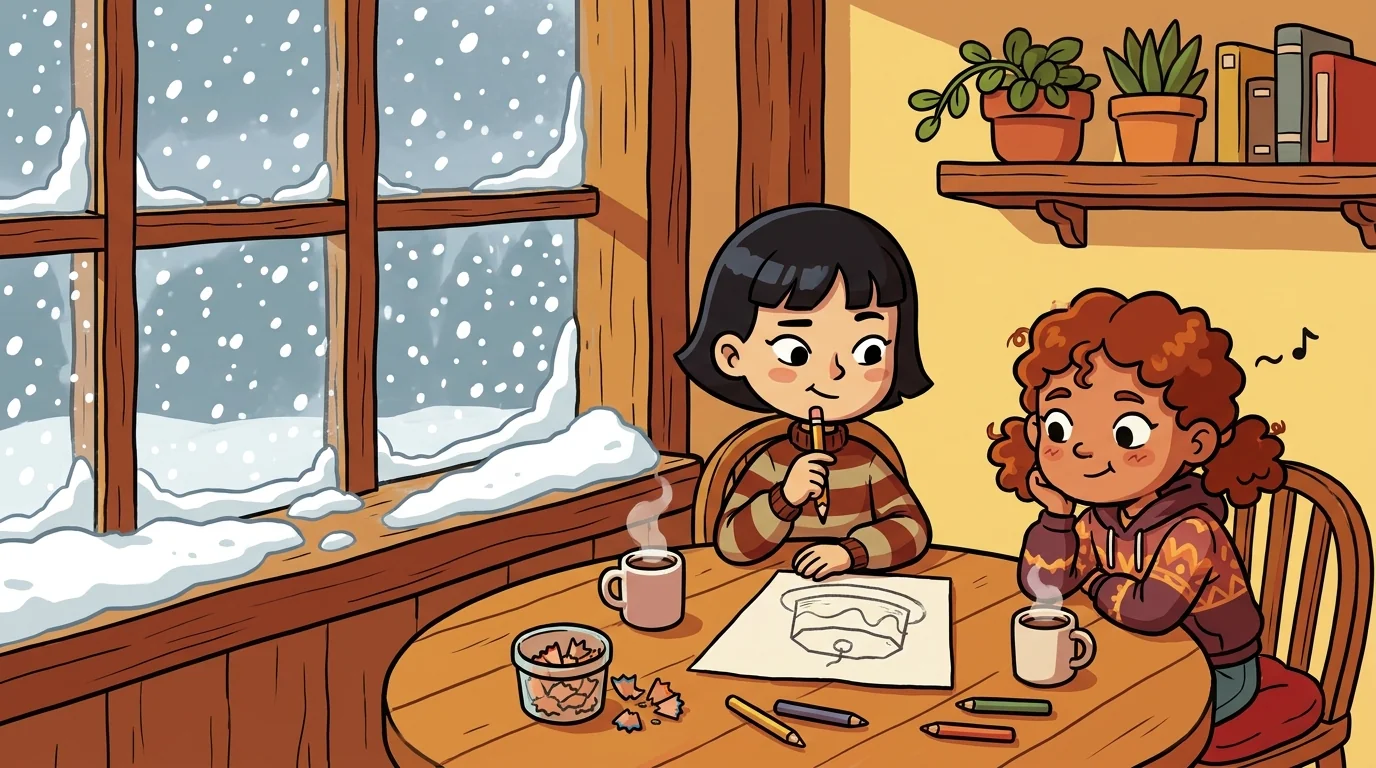
The snow fell in big, quiet flakes outside the math-circle window. Inside, it was warm and smelled like pencil shavings and hot cocoa. At a round wooden table, two friends stared at a piece of paper. On the paper was a drawing of a lopsided, nine-sided cake.
Circle Circe tapped a very sharp pencil against her chin. Her drawings were always neat, with perfect curves and straight lines. This messy cake problem bothered her. "A nonagon," she murmured. "For seven yetis. And they all need exactly the same amount."
Echo Edie leaned forward, her elbows on the table. She hummed a little tune, a habit she had when she was thinking hard. The problem wasn't just about the cake. It was about the yetis. The instructions said that if one yeti got even a crumb more than another, they would start a very loud, very grumpy yodeling contest that could cause an avalanche.
"No avalanches today," Edie said softly. She looked at Circe, then back at the wobbly drawing. The snow kept falling, piling up on the windowsill like a soft, white blanket. The challenge was clear, but the answer was hiding.
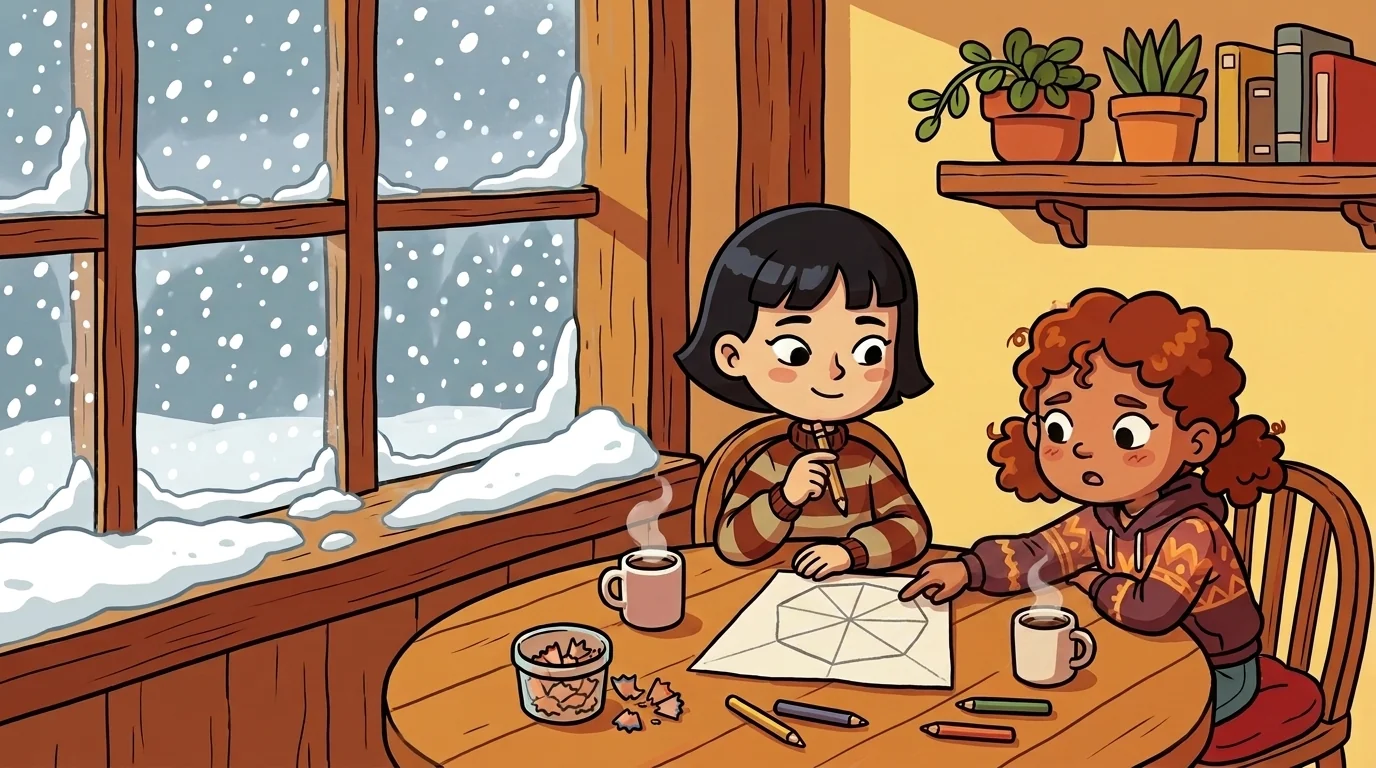
Circe drew a perfect nonagon on a fresh sheet of paper. She liked to start with a clean version of the problem. "Okay," she said, her voice clear and sure. "The simplest way to cut a cake is from the center, out to the corners. Like a pizza." She drew faint lines from the middle of her shape to each of the nine corners.
She pointed with the tip of her pencil. "We could give seven of those slices to the seven yetis. Then we'd have two slices left over." She looked at Edie, expecting a nod. It was a logical start. A complete, circular thought.
Edie tilted her head. "So, what you're saying is we should slice it like a pizza and give one slice to each yeti, which leaves two extra slices," she said, tracing Circe's lines in the air with her finger. Her voice was thoughtful, like she was trying the idea on for size.
"Yes, exactly," Circe said.
"Okay," Edie continued. "I hear that. And it's a fast way to get started. But the problem is that the two leftover slices need to be divided up between the seven yetis. And cutting up those two little triangles into seven perfectly equal bits seems... tricky. And messy."
Circe looked at her drawing. Edie was right. Those two leftover slices would have to be crumbled into seven tiny, equal piles. A crumb-based disaster. Not neat at all.
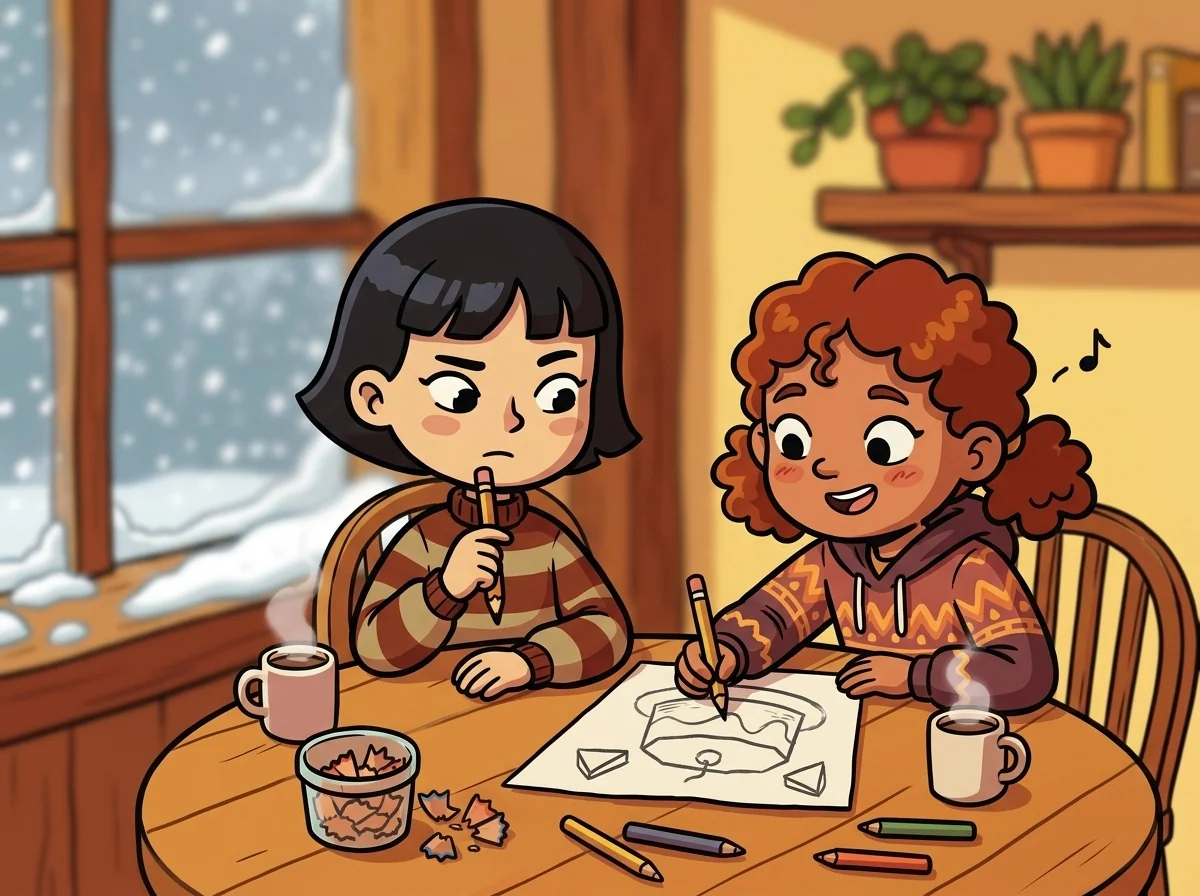
Edie picked up her own pencil, which was not as sharp as Circe's. "So, you showed that slicing it from the center makes leftover pieces that are hard to share," she began, making sure she had it right. Circe nodded.
"Right," Edie said. "So what if we don't start from the center? What if we try to make the cake itself easier to divide? It has nine sides, and we have seven yetis. Nine and seven don't play well together."
She drew a wavy line on her own paper, just for something to do. "What if we just... cut two of the sides off?" she suggested. She drew two heavy lines on the drawing, lopping off two of the nonagon’s corners. "Look. If we cut these bits off, the big piece left in the middle is a heptagon. A seven-sided shape."
She smiled. "Then we could cut that from the center, and it would make seven perfect, equal slices for the seven yetis!"
Circe looked at the new drawing. It was a bold idea. A seven-sided cake was much easier to divide for seven yetis. The logic was strong. But a new problem appeared, sitting right there on Edie’s paper: two lonely, triangle-shaped pieces of cake that had been cut off.
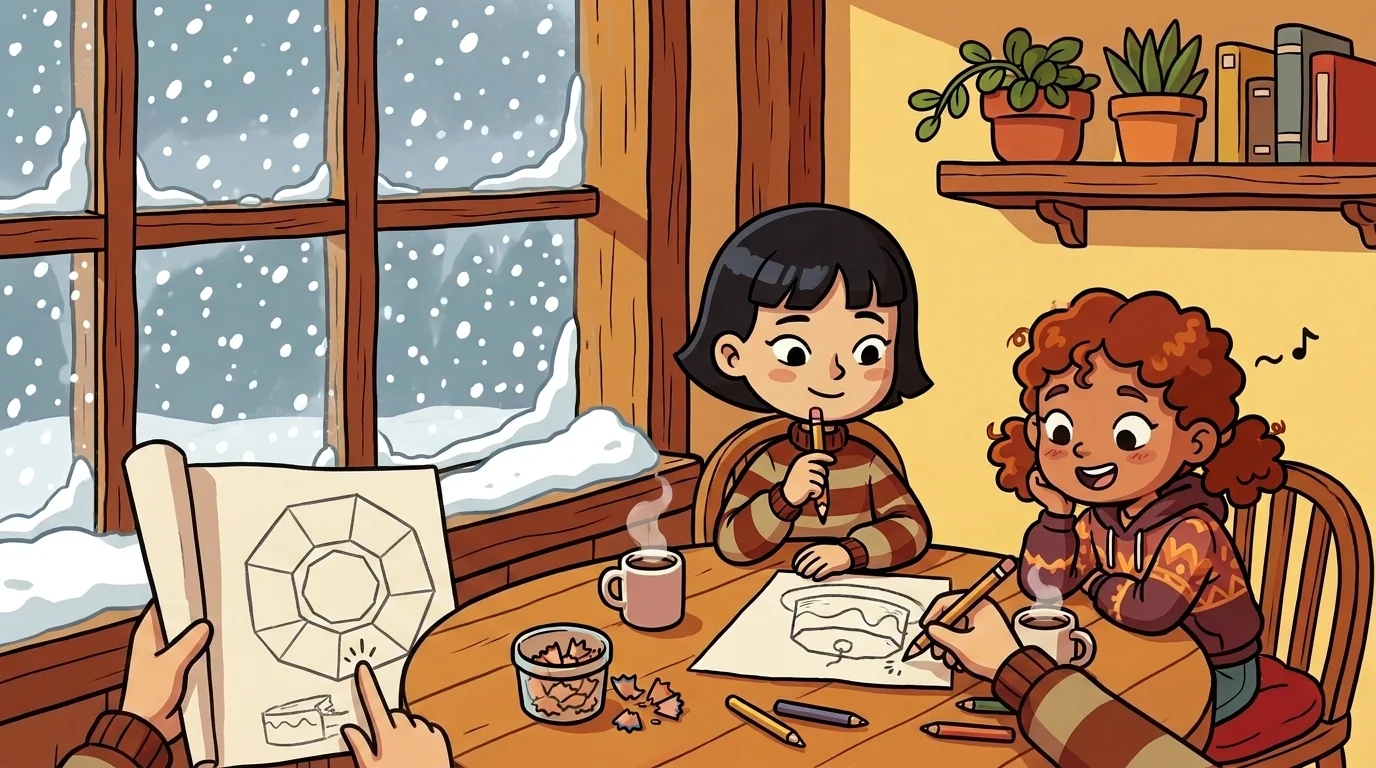
"Okay, I hear you," Circe said, picking up the thread. "You're saying that if we cut off two corners, we're left with a seven-sided cake that's easy to divide. That's really clever, Edie. It turns the hard part of the problem into an easy one."
Edie beamed. "Exactly!"
"But," Circe added gently, tapping the two cutoff pieces on Edie's drawing, "we still have these leftovers. We can't just throw them out. The yetis would know. They can smell wasted cake from a mile away."
Edie's smile faltered. "Oh. Right. So we have the same problem as before. Leftovers."
"So, your idea of changing the shape is smart, but we still have to divide the leftovers," Circe restated. She paused, looking at the perfect nonagon she had drawn earlier. "And my idea of slicing from the middle was simple, but the slices weren't easy to share. What if we combine them?"
She pointed to her own drawing. "What if we don't cut all the way to the center? What if we draw a smaller nonagon inside the big one?" She sketched it quickly. A small, nine-sided shape floated in the middle of the larger one. Now, instead of nine triangles, there were nine trapezoids—long, four-sided pieces—pointing inward. "Now we have nine identical pieces," she said.
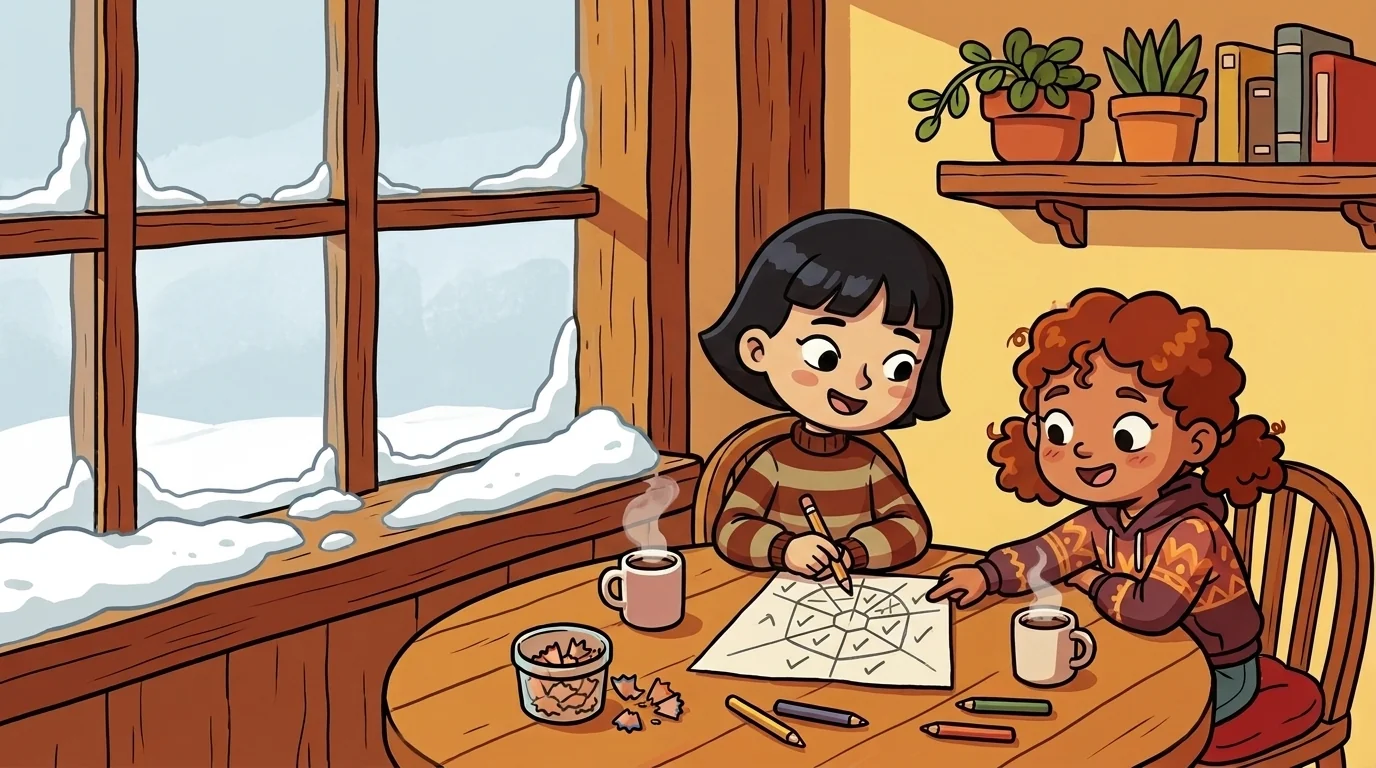
Edie’s eyes lit up. "So, you're saying we make an inner circle—well, an inner nonagon—and cut out nine long pieces around it," she said, her voice getting faster. "That's brilliant, Circe! Because now we have nine pieces that are all exactly the same shape and size."
"Exactly," Circe confirmed.
"And we have seven yetis," Edie went on. "So each yeti gets one whole piece." She started making checkmarks on the paper. "One for yeti one, one for yeti two... all the way to seven."
"That leaves two whole pieces left over," Circe said, finishing the thought. "And one small nonagon cake from the very middle."
Edie grabbed her pencil. "So now we just have to divide those two leftover trapezoid pieces and the little cake in the middle into seven equal shares," she said. "That's so much easier than dividing crumbs!" They quickly sketched out a plan: each of the two leftover pieces could be sliced into seven skinny strips. The center nonagon could be carefully cut up, too. Every yeti would get one big piece, two skinny strips, and one little chunk of the center.
They looked at their final drawing, covered in lines and checkmarks. It was a perfect, fair, and avalanche-proof solution. Outside, the snow had stopped falling. The world was quiet and clean.
"Good listening," Circe said with a small smile.
"Good echoes," Edie replied.
Hear it as an audio drama
A short play starring Circle and Echo, from MathCircle. Different voices, same idea. Listen any time after you read.
Loading audio…
Read the drama script
- Narrator: From Spark and Anvil and Mathcircle — this is Circle, in chapter 1 of the Mathcircle cast.
- Narrator: This drama uses an AI-generated voice. Voiced via Gemini 2.5.
- Narrator: In the Math Circle, two friends show that the most important tool isn't a pencil — it's the ear. Meet Circle and Echo.
- Circle: I'm Circle. Before I add my own idea, I say back what my teammate just said — in my own words — so they know I truly heard it.
- Echo: I'm Echo. And when Circle restates my thinking, I catch my OWN gaps. Hearing my idea come back tells me if it actually made sense.
- Narrator: A third solver blurts a half-formed idea about splitting a shape into triangles, then trails off, unsure.
- Circle: So what I hear you saying is — you'd cut the pentagon into triangles from one corner, and add their areas. Did I get that right?
- Solver: Yes! And hearing you say it, I realize it's three triangles, not two.
- Echo: See what happened? Circle didn't add anything new yet — just restated — and the idea got SHARPER on its own.
- Circle: That's listening as math. A restated idea is an idea examined. Only after I've truly received yours do I add mine.
- Echo: Talking over each other loses ideas. Restating first keeps every idea in the room long enough to grow.
- Narrator: Circle and Echo prove that a proof is often built not by the loudest voice, but by the most careful ear.
- Circle: Say back what you heard —
- Echo: then add what you think. That's how a circle of minds actually solves.
- Narrator: You've been listening to a Spark and Anvil chapter, written by the Spark and Anvil writing team for ages 9 to 14.
- Narrator: Apps stay free forever.
- Narrator: Curriculum aligned to Common Core and Next Generation Science Standards.
- Narrator: Released under Creative Commons BY-NC-SA 4.0 for educational reuse. Visit Spark and Anvil for the full transcript.
The MathCircle ensemble
Circle and Echo is one of the friends in MathCircle. Each friend shows you one idea by how they act; meet them all and you have the whole subject.
-

Circle Circe
Steps back so the kids can talk to each other
-

Echo Edie
Listens, then says your idea back so everyone hears it
-

Patty Patient
Gives everyone time to think — no rush
-

Tortoise Hare
Tries a slow way and a fast way, and lets a wrong try teach something
-

Tess Try-Small
Specializing — when a problem's too big, try the smallest version first
-

Gemma General
Generalizing — turning a pattern from a few cases into a rule for all of them
-

Hattie Hunch
Conjecturing — daring to guess boldly, then testing the guess honestly
-
Reva Reverse
Working backwards — starting from the goal and reasoning back to the start
-

Wendy Wonder
Notice-and-wonder — slowing down to observe and ask before rushing to solve
-

Cass Check
Sense-checking — asking whether an answer actually makes sense before trusting it