
Give
GIVE (Advanced) — giving is one real thing money is FOR, alongside spending and saving. The Advanced version names it as values-based allocation: choosing to send some of your money toward what matters to you, a personal decision never owed to anyone. It carries an OPPORTUNITY COST (money given can't also be spent or saved — that's what makes it a real choice, not a free gesture), and it's most effective when it's INTENTIONAL (deciding in advance what and how much) rather than pressured in the moment. Anti-preachy, anti-guilt, anti-shame: never a rule, never a scoreboard.
Loading audio…
Press play to listen along. The line being read lights up as you go.
Show full transcript
Loading transcript…
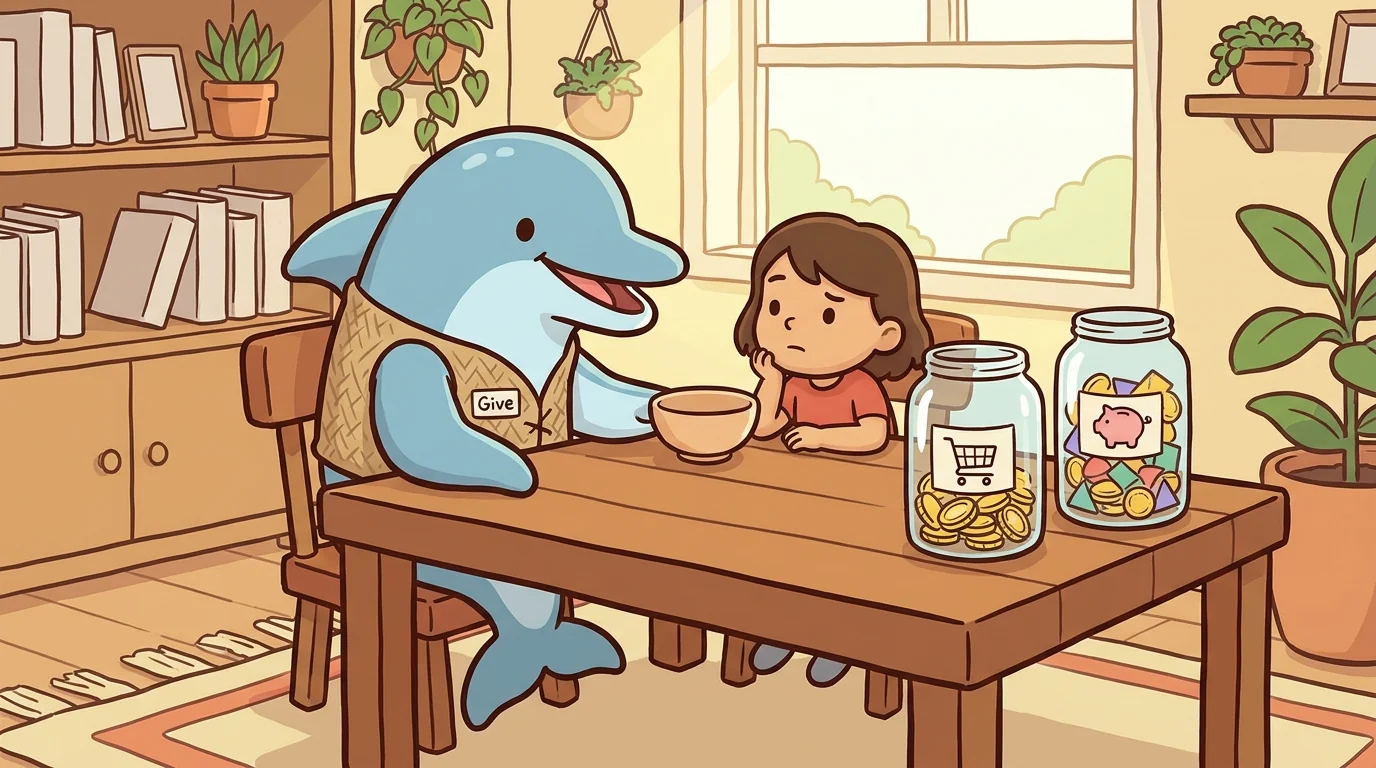

Give was a dolphin-tween — easy, open, generous by her whole nature, and famous for never once being preachy about it. When the young ones learned that money could be spent and saved, she surfaced with a grin and a third idea. "There's one more thing money can do," she said, "and people forget it because it's the only one that isn't about you. Money can be given — sent toward someone or something you want to help. Spend, save, give — three real jobs. Giving is a genuine choice about what your money is for, not a leftover afterthought."

But almost in the same breath she set down the guardrail, because giving is the money-topic most likely to be twisted into guilt. "Hear this first, before anything else," Give said, her voice easy and warm. "Giving is a personal value choice — never a rule, never a debt, never something you owe anyone. Nobody gets to shame you into it, and nobody gets to shame you out of keeping your own money either. It's called values-based giving because it flows from what you value — what you'd be glad to help — and your values are yours. A gift squeezed out by pressure or guilt isn't generosity. It's just pressure. Real giving is chosen freely, or it isn't the thing at all."

Then, because she respected the young ones enough to tell them the honest arithmetic, she named the part that makes giving mean something. "Here's what makes a gift a real choice and not a free gesture," Give said. "Money you give away can't also be spent or saved — that's called its opportunity cost, the next-best thing you gave up to give. And that cost is exactly what gives a gift its weight. If it cost you nothing, it would mean nothing. When you choose to send some of your money toward what matters to you, you're saying this matters more to me than the other things I could have done with it. The cost is the honesty of the gift. That's why giving is powerful — and why it should never be automatic or careless."

She rolled once, easy in the water, and taught the small craft that keeps giving joyful instead of fraught. "The trick," she said, "is to make it intentional — decide in advance what you'd like to give, and how much, back when you're calm and clear, instead of being caught in a hard moment with someone watching, deciding under pressure. If giving matters to you, you can even set aside a little for it the way Nest sets aside savings — a small, chosen amount, ready ahead of time. Then when the moment comes, you're not squeezed and you're not guilted; you're simply doing a thing you already decided you wanted to do. Planned giving is calm giving. Pressured giving is a trap wearing a kind face."
And she left them with the whole of it, gently, the way a dolphin leaves a wake. "So: money has three jobs — spend, save, give — and give is as real as the other two," Give said. "It carries a true cost, which is what makes it mean something. It's healthiest when it's decided ahead, freely, from your own values. And it is always, only, your choice. I will never make you feel small for giving, and I will never make you feel small for keeping. Generosity that's chosen is one of the best things money can do. Generosity that's forced isn't generosity at all — so keep it yours."
The MintForge ensemble
Give is part of MintForge's distributed-narrative cast. Each character embodies a different curricular primitive; together they teach the full subject.
-

Coin
Currency + exchange — what money is, what it does, what it can't measure
-

Tag
Percentage + markup — the transparent math of how prices are built
-

Grow
Compound interest — patient math of money over time
-

Plan
Budget allocation + opportunity cost — the math of choosing with limited resources
-

Tilt
Risk + variability — the math of uncertain outcomes, distributions over destinies
-

Due
Borrowing and debt — money owed carries a cost; what does it really cost to borrow?
-

Earn
Income — money comes from the value of work; earning before spending
-

Nest
Saving — setting money aside toward a goal, a little at a time
-

Wary
Money safety — spotting scams and keeping your money safe