Lag
The result comes late
Loading audio…
Press play to listen along. The line being read lights up as you go.
Show full transcript
Loading transcript…
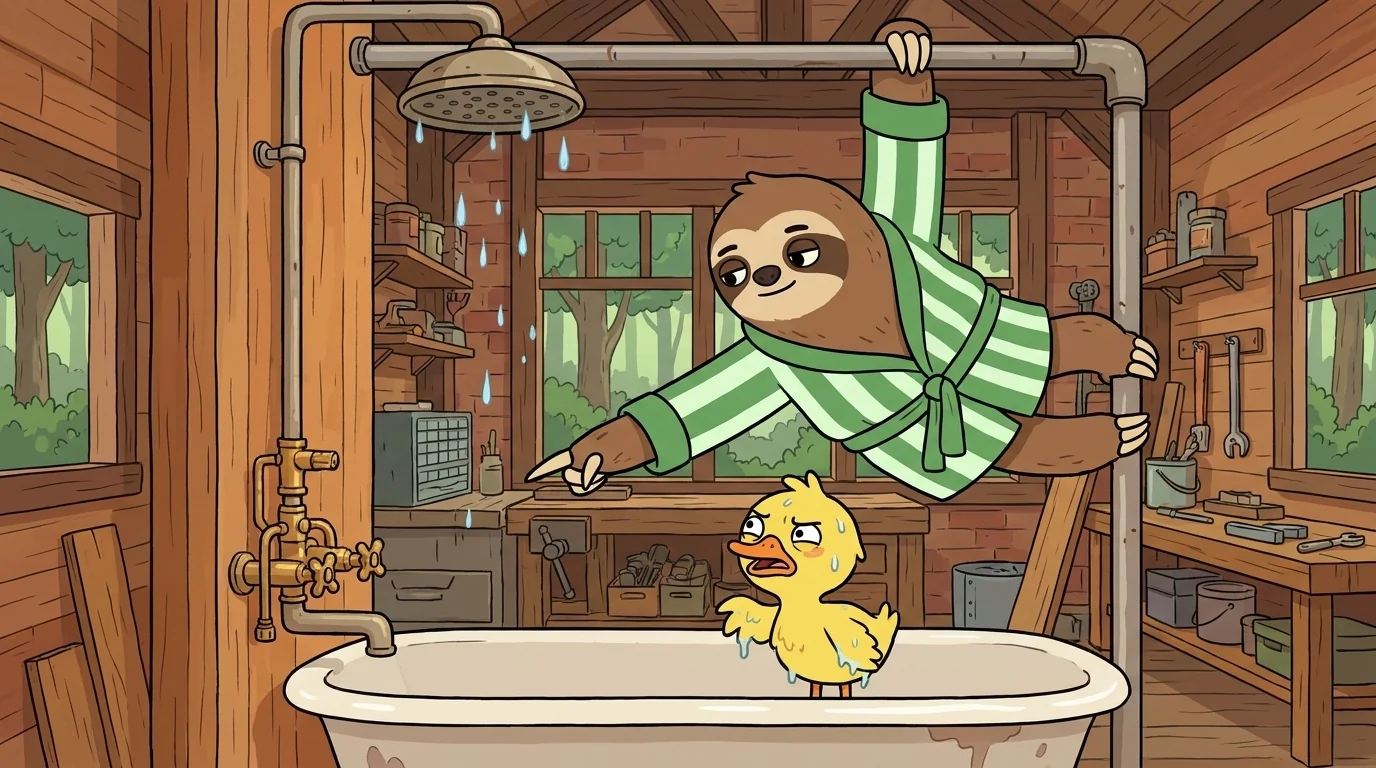
The shower in the workshop had a terrible temperature knob, and Lag was the only one who could work it.
He was a slow, unbothered sloth in a striped robe, hanging comfortably from the pipe above the tub. A frustrated duckling was fighting the shower, turning the knob hot, then — when nothing changed — hotter, then hotter, and then suddenly yelping as scalding water arrived all at once.
"Too hot! Too hot!" The duckling spun the knob all the way cold. Nothing. Colder. Nothing. Then — freezing water, a shriek.
"You're fighting the delay," Lag said, not moving. "Not the water."
The duckling glared up at him. "The water's broken!"
"The water's slow," Lag said gently. "You turn the knob here, but the hot water is way down in the pipes. It takes a few seconds to arrive. So when you turned it hot and nothing happened, the water wasn't ignoring you — it was on its way. You turned it hotter anyway. Then all of it arrived at once." He reached down one long arm and made a single small adjustment, then held perfectly still. "Watch. I turn it a little. Then I wait." A few seconds passed. Warm — just right — water arrived. "The trick isn't turning harder. It's remembering the answer comes late, and not panicking in the gap."
The duckling stood under the perfect warm water, amazed. "You just... waited."
"The hardest thing in the world," Lag said, smiling, "is to do one thing and then wait for it to work."
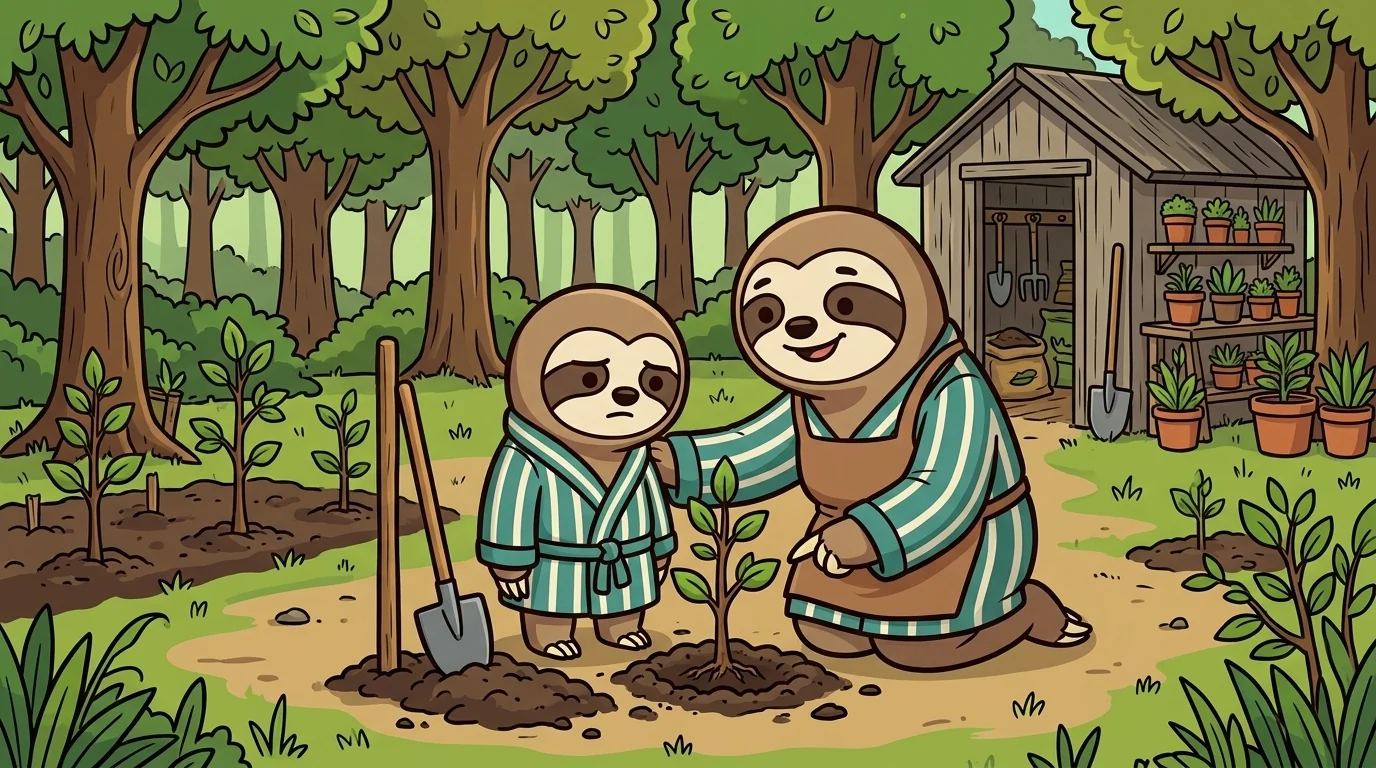
Lag learned about delays the year his family planted a slow-fruiting tree.
They planted it when he was small, and he checked it every single day, impatient for fruit. Nothing. He decided it was a dud and wanted to dig it up. His mother stopped him.
"It's not broken," she said. "It's slow. Some causes take years to show their effect. If you dig it up because nothing happened today, you'll never find out it was working all along, underground, where you couldn't see."
Young Lag hated that. He wanted the effect to follow the cause right away, like a light switch. But the tree taught him the patient truth: the gap between doing a thing and seeing it work is real, and it fools almost everyone. "Most mistakes," his mother said, "aren't from doing the wrong thing. They're from doing the right thing, seeing nothing yet, and giving up — or doing it again, and again, until you've done far too much."
The tree fruited four years later. Lag was there, and he never forgot the lesson: an effect that arrives late is still arriving.

He climbed slowly to Nexusforge at twelve, because a place that studied connection ought to respect the time between things.
Mesh, the mentor, met him and asked one thing. "Show me something that answers late."
Lag rolled a marble down a very long, curving tube. He tapped the top. "I pushed it here," he said. Seconds passed. Nothing came out the bottom. "If I panic now and push another marble, and another—" the first marble finally rolled out, then a second, then a third, all in a rush "—I get a pile-up. Because the answer to my first push was still traveling." He set the tube down. "The delay is invisible. That's what makes it dangerous. You can't see the marble in the tube, so you assume nothing's happening — and act like it. That's how you overshoot."
Mesh watched the marbles settle. "You belong here," he said.

Lag's favorite lesson was a little game of steering a ship.
A class gathered around a screen with a big cartoon ship and a rudder. "Turn the rudder left," Lag said. Pip did. The ship kept going straight. "It's not working!" Pip turned the rudder harder left. Still straight. Harder. Then — slowly, then all at once — the ship swung hard left, way past where Pip wanted, and he yanked the rudder right to fix it, and that overshot too, and the ship wobbled wildly down the channel. The class laughed. "You've made a ship that can't sail straight," Lag said cheerfully, "and you did it by being reasonable. Every single move made sense — you turned toward where you wanted to go. But a ship answers its rudder late. So by the time you saw the turn, you'd already turned too much." He reset the ship and steered it himself: one gentle rudder move, then a long, patient wait, then a tiny correction. The ship glided smooth down the middle. "Same rudder. Same ship," Lag said. "The only difference is I left room for the delay. I moved once, and trusted it to arrive." Then he showed the deep part: "Delays are why systems oscillate — why a thing swings too far one way, then too far the other, back and forth. It's almost never that the system is wild. It's that someone kept reacting to results that hadn't arrived yet."
Pip watched the smooth-sailing ship. "So the delay was the whole problem the whole time."
"The delay is usually the whole problem," Lag said. "And almost nobody sees it, because you can't see a thing that hasn't happened yet."
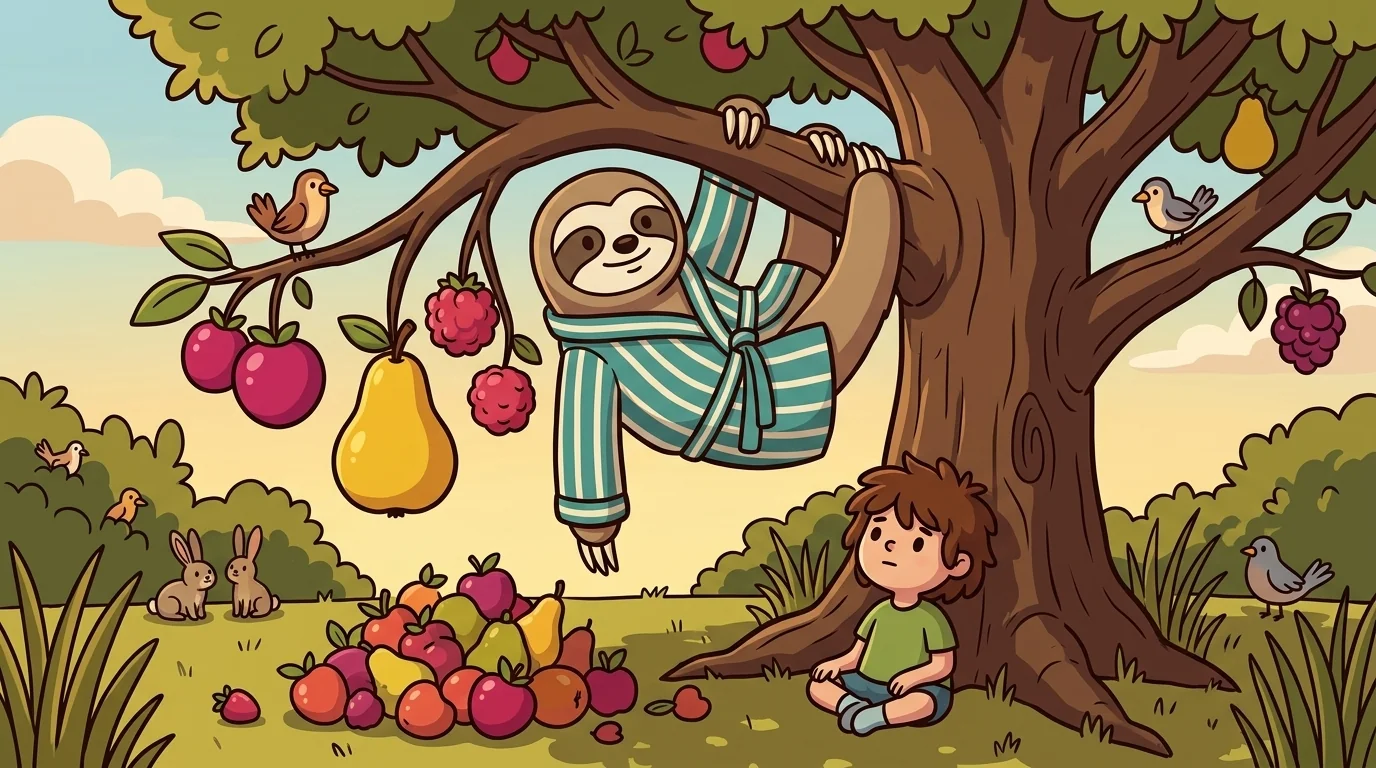
Later, Pip came back with a quieter question. "When you can't see the result yet... how do you not panic and keep pushing?"
Lag thought about the slow tree, and his mother's hand stopping his.
"You decide, before you start, that the answer will be late," he said. "That's the honest trick. If you expect the gap, the empty waiting stops feeling like failure and starts feeling like travel time." He hung there, easy, in his striped robe. "There's this itchy, twitchy urge to do more when nothing's happening yet — and that urge is what wrecks almost everything. The cure isn't more doing. It's trusting that you already did the thing, and it's on its way." He watched the restless energy drain out of Pip's shoulders. "Do one thing. Then wait for it to arrive. It will arrive."
He didn't say the rest aloud, but he thought it, warm and slow: the space between a push and its result isn't emptiness — it's the answer, traveling. Learn to sit in that space without flinching, and half the world's overshoots simply never happen. And in his chest sat the deep, unhurried calm of a creature who had made friends with waiting — the settled, patient warmth of knowing that a late answer is still, always, an answer on its way.
The NexusForge ensemble
Lag is one of the friends in NexusForge. Each friend shows you one idea by how they act; meet them all and you have the whole subject.
-

Tie
Connection / link — name the MECHANISM before drawing the line; refuse vague-correlation framings
-

Spiral
Reinforcing feedback — spirals grow good OR bad until something stops them; always ask 'what stops it?'
-

Damp
Balancing feedback — this loop is PROTECTING what the system tries to keep stable; what is it protecting?
-

Emerge
Emergence — the pattern isn't in any single rule; it appears FROM the rules running together
-

Steer
Leverage points — the biggest leverage is usually the LEAST obvious place to push (Meadows)
-

Amass
Stocks vs flows / accumulation
-

Topple
Tipping points / nonlinearity
-
Yon
System boundary
-
Snare
System traps / archetypes


