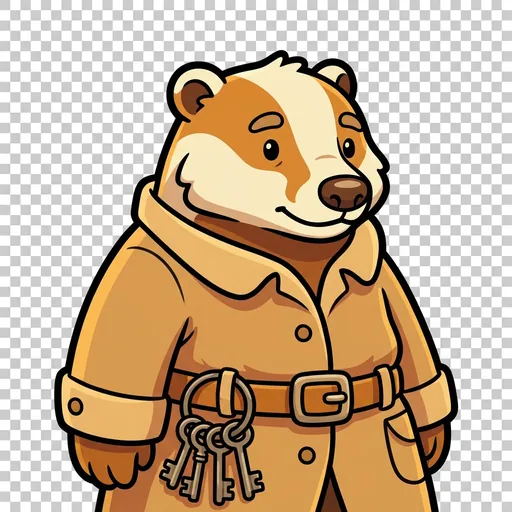
Snare
Some traps have a shape
Loading audio…
Press play to listen along. The line being read lights up as you go.
Show full transcript
Loading transcript…
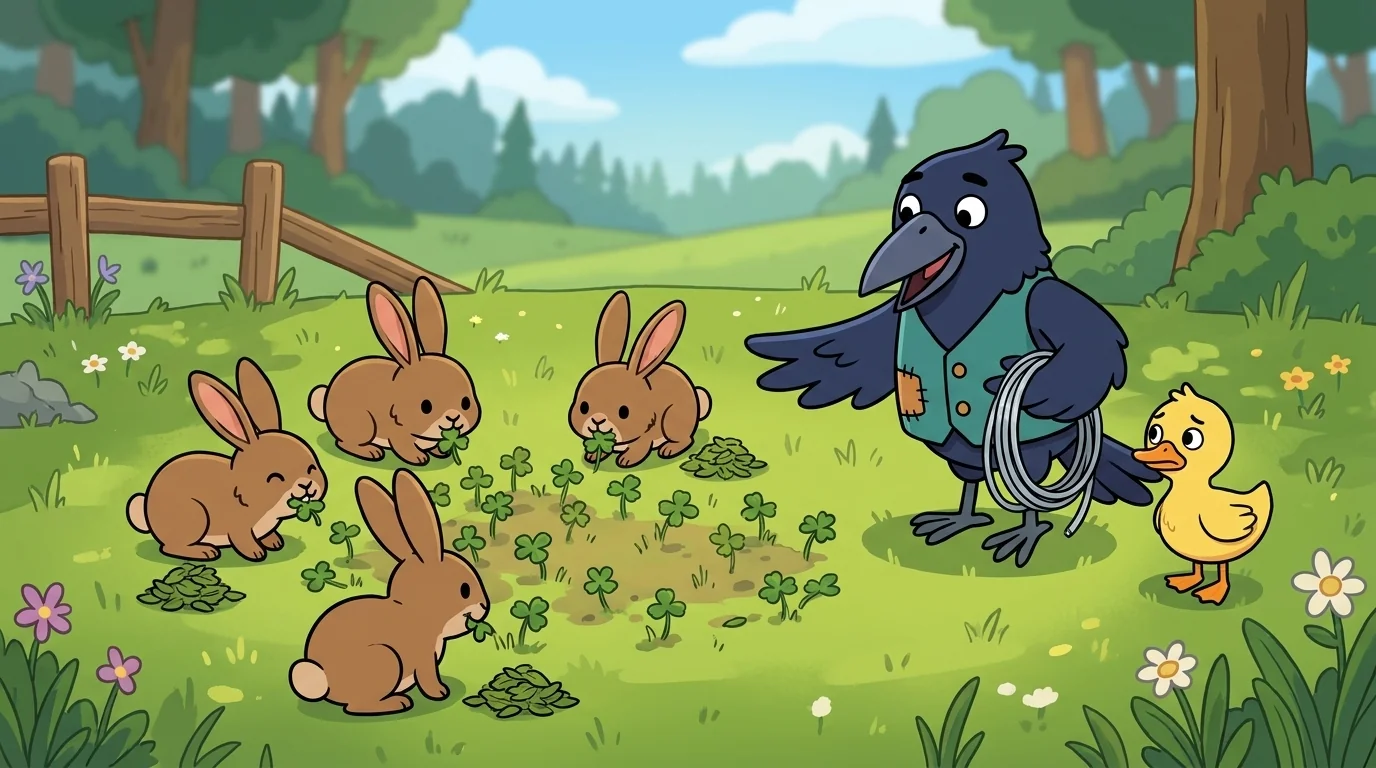
In a meadow near the workshop, a group of animals were all quietly making the same small mistake, and Snare was the one who could see the shape of it.
She was a watchful crow in a patched vest, a coil of untangling-wire always in her claws. In the meadow, five rabbits shared one patch of clover. Each rabbit, sensibly, took a little extra for itself. A duckling watched them nibble.
"They're being greedy," the duckling decided.
"They're being reasonable," Snare said. "Every single one of them. That's what makes it a trap." She pointed. "Each rabbit thinks: 'If I take a little more clover, I'm better off, and one rabbit's extra bite won't hurt the patch.' And that's true — for one rabbit. But all five think it, and do it, at the same time. So the patch gets eaten faster than it can grow back." She watched the clover thinning. "See the shape? Each one does the smart thing for itself, and the whole patch collapses — and then there's less for everyone, including the rabbit who grabbed most. Nobody was evil. Nobody was even foolish, one at a time. The trap did it — the shape of everyone-sharing-one-thing-and-each-taking-a-little-more."
The duckling frowned at the shrinking clover. "So it's not that they're bad."
"They're stuck in a shape," Snare said. "And the beautiful thing about shapes is — once you can see one, you can learn to get out of it."
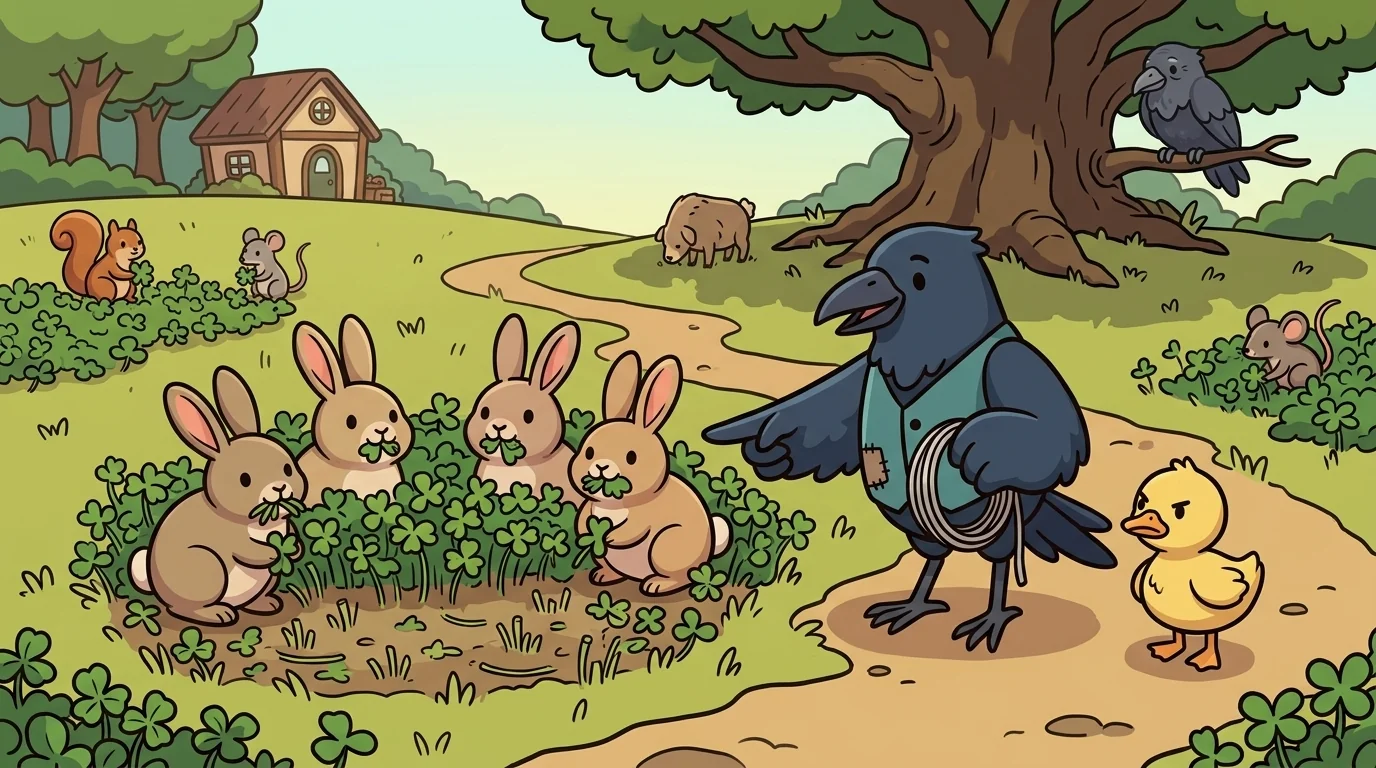
Snare learned to see trap-shapes the year her whole flock got caught in one.
There was one good roosting tree, and every crow wanted the best branch. So each crow arrived a little earlier than the day before, to beat the others. Which meant they all arrived earlier. Which meant, before long, the whole flock was showing up exhausted at dawn, competing for branches — and nobody was actually better off than when they'd all just arrived at a sensible hour.
Her grandmother, an old crow with knowing eyes, named it for her. "Do you see it?" she asked. "Each of you did the clever thing — arrive earlier. And because you all did, you're all worse off. That's a trap with a shape, little one. It's not about clever or foolish. It's about what happens when everyone races the same race."
"How do we get out?" young Snare asked.
"Somebody has to see the shape, name it out loud, and trust the others to change too," her grandmother said. "The crow who says 'we're all exhausting ourselves for nothing — let's all just agree to arrive at dawn-plus-one' — that crow breaks the trap. But it takes trust, and it takes going first." She ruffled Snare's feathers. "The trap isn't in any one of us. It's in the shape. Change the shape, and you free everyone at once."
Young Snare started collecting shapes after that — the racing-shape, the sharing-shape, the blame-shape — the way other crows collected shiny things.
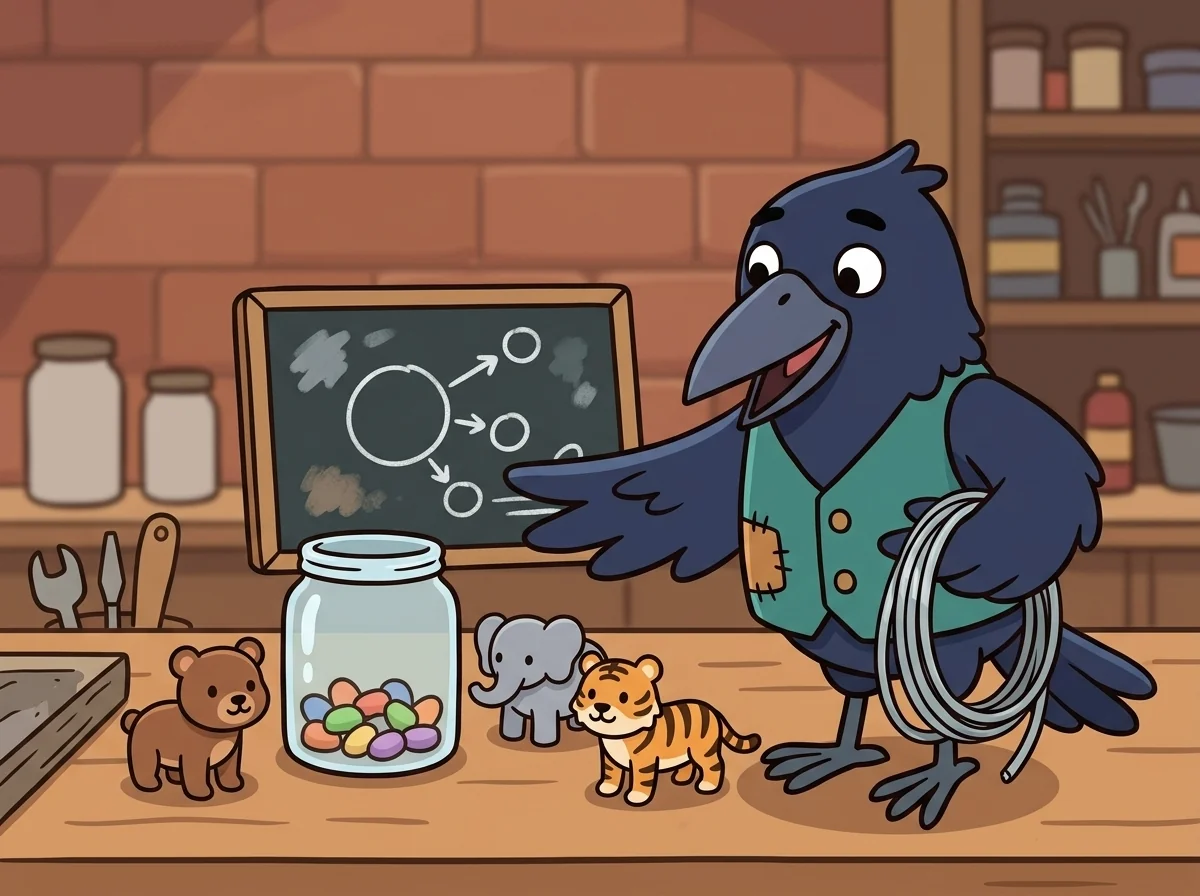
She flew to Nexusforge at twelve, because a place that studied systems ought to keep a catalog of the traps they fall into.
Mesh, the mentor, met her and asked one thing. "Show me a trap nobody meant to build."
Snare set out a jar of treats and three toy animals around it. "Rule: each one may take as much as it likes," she said, "but the jar only refills if some is left." She walked the toys through it. "If each one grabs all it can — sensible, for each one — the jar empties and never refills, and they all end up with nothing." She reset it. "But if each one takes a little less than it wants, the jar refills forever, and they all end up with more, every day." She looked up. "Same animals. Same jar. The only difference is whether they can see the shape they're in — and trust each other enough to leave some."
Mesh looked at the two outcomes. "You belong here," he said.
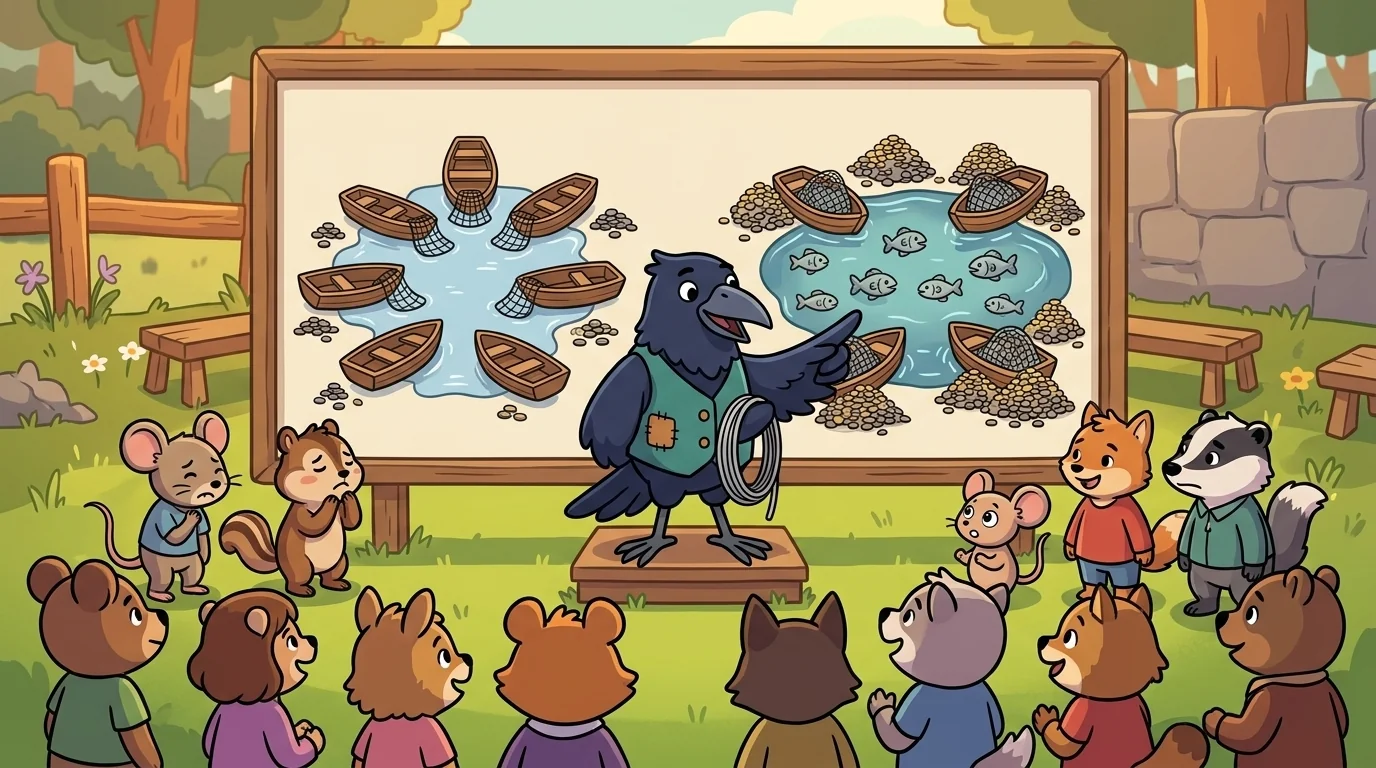
Snare's favorite lesson was a shared fishing pond, on a screen.
A class gathered around it, each kid controlling one fishing boat. "The rule," Snare said, "is simple. Catch as many fish as you want. The pond refills a bit each turn — but only from the fish left behind." The kids started fishing. Everyone, reasonably, caught a lot. By turn four the pond was empty, and every boat sat in dead water with an empty net. The class groaned. "You didn't do anything wrong, one at a time," Snare said. "Each of you thought, 'a few more fish for me won't hurt' — and each of you was right, alone. But you were all in the same trap-shape, and it collapsed the pond." She reset the game. "Now — before you fish, talk. See the shape first." The kids agreed out loud: everyone catches a little less, leaves fish to refill the pond. This time the pond stayed full, turn after turn, and every boat caught steadily, forever. Pip, at one of the boats, stared. "We all caught more by each catching less." "Because you saw the trap before it sprang," Snare said. Then she showed the deep part: "This shape has a name — some call it the trap of the commons. And it's everywhere: a shared pond, a shared clover patch, a shared sky, a shared quiet in a noisy room. Anytime many share one thing and each takes a little more, the shape is waiting. But a named trap is a beatable trap. Once you can say 'oh — we're in the commons shape,' you already know the way out: see the whole, leave some, and trust each other to do the same."
Pip looked at the full pond. "So the trick is seeing the shape before you're stuck in it."
"Seeing the shape," Snare agreed, "is ninety-nine percent of getting free of it."
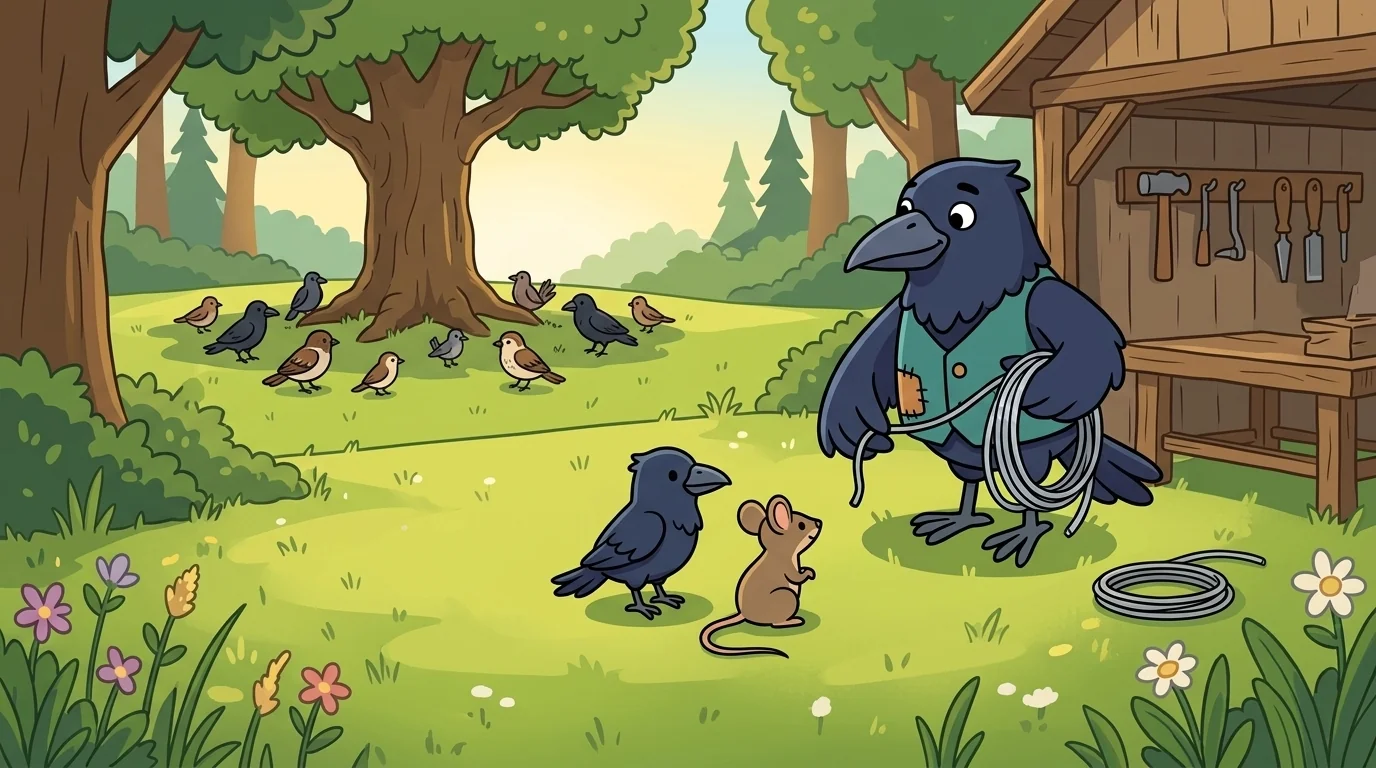
Later, Pip came back with a quieter question. "When you're already stuck in a trap-shape... how do you get out, if getting out means trusting everyone else to change too?"
Snare thought about the exhausted flock, and the one good tree, and her grandmother saying somebody has to go first.
"Somebody names it, out loud, and goes first," she said. "That's the honest trick, and it's the hard one. When you're caught in a shared trap, there's this tight, grabby, everybody-for-themselves feeling — like if you take less, you'll just lose while everyone else grabs." She smoothed her wire coil. "But that feeling is the trap talking. The way out is almost always to see the whole instead of just your piece, take a little less, and trust the others enough to say so out loud — because usually they're stuck in the exact same shape, wishing someone would." She watched the tightness ease in Pip's shoulders. "It takes courage to go first. But naming the shape is a gift to everyone in it — including you."
She didn't say the rest aloud, but she thought it, warm and sure: the worst traps aren't built by bad animals — they're built by reasonable ones, all doing the sensible thing at once. But a trap with a shape is a trap you can name, and a trap you can name is a trap you can leave — together. And in her chest sat the steady, generous calm of a creature who had learned to see the whole meadow, not just her own beak-full — a settled warmth that felt, most of all, like being on the same side as everyone else.
The NexusForge ensemble
Snare is one of the friends in NexusForge. Each friend shows you one idea by how they act; meet them all and you have the whole subject.
-
Tie
Connection / link — name the MECHANISM before drawing the line; refuse vague-correlation framings
-
Spiral
Reinforcing feedback — spirals grow good OR bad until something stops them; always ask 'what stops it?'
-

Damp
Balancing feedback — this loop is PROTECTING what the system tries to keep stable; what is it protecting?
-
Emerge
Emergence — the pattern isn't in any single rule; it appears FROM the rules running together
-

Steer
Leverage points — the biggest leverage is usually the LEAST obvious place to push (Meadows)
-
Amass
Stocks vs flows / accumulation
-

Lag
Delays
-
Topple
Tipping points / nonlinearity
-
Yon
System boundary