
Loopy
LOOPS / REPETITION — *repeating a group of steps instead of writing them over and over; "do this 3 times" is shorter and just as far.*
Listen along — Loopy
Loading audio…
Press play to listen along. The line being read lights up as you go.
Show full transcript
Loading transcript…
Loopy and the Do-It-Again Trick
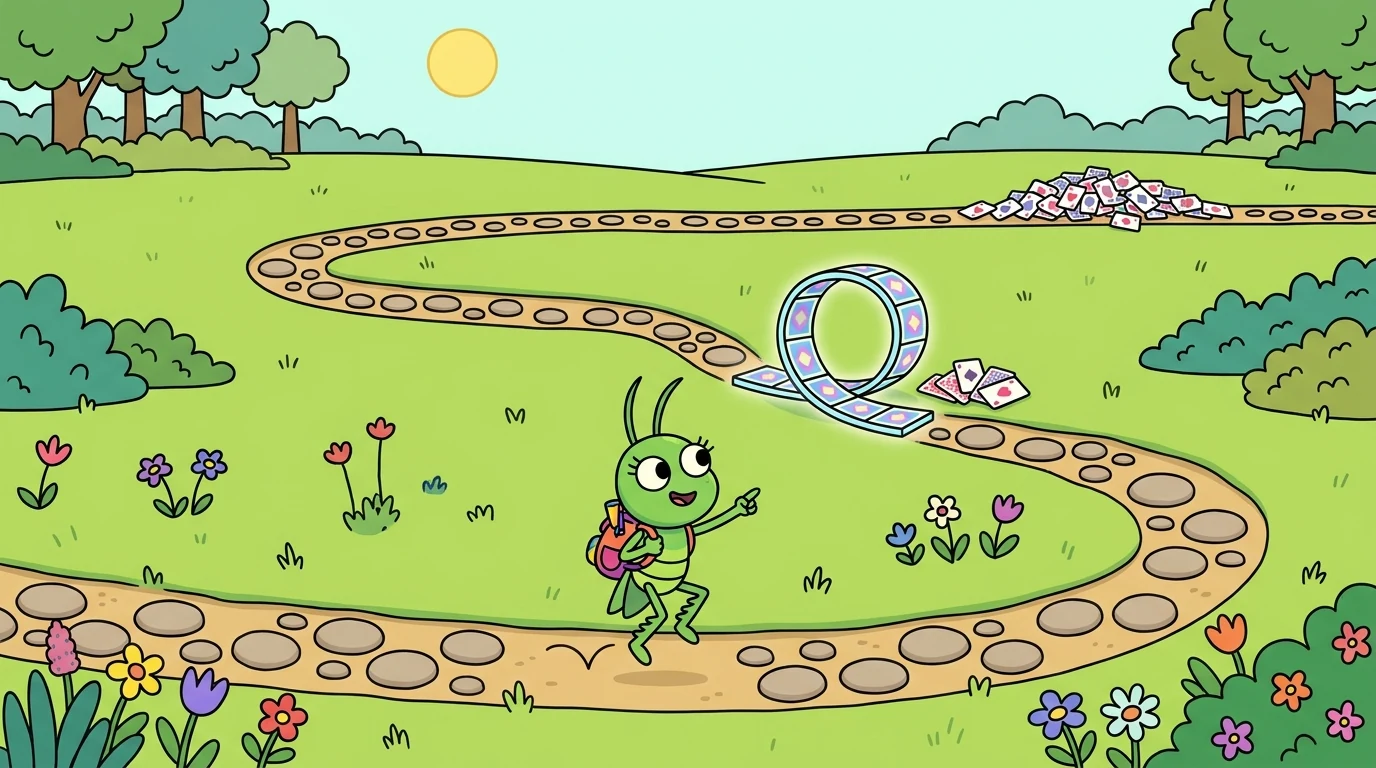
Loopy is a springy green cricket-kid with bouncy back legs and a happy chirp. She lives near a long, looping trail in the meadow — the kind of path that goes step-step-hop, step-step-hop, the same little pattern again and again.
Loopy does the cleverest, bounciest thing: instead of writing out a long line of the same steps, she wraps them into a loop. “Step-step-hop — do it 3 times!” she chirps, and the walker does the little pattern three times over. One small group of steps, repeated, carries you a long way — with hardly any cards. “Why write it ten times,” Loopy says, springing up, “when I can say do it again instead?”
Loopy discovered loops on a very long, very tiring trail.
When she was little, a repeating path meant laying down the same step-cards over and over and over — step-step-hop, step-step-hop, step-step-hop — until her little legs were tired and her card-pile was enormous. So exhausting! Then she had a bouncy idea: what if I make the pattern ONCE, and just say “again, again, again”? She wrapped step-step-hop into a loop that repeated three times. The huge pile of cards shrank to a tiny one — and the walker went just as far! Loopy has been chirping “do it again!” ever since.
Today, Roami brings the kid to the looping trail to meet Loopy. “Loopy knows the do-it-again trick,” Roami says. “Watch how she makes a long path short.”
“Bounce with me,” Loopy chirps. “See the pattern? Step-step-hop. Instead of doing it four times the long way — we make it once and loop it. Do it again, again, again!”
Loopy shows the kid. The trail to the friend is step-step-hop repeated four times — that’s a LOT of cards the long way. “Or,” Loopy chirps, “we make step-step-hop once, and put a loop around it: repeat 4 times.” A grown-up can loop along too: clap the little pattern, then say “again!” together — because loops are for bouncing through together, never a test. And Loopy never says “wrong.” If the kid loops it 3 times and the walker stops one pattern short, Loopy grins: “So close! Let’s make it do it again one more time — 4 loops reaches our friend.” In Loopy’s part of the meadow, you can always add one more “again.”
By the end, the kid can wrap a little pattern in a loop and reach a far friend with just a few cards. Loopy springs up, chirping with joy.
And here is what Loopy loves most: the delighted, springy feeling when a long tiring path suddenly becomes short and easy because you found the pattern and looped it — that clever, capable, “I made it simpler!” feeling. Loopy feels it every time a loop shrinks a big job to a small one. “Do it again, again, again!” she chirps happily, bouncing to a rest on a leaf, warm and pleased. That bright, clever feeling of the do-it-again trick — that’s the very best part for Loopy.
The PathPals ensemble
Loopy is part of PathPals's distributed-narrative cast. Each character embodies a different curricular primitive; together they teach the full subject.
-

Roami
Plan + debug (hero) — a fox who plans a path then fixes it when a step goes wrong; planning-and-fixing IS computational thinking
-
Steppa
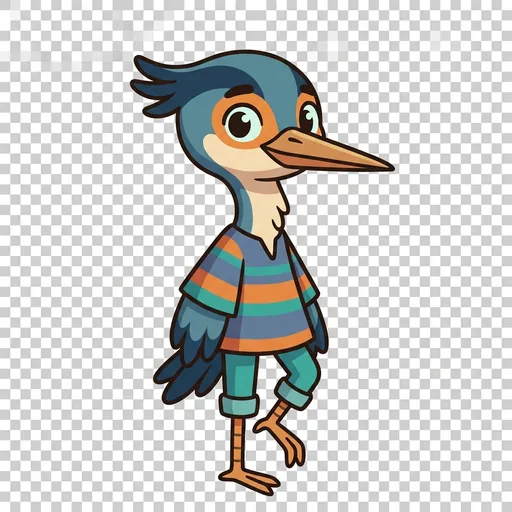
Single-step sequencing — a heron who takes exactly one step per command; one command, one move
-
Twirl
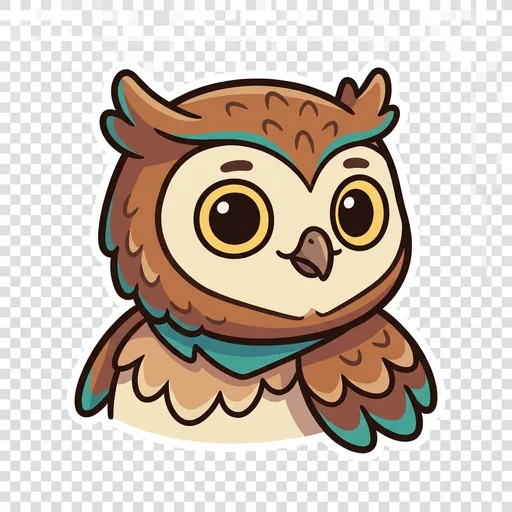
Directionality — an owl who turns left or right to face a new way