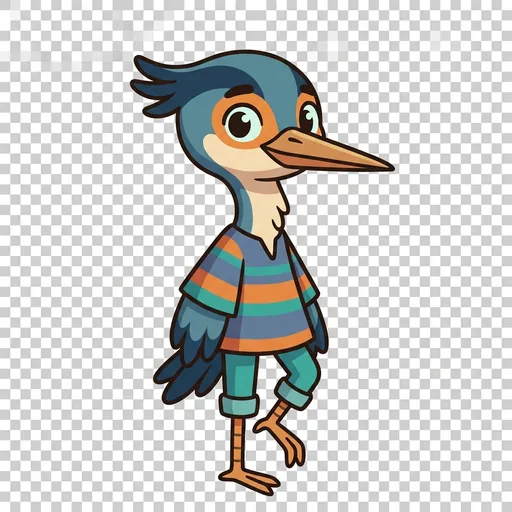
Roami
PLAN + DEBUG — *think out the path first, then fix the one step that went wrong; a plan you can fix is a plan that works.*
Listen along — Roami
Loading audio…
Press play to listen along. The line being read lights up as you go.
Show full transcript
Loading transcript…
Roami and the Path That Needed Fixing
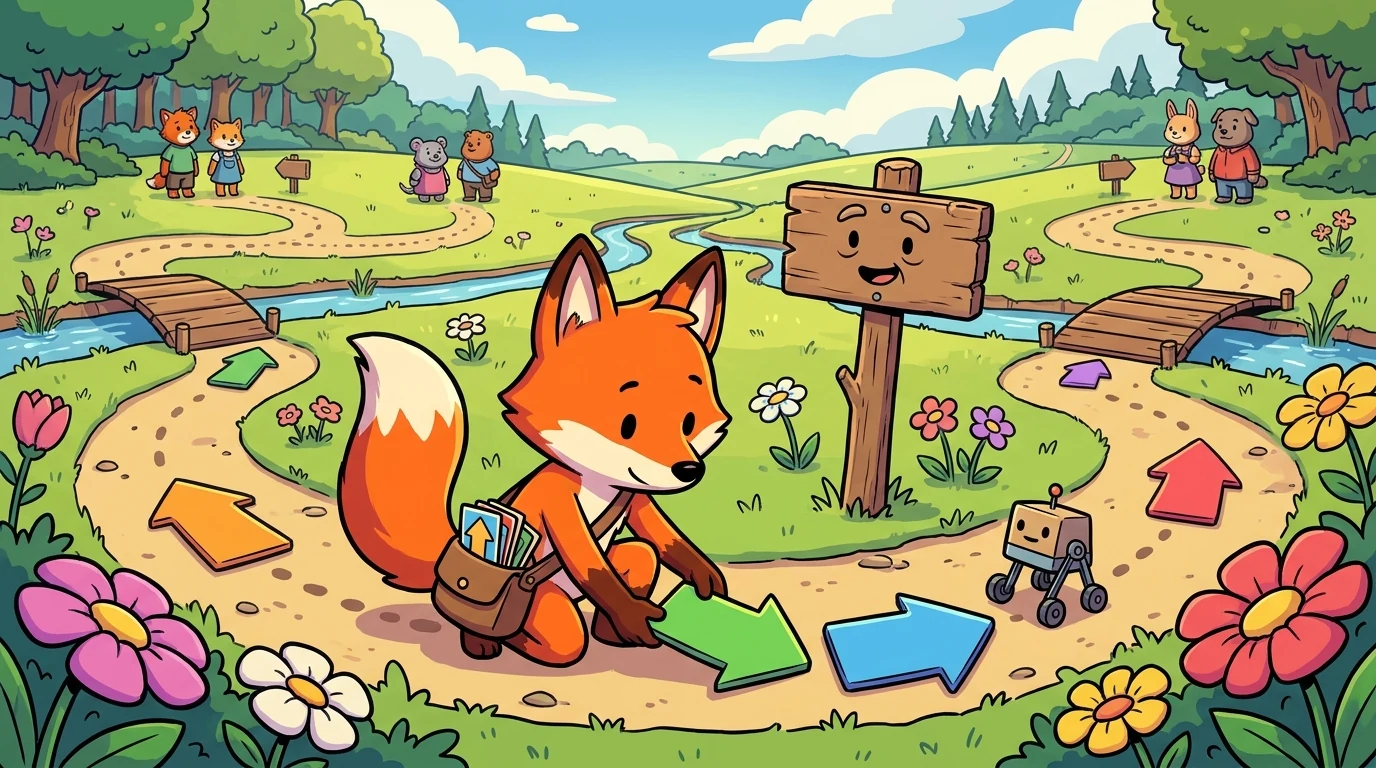
Roami is a bright orange fox-kid with a bushy tail and a little satchel of step-cards. Roami lives in the Trail-Meadow — a wide grassy place crisscrossed with dotted paths, little bridges, and a friend waiting at the end of each trail to be reached.
Roami does something clever: before taking a single step, Roami lays out the whole path first — one step-card, then another, then another — making a plan all the way to the friend. Then Roami runs the plan and watches. And if the little walker bumps a rock or misses a turn, Roami doesn’t start all over. Roami looks carefully, finds the one step that went wrong, and fixes just that one. “Plan it,” Roami says, tail swishing. “Run it. Then fix the step that’s wrong.”
Roami didn’t always fix things so calmly.
When Roami was little, if a path went wrong, the whole plan felt ruined — and Roami would sweep all the step-cards away and feel like giving up. It was frustrating! One day a patient old signpost said, “You don’t have to throw away the whole path, little fox. Usually just one step is wrong. Find that one. Change that one.” Roami tried it. There was one step pointing the wrong way — just one! Roami turned that single card around, ran the plan again, and the walker reached the friend. From then on, a wrong path wasn’t a disaster. It was just a step to find and fix.
Today, Roami takes the kid by the paw down the Trail-Meadow. “Come meet my friends,” Roami says. “Steppa, Twirl, and Loopy. Each one knows a piece of how paths work.”
“But first,” Roami says, laying out step-cards on the grass, “let’s do it the Roami way. Make the plan. Run the plan. If it goes wrong — don’t start over. Find the one step to fix.”
Roami shows the kid. They lay out four step-cards to reach a friend across the meadow. They run it — and the walker bumps into a bush on step three. A grown-up can plan paths too: the grown-up lays a card, the kid lays a card, you run it together and hunt for the wrong step — because building paths is for figuring out together, never a race. And Roami never says “you failed.” A wrong step isn’t a failure — it’s a clue. “Look — step three sent us into the bush,” Roami says kindly. “Let’s just fix step three.” They turn that one card, run it again, and the walker reaches the friend. In the Trail-Meadow, every wrong path is simply waiting to be fixed.
By the end, the kid has planned a path, found a wrong step, fixed it, and reached the friend all by themselves. Roami’s tail swishes with pride.
And here is what Roami loves most: that bright, satisfying click of finding the one wrong step and fixing it — the warm, capable feeling of “I made it work!” that comes not from being perfect, but from being a good fixer. Roami feels it every time a fixed path reaches its friend. “Plan it, run it, fix the wrong step,” Roami says happily, flopping into the soft grass. That glad, capable feeling of fixing your own path — that’s the very best part for Roami.
The PathPals ensemble
Roami is part of PathPals's distributed-narrative cast. Each character embodies a different curricular primitive; together they teach the full subject.