Bask and Sheath
SPREAD + CONFINE
Loading audio…
Press play to listen along. The line being read lights up as you go.
Show full transcript
Loading transcript…
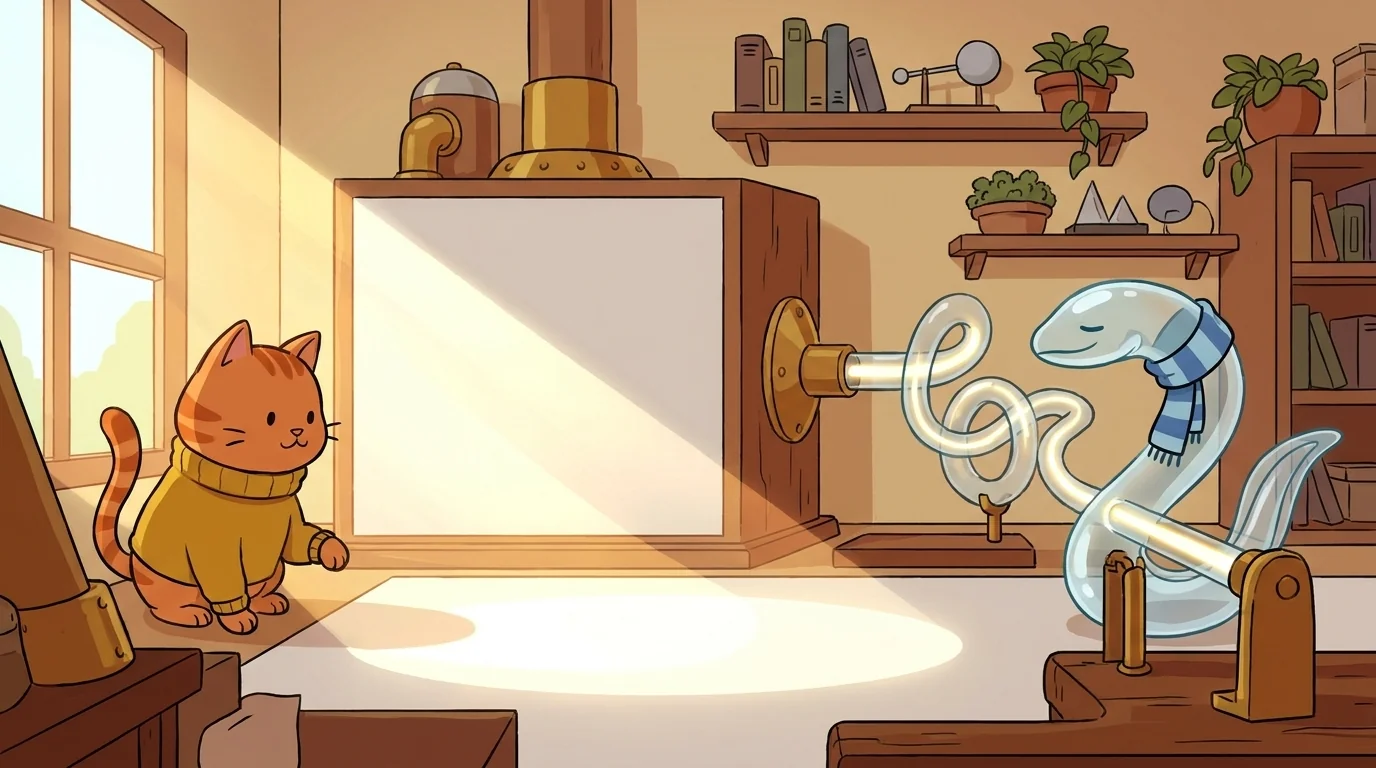
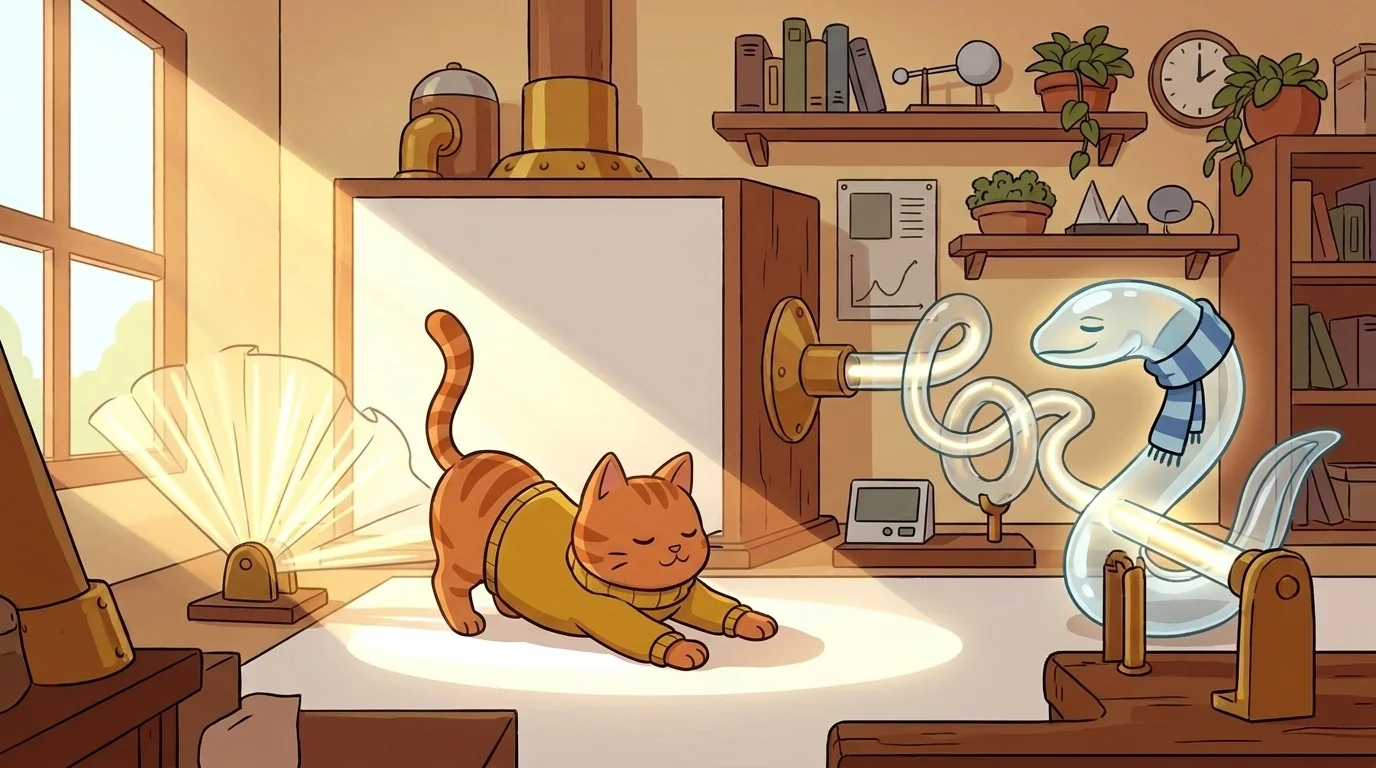
Bask the sun-warmed cat and Sheath the glass eel work the same beam of light from opposite ends of one question: what happens to light as it travels? Bask watches light spread — fanning out, covering more area, thinning fast, dimming with every step of distance. Sheath watches light kept from spreading — trapped, guided, bouncing along inside a clear thread, carried far without fading. And between them they hold the whole truth about a beam: light left to itself spreads and thins, but light guided can be carried whole across an ocean — and the difference between those two fates is something you can choose.
"Left alone, light spreads," Bask purrs, "and thins fast — twice as far is a quarter as bright." "Held in a guide," Sheath says, aglow, "light can't spread — so it carries far, and whole." "Spread trades brightness for reach," says Bask. "Confine keeps both," says Sheath. "The fate of the beam is a choice."
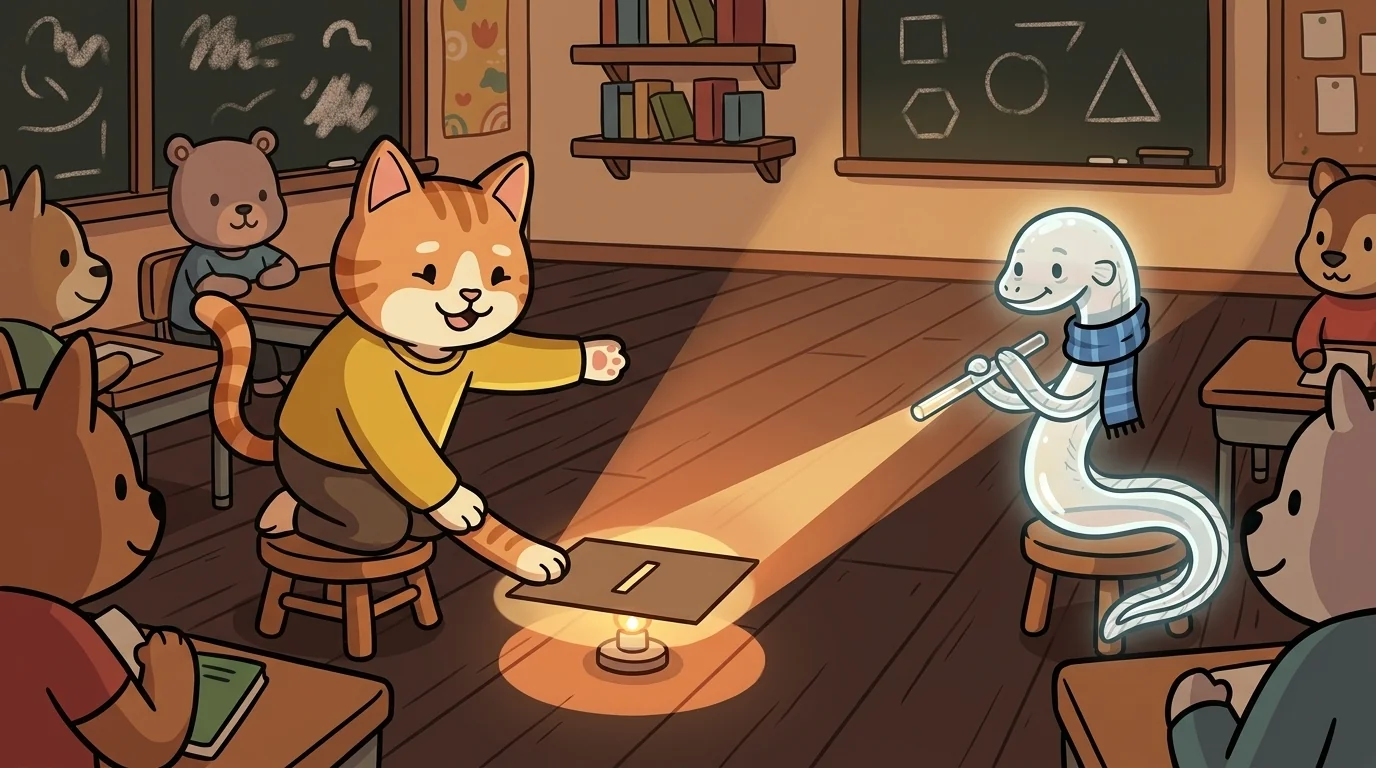
Bask shows the spreading fate. She sets a single small light behind a card and lets its beam fan out across the room. Close to the light, a bright, tight circle; farther, a wide, dim wash. "Light spreads as it travels," she says, "fanning wider and wider, so it has to cover more and more area — and light spread over a big area is thin, dim. That's why a lamp helps you read up close but barely lights the far wall. Move twice as far, and the same light covers four times the area, so it's a quarter as bright." She stretches in the tight bright circle. "Spreading light is generous — it reaches everywhere, lighting a whole room. But it pays for that reach by getting thin. A candle can light a whole room dimly, or one page brightly, but never both. Left to itself, light always spreads — and spreading is the same as fading." She glances at the glass eel. "Unless someone stops it from spreading. And that's Sheath's whole art."
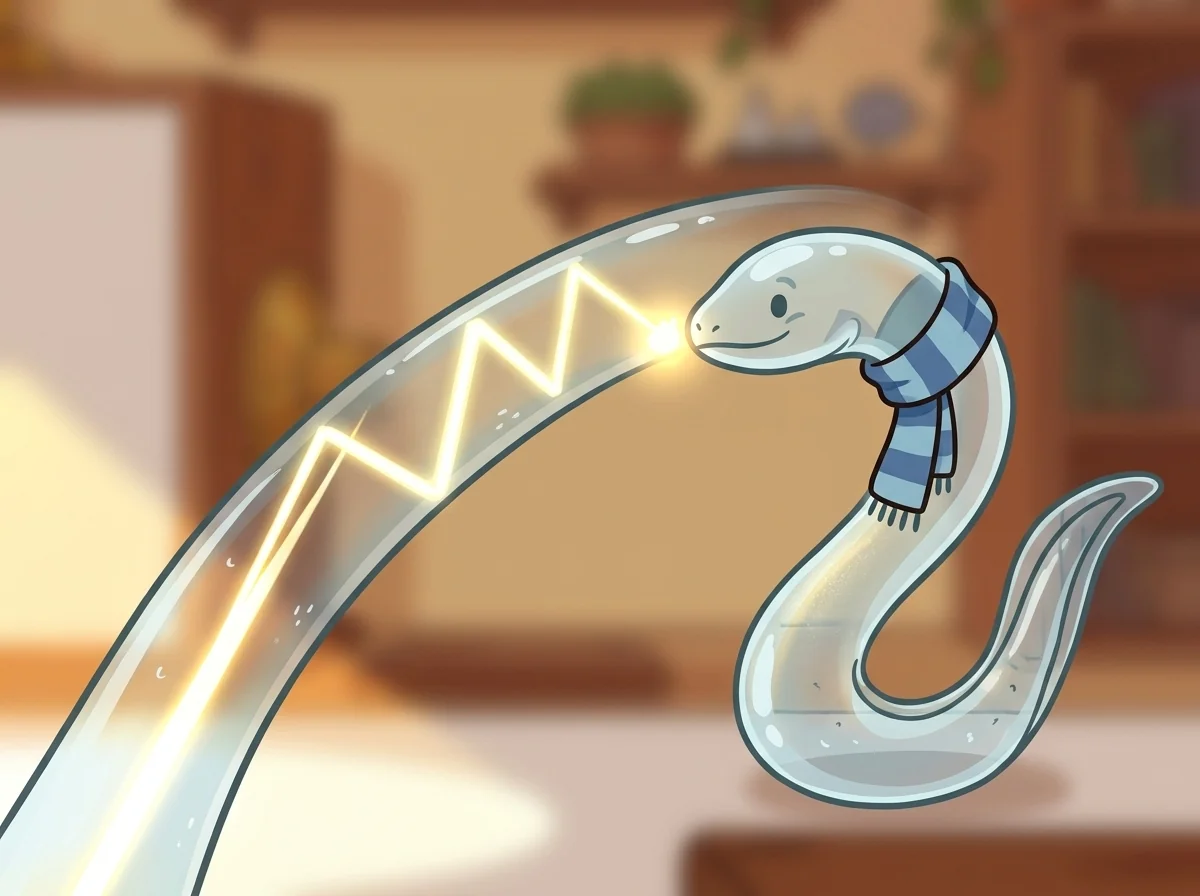
Sheath shows the confined fate. She swims inside a long, clear glass rod, and a beam entering one end travels the whole length — bouncing off the walls, unable to escape, arriving at the far end bright and whole. "Watch — this light can't spread," she says. "Every time it reaches the wall of the rod at a shallow angle, it reflects totally back inside. So instead of fanning out and thinning, it's trapped — carried straight down the guide, wall to wall, losing almost nothing." She curves the rod, and the light follows the bend, still bright. "Bask's open light would have spread across the whole room and faded to nothing over this distance. But held — guided, kept from spreading — the very same light travels far and arrives whole. That's how a hair-thin thread of glass carries a message across an ocean: not by making light brighter, but by refusing to let it spread."
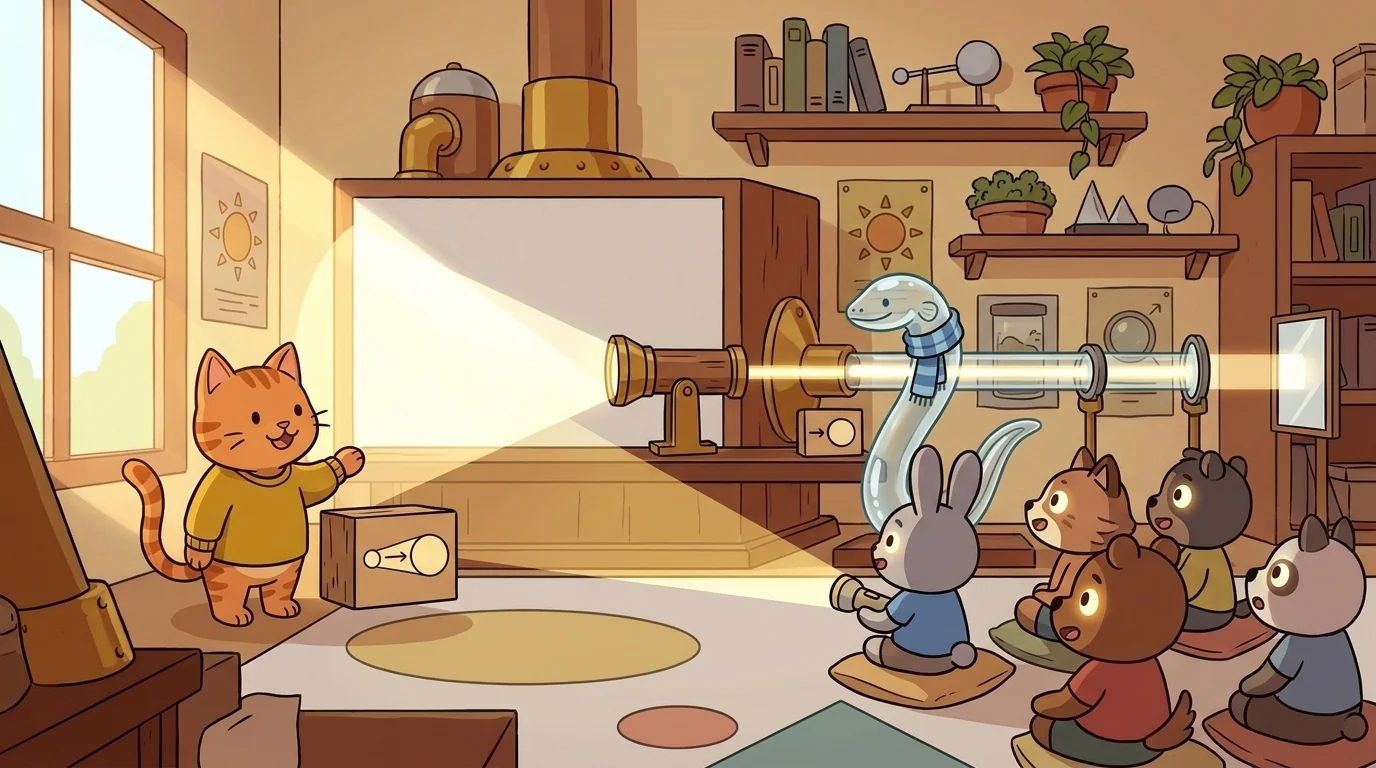
Then the two of them showed, together, the thing neither could show alone: that brightness-over-distance is not fixed by fate but chosen — and that knowing both spreading and confining lets you pick the right one for the job. A student had a puzzle. "I want to light up my whole room," she said, "and I want to send a bright signal to my friend's window far across the valley. Same flashlight. Why can't it do both?" And it took both of them. Bask answered the room. "For the room, you want me — spreading. Take the flashlight and widen the beam so it fans out and washes the whole room in light. It'll be dim, but everywhere — because spreading trades brightness for reach, and for a room, reach is what you want." Then Sheath answered the valley. "But for the far window, spreading is exactly wrong — fan the beam and by the time it crosses the valley it's spread so thin your friend sees nothing. For distance, you want me — confine it. Narrow the beam as tight as you can, so it barely spreads at all, and it'll arrive across the valley still bright enough to see. Same flashlight. Opposite setting." The student's eyes lit up. "So it's not that the flashlight can't do both — it's that spreading and confining are opposite choices, and I pick the one that fits the job!" "Exactly," they said together. "Spread me wide for a room; hold me tight for a distance," Bask purred. "One of us alone would only ever tell you half of it," Sheath said. "Bask would have you spread everything and wonder why nothing reaches far. I'd have you confine everything and wonder why nothing lights the room. But together — knowing light can spread or be kept — you hold the whole art of a beam: you choose its fate. Reach, or brightness. Wide, or far. And the choosing is yours."
"So a beam of light doesn't have one fate," the student said slowly. "I get to choose — spread it wide for reach, or keep it tight for distance?"
"The fate of the beam is yours," Sheath agreed, and Bask stretched in a wide warm wash of light while Sheath glowed inside her tight bright rod — the two fates, side by side, the same light choosing two different destinies. Bask set down her fanned-out, room-filling beam; Sheath set down her tight, guided thread; and between them lay the whole truth of light in motion. Under the quiet, the two of them felt the same clear, capable calm settle in: not the helplessness of a beam that only did one thing, but a warm, paired, we-hold-the-choice steadiness — the particular ease of two who each command one fate of light, so that between them any beam could be spread wide to warm a whole room or held tight to cross a valley, exactly as the moment needed. That spread-or-keep, reach-or-brightness, the-choice-is-ours feeling, richer than either spreading or confining alone, was to Bask and Sheath exactly why they work the same beam from opposite ends, and never once quarrel — because they both know that the wisdom is in the choosing.
The PrismForge ensemble
Bask and Sheath is one of the friends in PrismForge. Each friend shows you one idea by how they act; meet them all and you have the whole subject.
-

Mirror
Reflection (incoming ray bounces back)
-

Bend
Refraction (light slows in denser media)
-

Spread
Dispersion / spectrum (different wavelengths bend differently)
-

Focus
Lens action (converging + diverging)
-

Tint
Color mixing (additive RGB / subtractive CMY)
-

Drink
Color by absorption
-

Sheath
Total internal reflection
-

Eclipse
Shadows / straight-line travel
-

Bask
Intensity / spreading with distance
-
Dapple
Scattering