Eclipse
SHADOW
Loading audio…
Press play to listen along. The line being read lights up as you go.
Show full transcript
Loading transcript…
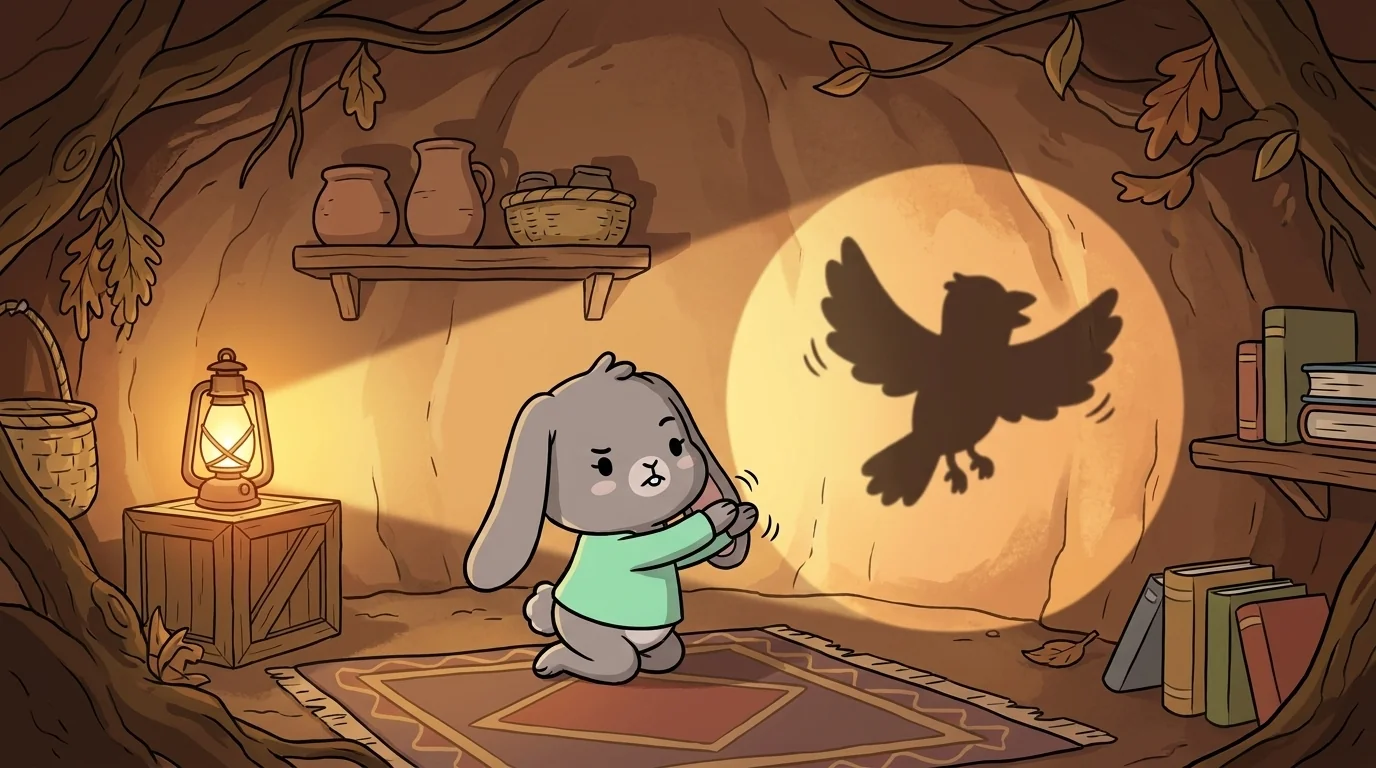
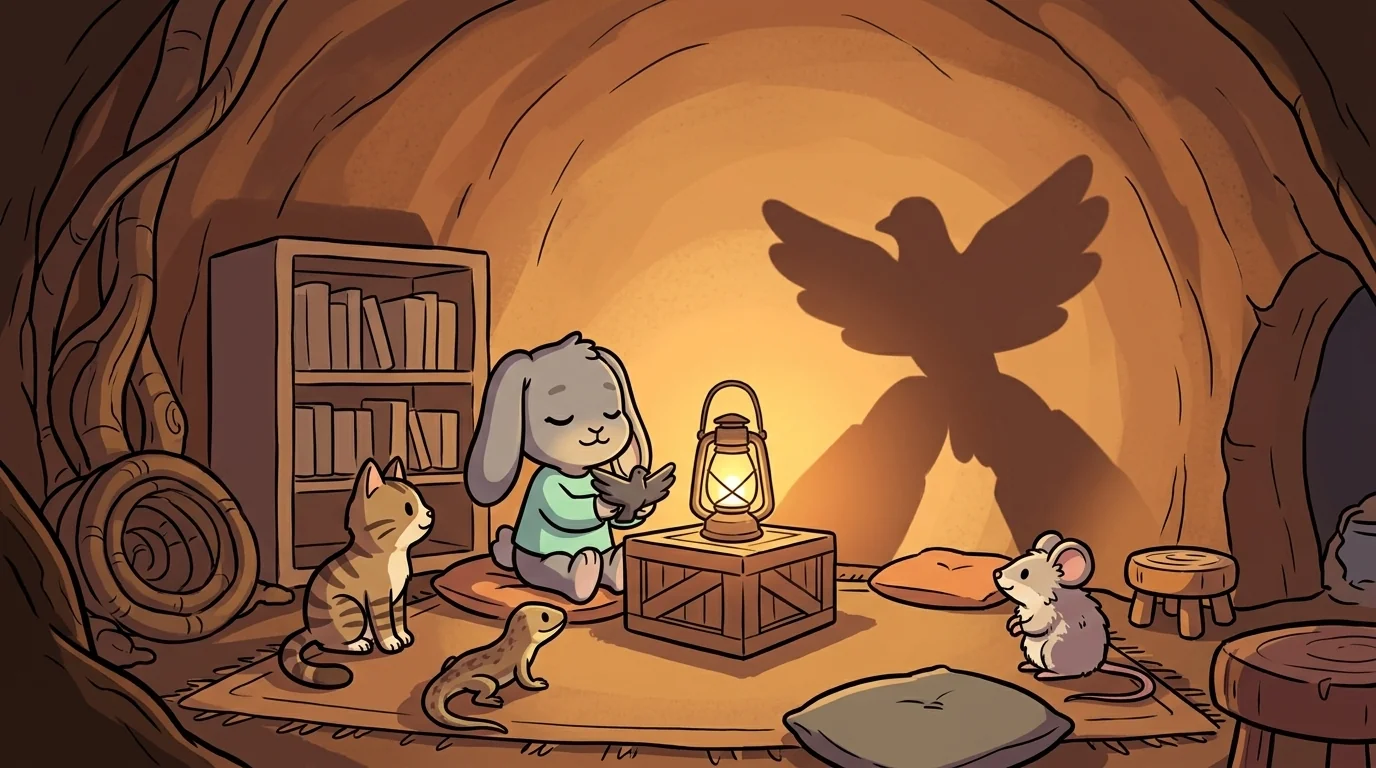
On the wall of Eclipse's burrow, a lantern threw a bright circle, and a small, floppy-eared rabbit named Eclipse was making a bird flap across it with just her two paws.
"People think a shadow is a thing," she said, wiggling her paw-bird. "Like darkness is a stuff that pours out from behind me." She shook her head, ears flopping. "But a shadow isn't a thing at all. It's just a place the light couldn't reach." She held her paw up in the lantern beam. "Light travels in perfectly straight lines — it never bends around a corner on its own. So when my paw gets in the way, the light can't curve around it. It just... stops. And behind my paw, where the light couldn't reach, there's a paw-shaped patch of no-light. That's the shadow. Not darkness arriving — light not arriving." She made the bird flap again, and its shadow flapped huge across the wall. "And here's the fun part: because light goes straight, the shadow is shaped exactly like the blocker — a paw makes a paw-shadow, a bird-shape makes a bird-shadow. The shadow is the blocker's silhouette, drawn in the light that couldn't get past it."
Eclipse learned what a shadow really was the night one grew and shrank like magic.
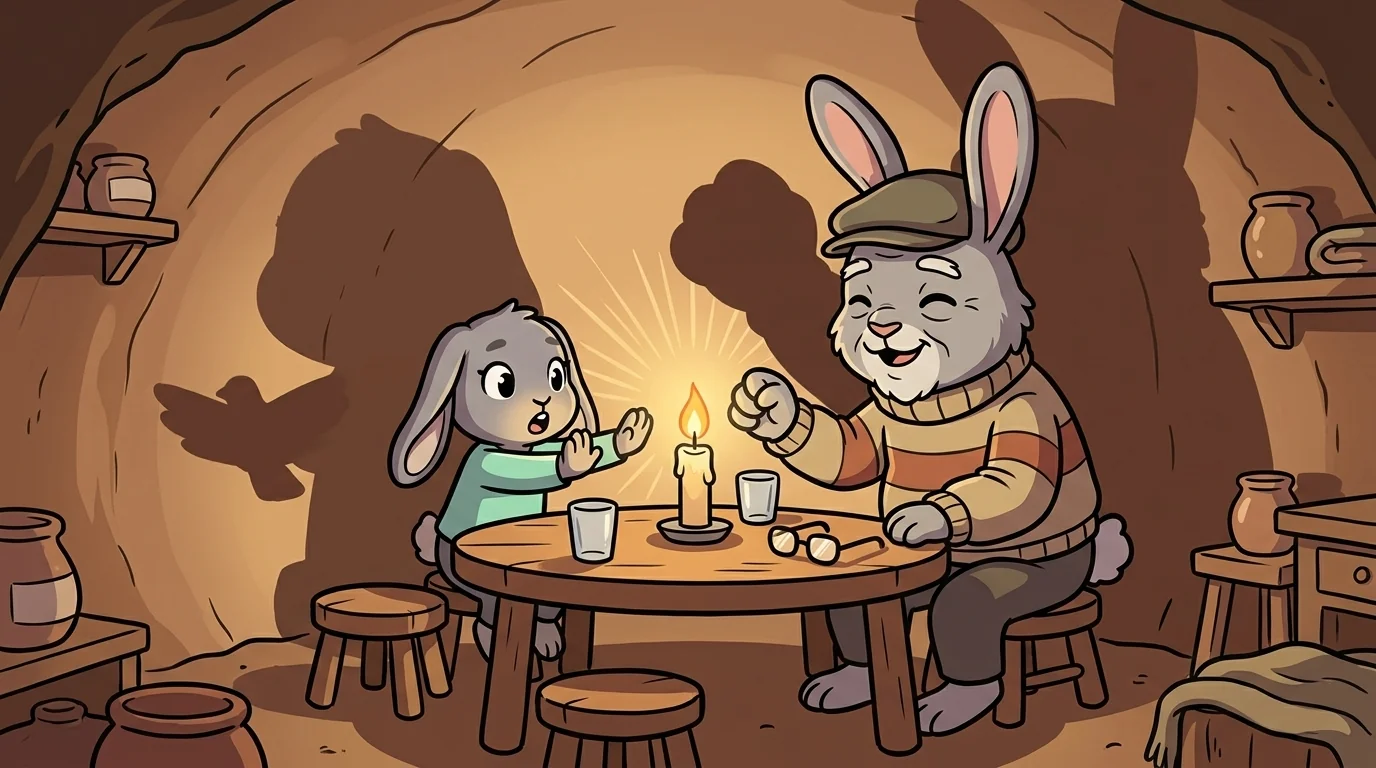
She'd been playing near a candle, and she noticed her shadow on the wall changed size — huge when she was near the candle, small when she was far — and she was sure something spooky was making it grow.
Her grandfather, an old rabbit with a lantern and a calm chuckle, sat with her.
"My shadow keeps growing," young Eclipse whispered. "Is it alive?"
"It's just geometry, little one," he said gently, "and geometry is never spooky once you see it." He held a paw close to the candle: a giant shadow. Then far away: a tiny one. "Light spreads out from the candle in straight lines, like strings from one point. When you're close to the candle, you block a big fistful of those spreading strings, and the shadow they'd have made is huge. When you're far, the strings have already spread wide, so you block only a few, and your shadow is small." He smiled. "Your shadow isn't alive, and it isn't magic. It's just the shape of the light you happened to block, and how big it is depends on where you stand between the light and the wall. Move toward the light — bigger shadow. Move away — smaller. Simple as that." He winked. "The scariest-looking shadows are always the ones cast by the smallest things, standing very close to the light."
Young Eclipse never feared a shadow again. She knew: it's not a monster. It's just the straight-line light, drawing the shape of whatever got in its way.
She hopped to PrismForge at twelve, because a place that studied light ought to understand the dark places it makes.
Optic, the head of the school, met her at the gate and asked one thing. "What is a shadow?"
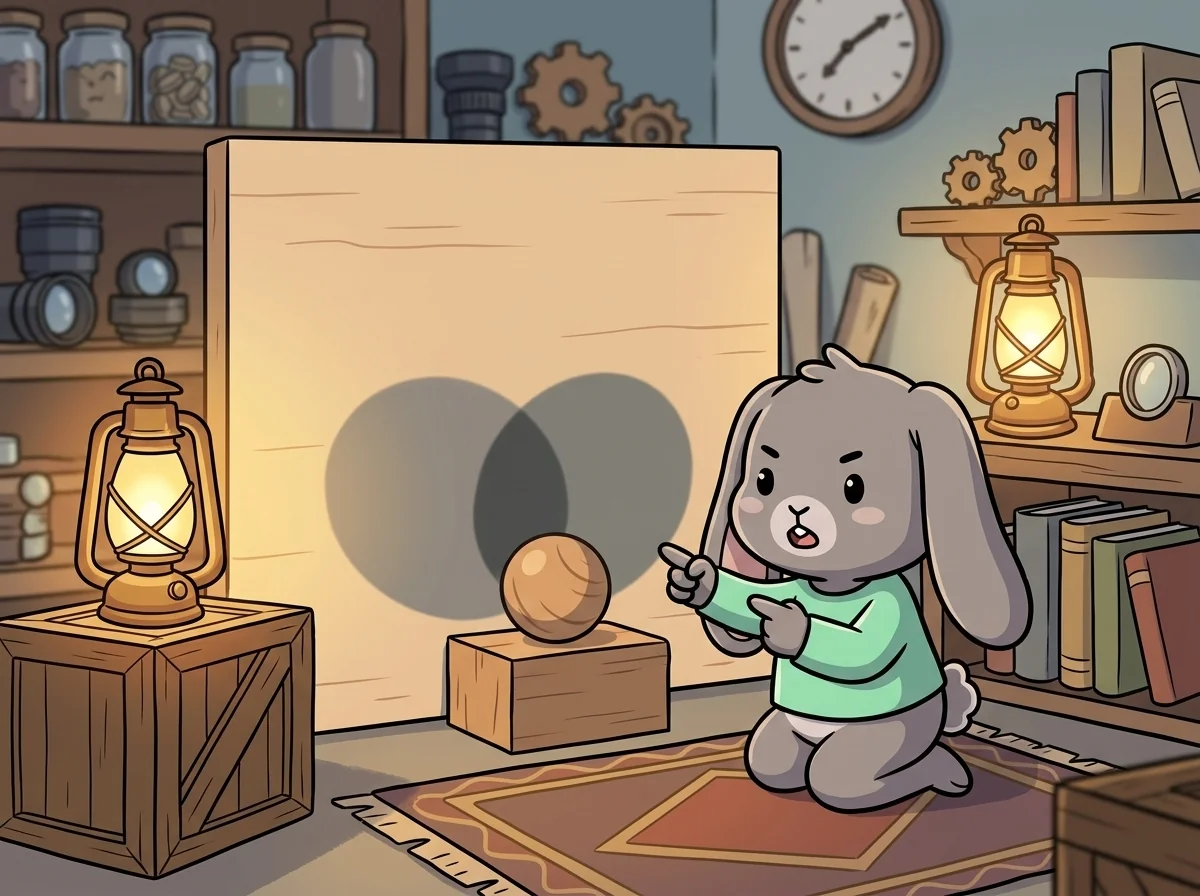
Eclipse set a small ball in a beam of light and pointed to the dark patch behind it. "That," she said. "The place the light couldn't reach — because light goes straight, and the ball got in the way, and light can't bend around it." Then she showed the clever part: she moved a second light to the other side. Now the ball had two shadows, one from each light — and where a spot was blocked from both lights, it was darkest (a deep shadow); where it was blocked from only one, it was a softer, half-shadow. "See? A shadow is exactly, precisely, the light that got blocked — no more, no less. Two lights, two shadows. Block one light, it's a soft shadow. Block them all, it's dark."
Optic looked at the double shadow. "You are appointed," he said.
In her workshop, Eclipse taught shadows as pure straight-line geometry. Sharp shadows from a tiny, far-off light (like the sun) — "the rays come in almost parallel, so the edge is crisp." Soft, fuzzy-edged shadows from a big, close light (like a window) — "the light comes from many points across the window, so the edges blur into a soft half-shadow, where some of the light gets through but not all." Then she gave the working rules: light travels in straight lines and never bends around a blocker on its own, so behind any blocker there's a shadow shaped like the blocker; the shadow gets bigger the closer the blocker is to the light (blocking more of the spreading rays) and smaller the farther away; and a shadow has a dark heart (where all the light is blocked) and often a soft edge (where only some is blocked) — which is why some shadows are crisp and others fuzzy. "A student asked why an eclipse of the sun is such a big deal," Eclipse grinned, ears perking. "Because it's the biggest shadow-game there is — one giant ball (the moon) getting exactly between us and the light (the sun), casting its shadow onto a whole patch of the world. Same trick as my paw-bird on the wall. Just... enormous. A shadow is a shadow, whether it's a bunny's ear or a whole moon."
"So a shadow isn't darkness coming," a student said slowly. "It's just light not arriving?"
"Just light not arriving," Eclipse agreed, and she settled by the lantern and made one last, gentle bird flap slowly across the wall, watching the shape of the light she blocked — not a monster, not a magic, just a soft drawing made of absence. There was a cozy, unafraid happiness in it — the deep, settled calm of a rabbit who had learned that the dark behind her was never a thing to fear, only a quiet place the straight light couldn't reach, shaped gently by whatever stood in its way. It made her feel safe, and playful, and curious about every shadow she'd ever run from. That nothing-to-fear, dark-is-just-blocked-light warmth — the easy gladness of a creature who understood the shape of absence — was, to Eclipse, the quiet comfort hidden in every shadow. "A shadow is only ever the light I blocked," she said softly, ears at rest, "drawn in the shape of me."
The PrismForge ensemble
Eclipse is one of the friends in PrismForge. Each friend shows you one idea by how they act; meet them all and you have the whole subject.
-

Mirror
Reflection (incoming ray bounces back)
-

Bend
Refraction (light slows in denser media)
-

Spread
Dispersion / spectrum (different wavelengths bend differently)
-

Focus
Lens action (converging + diverging)
-

Tint
Color mixing (additive RGB / subtractive CMY)
-

Drink
Color by absorption
-

Sheath
Total internal reflection
-

Bask
Intensity / spreading with distance
-
Dapple
Scattering