
Crux the Two-Directions
DIRECT VERSUS INVERSE PROPORTION — in direct proportion two quantities rise and fall together and their RATIO stays fixed (y = kx); in inverse proportion one rises as the other falls and their PRODUCT stays fixed (xy = k). Telling the two apart is the hinge every proportion problem turns on.
A story read by Crux the Two-Directions
Loading audio…
Press play to listen along. The line being read lights up as you go.
Show full transcript
Loading transcript…
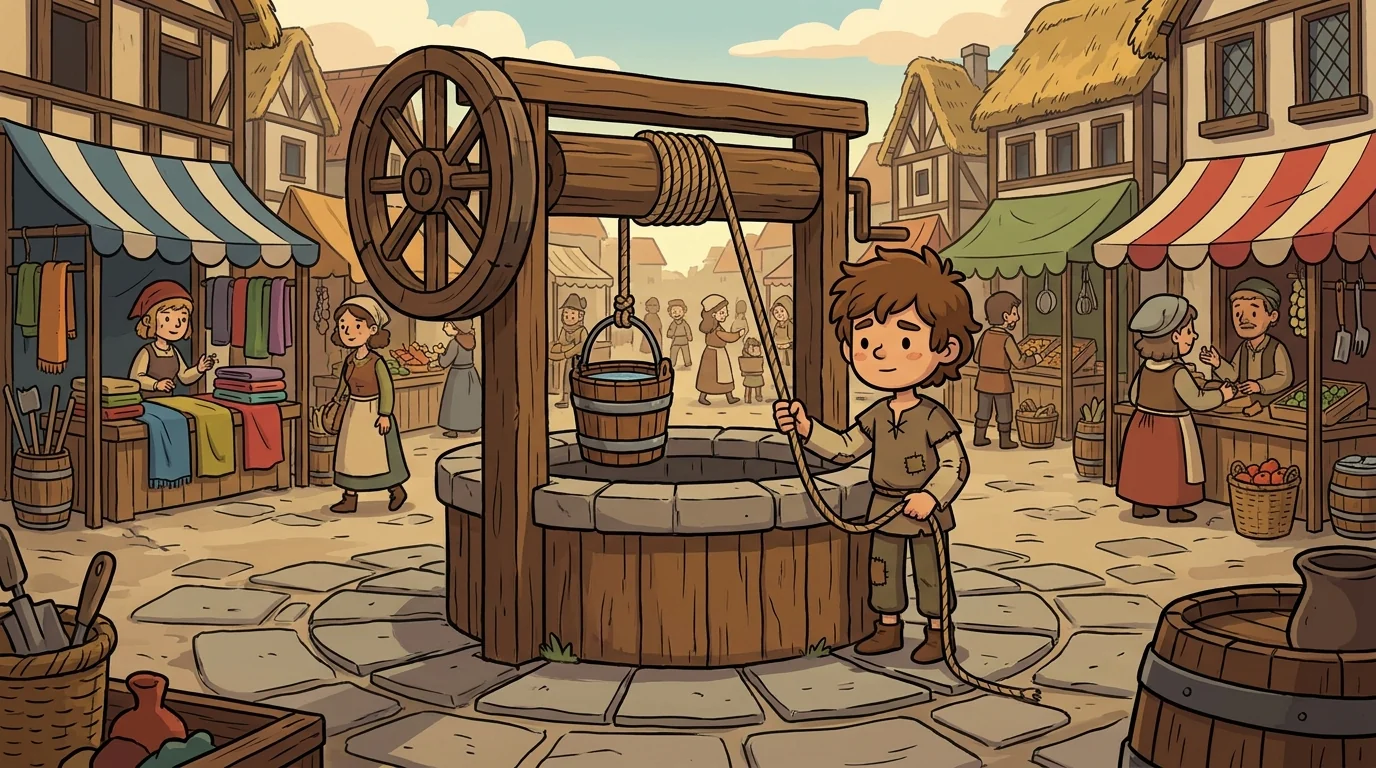
At the great draw-well of Winch, two ropes ran over one wheel, and Crux grew up with the whole of proportion already in his hands. Haul one rope down and the other rose; the bucket climbed exactly as fast as his arms fell. Two quantities, bound to a single wheel, forever opposite. Most of the town saw a way to fetch water. Crux, even as a boy, saw a rule about how two changing things can be tied together.
By the time the RatioRealm academy sent for him, he had spent years noticing that the world offers two — and only two — clean ways for a pair of quantities to be bound. He taught them as two questions asked before any number is written down.
The first way he called rising together. Buy twice the cloth, pay twice the coin. Walk twice as far at the same pace, take twice as long. When one quantity doubles, the other doubles; halve one, the other halves. Crux would write it the way the scholars did — y = k x — and then insist the children read it aloud not as a formula but as a sentence. "The output is always the input times one steady number. That steady number is the constant of proportionality. In rising-together — in direct proportion — the thing that never changes is the ratio of the two. Cloth to coin, always the same. Divide one by the other and you get k, every single time."
The second way he called trading off, and it was the one his well had taught him in his shoulders. Put twice as many workers on a ditch and it takes half the time. Double the speed of a journey and it takes half as long. Here, when one quantity doubles, the other halves — they move against each other, one rope down as the other climbs.
The Advanced trap, Crux warned, is to reach for the same method as before and scale both the same way. It comes out backwards. "In inverse proportion," he would say, "the ratio does not stay fixed — it changes with every pair. The thing that holds steady is the product. Six workers times four days is twenty-four worker-days of digging, and that ditch needs twenty-four worker-days no matter how you split them. Twelve workers? The product must still be twenty-four, so the time is two days. Three workers? Still twenty-four, so eight days. Multiply the two quantities and you always land on the same number. That number, k, is what the two are really guarding — not their ratio, their product. x y = k."

He drilled the distinction until the children could feel which was which. Direct proportion, graphed, is a straight line climbing from the corner: every step right is the same step up, because the ratio is fixed. Inverse proportion, graphed, is a curve that swoops down and flattens — a hyperbola — falling steeply then levelling, because as one quantity grows huge the other must shrink toward nothing to keep the product constant. "Two shapes," Crux said, tapping each. "A straight climb, and a falling curve. If you know which shape your problem is before you compute, you will never solve it backwards."
The hinge, he told them, was a single question — the crux, the point a whole problem turns on. "Ask it first, always. Do these two rise together, or do they trade off? Rise together: fix the ratio, use y = k x. Trade off: fix the product, use x y = k. Get the crux right and the arithmetic is easy. Get it wrong and every number after it is wrong, however careful your sums."

A boy named Fenn, who was quick with figures but had failed the same problem three times, stayed after one afternoon and turned the little model wheel Crux kept on his desk — one rope sinking as the other rose. His trouble, it turned out, was never the arithmetic. He had been treating a trade-off as a rise-together. He had doubled the workers and doubled the time, and been baffled that the ditch was never finished.
Crux sat beside him and let him work the wheel. "You did the sum perfectly," he said. "You just answered a different question than the one the ditch was asking. The workers and the days are on opposite ropes. When you pulled one up, you should have let the other down." Fenn ran it again — twelve workers, product still twenty-four, so two days — and the answer came out clean.
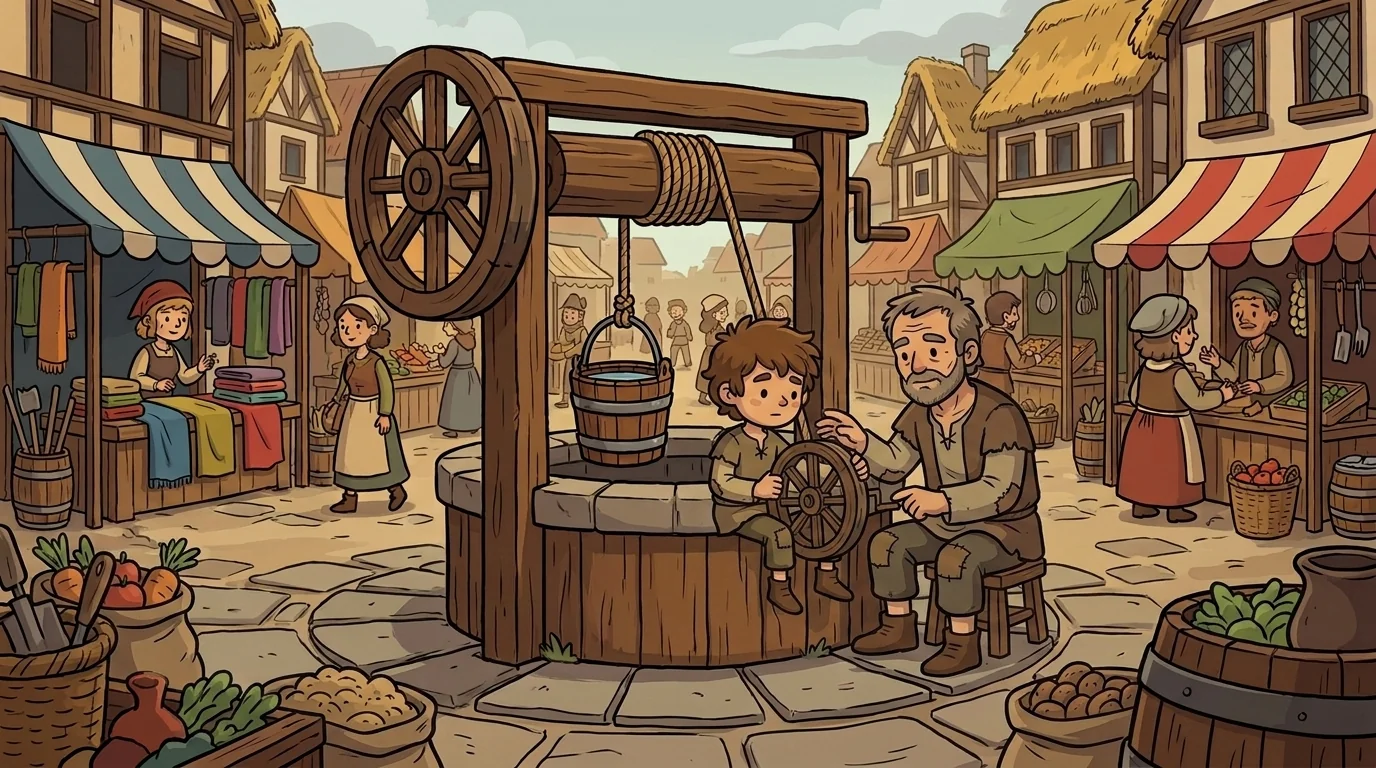
What stayed with Fenn, he told Crux later, was not the correction but the idea underneath it: that two things could be tied tightly together and still, honestly, be pulling opposite ways — and that this was not a flaw or a fight but a design. The two ropes needed each other precisely because one fell as the other rose; that was the whole point of the wheel.
Crux said that was the well's oldest lesson, and the one he had left the well to teach. "People expect everything worth having to rise together — more of this, more of that. But some of the truest relationships are trade-offs, and they only look like conflict if you demand they rise together. Name the kind first. Then the opposite motion stops being confusing and becomes the very thing you steer by." Fenn turned the wheel once more, down and up, down and up, and felt a thing that had looked like a contradiction settle quietly into a shape.
Crux still returns to Winch in the dry season to work the great wheel, and he still feels, in his shoulders, the down-and-up of the two ropes, and he still asks, of every pair of quantities he meets, the same first question before he reaches for a single number.
The RatioRealm ensemble
Crux the Two-Directions is part of RatioRealm's distributed-narrative cast. Each character embodies a different curricular primitive; together they teach the full subject.
-

Pair the Ratio-Speaker
Simple ratios (a:b) — the foundational "for every A, there are B" pattern
-

Scale the Doubler
Equivalent ratios (scaling both parts by the same factor; recipe-doubling primitive)
-

Unit the Per-One-Counter
Rates and unit rates (the per-one normalization that lets us compare different rates)
-

Cross the Proportion-Solver
Proportions and cross-multiplication (the canonical "if a/b = c/d then ad = bc" mechanic)
-

Centa the Percent-Translator
Percentages — the per-hundred special case + percent change
-

Keel the Constant-Keeper
The constant of proportionality (the fixed number that links the two quantities)
-

Portion the Fair-Divider
Sharing a quantity in a given ratio (splitting fairly by parts)
-

Splay the Scale-Keeper
Scale factor (scale drawings, maps, and models)
-

Warp the Part-and-Whole Namer
Part-to-part versus part-to-whole ratios (naming what is compared to what)