
Portion the Fair-Divider
SHARING IN A RATIO — dividing a whole quantity into parts that stand in a given ratio. To split 20 coins in the ratio 2:3, count the total shares (2 + 3 = 5), find the value of one share (20 ÷ 5 = 4), then hand out 2 shares and 3 shares (8 and 12).
A story read by Portion the Fair-Divider
Loading audio…
Press play to listen along. The line being read lights up as you go.
Show full transcript
Loading transcript…
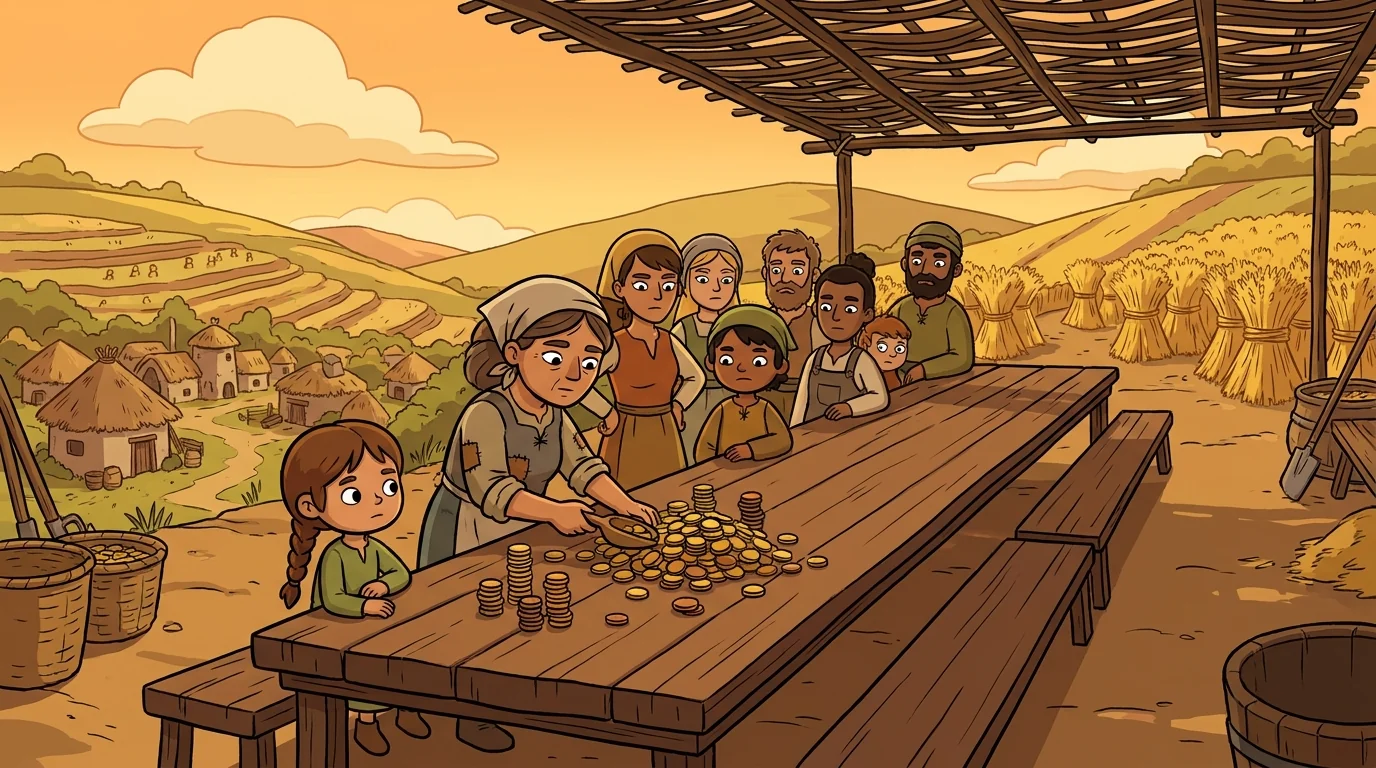
Portion grew up at a long table where everything had to be split, and where an unfair split could ruin a day.
Her family were harvesters in the valley below Tithe, part of a work-crew of many households who brought in the grain together each autumn and shared the pay at the end. And the pay was never shared equally, because the work was never equal. A household that sent three strong workers earned more than a household that sent one. A household that worked the whole season earned more than one that joined late. Every autumn the crew gathered at the long table to divide the season's coin, and every autumn the same danger hung over the table: if the split felt unfair, friendships that had lasted generations could crack in an afternoon.
Portion's mother was the one the crew trusted to make the split, and from a young age Portion sat beside her and watched. She saw how much depended on it — how a family's whole winter, and the peace of the whole valley, rode on a division being not just correct but visibly fair, so plain that no one could argue.
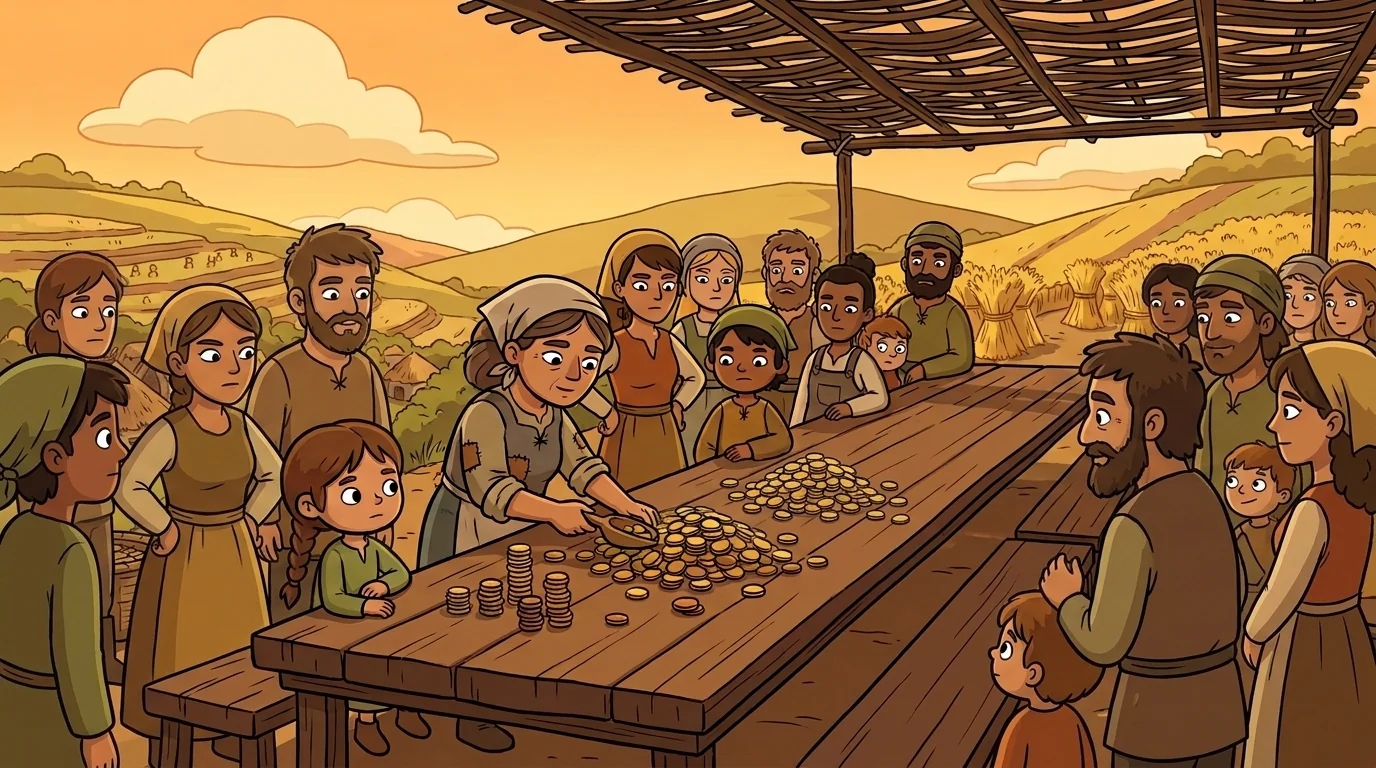
Her given name was Tithe, the same as the town, though she had been called Portion since she was ten, when she settled a quarrel between two brothers over a basket of apples by a method so clean that both brothers walked away satisfied. She had grown up caring, more than anything, that a share be fair — and she had learned that fairness in a mixed group was not about giving everyone the same, but about giving everyone their right proportion.
The method her mother taught her, and that Portion refined over the years, was always the same. You did not start by guessing anyone's share. You started by counting the total number of shares the ratio called for. If two households were to split the season in the ratio of three parts to two, that was three shares and two shares — five shares in all. Then you found what one share was worth, by dividing the whole pay by five. And once you knew the worth of a single share, every household's portion was simple: three shares for one, two for the other, and not a coin in dispute.
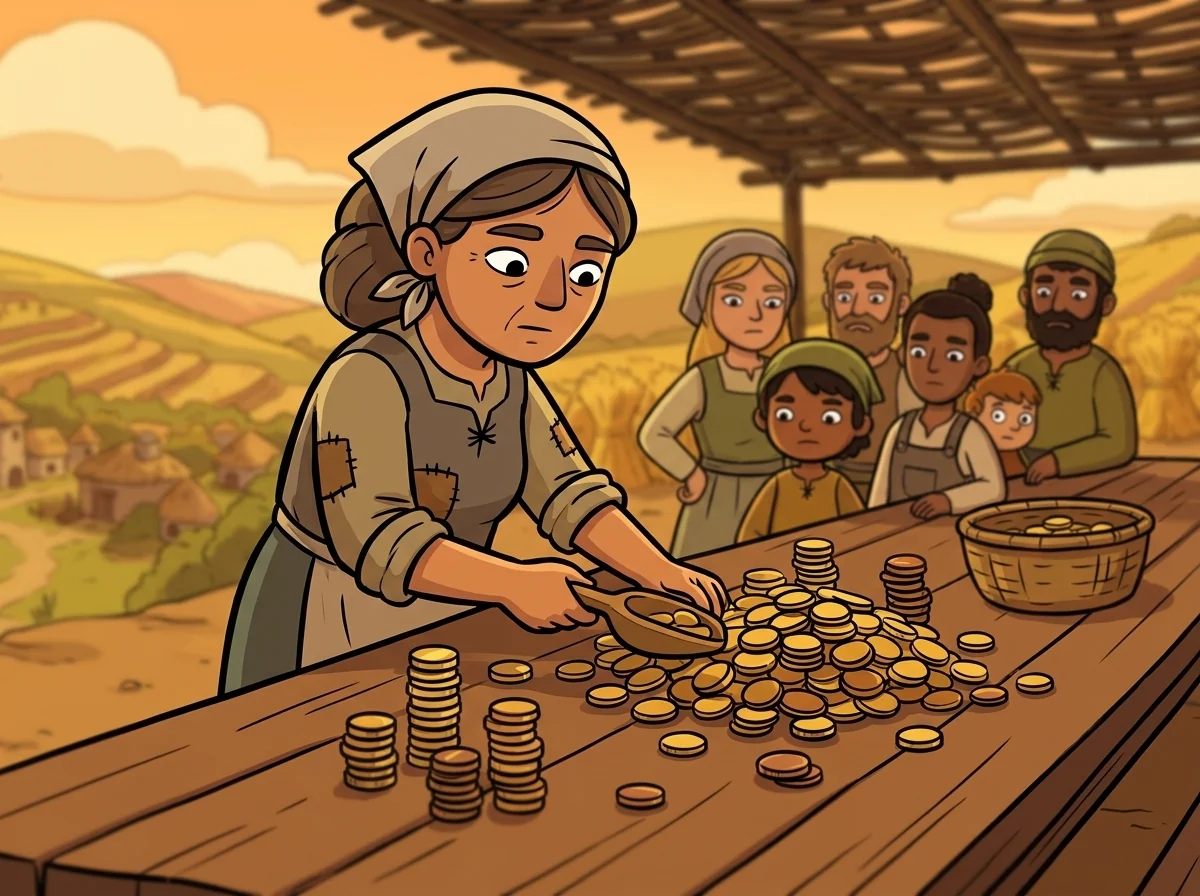
A steward from the RatioRealm academy passed through Tithe at settling-time and watched Portion divide a season's pay among seven households of different sizes without a single voice raised.
"You are sharing in a ratio," the steward said. "Dividing a whole into parts that hold a given proportion. Our students find it slippery — they try to guess the shares directly and tangle themselves. You count the shares first."
Portion had never left the valley. But she liked the thought of children learning to divide things so cleanly that no one felt cheated. She has taught sharing-in-a-ratio for six years.
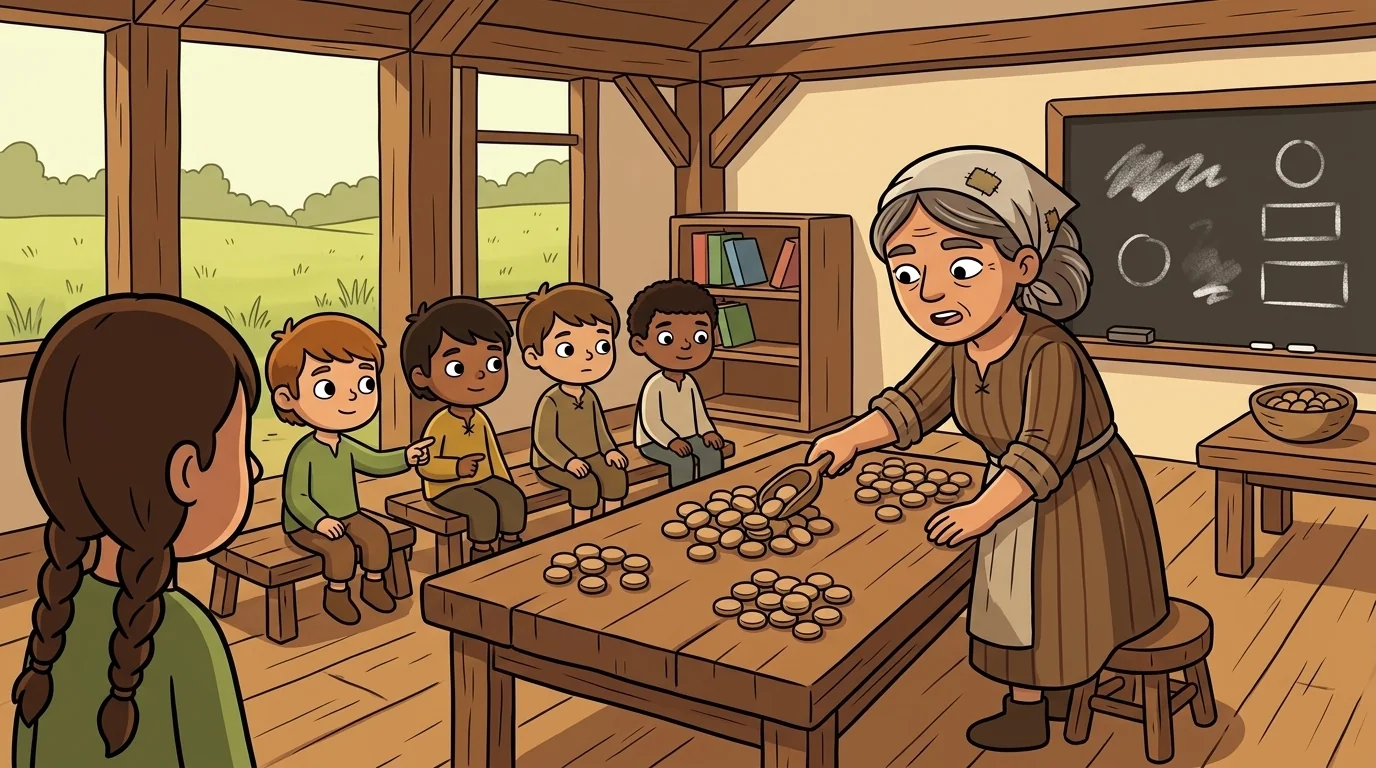
In her classroom Portion keeps a bowl of twenty smooth counters. She begins the same way each year. "Two children are to share these twenty in the ratio two to three," she says. "How many does each get?" The children guess wildly. Portion stops them. "Don't guess the shares. Count them. Two parts and three parts — that is five shares in all. Now" — she tips the twenty counters out — "share the twenty into five equal shares. What is one share worth?" The children divide: twenty into five is four. "So one share is four counters," says Portion. "Now hand them out: two shares — eight — to the first child, three shares — twelve — to the second. Eight and twelve. They add back to twenty, and they stand in the ratio two to three, and no one can argue." The children see it: the whole trick was never the shares themselves but finding the one share first — the single unit that made all the rest fall out fairly.
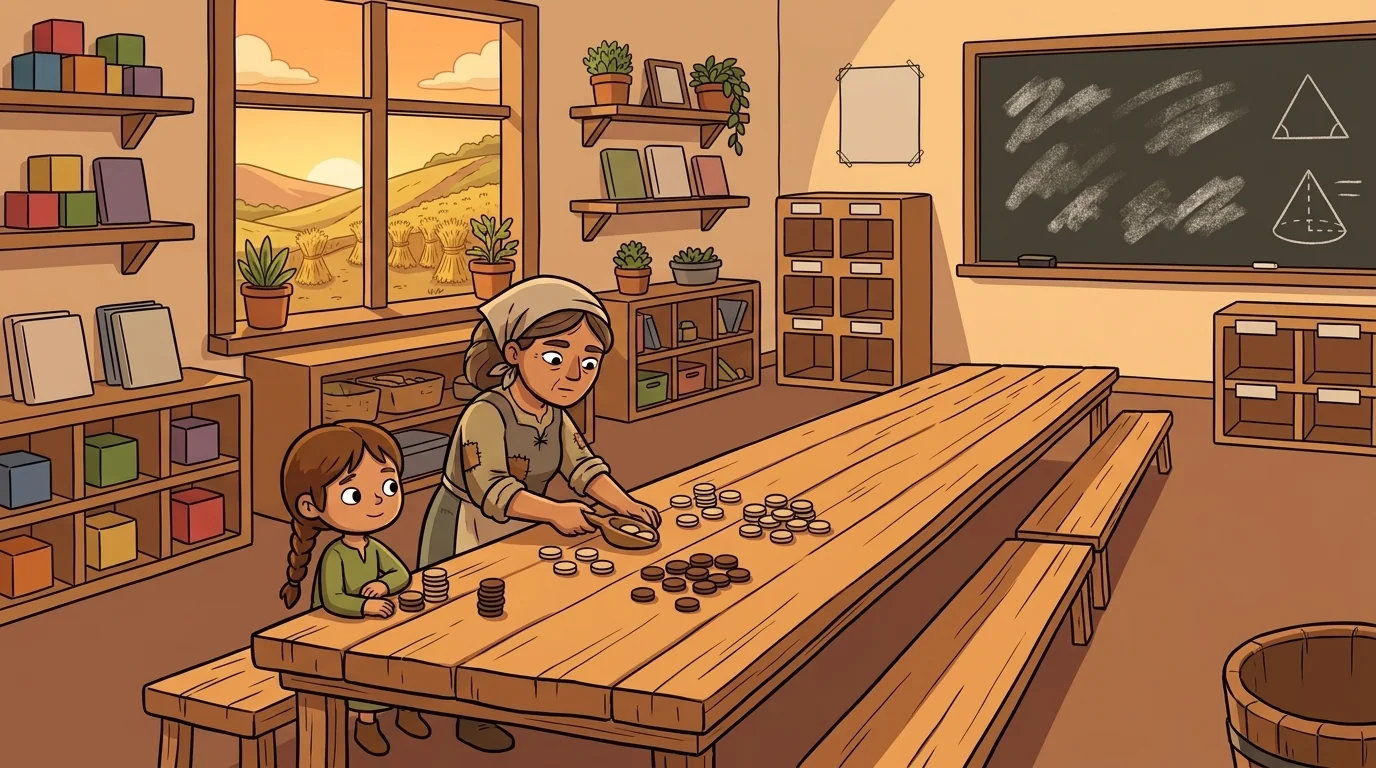
A girl named Wren stayed after, stacking the counters, and said the part that stayed with her was not the arithmetic but the feeling — that a way of splitting things could be so plainly fair that it took all the fear out of the sharing.
Portion sat with her at the long classroom bench. She said that was exactly why she had left the valley to teach it. "At my mother's table, a bad split could break a friendship that had lasted a hundred years," she said. "A good split — a fair one, done so everyone could see the working — kept the whole valley at peace. Fairness you can show is a kind of gift." Wren looked at the two little piles, eight and twelve, sitting honest and settled on the bench, and felt the quiet relief of a thing shared without anyone being wronged — the calm that comes when a division is not just right but trusted.
Portion is warm, careful, and cannot watch anything be divided without checking, silently, whether it was done fairly. She still goes home to Tithe each autumn for the settling, and she still sits beside her mother at the long table, and the split, she says, has not caused a quarrel in eleven years.
The RatioRealm ensemble
Portion the Fair-Divider is part of RatioRealm's distributed-narrative cast. Each character embodies a different curricular primitive; together they teach the full subject.
-

Pair the Ratio-Speaker
Simple ratios (a:b) — the foundational "for every A, there are B" pattern
-

Scale the Doubler
Equivalent ratios (scaling both parts by the same factor; recipe-doubling primitive)
-

Unit the Per-One-Counter
Rates and unit rates (the per-one normalization that lets us compare different rates)
-

Cross the Proportion-Solver
Proportions and cross-multiplication (the canonical "if a/b = c/d then ad = bc" mechanic)
-

Centa the Percent-Translator
Percentages — the per-hundred special case + percent change
-

Crux the Two-Directions
Direct versus inverse proportion (when one goes up, the other goes up — or down)
-

Keel the Constant-Keeper
The constant of proportionality (the fixed number that links the two quantities)
-

Splay the Scale-Keeper
Scale factor (scale drawings, maps, and models)
-

Warp the Part-and-Whole Namer
Part-to-part versus part-to-whole ratios (naming what is compared to what)