Keel the Constant-Keeper
THE CONSTANT OF PROPORTIONALITY — when two quantities are proportional, one is always the other multiplied by a single fixed number. That number, found by dividing one quantity by the other, stays the same across every pair; it is the steady multiplier that ties the two quantities together as they change.
A story read by Keel the Constant-Keeper
Loading audio…
Press play to listen along. The line being read lights up as you go.
Show full transcript
Loading transcript…

Keel grew up on boats, and he learned to trust the one part of a ship that never changes while everything else pitches and rolls.
His family were boatwrights on the estuary below the town of Trestle, and Keel was raised among half-built hulls. A ship, his father taught him, is a chaos of moving parts — sails that fill and slacken, oars that dip and rise, a deck that heaves in every swell. But down the center of every hull runs the keel: one long, straight, unmoving timber, the spine the whole ship is built around. The keel does not pitch or roll. Everything else moves relative to it. "Find the keel," his father said, "and you understand the ship. The keel is the thing that stays."
Keel — whose given name was Trestle, the same as the town, though he had been called Keel since he was ten — grew up looking, in everything, for the part that stays. And when he was older and first met arithmetic through a scholar who lodged at the boatyard, he found it there too. He was shown a table: buckets of tar and the coins they cost. One bucket, three coins. Two buckets, six coins. Three buckets, nine coins. The numbers all changed — buckets rising, coins rising — and Keel, who had spent his life hunting the steady timber, asked: what stays?

He divided coins by buckets. Three coins for one bucket: three. Six coins for two buckets: three. Nine for three: three. The answer was always three. Behind the whole shifting table lay one number that never moved — three coins for every single bucket — and that steady number was the relationship. Multiply any number of buckets by three and you had the cost. The buckets changed and the coins changed, but the three held them together like a keel.
He had found, without knowing its name, the constant of proportionality: the fixed multiplier that ties two changing quantities. It was the same discovery he had made about ships as a boy — that in any moving system, the thing worth finding is the part that stays the same, because everything else can be understood in terms of it.

A ship-buyer from the RatioRealm academy came to Trestle for a fishing-boat and found Keel, grown now, showing an apprentice how to read a price-table by hunting the number that did not change.
"You are finding the constant of proportionality," the buyer said. "The single multiplier behind a proportional relationship. Our students memorize y equals k times x without ever feeling what the k is. You found it by dividing, in a boatyard, without being told."
Keel had never left the estuary. But he liked the thought of children learning to find the steady thing inside a shifting one. He has taught the constant of proportionality for six years.
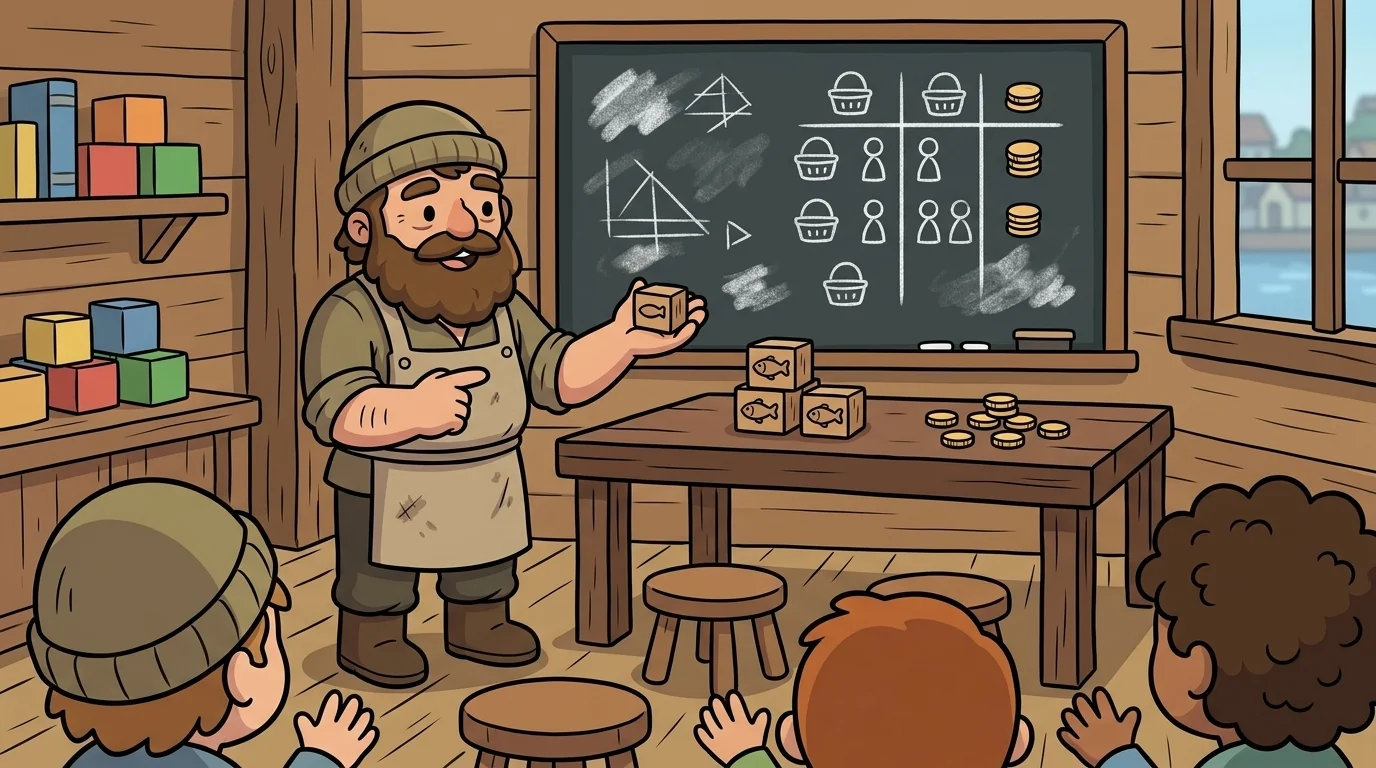
In his classroom Keel keeps a table chalked on the wall: baskets of fish against coins earned. Two baskets, ten coins. Four baskets, twenty. Six baskets, thirty. He begins the same way each year. "Everything here changes," he says. "Baskets go up. Coins go up. But something stays. Find it." The children stare. Keel gives them the boatwright's move: "Divide. Coins by baskets. Ten by two?" Five. "Twenty by four?" Five. "Thirty by six?" Five. The children see it — the steady five, five coins for every basket, standing unmoving behind the whole changing table. "That is the constant," says Keel. "It is the keel of the relationship. Once you have it, you own the whole table: any number of baskets, times five, is the coins. You never need the table again — you need the five." Then he writes it as the scholars do — coins = 5 × baskets — and the children see that the little letter standing in for five is just the steady number, dressed up.

A girl named Isla stayed after, looking at the chalked five, and said the thing that struck her was quieter than the arithmetic: that under a whole mess of changing numbers there could be one steady thing, and once you found it, the mess stopped being frightening.
Keel sat down beside her on the low bench. He said that was the truest thing the boatyard ever taught him, and that it went far past tables of fish. "When everything is moving — the deck, the sails, the weather — you find the keel, the part that stays, and you steer by it," he said. "It is the same with a confusing table, and it is the same, sometimes, with a confusing life. Find the one thing that holds steady, and everything else settles into place around it." Isla looked at the unmoving five behind all those shifting numbers and felt the specific relief of finding solid ground in a moving world — the calm of a steady thing to steer by.
Keel is steady, quiet, and cannot look at a set of changing numbers without dividing to find the one that stays. He still returns to Trestle at the launching-season, and he still lays his hand on the keel-timber of every new hull before it takes the water, and he still, he says, trusts the part that does not move.
The RatioRealm ensemble
Keel the Constant-Keeper is part of RatioRealm's distributed-narrative cast. Each character embodies a different curricular primitive; together they teach the full subject.
-

Pair the Ratio-Speaker
Simple ratios (a:b) — the foundational "for every A, there are B" pattern
-

Scale the Doubler
Equivalent ratios (scaling both parts by the same factor; recipe-doubling primitive)
-

Unit the Per-One-Counter
Rates and unit rates (the per-one normalization that lets us compare different rates)
-

Cross the Proportion-Solver
Proportions and cross-multiplication (the canonical "if a/b = c/d then ad = bc" mechanic)
-

Centa the Percent-Translator
Percentages — the per-hundred special case + percent change
-

Crux the Two-Directions
Direct versus inverse proportion (when one goes up, the other goes up — or down)
-

Portion the Fair-Divider
Sharing a quantity in a given ratio (splitting fairly by parts)
-

Splay the Scale-Keeper
Scale factor (scale drawings, maps, and models)
-

Warp the Part-and-Whole Namer
Part-to-part versus part-to-whole ratios (naming what is compared to what)