
Splay the Scale-Keeper
SCALE FACTOR AND SCALE DRAWINGS — enlarging or reducing every length by the same factor keeps a shape's proportions true; a scale of 1:100 means one unit on paper is a hundred on the ground. Every length scales by the factor, but AREA scales by the factor squared — the Advanced twist most people miss.
A story read by Splay the Scale-Keeper
Loading audio…
Press play to listen along. The line being read lights up as you go.
Show full transcript
Loading transcript…
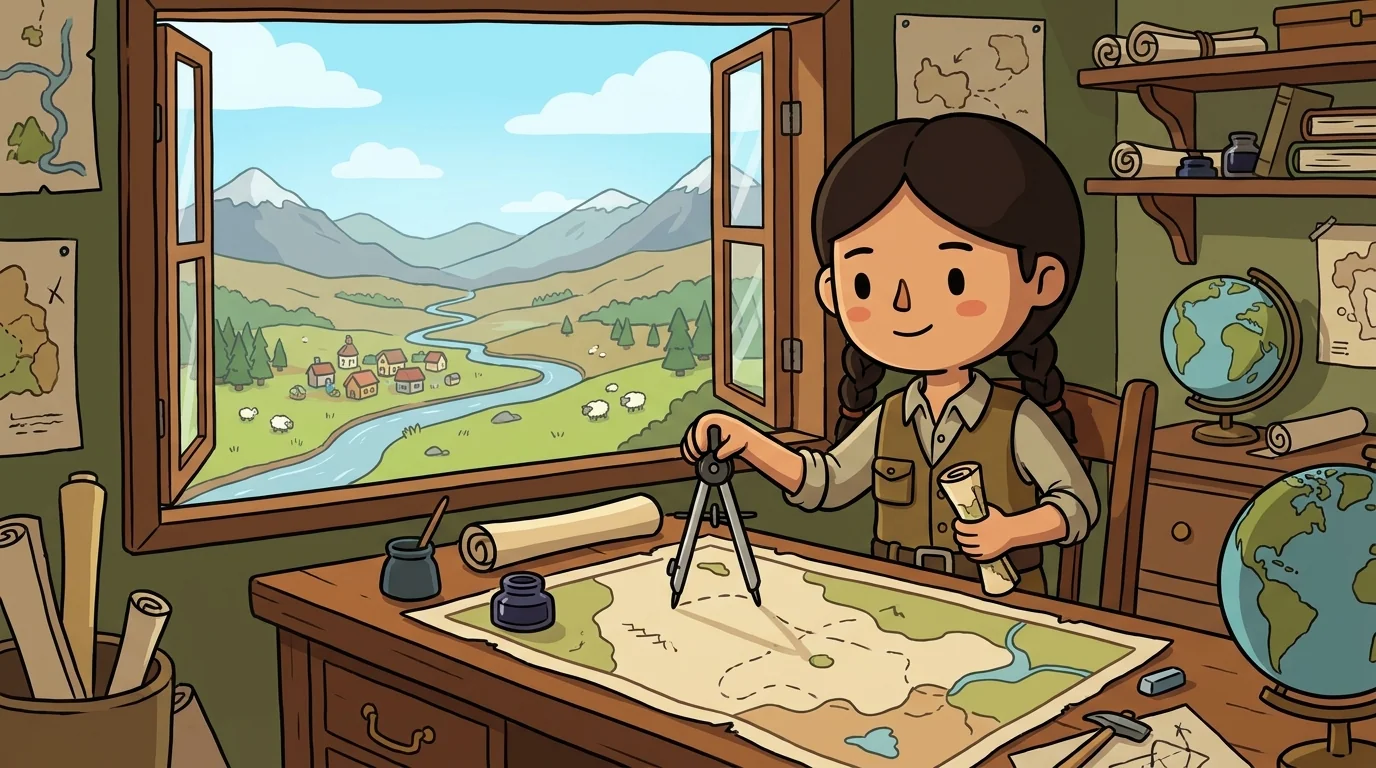
Splay grew up drawing maps, and she learned early that you can hold an entire valley in your two hands if you shrink it honestly. Her family were the valley's mapmakers, in the surveyor's house above Furlong, and travellers, traders, and shepherds all came to them for maps of the passes, the fords, the grazing-grounds. A map, her father taught her, is a strange and wonderful lie: a whole landscape, miles across, drawn small enough to fold into a saddlebag. "But the lie only works," he said, "if it is honest in its shrinking."
That honesty had a precise meaning, and it is the one the RatioRealm academy hired Splay to teach. Every distance on the ground has to shrink by the same amount to fit the paper. If the road shrank by a hundred but the river shrank by fifty, the map would be a monster — river and road in false relation, and a traveller lost by nightfall.
So the mapmakers worked to a scale: a single fixed factor by which the whole world was reduced. "One step on the paper stands for a hundred steps on the ground," Splay tells the children, chalking it as the surveyors write it — 1 : 100. "That is the scale factor. Every line on the map obeys it. The mountains, the meadows, the crooked lanes — all shrunk by the same hundred. And because every length shrinks by the same factor, the little paper valley keeps the exact shape of the great real one. The map and the land are similar — same shape, different size."
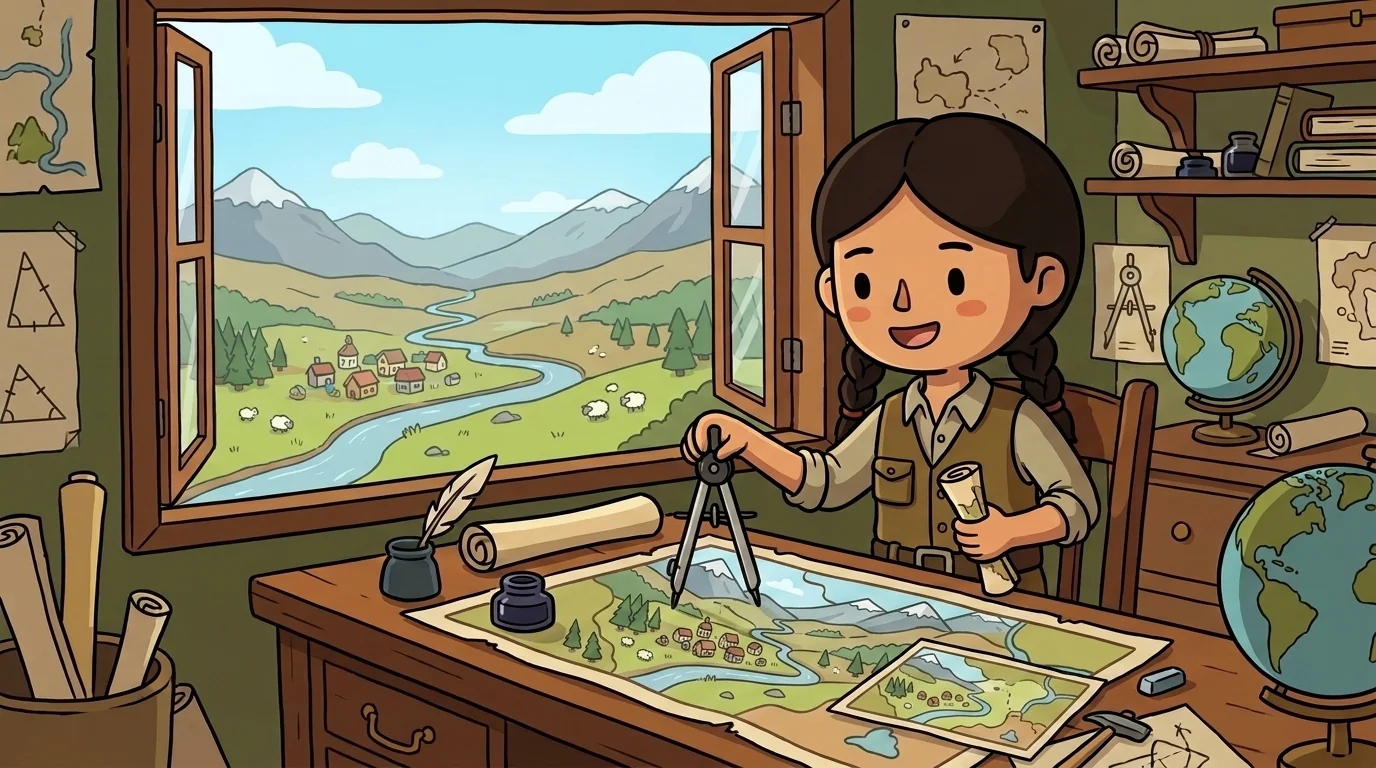
She makes them work it in both directions, because Advanced students must travel the scale both ways. "The map says the road is four inches long, at a scale of one to a hundred. How long on the ground?" Four hundred inches. "The real bridge is thirty feet; how long do I draw it at one to a hundred?" Point-three of a foot — a hair over a third of an inch. "Multiply to go from paper to ground; divide to go from ground to paper. The scale factor is the bridge between the two worlds, and it works in either direction as long as you keep it the same for every length."
Then she springs the trap the whole lesson is built around. "Enlarge a square garden by a scale factor of three. Each side triples — a two-yard side becomes six. But how much bigger is the garden — the area you must plant?" The children say three. Splay shakes her head. "Watch. The old garden is two by two — four square yards. The new one is six by six — thirty-six. Thirty-six over four is nine. Not three. When every length triples, the area grows by three times three — by the factor squared."
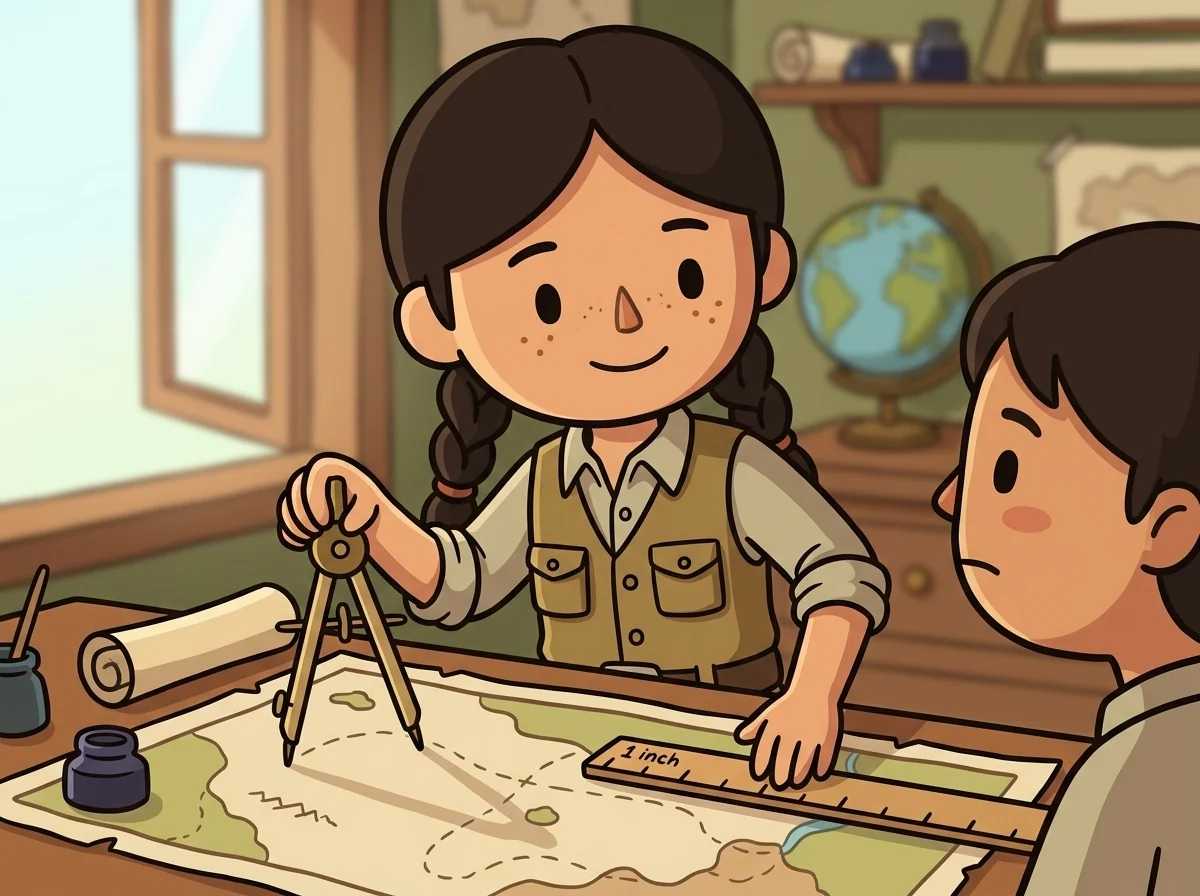
She lets that settle, because it overturns their first instinct. "Length scales by the factor. Area scales by the factor squared. Double every length and the area quadruples; triple them and the area grows nine-fold. It is why a map at one to a hundred packs ten thousand real paces of ground into one paper pace of area — a hundred squared. If you ever scale a shape and its area grows by the plain factor, you have made an error somewhere, because area cannot help but square."
A quiet boy named Reave, who wanted to enlarge a drawing of his father's boat, had made exactly that error — tripled the length, tripled the sailcloth, and run desperately short of cloth. Splay found his working. "Your lengths were perfect," she said. "But sail is an area. Triple the boat and you need nine times the cloth, not three. The shape stayed true — you scaled every length by the same factor, which is the hard part, and you got it right. You only forgot that area lives in two directions at once, so the factor has to act twice."
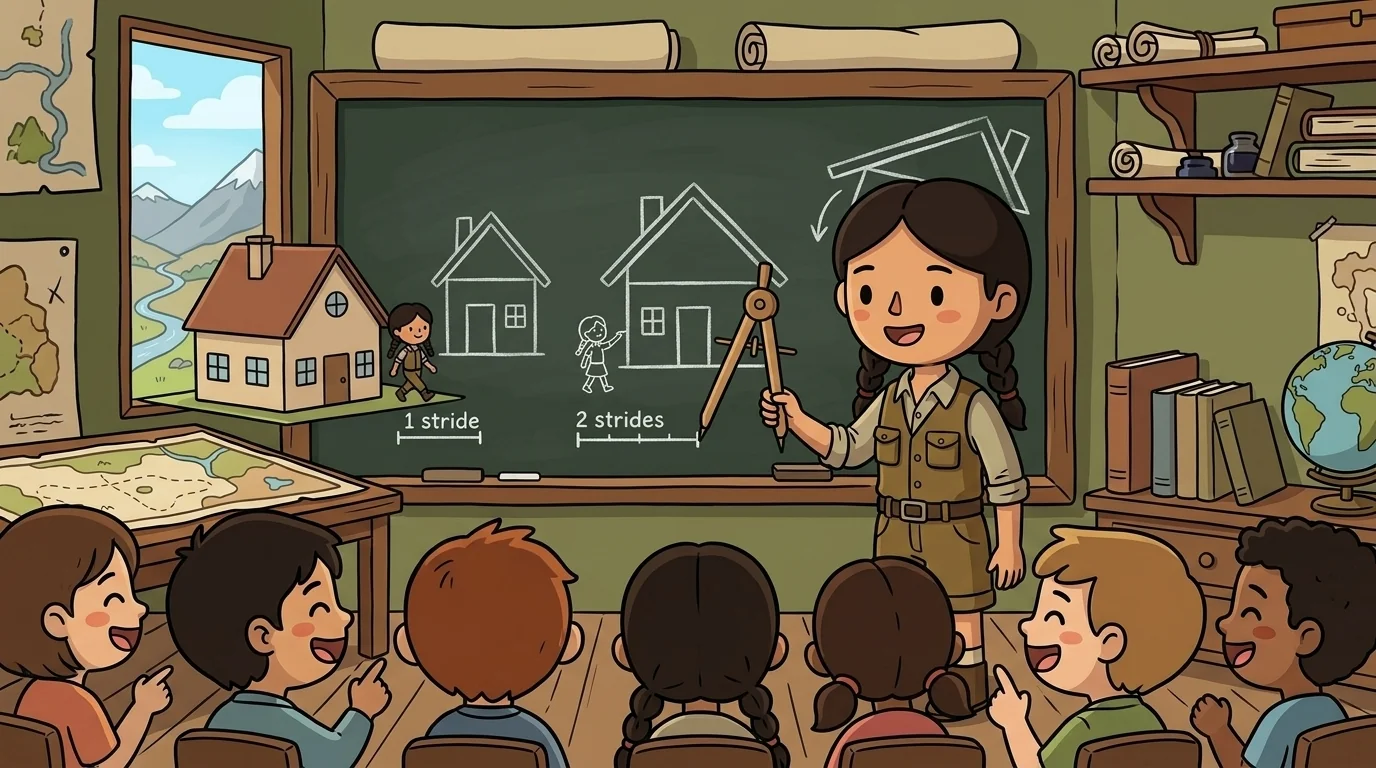
Reave redid it, nine-fold, and the paper boat came out true. What stayed with him, he told her, was not the correction but the fairness underneath the whole craft: that a shape holds together only if you shrink or grow every part by the same amount — no favourites, no shortcuts.
Splay said that was the maker's oldest discipline. "The moment you scale one length more than another, the shape lies. A faithful map, a true enlargement, an honest model — they all rest on the same even-handedness: one factor, applied to everything." Reave looked at the small true boat beside the large one and felt the specific satisfaction of a copy that had kept its shape.
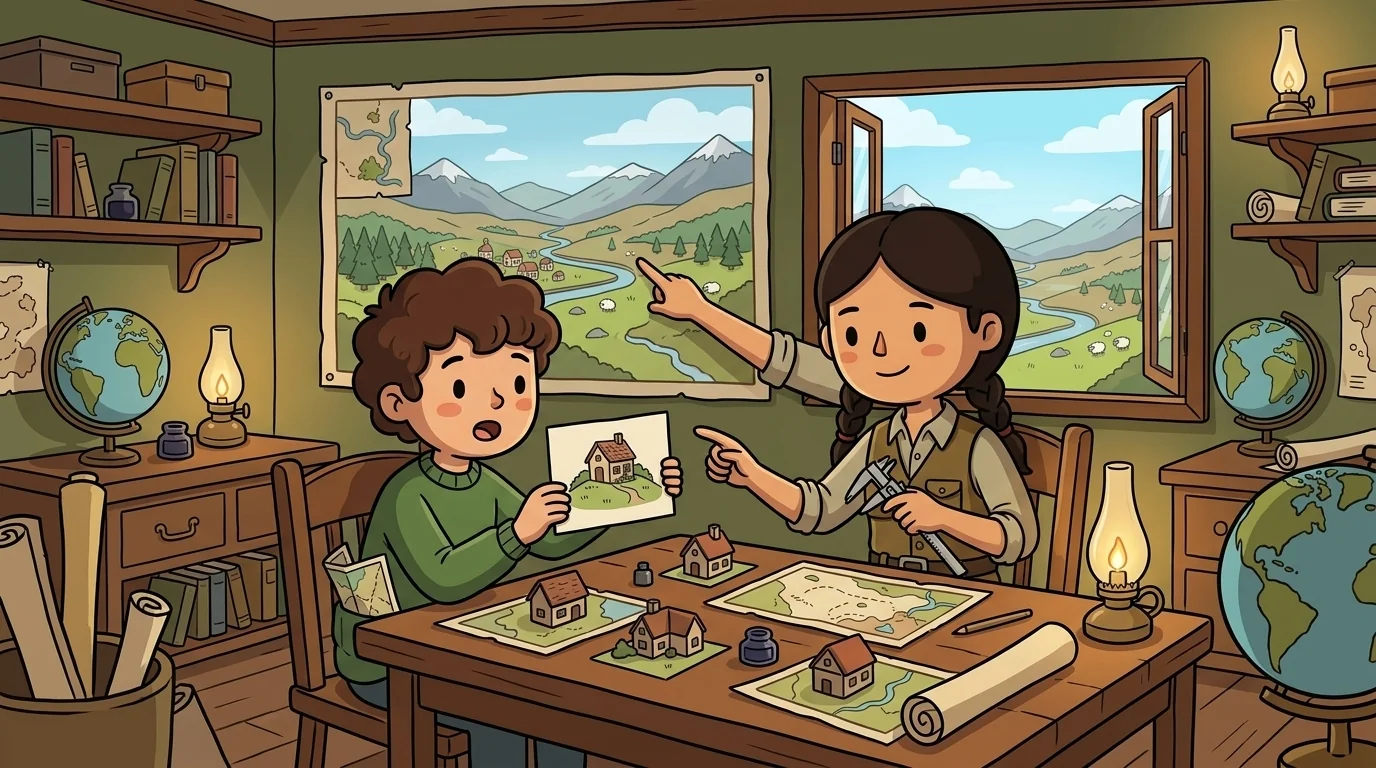
Splay is precise and even-handed, and cannot look at a drawing without checking whether it was shrunk honestly. She still climbs to the surveyor's house above Furlong in the clear season, and she still walks the passes with a measuring-chain, and she still believes a map is only worth folding if every line of it obeyed the same scale.
The RatioRealm ensemble
Splay the Scale-Keeper is part of RatioRealm's distributed-narrative cast. Each character embodies a different curricular primitive; together they teach the full subject.
-

Pair the Ratio-Speaker
Simple ratios (a:b) — the foundational "for every A, there are B" pattern
-

Scale the Doubler
Equivalent ratios (scaling both parts by the same factor; recipe-doubling primitive)
-

Unit the Per-One-Counter
Rates and unit rates (the per-one normalization that lets us compare different rates)
-

Cross the Proportion-Solver
Proportions and cross-multiplication (the canonical "if a/b = c/d then ad = bc" mechanic)
-

Centa the Percent-Translator
Percentages — the per-hundred special case + percent change
-
Crux the Two-Directions
Direct versus inverse proportion (when one goes up, the other goes up — or down)
-

Keel the Constant-Keeper
The constant of proportionality (the fixed number that links the two quantities)
-
Portion the Fair-Divider
Sharing a quantity in a given ratio (splitting fairly by parts)
-
Warp the Part-and-Whole Namer
Part-to-part versus part-to-whole ratios (naming what is compared to what)