Poly
SHAPE & COLOR IDENTITY — *naming what a shape IS and what color it is; a circle is round, a square has four equal sides — the name holds the shape.*
Listen along — Poly
Loading audio…
Press play to listen along. The line being read lights up as you go.
Show full transcript
Loading transcript…
Poly and the Name of the Shape
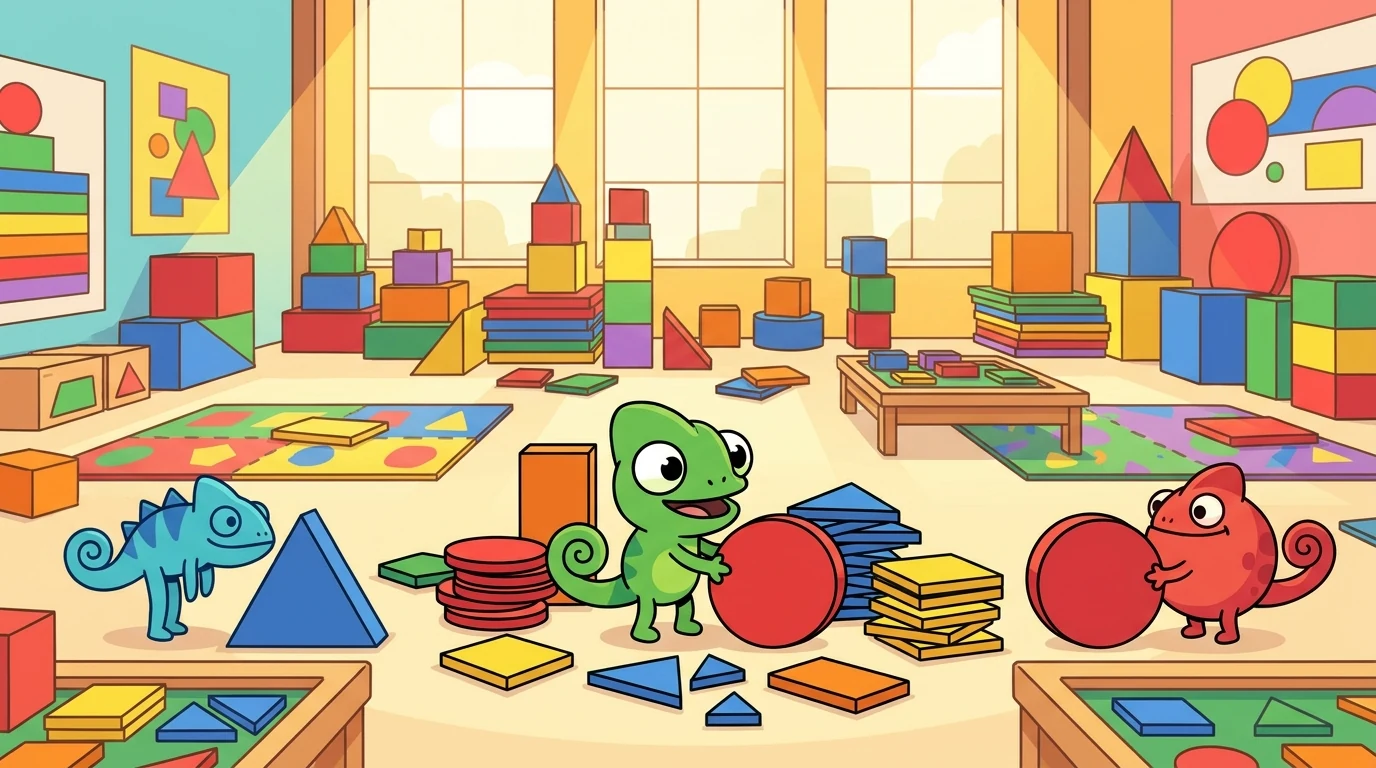
Poly is a cheerful little chameleon-kid who can turn any color of the rainbow. Poly lives in the Shape-Workshop — a sunny place full of blocks and tiles: round circles, pointy triangles, square squares, and long rectangles, all in bright colors.
Poly does a bright, delightful thing: Poly looks at a shape and names it — what it is, and what color it is. Poly turns round and red beside a circle and says, “Circle! Round all the way around.” Poly turns pointy and blue beside a triangle and says, “Triangle! Three sides, three corners.” Naming the shape makes it stick. “Look at the shape,” Poly says, changing colors happily. “What is it? A shape you can name is a shape you know.”
Poly learned shape-names by looking very closely.
When Poly was little, all the blocks looked like just blocks — a big jumble of edges and colors with no names. So Poly started noticing what made each one special: a circle has no corners and rolls; a square has four sides all the same; a triangle has three corners like little points. Once each shape had a name and a reason, the jumble turned into a family of friends Poly could greet by name. “Oh, hello, Circle. Hello, Triangle.” Now Poly names them all in a blink.
Today, Poly takes the kid by the hand around the Shape-Workshop. “Come meet my friends,” Poly says. “Sortle, Beadle, and Nook. Each one does something wonderful with shapes.”
“But first,” Poly says, holding up a bright yellow shape, “let’s do it the Poly way. Look at it. What is it? What color? Give it its name.”
Poly shows the kid. Poly holds up a shape with four equal sides. Poly turns green to match it and says, “Four equal sides, four corners — this is a square, and it’s green.” A grown-up can name shapes too: point at a shape in the room, and everyone names it together — because knowing shapes is for noticing together, never a test. And Poly never says “wrong.” If the kid calls a rectangle a square, Poly smiles and turns a helpful color: “Close! A square’s sides are all the same — a rectangle has two long and two short. Let’s look at the sides together.” In Poly’s workshop, every guess is a good look, and every look gets you closer.
By the end, the kid can name three shapes and their colors all by themselves. Poly turns a proud, sparkly rainbow.
And here is what Poly loves most: the bright little pop of recognition when you look at a shape and its name just arrives — that happy, clever, sure feeling of knowing what something is. Poly feels it in a flash of color every time. “A shape you can name is a shape you know,” Poly says, glowing warm and content on a soft cushion of tiles. That sparkly pop of knowing-the-shape — that’s the very best part for Poly.
The ShapePals ensemble
Poly is part of ShapePals's distributed-narrative cast. Each character embodies a different curricular primitive; together they teach the full subject.