
Clever Gecko
CLEVER GECKO — the gecko lets go of its tail to save its whole self. a sacrifice is not a loss; it is a purchase. you spend the small to buy the large.
A story read by Clever Gecko
Loading audio…
Press play to listen along. The line being read lights up as you go.
Show full transcript
Loading transcript…
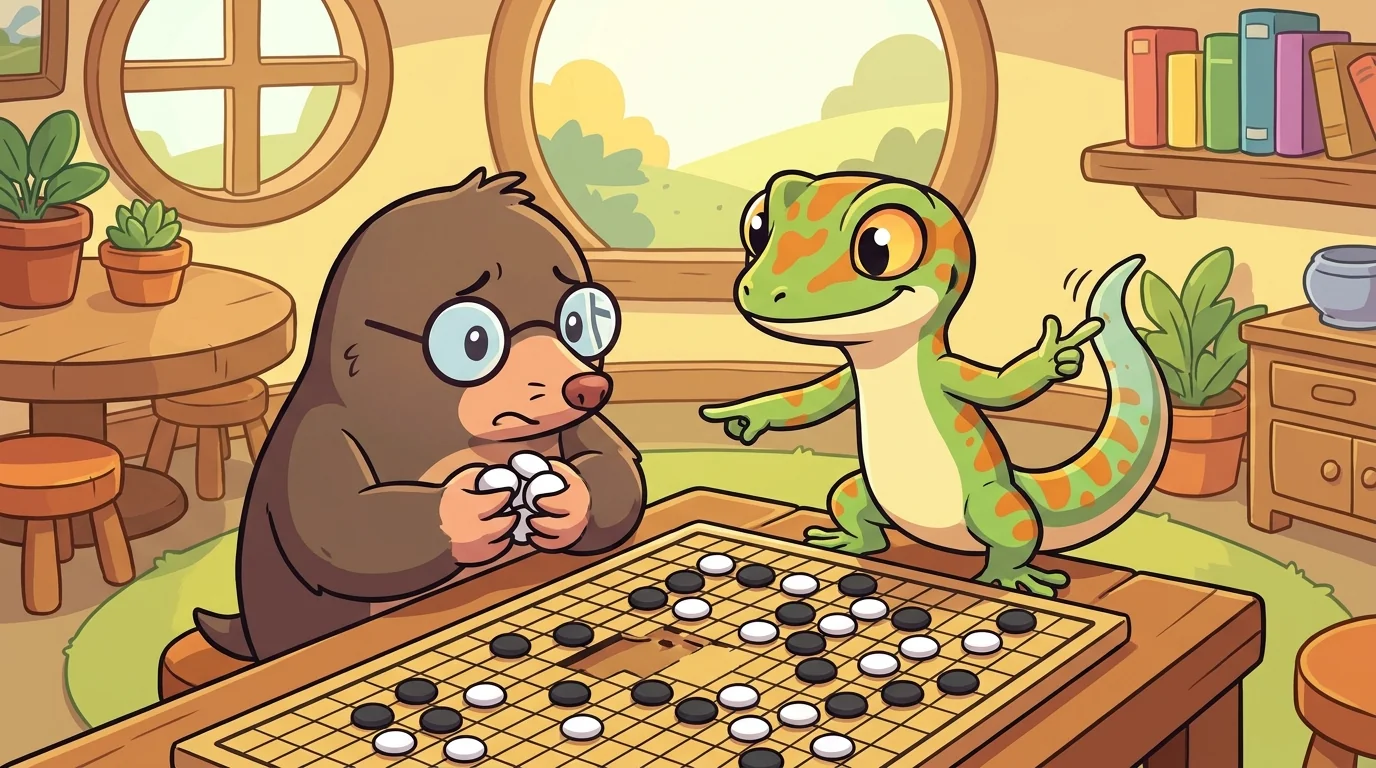
On the board of quiet stones, a young mole was spending his fourth straight move trying to rescue three trapped stones, and Clever Gecko sat down beside him not to comfort him but to teach him to count.
"You keep saving these three," she said, quick-eyed and bright, her tail resting loose beside her as though she'd already half forgotten it was attached. "So let's do the sum you're refusing to do. Three stones is worth six points if they die — three stones captured, three points of territory underneath. Six points, total." She tapped the far side, wide and open. "Now: what is a move worth over here, where nobody has played? Fifteen points. Maybe twenty." She let that sit. "Every turn you spend clutching a six-point tail is a turn you did NOT spend earning twenty somewhere else. You are not losing three stones. You are losing three stones' worth of nothing while paying twenty for it, again and again."
The mole stared. "So the three stones aren't the loss."
"The three stones were dead the moment they were surrounded," Clever Gecko said. "The loss is everything you bought trying to un-die them. A sacrifice isn't giving up. It's the moment you stop paying good moves for dead stones and go spend them where they're worth four times as much."
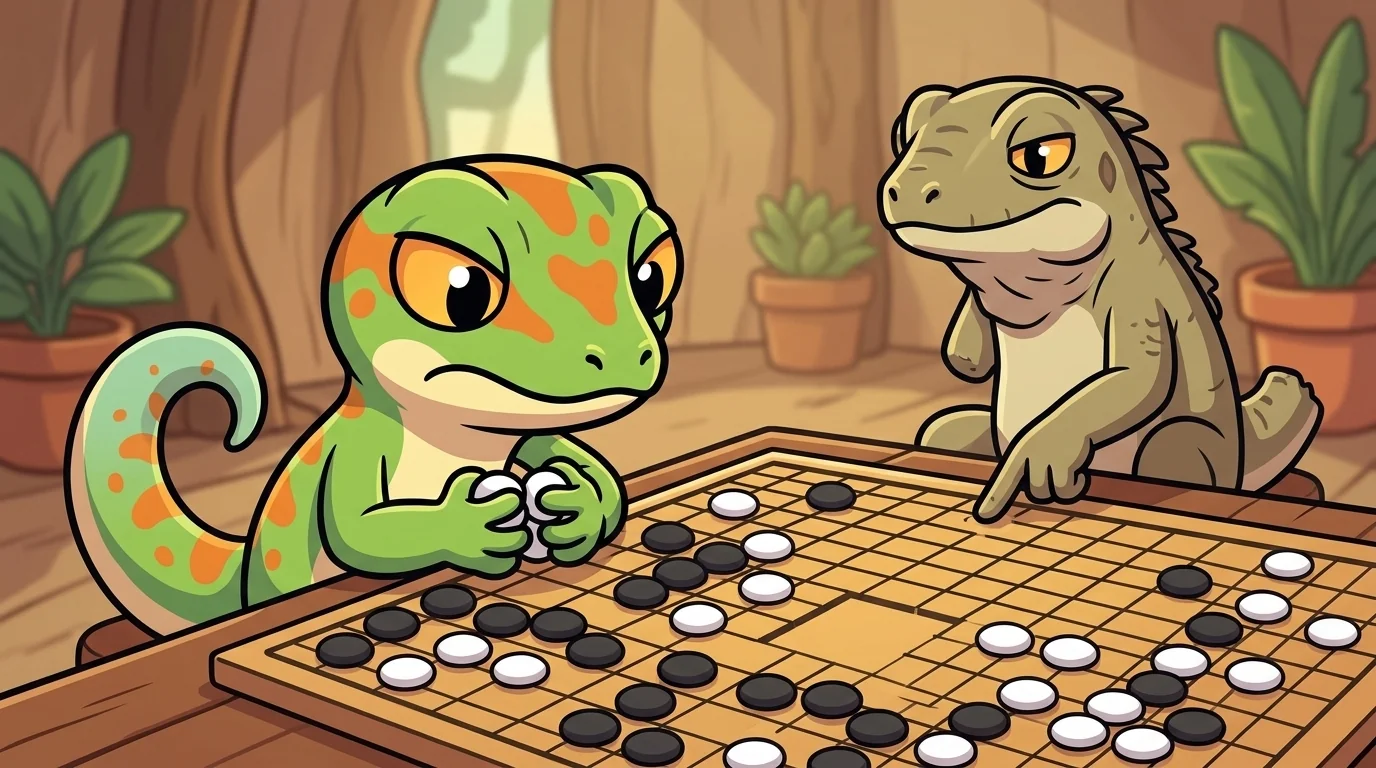
Clever Gecko had, once, been unable to do this arithmetic at all.
When she was young, every stone felt like a piece of her own body, and losing one felt like a wound. So she defended. She defended stones that could not be saved, poured five moves into rescues that were lost before she began, and while she was busy proving she would never abandon a single stone, her opponents quietly wrapped up the entire rest of the board. She lost enormous games by margins so wide they were almost funny — and she never once traced the loss to the three stones she'd "saved." She thought she simply hadn't fought hard enough.
An old lizard, missing the last inch of her own tail and entirely at peace about it, watched her lose one such game and then sat down. "You play as if every stone is worth the same," she said. "But a stone's worth is not fixed. A stone is worth exactly what it does. A stone that can still make territory, still connect, still live — precious. A stone already surrounded and dead — worth only the points it hands over, and not one move more." She flicked the stump of her tail. "A fox had me here once. I could have fought to keep the tail and been eaten with it. Instead I read the position: the tail was six points, my life was the whole board. I let the tail go and darted away whole. It grew back. I would not have."
She tapped the grid. "Ask of every trapped stone the only question that matters: what does keeping it cost, and what could that same move earn elsewhere? When the answer is 'it costs more than it's worth,' you do not mourn it. You let it go, and you go get the twenty."
Clever Gecko learned to count — to weigh the six against the twenty, coldly, gladly — and the games she'd been losing by drowning turned into games she won by walking away. The clinging that had felt like loyalty turned out to be a math error. She had never lacked courage. She had only been paying twenty for six.
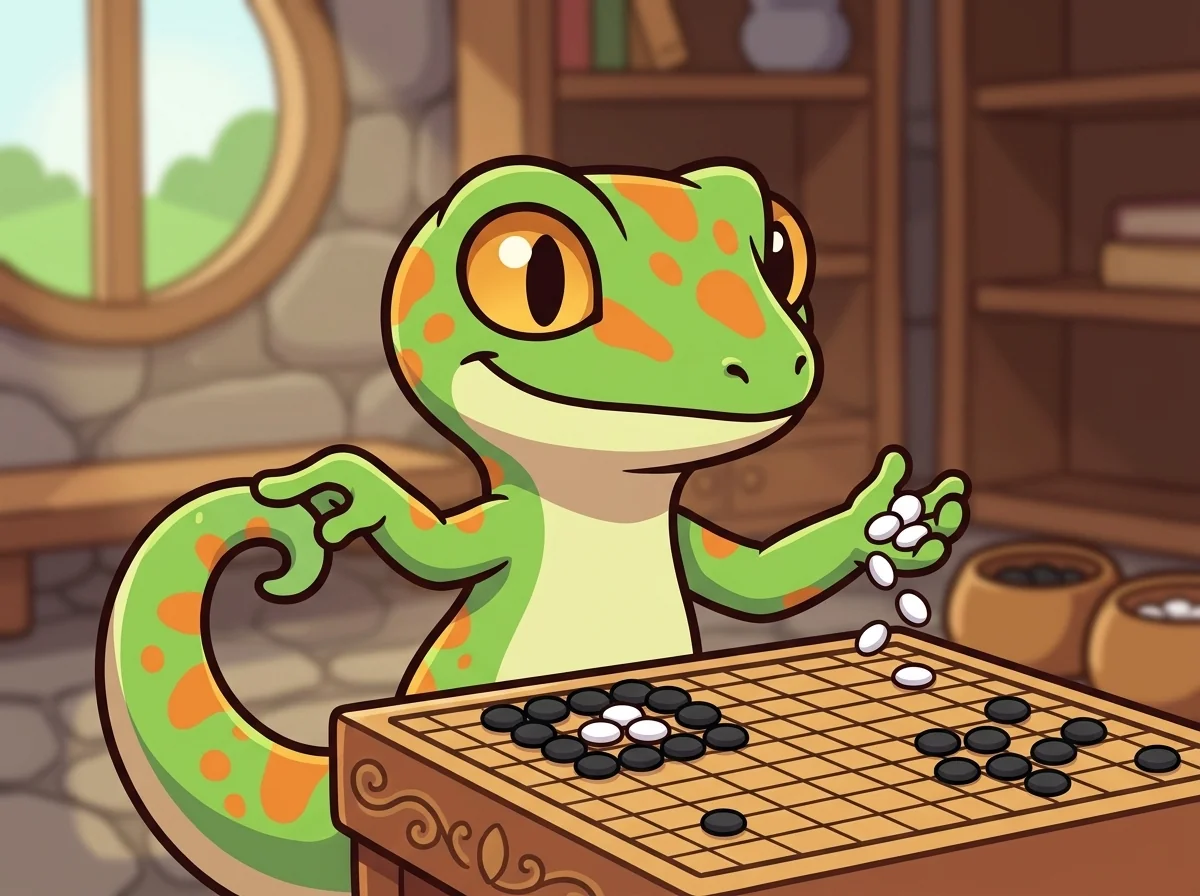
She came to Stonesong already grey at the edges, because a place that taught the deep game needed someone who had learned to let go on purpose.
Master Snail met her at the gate and asked the one question. "Clever Gecko — what do you teach?"
She did not answer with words. She set down four black stones in a tight trap around three white ones, then, instead of the frantic defense a beginner would play, she calmly placed her freed stone far away, in open space — and gestured at the whole side of the board that now leaned her way. "I teach that the three white stones and the twenty-point side are on the same balance-scale," she said. "Most players only see the stones about to die. I teach students to see the other pan of the scale — the move they get to make instead. A sacrifice is just a trade where you noticed you were getting the better end."
Master Snail regarded the lonely, powerful stone she'd played. "Most of the cast teach students to hold on," he said. "You teach them the harder thing — to know precisely when to open the hand. Stay."
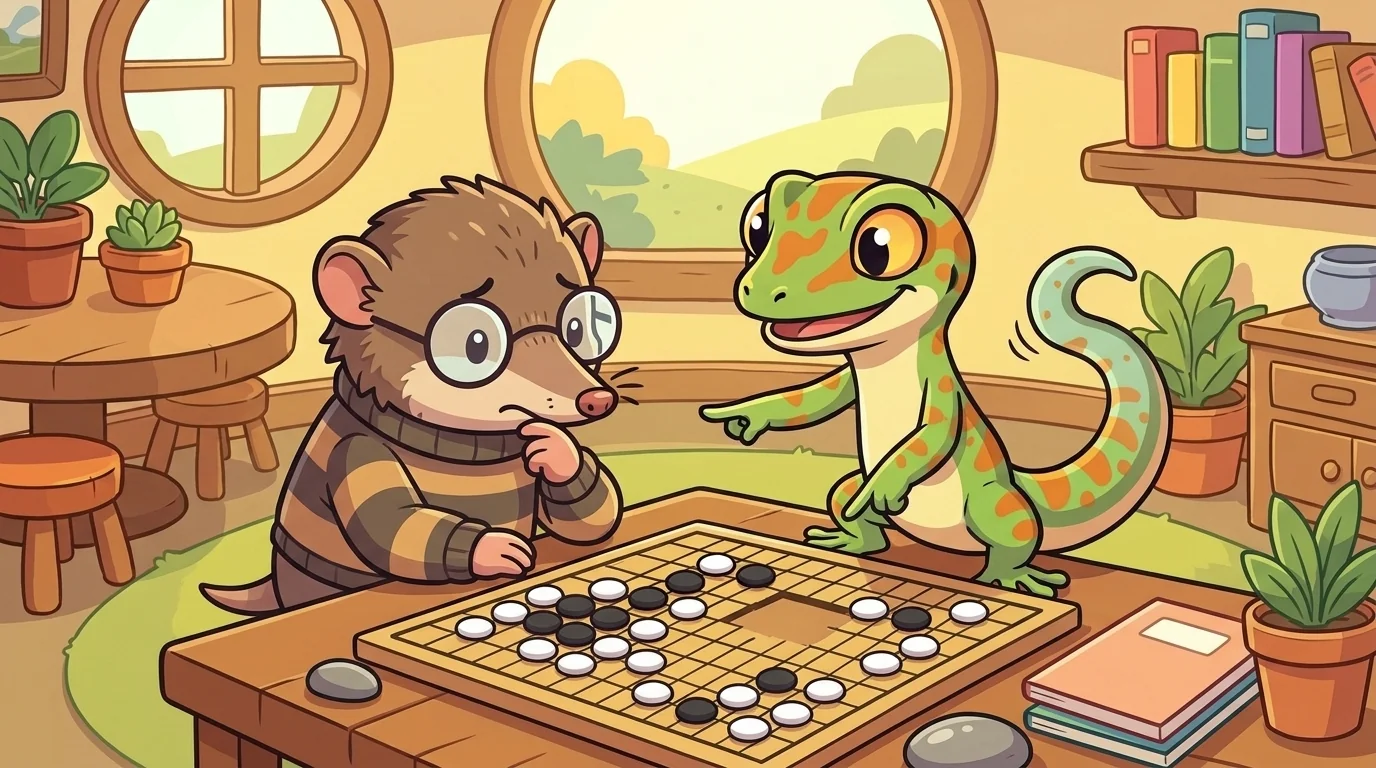
There is a deeper turn to the gecko's craft, and she saved it for the students who had already learned to count.
A dead stone, she taught them, is not always finished doing its work. "You gave up three stones here," she told a sharp young stoat one afternoon, tapping a spot where three of the stoat's stones had been captured. "Most players forget them the instant they're gone. But look — the shape of where they died still presses on your opponent's group. There's a weakness left behind. A scar. In the old games they call it aji — the taste that lingers." She placed a single new stone that leaned on that old scar, and suddenly the opponent's "safe" group had to answer. "A stone can be captured and still be threatening, if you sacrificed it into the right shape. That is the master's sacrifice: you don't just let the tail go — you let it go in a direction that keeps biting after it's gone."
The stoat looked at the ghost of her dead stones, now doing more work dead than they had alive. "So a good sacrifice keeps working."
"The tail you drop can still trip the fox," Clever Gecko said, delighted. "That is the whole art."
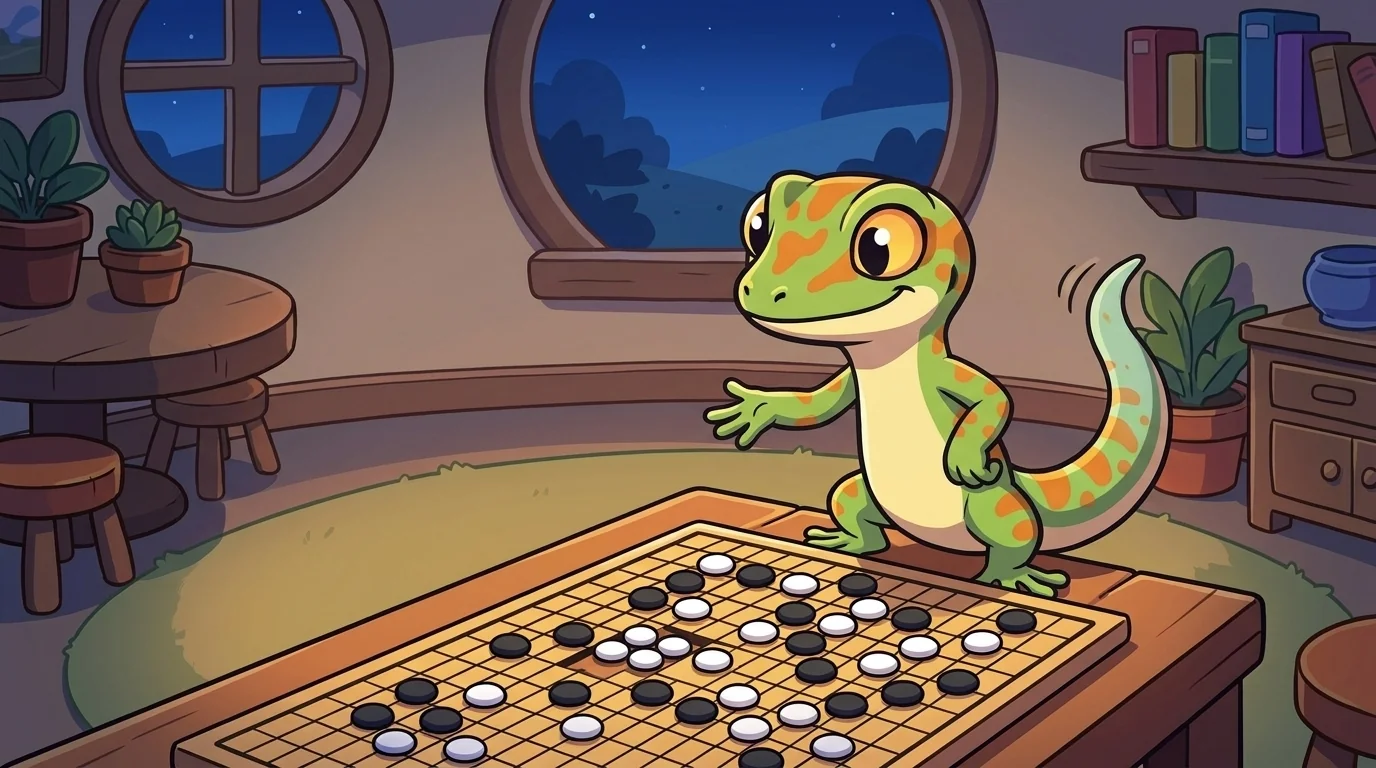
The mole was still sitting with his three doomed stones when she returned to him.
"I did the sum," he said slowly. "Six points. And the side is worth about eighteen." He hovered his hand over the open space, then hesitated at the very edge of letting go. "It still feels like quitting."
"It feels like quitting," Clever Gecko agreed gently, "because you learned to measure yourself by what you refuse to lose. But a Go player measures by what the whole board is worth at the end. You will lose stones in every game you ever play — the good player and the beginner both lose stones. The difference is that the good player chooses which ones, and charges the opponent for the privilege." She nudged the open side. "Let the three go. Take the eighteen. And leave them in a shape that still whispers."
The mole let the tail go — placed his stone wide, gave the three away without a flinch — and watched his own territory swell far past anything the three stones could ever have held. The tight, clinging dread in his chest opened into something loose and clear-eyed and almost weightless. He had not lost three stones. He had finally learned what they were for.
The StoneSong ensemble
Clever Gecko is part of StoneSong's distributed-narrative cast. Each character embodies a different curricular primitive; together they teach the full subject.
-

Patient Bamboo
Patience and slow growth — long-game positioning
-

Hungry Crane
Capture instinct — taking what's available
-
Master Snail
Deliberate strategy — every move considered
-

Sparring Tiger
Aggressive contact — direct attacks and clashes
-
Nimble Cat
Good shape — the most work from the fewest stones
-
Tidy Mouse
Endgame — the small edge-moves that quietly decide it
-

Two-Eyed Owl
Life and two eyes — a group that cannot be captured
-
Weaver Ant
Connection — linked stones are strong, cut stones weak
-

Wide Heron
Territory and influence — claiming space by standing wide