
Nimble Cat
NIMBLE CAT — the cat never wastes a movement. good shape does the most work with the fewest stones; the worst shape is the one that overlaps its own effort.
A story read by Nimble Cat
Loading audio…
Press play to listen along. The line being read lights up as you go.
Show full transcript
Loading transcript…
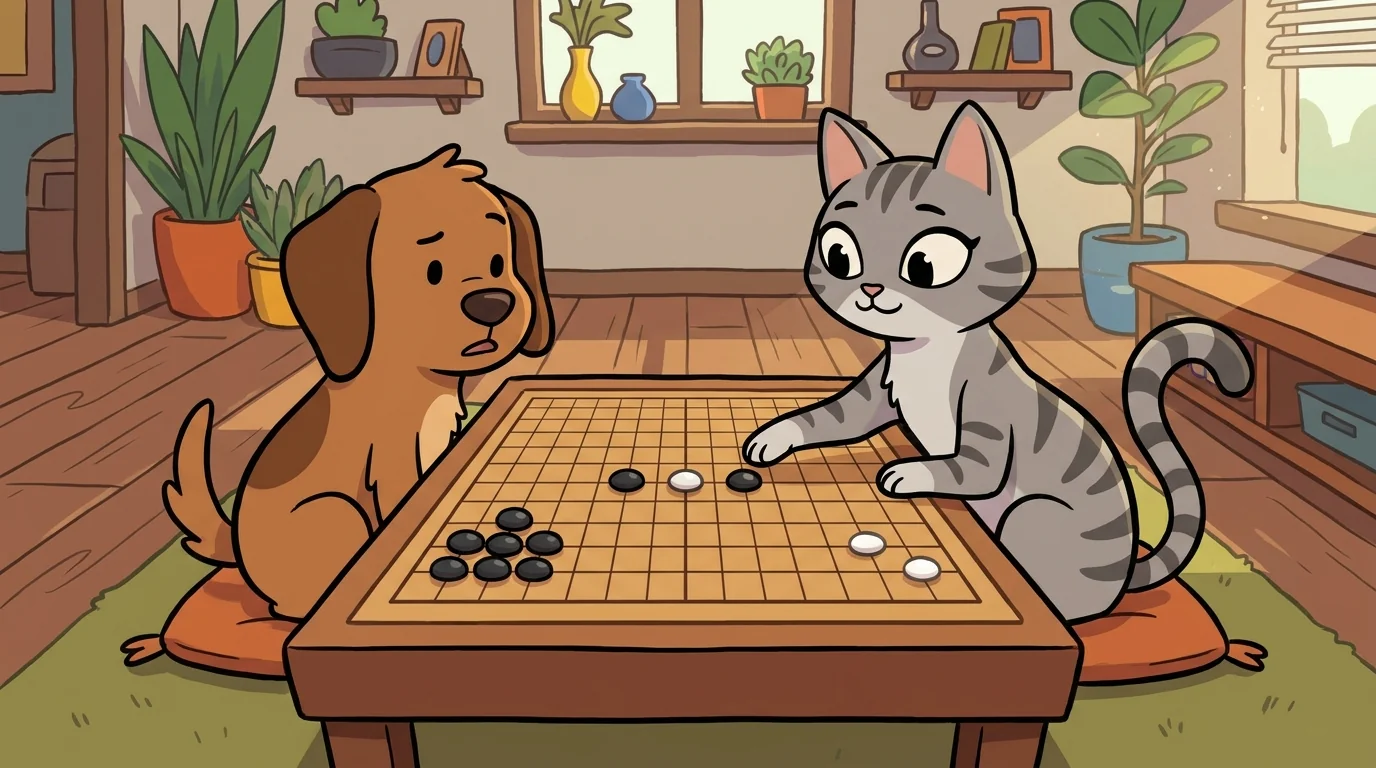
On the board of quiet stones, a young dog had built a wall of six stones jammed into a solid block and was admiring how strong it looked, and Nimble Cat sat down to explain, kindly, that he had confused heavy with strong.
"Six stones," she said, sleek and unhurried, not a whisker misplaced. "And I can show you the exact three that are doing nothing." She pointed at four of his stones arranged in a little square. "That is the shape every teacher warns you about — four stones packed into a solid block. The old players call it the empty triangle's big cousin; it is the most inefficient shape in the game. Count the liberties — the breathing-spaces around the edge. A clump of four has fewer breathing-spaces per stone than three stones spread in a good shape. You paid four stones and bought less safety than three well-placed ones would give you."
The dog bristled. "But it's all connected. It's a wall."
"It is a wall with its own feet nailed together," Nimble Cat said. She swept two of his stones off and left the rest in a light, stepping shape — a diagonal, a one-space skip. "Look now. Same connection. More breathing room. Harder to attack. And you have two whole stones back in your hand to go play somewhere the board is still empty. Good shape isn't decoration. It is stones arranged so that not one of them repeats the job another is already doing."
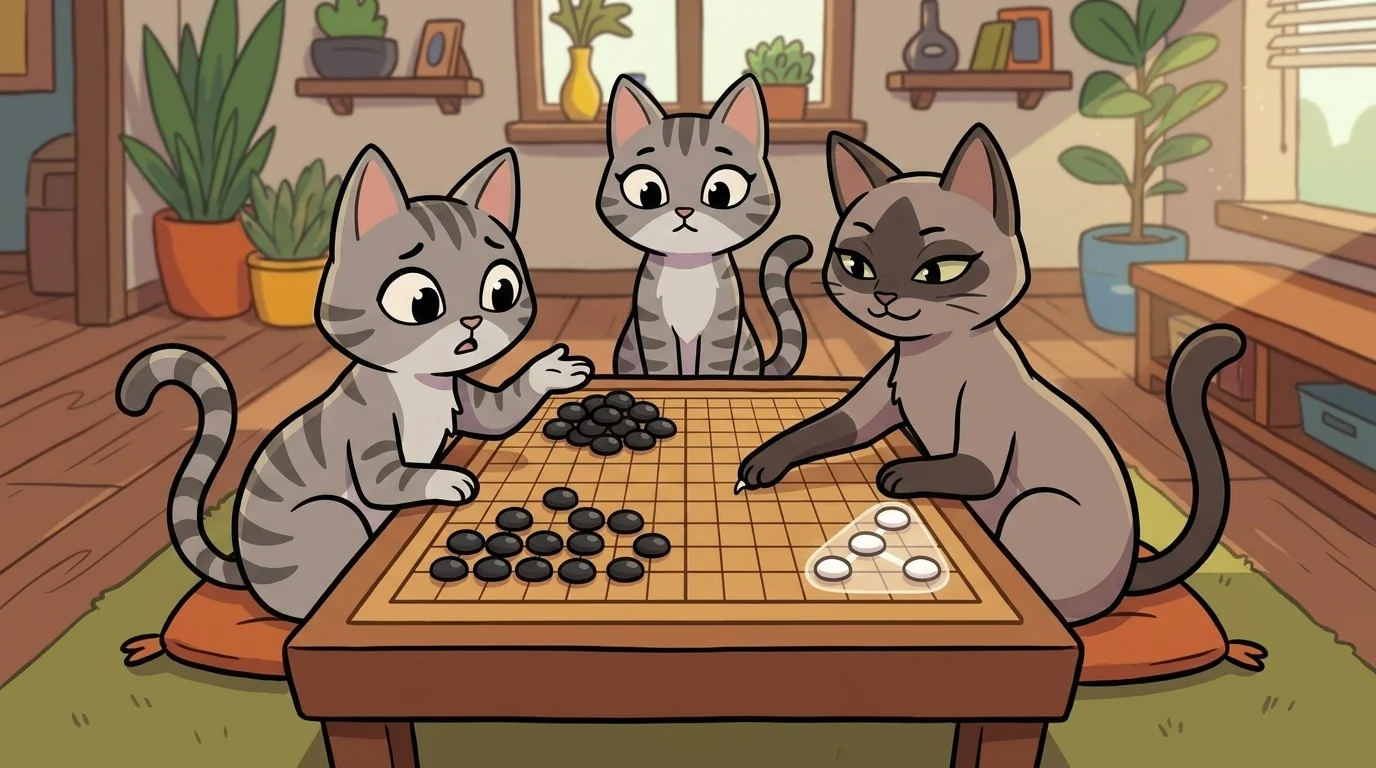
Nimble Cat had once been the clumsiest player in her grove.
When she was young she believed the same thing the dog believed — that safety was a matter of quantity, that if two stones were good then five stones stacked on top were surely better. So she overbuilt. Every group she made was a dense, anxious lump, three stones doing the work of one, and she was forever running out of stones to play while her opponents, using each stone once and well, seemed to be in four places at the same time. She lost by running dry. And each time, she concluded she simply hadn't packed tightly enough.
An old cat, so economical in her movements that she seemed to teleport, stretched out beside her one evening and watched her build another lump. "You move like you're being charged by the step," she said. "Watch." She crossed the whole courtyard to a high ledge — and did it in three flowing motions where the young cat would have taken nine. "Every movement did exactly one job the others hadn't. That is not laziness. That is respect for effort." She placed three stones on the board in a light shape, each covering ground the others left open. "Your lump of six covers this much. My three cover the same — and I still hold three stones. The question for every stone you place is not 'is this safe?' It is 'does this stone do something no stone already here is doing?' If the answer is no, you have wasted a move, and in this game a wasted move is how you lose to someone no cleverer than you."
Nimble Cat learned to play light — good shape, no overlap, each stone earning its place — and suddenly she too was everywhere at once, while her old habit of overbuilding became the mistake she watched opponents make. The anxious out-of-stones dread turned into a spare, exact calm. She had never needed more stones. She had only been making three of every four do nothing.
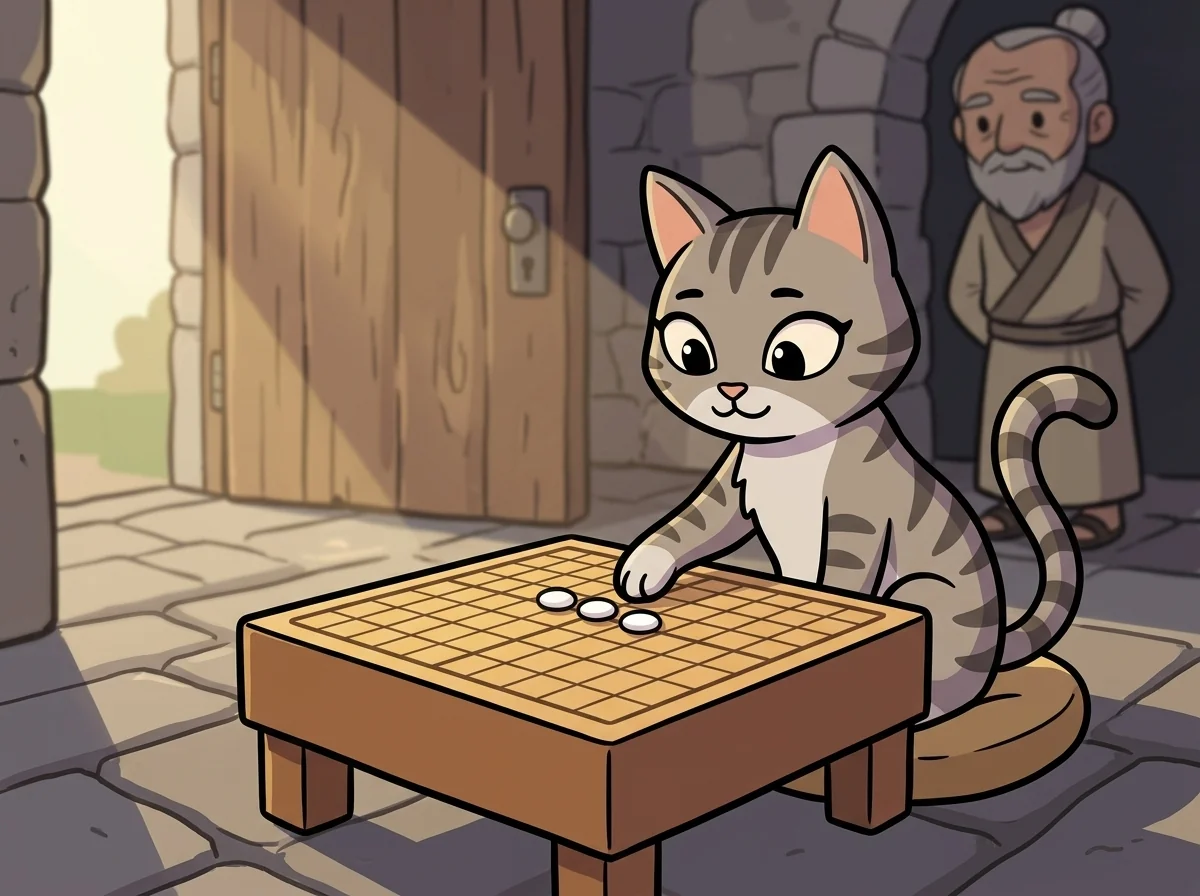
She came to Stonesong lean and precise, and Master Snail met her at the gate with the one question. "Nimble Cat — what do you teach?"
She answered by placing four stones in a solid square, looking at it with open distaste, then rebuilding the same connection in a stepping shape using only three. "I teach students to feel waste," she said. "Most players can tell a strong group from a weak one. Fewer can look at a strong group and see that it's strong the expensive way — that it did with six what three could do, and lost the game everywhere else to pay for it. I teach the eye that flinches at a clumped stone."
Master Snail turned the two shapes over slowly. "Efficiency is the quiet virtue," he said. "Nobody claps for the move you didn't need to make. Stay, and teach them to hear the applause anyway."
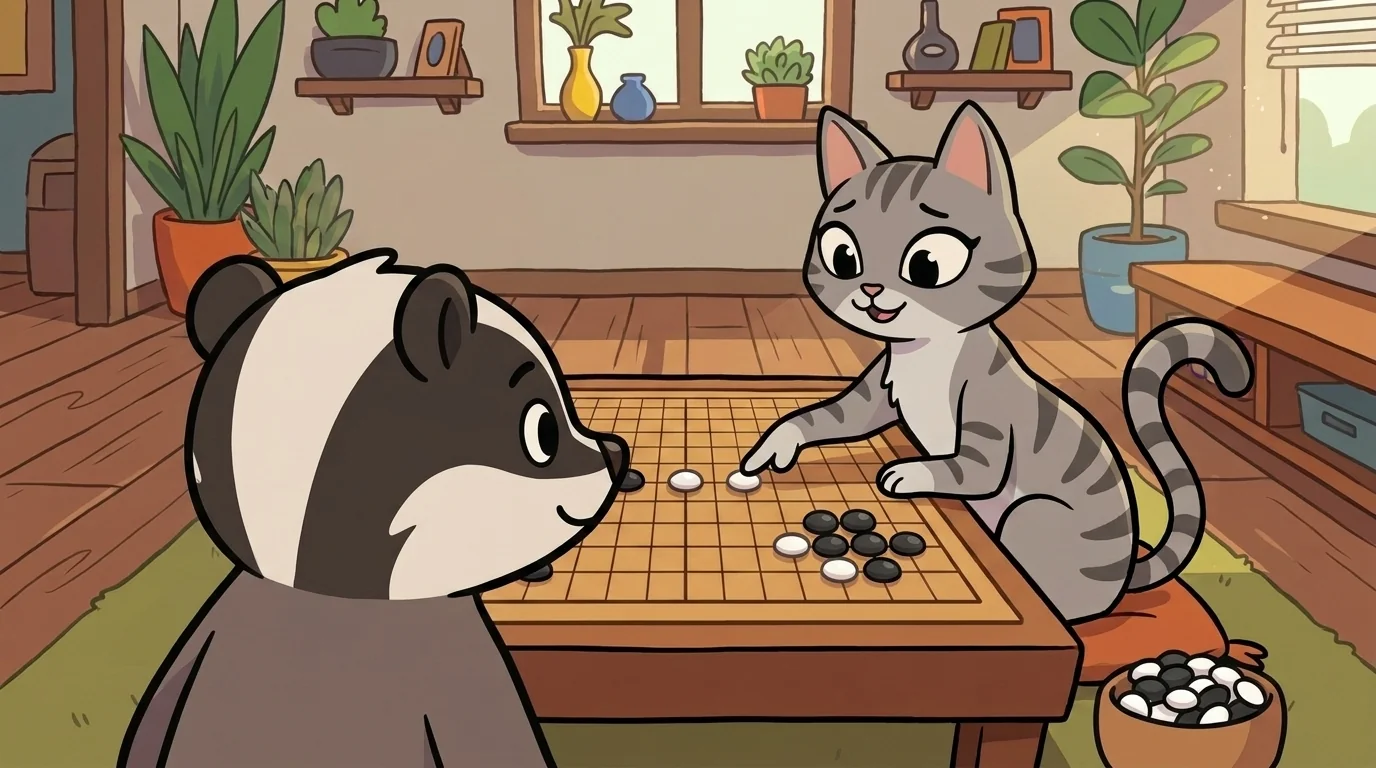
There is a subtlety to good shape, and Nimble Cat saved it for students who had stopped clumping.
"Efficient is not the same as thin," she warned a quick young weasel who had over-learned the lesson and begun spreading her stones so far apart they no longer helped each other at all. "You cured the clump and caught the opposite disease. A one-space jump is beautiful — until your opponent plays between your stones and cuts them. Good shape is the exact balance: as light as you can be while still holding together." She showed the weasel the difference between a connection that only looked connected and one that truly could not be cut. "Waste is doing the same job twice. But leaving a job undone — a cutting-point unguarded — is worse than waste; it's a hole. The cat's grace is finding the shape that is light AND whole. Not the fewest stones. The fewest stones that still do the whole job."
The weasel studied the two shapes — one thin and cuttable, one light and solid — and saw that they differed by a single stone in a single place. "So the art is the one stone between too-heavy and too-thin."
"The art is always the one stone," Nimble Cat purred. "That's why it's an art."
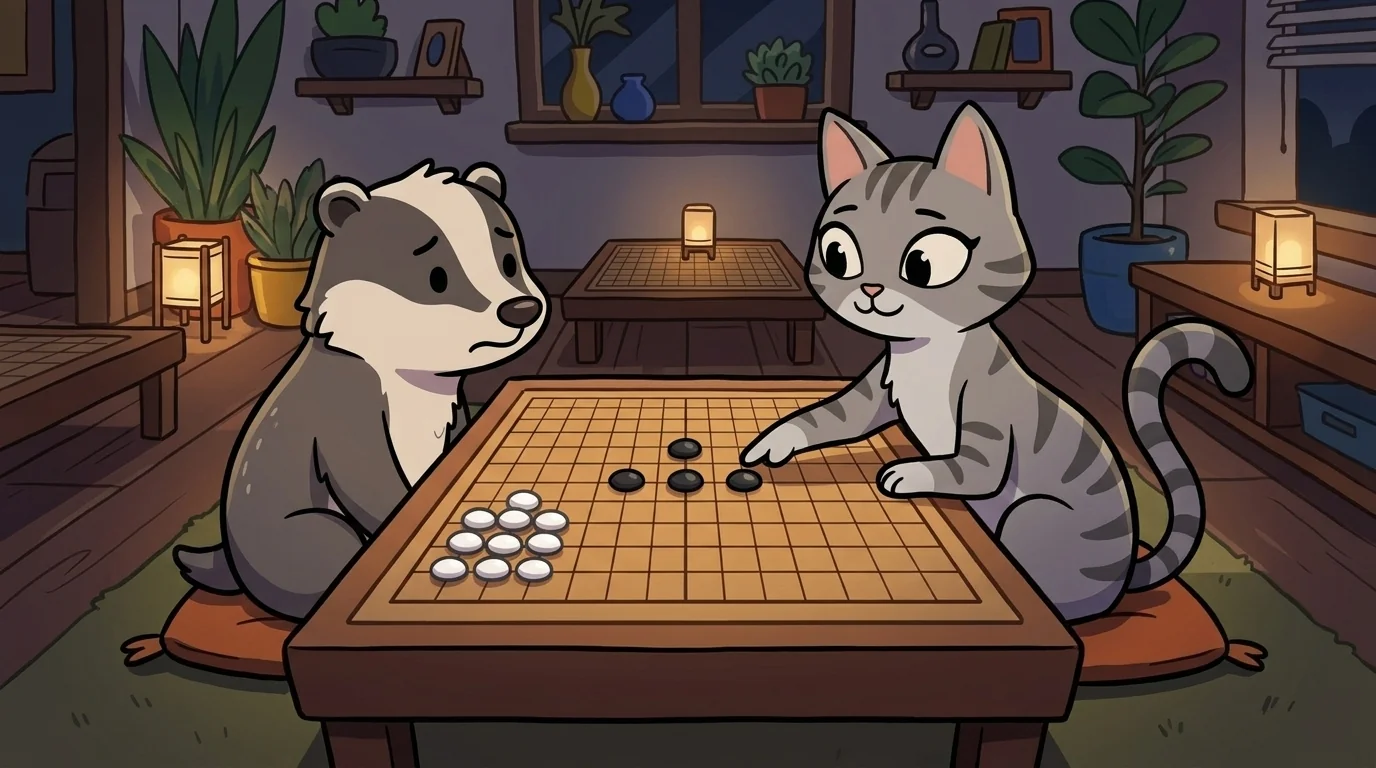
The dog was still looking at his broken-up lump when she came back around.
"I counted the breathing-spaces," he admitted. "The three-stone shape really does have more, per stone. And I have two stones back." He set one of them far away, in open territory, and looked faintly amazed at how much more of the board he suddenly occupied. "It felt weaker to give up the wall. It's not weaker."
"It was never a wall," Nimble Cat said. "It was three good stones and three apologies. Now it's three good stones and two of them are out earning." She flicked her tail, precise as a metronome. "Play every stone as if it's the only one you'll get. Ask it to do a job no other stone is doing. Waste nothing, leave no hole — and you will be everywhere, on fewer stones than the player who thought more was strength."
The dog looked at his light, stepping shape and the two stones now working across the board, and the proud, heavy feeling he'd started with turned into something quicker and cleaner. He hadn't been strong before. He'd been expensive.
The StoneSong ensemble
Nimble Cat is part of StoneSong's distributed-narrative cast. Each character embodies a different curricular primitive; together they teach the full subject.
-

Patient Bamboo
Patience and slow growth — long-game positioning
-

Hungry Crane
Capture instinct — taking what's available
-

Master Snail
Deliberate strategy — every move considered
-

Sparring Tiger
Aggressive contact — direct attacks and clashes
-
Clever Gecko
Sacrifice — give up the small stone to win the bigger prize
-

Tidy Mouse
Endgame — the small edge-moves that quietly decide it
-

Two-Eyed Owl
Life and two eyes — a group that cannot be captured
-
Weaver Ant
Connection — linked stones are strong, cut stones weak
-

Wide Heron
Territory and influence — claiming space by standing wide