
Weaver Ant
WEAVER ANT — one ant is nothing; ants linked are a bridge. connected stones share their liberties and cannot be picked off one by one; the whole game turns on your cutting-points and your enemy's.
A story read by Weaver Ant
Loading audio…
Press play to listen along. The line being read lights up as you go.
Show full transcript
Loading transcript…
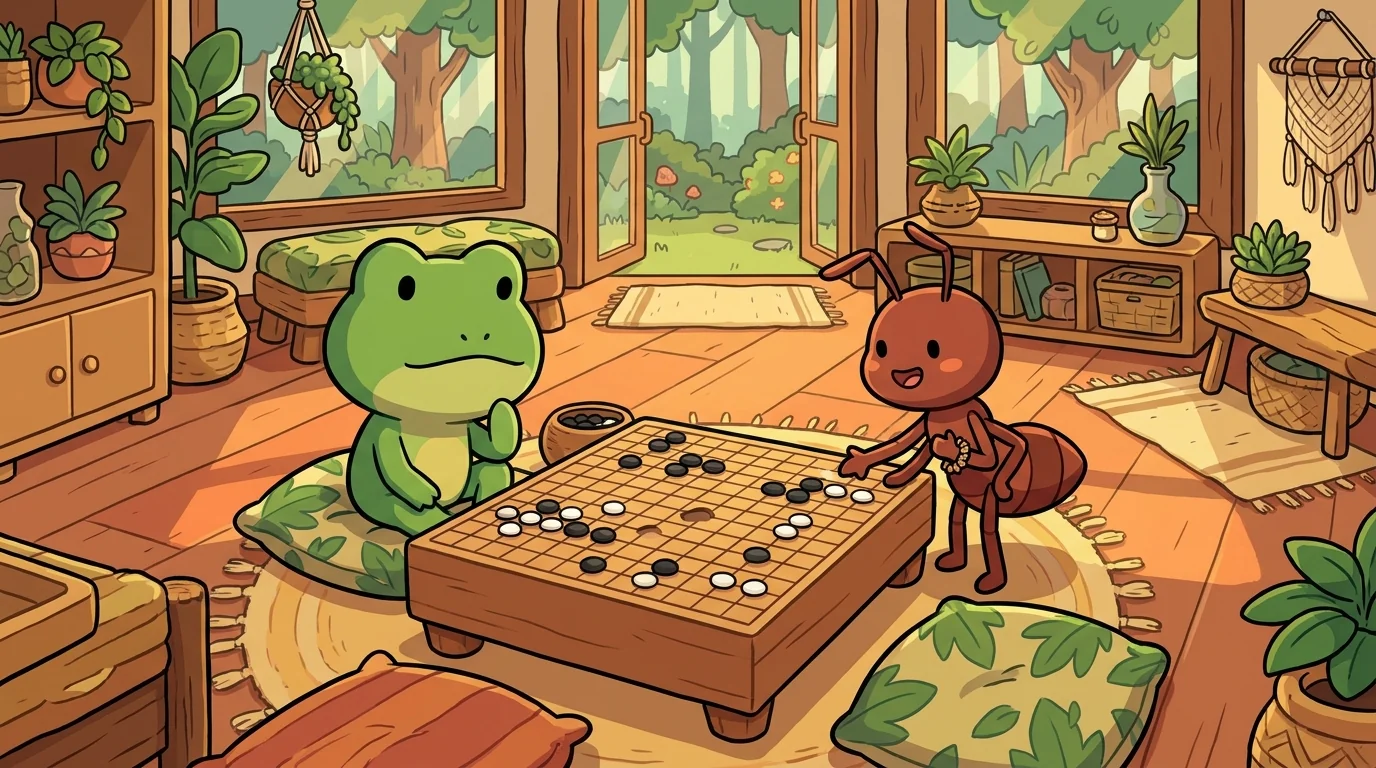
On the board of quiet stones, a young frog had scattered lonely stones across the whole board and felt he'd covered a great deal of ground, and Weaver Ant crawled up beside him to explain why every one of those stones was a snack.
"Look at this one," she said, small and busy and warm, a woven charm around one leg. "All alone. It has four breathing-spaces — four liberties — and your enemy only has to fill those four to eat it. Now watch." She placed a stone linking it to a neighbour. "Connected. And here's the thing beginners never feel: connected stones share their liberties. To capture them now, your enemy must fill the breathing-spaces of both at once — far more than four. An attack on one is answered by the strength of both." She touched her woven charm. "One ant is a bird's breakfast. Ants linked leg to leg are a bridge no bird can lift. It is exactly the same with stones."
The frog looked at his scattered dots. "So spreading out isn't covering ground. It's making snacks."
"It's making a picnic for your opponent," Weaver Ant said. "And there's a second half. Every place where the enemy's stones want to link but haven't yet — that's a cutting point. Play there, and their two strong stones fall into two lonely snacks. Connect your own; cut theirs. That is the whole dance of strong and weak."
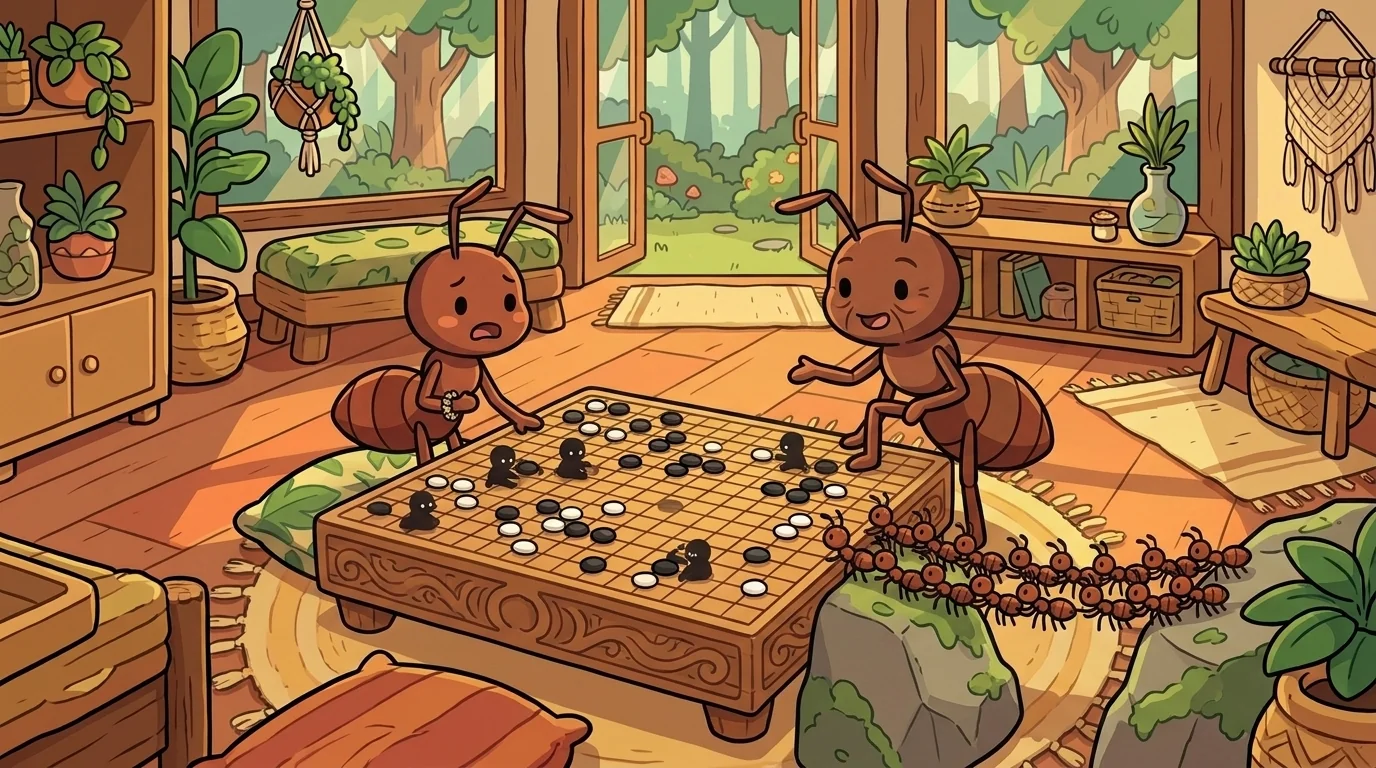
Weaver Ant had once been the loneliest player in the colony.
When she was young she loved to be everywhere — a stone in this corner, a stone in that, spread thin across the whole board, feeling vast and important. But her stones never helped each other. Each sat alone with its four little liberties, and her opponents surrounded them one at a time, unhurried, picking off a lonely stone here and a lonely stone there, until she had nothing left but a board full of the other player's linked, unbreakable groups. She lost, scattered and helpless, and concluded she simply couldn't hold anything — that holding on wasn't a thing she was built for.
An old colony-ant, herself one strand of a living bridge of thousands linked leg to leg across a stream, paused beside her. "You spread into a hundred lonely dots," she said, "and a lonely dot is four liberties and a short life. Watch what linking does." She showed how two connected ants could hold a weight neither could hold alone. "Not one of us is strong. But joined, we share our strength — every ant's grip helps every other. Break the bridge at one point and it falls; that one point is the only thing the river needs to find." She tapped the board. "So there are always two questions. Am I keeping my stones linked, sharing their liberties into groups too strong to pick off? And where is the enemy's bridge weakest — the one cutting-point where, if I play, their strength falls into pieces?"
Weaver Ant learned to link and to cut — to keep her own stones sharing liberties in solid groups, and to hunt the single spot where an enemy's stones could be split — and her scattered helplessness became a woven, unbreakable strength. The lonely, picked-off dread turned into a warm, connected steadiness. She had never been too weak to hold on. She had only been a hundred lonely dots that never learned to hold hands.
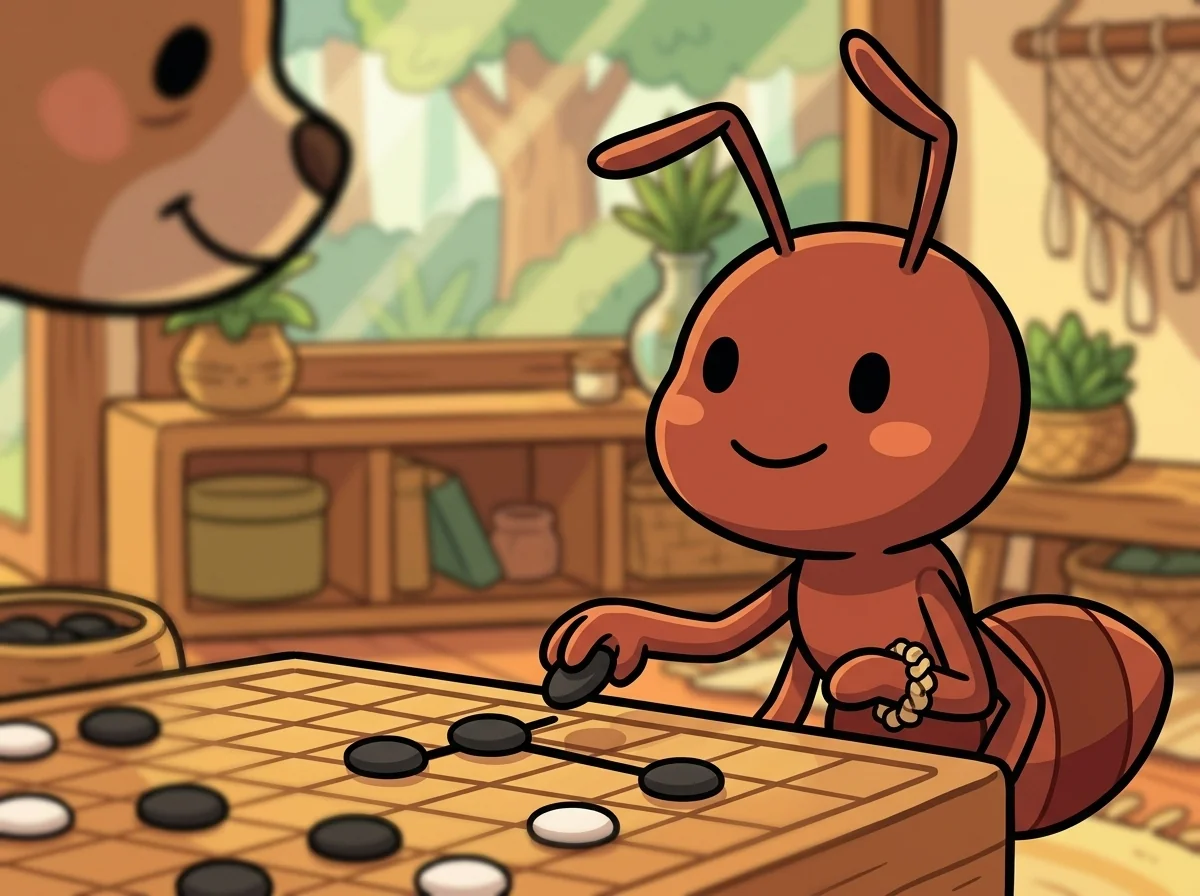
She came to Stonesong busy and warm, and Master Snail asked the one question. "Weaver Ant — what do you teach?"
She answered by placing two lonely enemy stones a small gap apart, then playing a single stone in the gap — cutting what wanted to join — so the two enemy stones fell into two capturable pieces. Then she did the same for her own stones, but in reverse: linking, so they could not be split. "I teach that strong and weak are not about how many stones," she said, "but about whether they hold together. Most students count stones. I teach them to see the joins — their own to protect, the enemy's to break. A stone's strength is borrowed from the stones it's connected to."
Master Snail studied the linked group and the cut one. "The whole board is a question of what holds together and what comes apart," he said. "Teach them to see the seams. Stay."
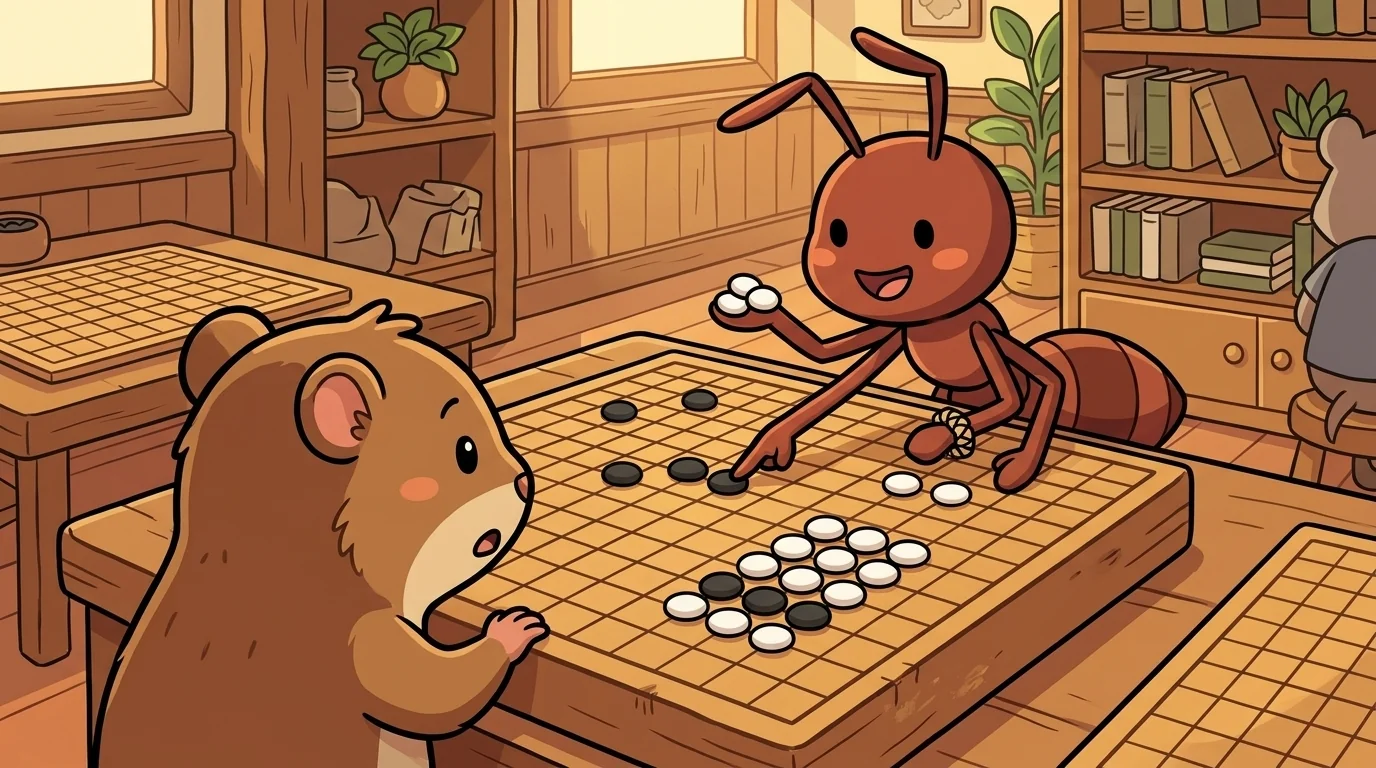
There is a subtlety to cutting, and Weaver Ant saved it for students who'd stopped scattering.
"Not every cutting point is worth cutting," she warned a fierce young otter who had begun slicing at every join she could find. "You cut here—" the otter had split two enemy stones "—but look what you made: a lonely cutting stone of your own, sitting in the middle of the enemy's strength, with four liberties and no friends. You turned their weakness into your snack." She showed the otter the difference between a cut that leaves the cutter strong and a cut that leaves the cutter stranded. "A cut is only good if, after it, you are the one still connected and they are the ones in pieces. Ask before you cut: after I split them, who is lonely — them, or me? Cut when the answer is them. Otherwise you've just walked a single ant into the anthill."
The otter looked at her stranded cutting stone. "So cutting is only strong if I stay linked while I do it."
"Everything in this game," Weaver Ant said happily, "is the same question wearing a different hat: who holds together, and who comes apart? Make sure the answer is always you hold; they scatter."
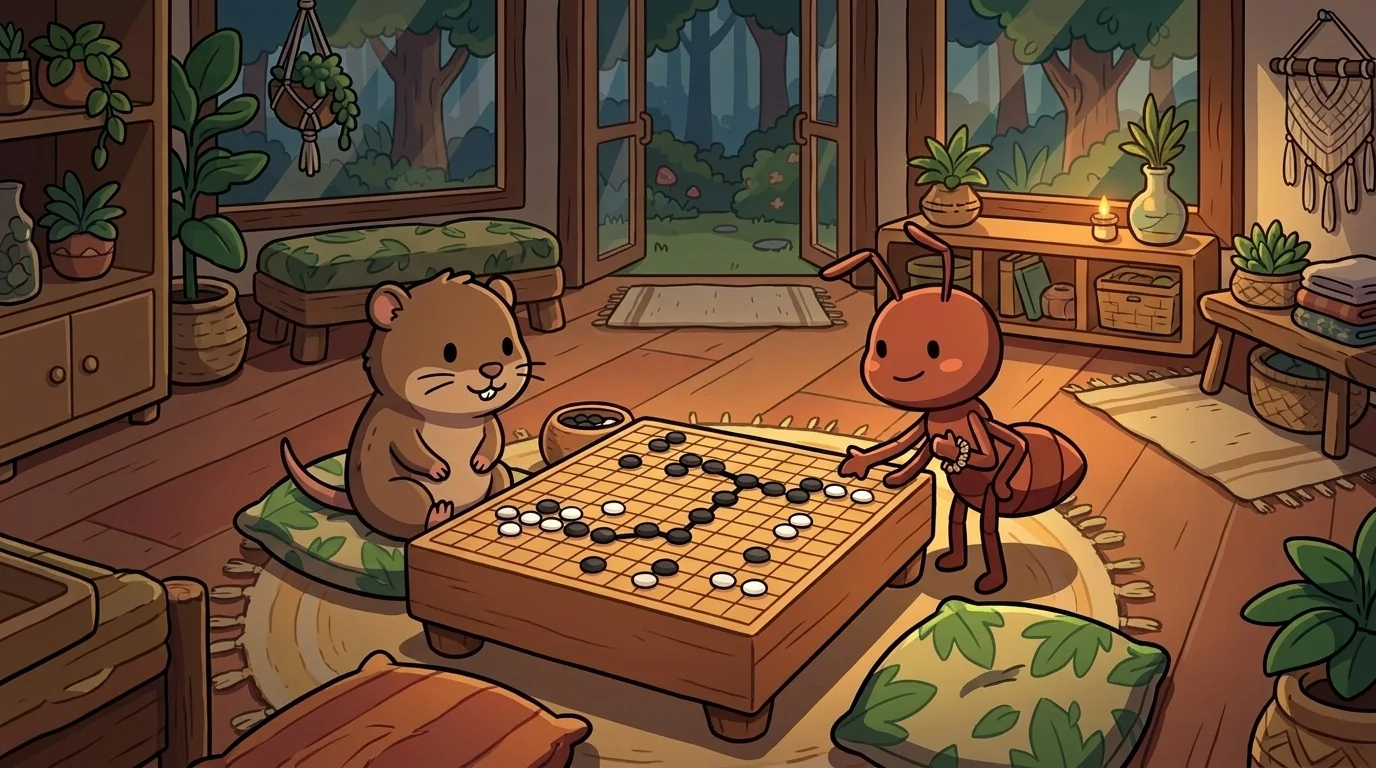
The frog was still surrounded by his lonely dots.
"Share the liberties," he said slowly, linking two of his stones so they breathed as one. "And find the enemy's weak join." He spotted a spot where two enemy stones reached toward each other but hadn't yet touched, and played between them — and their two-stone strength fell into two lonely, capturable pieces, while his own stones stood linked and solid. "It's the same move, looking two directions. Connect me. Cut them."
"That's the whole craft in one breath," Weaver Ant said, delighted, her woven charm catching the light. "A lone stone is a snack. A linked group shares its liberties and holds. So weave your own into bridges — and find the one point where the enemy's bridge comes apart." She patted the board. "You were never too weak to hold ground, little frog. You were just a hundred ants who never learned to link."
The frog looked at his stones — some now woven into a group too strong to pick off, the enemy's split into lonely pieces — and the scattered, helpless feeling turned into something solid and shared. He hadn't covered the board before. He'd only decorated it with snacks.
The StoneSong ensemble
Weaver Ant is part of StoneSong's distributed-narrative cast. Each character embodies a different curricular primitive; together they teach the full subject.
-

Patient Bamboo
Patience and slow growth — long-game positioning
-
Hungry Crane
Capture instinct — taking what's available
-
Master Snail
Deliberate strategy — every move considered
-

Sparring Tiger
Aggressive contact — direct attacks and clashes
-
Clever Gecko
Sacrifice — give up the small stone to win the bigger prize
-
Nimble Cat
Good shape — the most work from the fewest stones
-
Tidy Mouse
Endgame — the small edge-moves that quietly decide it
-
Two-Eyed Owl
Life and two eyes — a group that cannot be captured
-
Wide Heron
Territory and influence — claiming space by standing wide